
Stop treating your bananas like garden statues and start using them as high-speed nutrient pumps. Banana plants are 90% water and are heavy feeders. If you plant them in a flat hole, they remain ‘static’ and hungry. A dynamic banana circle turns your kitchen waste and laundry water into an energy flow that fuels massive growth and sweet, nutrient-dense fruit.
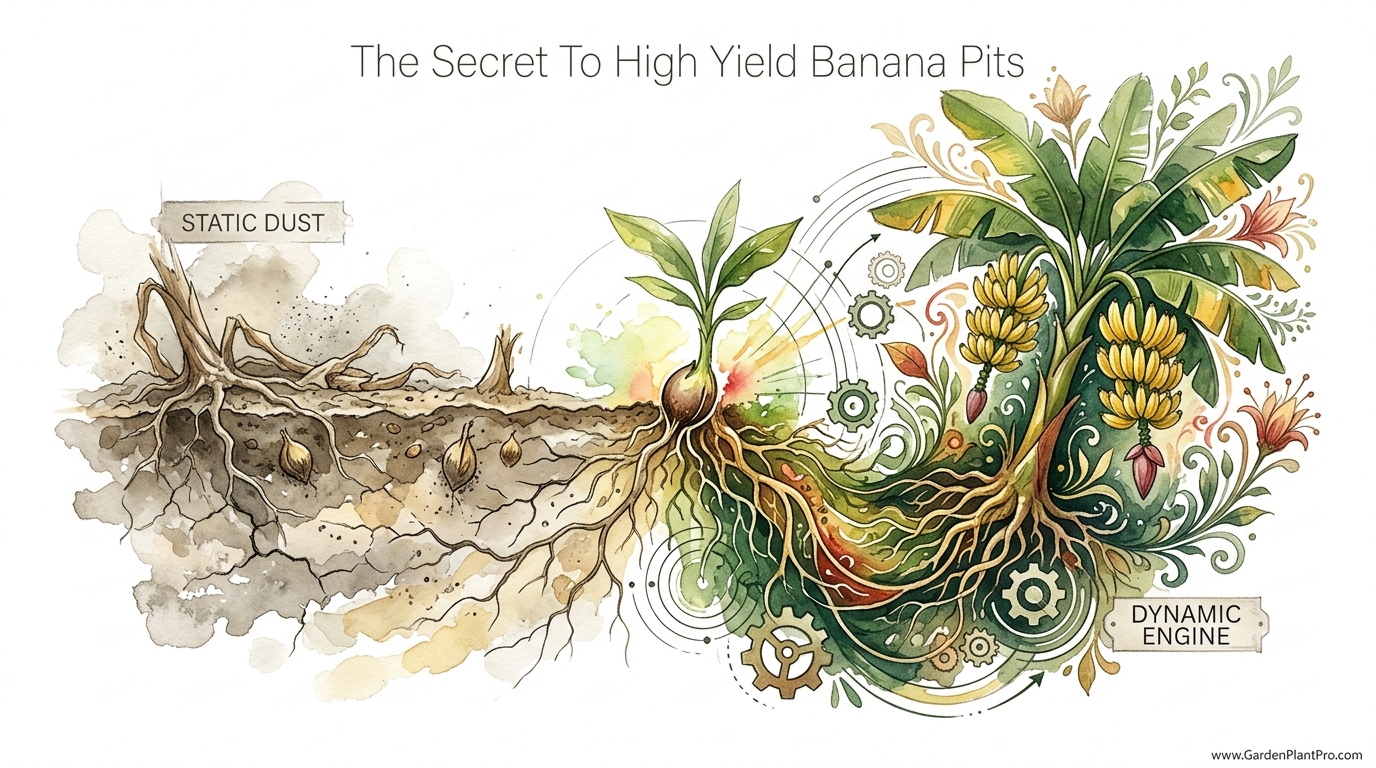
I have spent many years watching folks plant a single banana tree in the middle of a lawn, only to wonder why it looks tattered and never produces a decent bunch. A banana plant in isolation is like a lonely engine with no fuel line. It sits there, collecting “static dust,” struggling against the wind and the drying sun. But when you group them into a functional system, you create a “dynamic engine” that drives its own fertility.
If you are looking to turn a corner of your yard into a lush, productive jungle that practically feeds itself, you have come to the right place. We are going to walk through how to build a system that mimics the forest floor, keeps your kitchen scraps out of the bin, and rewards you with more bananas than you can give away to the neighbors.
The Secret To High Yield Banana Pits
The true secret to a high-yield banana pit is that it is not really a “planting hole” at all; it is a giant, living stomach. In the world of permaculture and traditional tropical agriculture, we call this a banana circle. It is a circular mound of earth surrounding a central composting pit that acts as a focal point for water and nutrients.
Instead of the plant having to search through compacted, dry soil for a bit of food, you bring the food directly to a central “feeding station.” Banana plants have shallow, greedy roots that are designed to spread out and find moisture. In a circle, every plant has its roots pointing toward a central reservoir of decomposing organic matter. This setup creates a microclimate where humidity is higher, wind is blocked, and the soil stays perpetually moist.
You will find these systems used everywhere from the humid tropics of Africa, where they originated, to suburban backyards in Florida or Queensland. The design is elegant because it solves several problems at once: it disposes of waste, harvests rainwater, and produces high-calorie food in a very small footprint.
How to Build Your Own Biological Engine
Building a banana circle is a bit of a weekend project, but the rewards last for years. You want to start by choosing a spot that gets plenty of sun—at least 6 to 8 hours—and is protected from the harshest winds. Bananas have giant leaves that act like sails; in a big storm, a lone tree will shred, but a circle of trees protects itself.
First, mark out a circle on the ground about 2 meters to 3 meters (6.5 to 10 feet) in diameter. This gives you enough room for a substantial pit in the middle and a sturdy mound around the rim. Dig out the center of that circle to a depth of about 1 meter (3 feet) at the very center, creating a bowl shape.
Take the soil you dug out and pile it up in a ring around the edge of the hole. This creates a raised “donut” or berm of loose, aerated soil. This is where you will actually put your plants. By raising the planting area, you ensure that the “corms” (the underground base of the banana) do not sit in standing water, which can cause them to rot, while the roots can still reach down into the moist pit.
Once the hole is dug and the mound is shaped, it is time to fill the “stomach.” I like to start with a base of heavy logs or thick branches. This is a bit like the “hugelkultur” method; the wood acts as a fungal sponge that holds onto moisture for months. On top of the wood, add layers of brown material like cardboard, straw, or fallen leaves, followed by green material like grass clippings and kitchen scraps.
The “Engine” Components: What to Plant
A banana circle is a “guild,” which means we do not just plant bananas. We plant a team. To get the best results, you want to space your main banana suckers around the mound. For a 2-meter (6.5-foot) circle, 4 to 6 plants are ideal. Place them at the “compass points”—12, 3, 6, and 9 o’clock.
Between the bananas, you should plant “support” crops. Papayas are a classic choice because they grow tall and thin, fitting perfectly in the gaps. On the edges of the mound, plant sweet potatoes. These act as a “living mulch,” spreading their vines across the soil to keep it cool and prevent weeds from taking hold.
On the inside rim of the pit, where it is dampest, you can plant Taro or Elephant Ears. These plants love “wet feet” and will soak up the excess moisture. Finally, on the outside of the mound, plant Lemongrass or Comfrey. These hardy plants help hold the soil of the mound together so it does not wash away in the rain.
Benefits of the Circular Design
The most immediate benefit is the massive increase in fruit production. Because the plants have constant access to the “soup” of nutrients leaching out of the central pit, they grow faster and produce larger bunches. I have seen plants in a circle reach fruiting size months faster than those planted in a standard garden bed.
Labor savings are another huge advantage. Think about it: instead of walking around to six different trees to mulch and water them, you just throw everything into the center of the circle. Your kitchen scraps, your yard trimmings, and even your greywater all go into one spot. It is the ultimate “lazy gardener” strategy that actually produces better results.
Environmental health improves as well. The central pit acts as a bio-filter. If you direct the water from your outdoor shower or laundry (using biodegradable soaps, of course) into the pit, the plants and the soil microbes clean that water before it ever hits the water table. You are turning a waste product into a resource.
Challenges and Common Pitfalls
Drainage is the most common hurdle I see people trip over. If you have heavy clay soil, a 1-meter (3-foot) deep pit can essentially turn into a “bathtub” that holds stagnant water. If the water cannot drain away, it will go anaerobic, smell like rotten eggs, and eventually kill the banana roots. In heavy clay, you might need to dig a small overflow trench leading away from the pit or make the pit shallower and the mound higher.
Another mistake is “over-planting.” It is tempting to put ten bananas in one circle, but they will eventually crowd each other out. Each “mother” plant will produce “pups” or suckers. If you don’t thin these out, you will end up with a tangled mess of small, weak stems and very little fruit. You want to maintain a “grandmother, mother, and daughter” system—one fruiting stem, one mid-sized stem, and one small sucker for each of your original planting spots.
Pests like the banana weevil can also be an issue if the area is not kept clean. While we want a “wild” look, you should still prune off dead, brown leaves. Chop them up and throw them into the center pit. This keeps the air moving around the base of the plants and removes hiding spots for bugs that might want to munch on your crop.
DIY PROJECT: Collect rainwater no matter where you live...
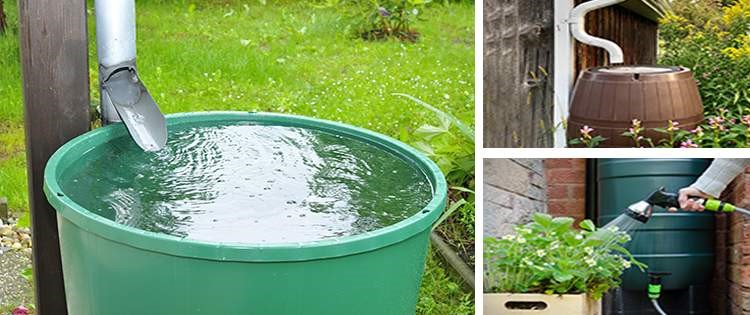
This DIY project is the best way to legally collect rainwater NO MATTER where you live. Get chlorine-free water, cut down on your water bills, and have enough for an emergency situation or to water your garden. Read More Here...
Limitations: When This May Not Be Ideal
Banana circles are not a “one size fits all” solution for every climate. If you live in a region with heavy, prolonged freezes, your bananas will die back to the ground every winter. In these areas, the “circle” still works as a great composting system, but you won’t get the multi-year “canopy” effect that makes the system so productive in the subtropics.
Space is another constraint. A full-sized banana circle needs a footprint of about 4 to 5 meters (13 to 16 feet) when you account for the overhanging leaves. If you have a tiny urban lot, a full circle might swallow your whole yard. In those cases, a “banana crescent” against a fence might be a better use of space.
Finally, consider your neighbors. A central pit full of decomposing scraps is a paradise for worms, but if you throw in meat or dairy, it will attract rats and smell terrible. Keep the pit restricted to “green and brown” garden waste and vegetable kitchen scraps to keep the peace and the productivity high.
Comparison: Traditional Rows vs. Banana Circles
| Feature | Traditional Row Planting | Dynamic Banana Circle |
|---|---|---|
| Water Efficiency | Low; water evaporates from flat soil. | High; central pit captures and holds moisture. |
| Nutrient Delivery | Requires frequent manual fertilizing. | Self-fertilizing through central composting. |
| Maintenance | High; weeding and mulching each tree. | Low; “chop and drop” into the center. |
| Yield per Sq Meter | Moderate. | Exceptional; utilizes vertical and horizontal space. |
Practical Tips for Success
Experience has taught me that the little things make the biggest difference. For instance, when you plant your suckers, angle them slightly outward, away from the center of the pit. As the plant grows and the heavy bunch of bananas forms, the weight will naturally pull the plant further outward, making it easier to harvest and keeping the center of the circle clear for adding more mulch.
Use “Sword Suckers” whenever possible. These are the young pups with narrow, pointed leaves. They have a much stronger root system than “Water Suckers” (which have broad leaves at a young age). A sword sucker will establish faster and produce a more resilient adult plant.
If you are using the pit for greywater, try to install a simple pipe that leads from your house directly into the center of the pit. Bury the pipe slightly so you don’t trip over it. This ensures the water goes exactly where it is needed—right into the root zone—without wetting the leaves, which can sometimes lead to fungal issues like Sigatoka or “Black Spot.”
Advanced Considerations: The Walking Banana
One of the coolest things about a banana circle is that it is a moving system. Bananas do not stay in one spot; they “walk.” Each new sucker grows a few inches away from the parent corm. If you are clever, you can train your bananas to walk in a specific direction.
I always pick a direction—say, clockwise—and only keep the suckers that pop up on that side of the mother plant. Over several years, the entire “ring” of bananas will slowly rotate around the pit. This ensures that the plants are always moving into “fresh” soil on the mound while their old, spent corms decompose and add even more organic matter back into the system.
You can also integrate small livestock if your local laws allow it. A few chickens or ducks love to scratch around the base of a banana circle. They eat the bugs, provide “high-octane” fertilizer with their droppings, and enjoy the shade provided by the giant leaves. It is a perfect closed-loop system that feels less like a garden and more like a functioning ecosystem.
Example Scenario: The 12-Month Transformation
Imagine you have a boggy, useless corner of your backyard where nothing but weeds will grow. In January, you dig your 2-meter (6.5-foot) pit and build your mound. You fill the pit with old logs, a couple of bags of manure, and your kitchen scraps. You plant four Cavendish banana pups and a handful of sweet potato slips.
By April, the sweet potatoes have completely covered the mound, acting as a green carpet that suppresses the weeds. The bananas are now waist-high and putting out a new leaf every week. You are dumping your laundry water into the pit twice a week, and the soil feels like a rich, damp sponge.
By September, the bananas are over 3 meters (10 feet) tall, and the first “bell” (the flower) appears on the largest plant. The humidity inside the circle is noticeably higher than the rest of the yard, and you have already harvested several buckets of sweet potato greens for stir-fries. By December, you are cutting down your first 20-kilogram (44-pound) bunch of bananas. You chop the old stem into chunks, throw it into the pit to feed the next generation, and the cycle begins again.
Final Thoughts
A banana circle is more than just a way to grow fruit; it is a lesson in how nature works when we stop fighting it. By creating a system that turns waste into a “high-speed nutrient pump,” you are doing more than just gardening—you are building soil, conserving water, and creating a habitat.
I encourage you to look at your yard not as a collection of individual plants, but as a series of flows. Where does the water go? Where does the waste go? When you connect those flows into a banana circle, you create a “Dynamic Engine” that rewards you with abundance year after year.
Start small if you have to, but definitely start. Once you see the sheer speed of growth and the health of the soil inside a well-managed pit, you will never want to go back to planting in “static” holes again. Get out there, dig a hole, and let the bananas do the rest of the work for you.