
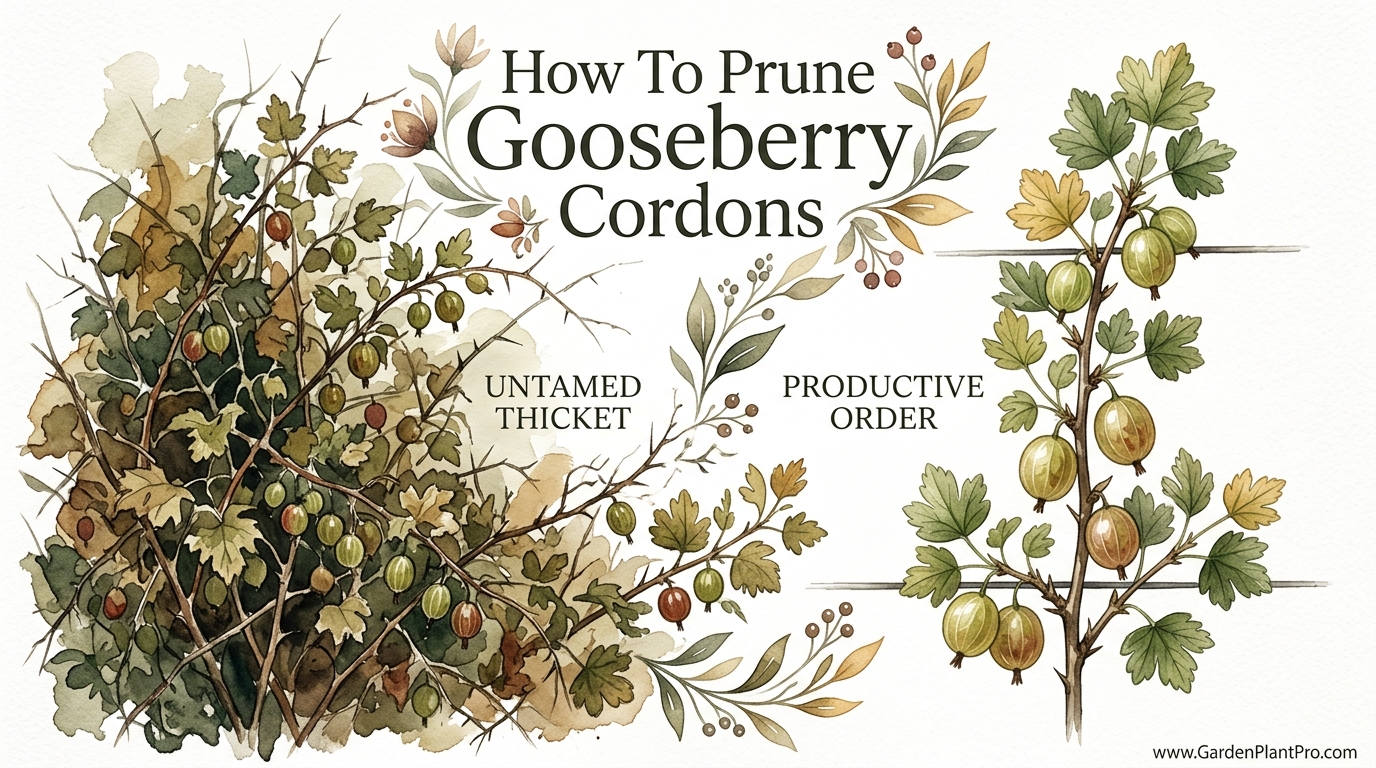
Why are you fighting a thorny fortress for a handful of berries when you could harvest gallons from a single, orderly stem? Most gardeners let their gooseberries turn into a prickly nightmare that’s impossible to harvest. The secret to massive yields without the scratches is the ‘Cordon Method.’ Training the plant into a vertical column of fruit allow sunlight to hit every berry and make picking as easy as zipping a jacket.
When I first started gardening forty years ago, I had a row of gooseberry bushes that looked like a tangled heap of barbed wire. I dreaded the harvest so much that I often left half the fruit for the birds. Then I saw a neighbor’s allotment where he had these tall, elegant stems of fruit growing like green towers. He told me he was using the cordon system, a technique borrowed from the commercial growers in the Netherlands and the formal gardens of Victorian England. It changed everything. Suddenly, I could grow six different varieties in the space where I used to have two messy bushes.
Growing gooseberries this way isn’t just about aesthetics. It’s about efficiency. You get larger fruit because the plant isn’t wasting energy on a thousand tiny twigs. You get healthier plants because the air can actually move through the leaves, whisking away the dampness that leads to mildew. If you’ve ever lost a crop to the dreaded grey fuzz of powdery mildew, you’ll know exactly why that matters.
The Concept of the Gooseberry Cordon
A cordon is essentially a fruit tree or bush that has been restricted by careful pruning to a single main stem. Instead of a wide, sprawling shrub, you have a vertical rod. All the fruit is produced on short side-shoots, called spurs, which grow directly off this central leader. Think of it as a vertical orchard where every inch of the stem is working for you.
This method is perfect for small gardens, narrow pathways, or even for creating a fruiting “wall” against a fence. You can plant single cordons as close as 30 to 45 centimeters (12 to 18 inches) apart. In a traditional bush setup, you would need at least 1.5 meters (5 feet) between plants. This means you can fit three or four different flavors of gooseberry into a space that would normally only accommodate one.
How To Prune Gooseberry Cordons
Pruning a cordon gooseberry is a twice-a-year discipline that relies on a very specific rhythm. This technique exists to keep the plant within its narrow footprint while forcing it to produce high-quality fruiting spurs rather than long, wandering branches. Gardeners use this method when they want to prioritize fruit size and ease of harvest over raw biomass.
The process begins in the summer and is refined in the winter. You are essentially teaching the plant to stop growing “out” and start growing “up,” while keeping its fruiting energy concentrated near the main stem. This creates a pillar of berries that is fully exposed to the sun, which is vital for developing the sugars in dessert varieties.
Setting the Foundation: The Trellis and Spacing
You cannot grow a cordon without a solid support system. Gooseberries are not self-supporting when trained this way, especially when they are heavy with fruit. A simple post-and-wire system is the standard.
Install two or three horizontal wires between sturdy posts. The first wire should be about 60 centimeters (2 feet) from the ground, the second at 120 centimeters (4 feet), and a third at 150 centimeters (5 feet) if you want tall cordons. At every planting station, secure a long bamboo cane vertically to the wires. This cane provides the straight track that your gooseberry will follow.
Spacing is your next consideration. Single cordons should be spaced 30 to 38 centimeters (12 to 15 inches) apart. If your soil is particularly rich, lean toward the wider spacing to account for more vigorous growth. Planting them too close in heavy, wet soil can restrict airflow, which invites disease despite your best pruning efforts.
The Summer Pruning Technique
Summer pruning is the most important step for fruit quality. This typically happens in early to mid-July, depending on your local climate. The goal here is to stop the plant from putting all its energy into new, soft green growth that won’t have time to ripen before winter.
Identify the new side shoots that have grown out from the main stem during the spring. These will be bright green and pliable. Count five leaves from the base of the shoot and make a clean cut just above the fifth leaf. This leaves a short “stub” that will eventually become a permanent fruiting spur.
Do not prune the very top of the main stem (the leader) during the summer unless it has reached the top of its support. Leave that leader to continue growing upward. If you see any shoots growing from the very base of the plant near the soil, cut those off entirely. These are “suckers” and they will steal energy from your main fruited stem.
The Winter Pruning Ritual
Winter pruning takes place when the plant is dormant, usually between late November and early March. This is the structural phase where you tidy up the work you started in the summer.
Go back to those side shoots you shortened to five leaves in July. Now, cut them back even further, leaving only one or two buds. These buds will produce the flowers and fruit in the coming season. By keeping these spurs short, you ensure the fruit is held close to the main stem where the wood is strongest.
Now look at the main leader. If the plant is still young and hasn’t reached the top of the wire, prune the top of the leader by about one-third of its new growth. Always cut just above a healthy bud. If the plant has reached its maximum desired height, usually around 1.7 meters (5.5 feet), prune the leader back to just one bud of the current year’s growth to keep it at that height permanently.
Choosing the Best Varieties for Cordons
Not every gooseberry variety behaves well as a cordon. Some are naturally more “weeping” or “prostrate,” meaning they want to crawl along the ground. You want varieties with an “upright” habit.
Hinnomaki Red is a personal favorite for cordons. It is incredibly hardy and naturally resistant to mildew. The berries are medium-sized, dark red, and have a delicious skin that is sweet enough to eat straight from the plant.
Invicta is the workhorse of the gooseberry world. It produces massive crops of green fruit. While it’s technically a culinary variety (meaning it’s great for pies), if you leave the berries to turn slightly yellow on a cordon in full sun, they become surprisingly sweet.
DIY PROJECT: Collect rainwater no matter where you live...
This DIY project is the best way to legally collect rainwater NO MATTER where you live. Get chlorine-free water, cut down on your water bills, and have enough for an emergency situation or to water your garden. Read More Here...
Pax is a modern variety that is nearly thornless. If you are particularly sensitive to scratches, this is the one for you. It trains beautifully into a cordon and produces large, red dessert fruit.
The Practical Benefits of the Cordon Method
Harvesting is the most obvious advantage. In a traditional bush, the berries are hidden inside a thicket of thorns. In a cordon, the berries hang in clear, accessible clusters along the stem. You can pick an entire gallon of fruit in minutes without a single scratch on your forearms.
Disease management becomes much easier with this open structure. Powdery mildew thrives in stagnant, humid air. Cordons allow the wind to whistle through the foliage, drying the leaves quickly after rain. This often means you can grow older, more flavorful varieties that might otherwise succumb to disease in a crowded bush.
Fruit size is significantly improved. Because the plant is restricted to a limited number of fruiting spurs, it can pump more sugar and water into each individual berry. You get exhibition-quality fruit that looks as good as it tastes.
Common Challenges and How to Avoid Them
One frequent mistake is being too timid with the pruners. New gardeners often feel bad cutting off so much green growth in the summer. However, failing to prune hard enough results in a “shaggy” cordon that quickly loses its shape. This creates a mess of crossing branches that defeats the whole purpose of the method.
Another pitfall is ignoring the Gooseberry Sawfly. These little green caterpillars can strip a plant of its leaves in forty-eight hours. The beauty of a cordon is that you can see them early. Check the underside of the lower leaves in late spring. If you see tiny holes, the sawfly larvae are there. Because the plant is so open, you can easily pick them off by hand or use an organic spray effectively.
Don’t forget about nutrition. Gooseberries are “potash hungry.” They need potassium to fruit well and stay healthy. Every spring, I give my cordons a handful of sulfate of potash and a thick mulch of well-rotted compost. Keep the mulch away from the direct base of the stem to prevent rot.
Limitations: When Cordons Might Not Work
Cordons require more maintenance than bushes. If you are a “plant it and forget it” type of gardener, a traditional bush might be better. You have to be there in July and you have to be there in January to do the work. If you miss a couple of years of pruning, the plant will revert to a messy shrub that is very difficult to “re-train” back into a single stem.
Extremely windy sites can also be a challenge. Even with a trellis, a tall cordon acts like a sail. In a gale, the main stem can snap if it isn’t tied securely to its cane. Ensure your posts are driven deep into the ground—at least 60 centimeters (2 feet)—to handle the leverage of the plants.
Comparing the Two Approaches
The choice between a traditional bush and a cordon often comes down to your garden goals and available time.
| Feature | Traditional Bush | Cordon Method |
|---|---|---|
| Space Required | 1.5m x 1.5m (5ft x 5ft) | 0.4m x 0.4m (1.3ft x 1.3ft) |
| Pruning Difficulty | Moderate / Intuitive | Disciplined / Precise |
| Harvesting Ease | Difficult (Thorns) | Very Easy (Accessible) |
| Fruit Quality | Variable | Superior Size & Sugar |
| Initial Cost | Low (Just the plant) | Higher (Support structures) |
Advanced Consideration: Multi-Stem Cordons
Once you’ve mastered the single cordon, you might want to try “Double” or “Triple” cordons. These are essentially plants that have been allowed to develop two or three main vertical stems from the base, usually trained in a ‘U’ or ‘W’ shape.
Double cordons are great for filling a specific width of wall space more quickly. You prune them exactly like a single cordon, treating each of the two stems as an individual vertical leader. Spacing for double cordons should be wider, around 60 to 90 centimeters (2 to 3 feet), to allow each “arm” enough room to breathe.
Renovating an old, neglected gooseberry bush into a cordon is also possible. Select the straightest, healthiest young branch near the center of the bush. Cut away every other branch right down to the ground. Secure your chosen branch to a stake and begin the summer and winter pruning cycle. It takes about two seasons for the plant to adjust, but it’s a great way to save a favorite variety that has become overgrown.
A Seasonal Scenario: The Gardener’s Year
Imagine it’s early March. You’re standing in the garden with your sharpest secateurs. Your cordons look like bare brown sticks tied to canes. You notice the buds are just starting to swell with a hint of green. This is the moment for your final winter check. You snip the tips of the side-shoots back to two buds and shorten the leader.
By May, the plants are covered in tiny, inconspicuous green flowers. You notice the bees are busy, even in the cool spring air. By June, the fruit is forming. You see a few sawfly larvae on the lowest leaves and quickly squish them.
July arrives, and the new green shoots are 30 centimeters (1 foot) long. You spend twenty minutes walking down the row, pinching back those shoots to five leaves. This opens up the plant just as the berries are starting to ripen. The sun hits the fruit, turning your red varieties deep crimson and your yellow ones translucent like honey. You pick a bowl of berries for a crumble, and for the first time in years, your hands are completely free of scratches.
Final Thoughts
The cordon method represents a shift from “letting nature take its course” to “guiding nature for maximum benefit.” It is the difference between a wild, unproductive thicket and a high-performance garden system. While it requires a bit more hardware and a regular pruning schedule, the rewards in terms of space saved and fruit quality are undeniable.
Do you have some charcoal in your house right now? We call charcoal a “miracle leftover” for anyone who wants to be a little more self-sufficient and cut costs. That’s because it can help you with so many different things around the house and garden. You can even use it to make an energy-free fridge. Read More Here...
Taking the time to train your gooseberries this way pays dividends for a decade or more. A well-maintained cordon will remain productive for fifteen to twenty years if the soil is kept healthy. It’s a satisfying, meditative way to garden that brings order and abundance to even the smallest backyard.
Experiment with one or two plants this season. Once you experience the ease of a cordon harvest, you’ll likely never go back to the thorny fortress of a traditional bush. This technique opens up a world of possibilities for soil health and garden planning that can be applied to many other soft fruits as well.