
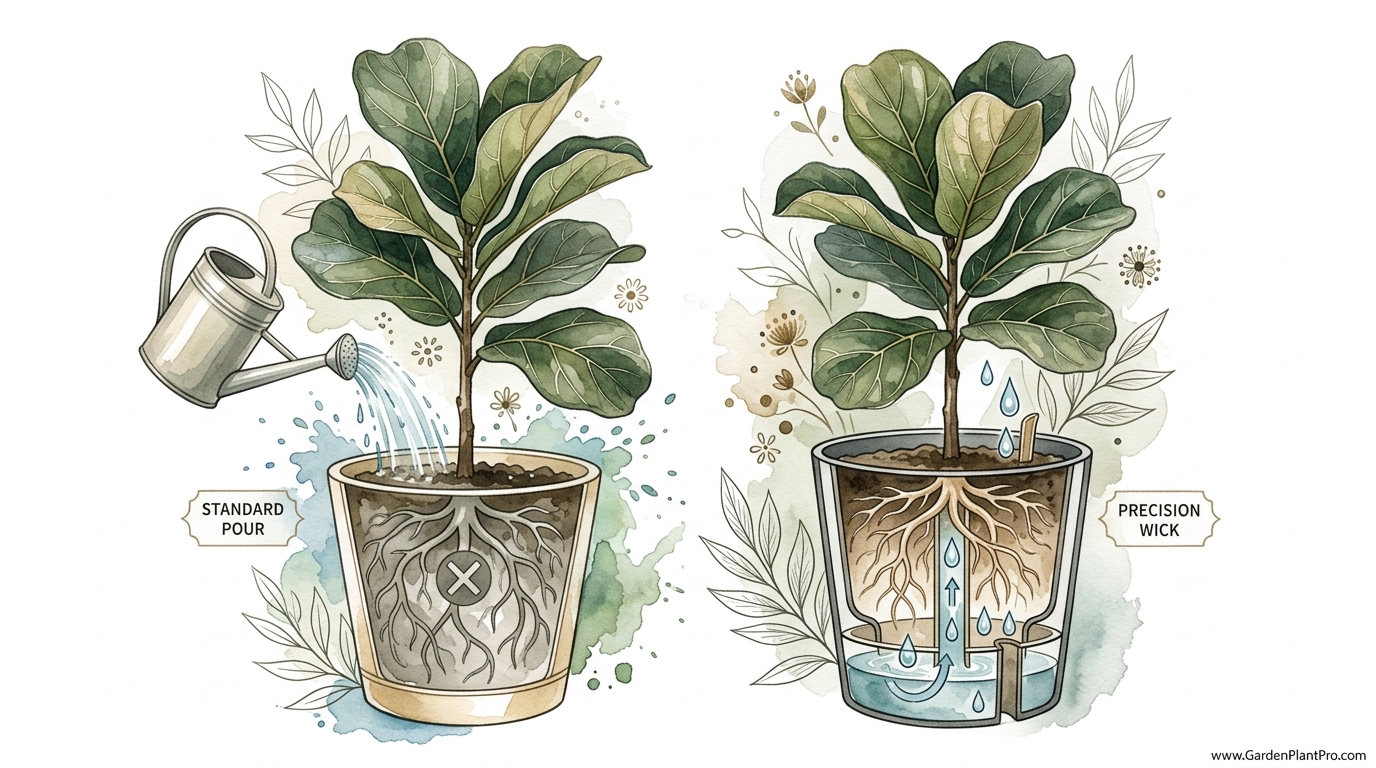
If you are watering from the top, you are likely starving 70% of your plant’s root system. Most Fiddle Leaf Figs die from ‘Standard’ watering—a quick pour that leaves dry pockets and causes rot. Switch to the ‘Precision’ method: bottom-wicking and root-level monitoring that mimics the tropical forest floor.
I have spent the better part of forty years watching these finicky giants grow, and if there is one thing I have learned, it is that they do not forgive a heavy hand. You bring one home from the nursery, and it looks like a million bucks with those broad, glossy leaves. Then, a month later, the spotting starts, and the leaves begin to drop like lead weights.
Most folks think they are under-watering when they see brown spots, so they pour on more. In reality, they are often drowning the very roots that keep the plant anchored. It is a heartbreaking cycle that I have seen play out over and over across backyard fences and kitchen tables.
The secret to a thriving Fiddle Leaf Fig (*Ficus lyrata*) is not just how much water you give it, but how that water moves through the soil. We need to stop thinking about watering as a chore and start thinking about it as a delivery system for oxygen and hydration. When you master the balance between the two, you stop being a plant owner and start being a plant partner.
How To Water Fiddle Leaf Fig Without Root Rot
Root rot is a silent killer that starts long before you see the first brown spot on a leaf. It is essentially a fungal or bacterial infection that takes hold when the roots of your Fiddle Leaf Fig are deprived of oxygen. In the wild, these plants grow in the rainforests of Western Africa, where they might get drenched by heavy rains, but the soil is so porous that the water moves through in a flash.
When we bring them indoors, we often put them in heavy potting mixes that hold onto moisture like a soaked sponge. If those roots sit in stagnant water for more than a day or two, they begin to suffocate. Once the tissue dies, opportunistic fungi move in, and that is when the rot truly sets in. You will know it is happening if the base of the plant starts to smell musty or if the soil stays wet for more than ten days after a watering.
Precision watering is the practice of ensuring the entire root ball is saturated without leaving “perched water” at the bottom of the pot. It is about understanding that the bottom third of your pot is where the most critical roots live. If you only water the top, the bottom stays dry and the roots die. If you pour too much, the bottom becomes a swamp. Precision wicking allows the plant to draw up exactly what it needs through capillary action.
The Precision Wicking Method: Step-by-Step
To implement a precision watering system, you have to move away from the “pour and pray” mentality. Here is how I have done it for years with my most prized specimens.
1. The Submersion Technique
For plants in growers’ pots (those plastic ones with plenty of holes), find a basin or a sink large enough to hold the base. Fill it with about 3 to 4 inches (7.5 to 10 cm) of room-temperature water. Place the pot inside and let it sit. You are not drowning the plant; you are letting the soil act as a wick.
2. Monitoring the Draw
Check the top of the soil after about 15 to 20 minutes. You will eventually see the surface begin to look darker and feel slightly damp to the touch. This indicates that the water has travelled all the way from the bottom to the top, ensuring there are no dry pockets left behind. For larger pots, this may take up to 45 minutes.
3. The Crucial Drainage Phase
Once the soil is saturated, remove the pot from the water. This is the part most people skip. You must let the pot drain in a sink or outside for at least 30 minutes. If you put it straight back into a decorative saucer and it keeps dripping, that standing water will cause the very rot you are trying to avoid.
4. Using a Wicking Cord
For a more automated approach, you can insert a cotton or nylon wicking cord into the bottom drainage hole. One end sits in the soil, and the other hangs into a reservoir of water below. The plant will naturally pull moisture as the soil dries out. This mimics the constant, light moisture of a forest floor rather than the “flood and drought” cycle of manual watering.
Benefits of Precision Watering
Switching to a more deliberate watering method offers more than just rot prevention. It changes the entire architecture of the plant’s root system.
- Stronger Root Foundation: When water is drawn from the bottom, the roots grow downward toward the source. This creates a deep, stable root system that can support a 6-foot (1.8-meter) tree without it leaning.
- Consistent Moisture: You eliminate the “dry core” problem where the center of the root ball stays bone-dry while the edges are soaked.
- Pest Management: Fungus gnats love the damp top inch of soil. By bottom-watering, the surface stays drier for longer, making it a less attractive nesting ground for those pesky flies.
- Leaf Health: Proper hydration prevents the “edema” (small red or brown spots on new leaves) that occurs when a plant takes in too much water too quickly after being thirsty for too long.
Challenges and Common Mistakes
Even the best methods have their pitfalls. I have seen many a neighbor get over-excited about bottom watering and end up with a salty mess of a plant.
The Salt Buildup Trap: When you always water from the bottom, minerals from your tap water and salts from fertilizers have nowhere to go. They travel up with the water and eventually form a white, crusty layer on the soil surface. This can actually burn the roots over time. To avoid this, you must “flush” the soil from the top with filtered water once every three months.
Forgetting the “Wait” Period: Some folks leave their Fiddle Leaf Fig in the basin overnight. That is too long. While the soil is wicking, it is also displacing air. If you leave it submerged for 12 hours, the roots are effectively holding their breath the whole time. Stick to a 30-minute window.
Ignoring the Moisture Meter: You cannot water on a schedule. If you water every Friday just because it’s Friday, you will eventually kill your plant. Factors like humidity, light, and the season change how fast the plant drinks. Always use a moisture meter or the “two-knuckle test” before you even think about getting the watering can out.
Limitations of the Method
Precision wicking is wonderful, but it is not a silver bullet for every situation. You have to be realistic about the environment you have provided for your fig.
Large, heavy specimens in ceramic pots that weigh 50 pounds (22 kg) or more are nearly impossible to move to a sink. In these cases, you have to rely on a moisture meter and very careful top watering. You might also find that in extremely humid environments, the soil takes too long to dry out after a bottom soak, which can increase the risk of fungal leaf spots.
DIY PROJECT: Collect rainwater no matter where you live...
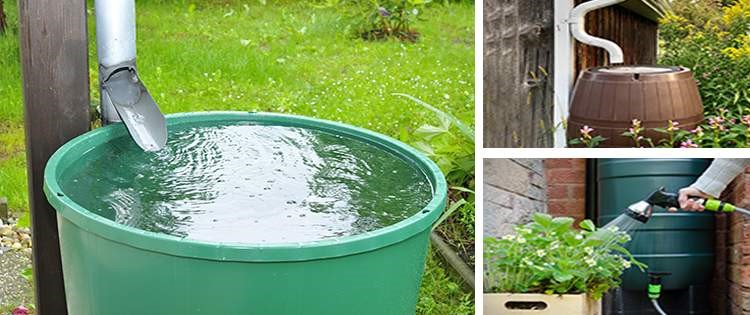
This DIY project is the best way to legally collect rainwater NO MATTER where you live. Get chlorine-free water, cut down on your water bills, and have enough for an emergency situation or to water your garden. Read More Here...
If your water is particularly “hard” (full of calcium and magnesium), bottom watering will accelerate mineral buildup faster than usual. You may need to use rainwater or distilled water to keep the soil chemistry balanced.
Standard Pour vs. Precision Wick
| Feature | Standard Pour (Top) | Precision Wick (Bottom) |
|---|---|---|
| Saturation Level | Often uneven; dry pockets likely | Uniform; saturates entire root ball |
| Root Rot Risk | High due to “perched water” | Low; soil only takes what it needs |
| Fungus Gnat Risk | Higher; topsoil stays damp | Lower; topsoil stays drier |
| Ease of Use | Very easy and quick | Moderate; requires moving the plant |
Practical Tips for Success
Over the years, I have developed a few “old-timer” tricks that make a world of difference for these trees. First, always wipe the leaves down with a damp cloth once a month. Dust blocks the stomata (the plant’s pores), which makes it harder for the plant to “sweat” out excess moisture. If the plant can’t breathe, it won’t drink, and the soil will stay wet too long.
Second, pay attention to the seasons. In the winter (or the dormant season in your region), your Fiddle Leaf Fig might only need water once every three weeks. In the height of summer, it might be every five days. I always tell people to aim for a “4” on a standard 1–10 moisture meter before watering again. If the meter is at a 5 or 6, walk away and wait two more days.
Lastly, ensure your potting mix is “chunky.” A good mix should include about 30% perlite or orchid bark. This creates air pockets. Even if you overwater slightly, those air pockets act like little oxygen tanks for the roots, giving them a fighting chance against rot.
Advanced Considerations: The Perched Water Table
For those of you who want to go deeper, you need to understand the physics of the “perched water table.” In any pot, there is a layer at the very bottom where the soil stays 100% saturated because gravity isn’t strong enough to pull the water out of the tiny pores in the dirt. This is where rot lives.
If you use a tall, narrow pot, the perched water table is far away from the main root system. If you use a short, wide pot, the roots are sitting right in that danger zone. This is why I always recommend using a pot that is “deeper than it is wide” for Fiddle Leaf Figs. It gives you a much larger buffer zone for error.
If you are fertilizing, I suggest a 3:1:2 (Nitrogen-Phosphorus-Potassium) ratio. However, never fertilize a dry plant. If you are bottom-wicking, let the plant soak up plain water for 10 minutes first, then add a diluted fertilizer to the basin for the final 10 minutes. This prevents the concentrated salts from shocking the thirsty roots.
Real-World Example: Saving “Old Reliable”
A few years back, a neighbor brought me a Fiddle Leaf Fig that was down to its last three leaves. The soil was a muddy mess, and the leaves were covered in dark, mushy spots. We pulled it out of the pot and saw that the bottom half of the roots were black and slimy—classic root rot.
We trimmed away the rot until we hit firm, tan-colored roots. We repotted it into a mix of 50% potting soil and 50% coarse bark in a pot with massive drainage holes. For the next six months, we only watered using the precision wicking method. By the following summer, that plant had put on six inches (15 cm) of new growth and had leaves the size of dinner plates. It wasn’t magic; it was just giving the roots the air they had been begging for.
Final Thoughts
Mastering the watering of a Fiddle Leaf Fig is one of the most rewarding milestones for any gardener. It marks the transition from just “keeping a plant alive” to truly understanding the delicate dance of biology and physics happening beneath the soil. While top watering is the standard, precision wicking is the professional’s secret to longevity.
Do not be afraid to get your hands dirty. Stick your fingers in the soil, lift the pot to feel its weight, and watch how the leaves react to every drink. If you listen closely enough, the plant will tell you exactly what it needs. Gardening is a conversation, not a set of instructions.
As you continue your journey, you might want to look into other advanced practices like soil aeration or the use of beneficial microbes to further protect your roots. For now, focus on that bottom-up hydration. Your Fiddle Leaf Fig will thank you with a canopy of green that will be the envy of the whole neighborhood.