
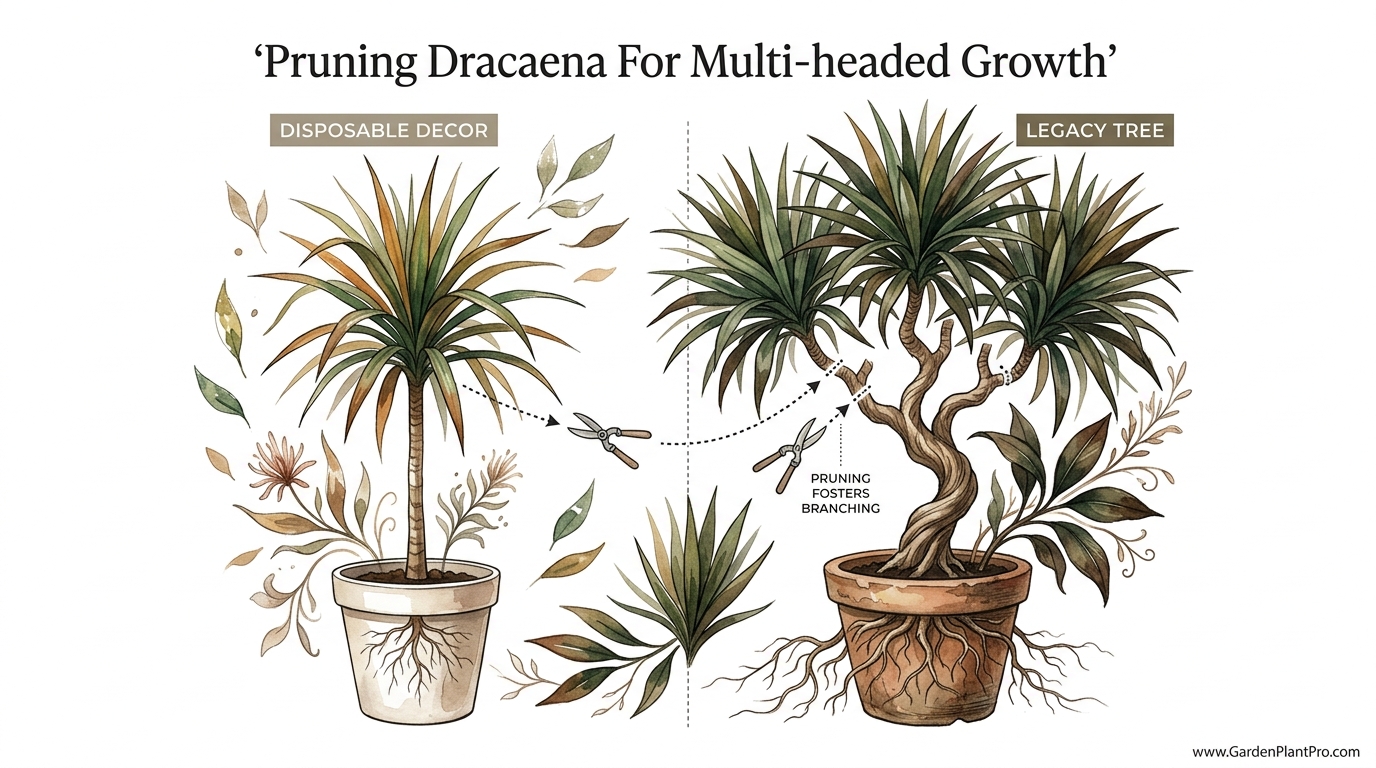
Most people toss their Dracaena when it gets ‘too tall,’ but that’s exactly when the real masterpiece begins. Are you treating your Dragon Tree like a temporary guest? Most indoor Dracaenas die young because owners are afraid to cut them. By mastering the ‘Trunk Chop,’ you stop the leggy lean and trigger a multi-headed growth cycle that turns a $20 plant into a generational heirloom. Stop buying new ones and start building a legacy.
Growing a Dracaena shouldn’t be about just keeping it alive until it hits the ceiling. These plants are built for longevity and can live for decades if you understand how their stems work. When a plant gets spindly, it is often a sign of “apical dominance,” where the main tip hogging all the energy. A strategic cut resets that clock and tells the plant to diversify its assets.
Pruning Dracaena For Multi-headed Growth
Pruning Dracaena for multi-headed growth is the practice of removing the top of a primary cane to force the plant to sprout multiple new branches from dormant buds. In the professional nursery world, this is often called “heading” or “topping.” It is the primary method used to transform a single, lanky stalk into a lush, architectural “shrub” or “tree” form.
This technique works because Dracaenas have latent buds tucked under their bark at every leaf scar. When the main growing tip is removed, the plant undergoes a hormonal shift. The supply of auxin—the hormone that keeps the lower buds “asleep”—is cut off, allowing cytokinins to rush to the nodes and trigger new growth. Usually, two to four new heads will emerge just below the cut, creating a fuller, more balanced canopy.
Real-world gardeners use this not just for aesthetics but for safety and health. A Dracaena marginata that has grown 8 feet (2.4 meters) tall on a thin 1-inch (2.5 cm) cane is a tipping hazard. Hard pruning brings the center of gravity back down, strengthens the base, and prevents the plant from snapping under its own weight.
How the Trunk Chop Works: A Step-by-Step Guide
Performing a trunk chop can feel intimidating because you are essentially “beheading” your favorite plant. However, these plants are incredibly resilient. If you follow a logical process, the recovery rate is nearly 100% for healthy specimens.
Timing and Preparation
The best time to prune is during the active growing season, which is typically early spring through mid-summer. In the Northern Hemisphere, this means May through July, while in the Southern Hemisphere, you are looking at November through January. Plants have the most stored energy during these months and can heal wounds faster.
Before you start, ensure your plant is well-hydrated. Water the plant thoroughly two days before you plan to prune. A hydrated plant has higher turgor pressure, which helps the cells at the cut site seal effectively.
Making the Cut
Select a height where you want the new branching to begin. Remember that the new heads will grow upwards from the cut, so leave enough room for them to reach toward the light. Use a pair of sharp, bypass pruning shears or a fine-toothed saw for thicker trunks.
Sterilize your tools with 70% isopropyl alcohol or a 10% bleach solution to prevent the spread of pathogens. Make a clean, swift cut at a 45-degree angle. This angle is important because it prevents water from pooling on the flat surface of the wound, which can lead to fungal rot.
Post-Cut Management
The exposed “stump” does not usually need a sealant if kept indoors where humidity is moderate. If you are in a very humid environment, you can dab a bit of cinnamon or horticultural wax on the cut to act as a natural fungicide.
Move the plant to a location with bright, indirect light. It needs photosynthesis more than ever to fuel the production of new heads. However, avoid direct, scorching sun, as the plant is currently in a state of “recovery.”
Benefits of Strategic Pruning
The most obvious benefit is the aesthetic transformation. A multi-headed Dracaena looks intentional and high-end, whereas a single leggy cane often looks like “disposable decor.” Beyond looks, there are several practical advantages to this approach.
Longevity and Structural Integrity
Regular pruning prevents the plant from becoming “top-heavy.” By keeping the foliage closer to the root system, you ensure the nutrients don’t have to travel as far, which often results in larger, more vibrant leaves. It also encourages the trunk to “thicken up” over time, creating a sturdy base that can support a massive canopy.
Resource Management
When a plant is too tall, it often drops its lower leaves to conserve energy for the top. This results in the “palm tree” look that many people dislike. Pruning forces the plant to reinvest that energy into new, lower growth, filling in the bare spots and creating a dense, lush appearance.
Propagation Opportunities
Every time you prune, you get a “free” plant. The top portion you cut off can be easily rooted in water or soil to create a new Dracaena. This allows you to expand your collection or share your plant’s legacy with friends and family without spending a dime.
Challenges and Common Mistakes
While Dracaenas are tough, they aren’t invincible. Most pruning failures come from poor timing or improper technique. Recognizing these pitfalls early can save your plant from a slow decline.
Pruning During Dormancy
Cutting a Dracaena in the dead of winter is a common error. During the short days of winter, the plant’s metabolism slows down significantly. If you chop it then, the wound may stay wet and open for weeks without any new growth “pushing” through. This creates an open invitation for bacteria and rot to enter the trunk.
Using Dull or Dirty Tools
A dull blade crushes the delicate vascular tissue (the xylem and phloem) rather than cutting it. This jagged wound takes much longer to heal and increases the risk of “dieback,” where the tip of the cane turns brown and mushy. Always ensure your shears are sharp enough to slice through a branch like butter.
DIY PROJECT: Collect rainwater no matter where you live...

This DIY project is the best way to legally collect rainwater NO MATTER where you live. Get chlorine-free water, cut down on your water bills, and have enough for an emergency situation or to water your garden. Read More Here...
Overwatering After the Chop
Once you remove the foliage, the plant loses its primary means of transpiration—the process where it “breathes” out moisture through its leaves. This means the soil will stay wet for much longer than usual. If you continue your regular watering schedule, you will likely drown the roots. Reduce watering by at least 50% until you see new green “nubs” emerging.
Limitations: When This May Not Work
Pruning is a powerful tool, but it is not a cure-all for a dying plant. There are specific situations where a “trunk chop” is ill-advised or likely to fail.
Weak or Diseased Root Systems
If your Dracaena is already suffering from root rot or a heavy pest infestation (like scale or mealybugs), a hard prune might be the final blow. The plant needs a healthy root system to push out new growth. Always address health issues and wait for the plant to show signs of stability before attempting a major structural cut.
Extremely Low Light Conditions
Dracaenas are often marketed as “low-light” plants, but that only applies to survival, not recovery. If you prune a plant kept in a dark corner, it may never sprout new heads. It will simply sit as a bare stick until it eventually shrivels. For successful branching, the plant needs at least 200–400 foot-candles of light.
Very Old, Decaying Canes
Sometimes an old Dracaena fragrans (Corn Plant) will have a trunk that has become hollow or soft in the center. Pruning into decayed wood will not result in new growth. You must cut back until you reach healthy, firm, white or light-green tissue inside the cane.
Comparison: Trunk Chop vs. Replacement
Many people choose to simply buy a new plant when theirs gets too tall. Here is how the “Legacy Tree” approach compares to the “Disposable Decor” mindset.
| Feature | The Trunk Chop (Legacy) | Buying New (Disposable) |
|---|---|---|
| Cost | $0 (Uses existing plant) | $20 – $150 (Depending on size) |
| Visual Result | Custom, multi-headed, architectural | Generic, single-headed nursery look |
| Plant Strength | Thickened trunk, acclimated roots | Thin stalks, potential transplant shock |
| Sustainability | High (Zero waste, more plants) | Low (Plastic pots, shipping carbon) |
Practical Tips and Best Practices
If you want to ensure the best results, think like a professional grower. These small adjustments to your routine can significantly speed up the recovery process.
- The “Step-Down” Method: If you have multiple canes in one pot, don’t chop them all at the same height. Cut them at staggered levels (e.g., one at 1 foot, one at 2 feet, and one at 3 feet). This creates a “staircase” of foliage that looks more natural and fills the vertical space better.
- Focus on Humidity: While Dracaenas don’t need a rainforest, a slight boost in humidity (around 50-60%) during the first two weeks after a prune can help the new buds break through the bark more easily.
- Rotate for Symmetry: Once the new heads begin to grow, rotate the pot 90 degrees every week. This ensures all new heads receive equal light and grow at a similar rate, preventing the plant from leaning toward the window.
- Skip the Fertilizer: Do not fertilize immediately after pruning. Wait until you see actual leaves unfolding. Fertilizing a “headless” plant can lead to a buildup of salts in the soil that damages the roots.
Advanced Considerations for Serious Growers
For those who want to take their Dracaena care to the next level, you can experiment with “notching” or “air layering.” These techniques allow you to control growth without always resorting to a full chop.
Notching involves making a small, downward-angled cut about 1/4 of the way into the trunk just above a dormant bud. This “tricks” the plant into sending growth hormones to that specific spot without removing the top of the plant. It is a more advanced move that requires a steady hand and a very sharp knife.
If you have a particularly valuable or variegated specimen, like a Dracaena reflexa ‘Song of India,’ consider air layering before you prune. Wrap a section of the stem in moist sphagnum moss and plastic wrap. Once roots form inside the moss (usually in 6–10 weeks), you can cut below the new roots. This gives you a fully rooted “top” to plant immediately, while the bottom stump begins its multi-heading process.
Example Scenario: Reviving a 7-Foot Marginata
Imagine a neighbor has a Dracaena marginata that has hit the ceiling. It is a single, thin trunk with a tiny tuft of leaves at the very top. It is leaning at a 30-degree angle and looks sad.
We would start by cutting that trunk down to about 3 feet (90 cm) in early June. We make the 45-degree cut and place the pot in a spot with bright, filtered light. We cut the top portion into two 12-inch (30 cm) segments and place them in a jar of distilled water.
Within three weeks, small green bumps appear on the 3-foot stump. By August, those bumps have turned into three distinct heads of narrow, red-edged leaves. Meanwhile, the cuttings in the jar have 2-inch (5 cm) roots and are ready to be potted back into the base of the original plant. By the end of the summer, the neighbor doesn’t just have a shorter plant; they have a dense, multi-tiered “forest” in a single pot.
Final Thoughts
Mastering the art of the Dracaena trunk chop is the bridge between being a “plant owner” and a true gardener. It requires patience and a bit of bravery, but the reward is a plant that grows more beautiful with every passing decade. Instead of seeing a tall, leggy plant as a problem to be replaced, see it as the raw material for your next masterpiece.
The logic is simple: remove the leader, and the followers will rise. By taking control of the plant’s hormonal balance, you dictate its shape, its strength, and its future. Your Dragon Tree isn’t just a piece of furniture; it’s a living entity that responds to your care with a flush of new life.
Don’t be afraid to make the cut. As long as you respect the seasons and use clean tools, your Dracaena will reward you with a fuller, more vibrant canopy that will outlast any store-bought replacement. Start today, and within a few months, you will see the beginning of your plant’s true legacy.