
Your cherry tree is starving for friends, not just fertilizer. A fruit tree in a lawn is a tree in a desert. It relies entirely on you for water, food, and pest control. But in a ‘Guild,’ the plants around the tree do the work for you. Comfrey mines minerals, lavender attracts pollinators, and clover fixes nitrogen. Stop gardening for the tree and start gardening for the ecosystem.
For years, I watched my neighbors struggle with their backyard orchards. They would spend hours spraying chemicals and hauling bags of synthetic fertilizer, only to end up with cracked fruit or trees that looked tired after just a few seasons. I realized long ago that nature doesn’t grow in rows of bare dirt and short grass. It grows in tangled, beautiful communities where every plant has a job to do.
A plant guild is simply a way of mimicking that natural community. Instead of seeing your cherry tree as a solitary producer, you see it as the anchor of a small, self-sustaining forest. When you get the balance right, the tree grows stronger, the fruit tastes better, and you spend less time working against nature and more time enjoying the harvest.
Developing a guild isn’t a weekend project that you finish and forget. It is an evolving relationship between the soil, the insects, and the understory plants you choose to invite into the space. As you walk through your garden, you’ll start to see how a patch of chives protects the trunk or how a cluster of lupines feeds the roots. This guide is born from decades of trial, error, and some of the sweetest cherries I’ve ever tasted.
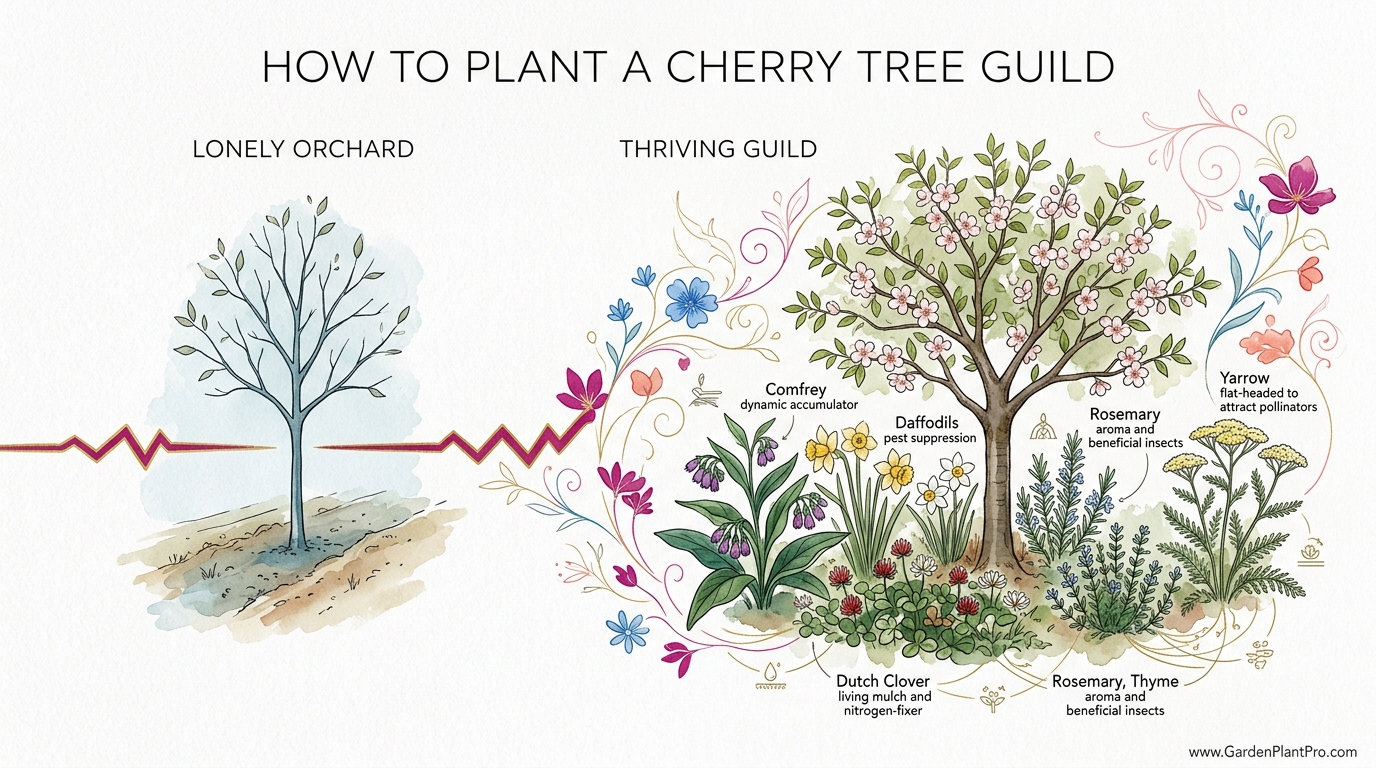
How To Plant A Cherry Tree Guild
A cherry tree guild is a purposeful grouping of plants centered around a cherry tree to enhance its health and productivity. In the permaculture world, this is known as a polyculture, which is just a fancy way of saying “growing many things together.” The goal is to create a mini-ecosystem where the plants support each other, reducing the need for human intervention like weeding, fertilizing, or spraying for pests.
In a typical backyard, most fruit trees are surrounded by grass. Grass is a fierce competitor that steals nitrogen and water from the tree’s shallow feeder roots. By replacing that grass with a “guild” of supportive companions, you change the dynamic. You move from a Lonely Orchard model, where the tree is an island, to a Thriving Guild, where the tree is supported by a community.
Real-world applications of this method are found in food forests and sustainable homesteads globally. Gardeners use guilds because they maximize space in small yards. Instead of having a flower bed in one corner and a fruit tree in the center, you stack those functions. You get beauty from the flowers, herbs for your kitchen, and a healthier cherry harvest all in the same 10-foot (3-meter) circle.
The Blueprint: Designing Your Guild Layout
Designing a guild starts with understanding the drip line. The drip line is the imaginary circle on the ground directly beneath the outermost tips of the tree’s branches. This is where most of the tree’s active feeder roots live and where rain naturally drips off the leaves. Most of your guild planting will happen within this circle and slightly beyond it.
I like to think of the layout in concentric rings, starting from the trunk and moving outward. Each zone has a specific purpose. You want to keep the area immediately around the trunk clear to prevent rot, while the outer zones are where the heavy lifting happens.
Zone 1: The Protection Ring (0 to 12 inches / 30 cm from trunk)
Keep this area clear of most plants. A thick layer of wood chips is best here. If you plant too close to the trunk, you risk trapping moisture against the bark, which can lead to crown rot or invite voles to chew on the tender bark. A few small bulbs like daffodils or garlic can be tucked in here to deter rodents, but generally, this is a “no-grow” zone for herbaceous plants.
Zone 2: The Inner Circle (1 to 3 feet / 30 to 90 cm from trunk)
This is the home for your aromatic pest confusers. Plants like chives, oregano, and thyme work well here. Their strong scents help mask the smell of the cherry tree from pests like the cherry fruit fly. These plants have relatively shallow roots that won’t aggressively compete with the tree, and they provide a low-growing carpet that suppresses weeds.
Zone 3: The Drip Line Heavyweights (3 feet / 90 cm to the edge of the canopy)
This is where you place your dynamic accumulators and nitrogen fixers. Comfrey is the undisputed king of this zone. Its deep taproots reach down into the subsoil—sometimes as deep as 6 to 10 feet (2 to 3 meters)—to pull up minerals like potassium and calcium. Lupines and white clover also belong here to provide a steady stream of nitrogen to the soil.
Step-by-Step: Establishing the Guild
Establishing a guild is a process that usually takes two to three seasons to fully mature. You don’t have to plant everything on day one. In fact, I often recommend starting with the tree and a few key companions, then adding more as you see how the space evolves.
Phase 1: Soil Preparation and Tree Planting
Start by clearing a circle of grass at least 6 feet (1.8 meters) in diameter. You can do this by digging, but I prefer “sheet mulching.” Lay down several layers of plain brown cardboard over the grass, wet it thoroughly, and cover it with 4 inches (10 cm) of wood chips or compost. This kills the grass without disturbing the soil life.
Plant your cherry tree in the center. Ensure the graft union—that bumpy scar near the base of the trunk—stays at least 2 inches (5 cm) above the soil line. If you bury the graft, the tree may grow its own roots from the scion, losing the benefits of the rootstock, such as dwarfing or disease resistance.
Phase 2: Introducing the First Companions
In the first year, focus on nitrogen fixers and ground covers. White clover is a fantastic “living mulch.” It stays low, fixes nitrogen, and doesn’t mind being stepped on when you’re harvesting. Sprinkle clover seed directly over the mulch in early spring. You can also tuck in a few lupine starts near the drip line to begin building soil fertility immediately.
Phase 3: The Aromatic and Accumulator Layers
By the second year, the cardboard has broken down, and the soil is ready for deeper-rooted perennials. This is when I add the comfrey and chives. Space your comfrey plants about 3 feet (90 cm) apart around the edge of the drip line. Plant chives in small clusters around the inner ring.
Choosing the Right Cherry Variety
The heart of your guild is the tree itself. Not all cherries are created equal, and your climate will dictate which one thrives. If you live in a humid area with wet summers, tart cherries (also called sour cherries) like ‘Montmorency’ or ‘Northstar’ are often more resilient. They are generally self-fertile and handle fungal pressure better than sweet varieties.
Sweet cherries like ‘Bing’ or ‘Rainier’ prefer drier air and often require a second tree for pollination. If you only have room for one tree, look for self-fertile sweet varieties like ‘Stella’ or ‘Lapins.’ Always check the chill hour requirements for your specific region to ensure the tree will actually set fruit.
DIY PROJECT: Collect rainwater no matter where you live...
This DIY project is the best way to legally collect rainwater NO MATTER where you live. Get chlorine-free water, cut down on your water bills, and have enough for an emergency situation or to water your garden. Read More Here...
The “Seven Layers” of a Thriving Guild
While you don’t need all seven layers in a small backyard, understanding them helps you visualize how to stack plants for maximum efficiency.
- The Canopy: Your cherry tree (standard, semi-dwarf, or dwarf).
- The Low Tree: Smaller fruiting shrubs like blueberries or currants (if the cherry is standard size).
- The Shrub: Flowering shrubs like elderberry or butterfly bush to attract predators.
- The Herbaceous: Comfrey, yarrow, and borage for nutrient cycling.
- The Rhizosphere: Root crops like garlic, onions, or carrots.
- The Soil Surface: Ground covers like strawberries or clover.
- The Vertical Layer: Climbing plants like peas or beans (careful not to let them choke the tree).
Benefits of a Cherry Tree Guild
Why go through the trouble of planting a dozen different species around one tree? The benefits are measurable and long-term.
1. Natural Pest Management: By planting umbelliferous flowers like dill and coriander, you attract parasitic wasps and hoverflies. These “good bugs” eat the aphids and caterpillars that would otherwise feast on your cherry leaves.
2. Self-Fertilization: Dynamic accumulators like comfrey act as nutrient pumps. When you “chop and drop”—cutting the leaves back and letting them rot on the ground—you are providing a slow-release, high-potassium fertilizer perfectly suited for fruit production.
3. Improved Soil Structure: The various root depths of a guild break up compacted soil. Deep taproots create channels for water and oxygen to reach the cherry tree’s roots, while the fungal networks (mycorrhizae) that develop in a diverse guild help the tree absorb minerals more efficiently.
4. Water Retention: A living mulch of strawberries or clover keeps the sun from baking the soil. This reduces evaporation and keeps the root zone cool during the heat of mid-summer, which is critical for preventing fruit drop.
Challenges and Common Mistakes
Even the best-laid plans can go sideways if you aren’t careful. Here are the most common pitfalls I see.
Mistake 1: Planting Invasive Companions
Some plants, like mint or certain varieties of lemon balm, are incredibly aggressive. They will quickly take over the entire guild and start competing with the cherry tree for water. If you want to use these, plant them in pots and sink the pots into the ground, or be prepared to pull them back every single week.
Mistake 2: Overcrowding the Trunk
I can’t stress this enough: keep the trunk clear. If you have plants touching the bark, you’re inviting trouble. Airflow is the best defense against the fungal diseases that cherries are prone to, such as brown rot and powdery mildew.
Mistake 3: Forgetting the Birds
A thriving guild attracts life, and that includes birds. While birds are great for eating pests, they love cherries just as much as you do. A guild won’t stop a flock of robins. You’ll still need a plan for netting or shiny deterrents when the fruit starts to blush red.
Limitations: When a Guild Might Not Be Ideal
Guilds are fantastic, but they aren’t a magic wand. There are situations where this approach might be difficult.
If you have an extremely small space, such as a tiny urban patio, a full guild might feel too cluttered. You might be better off with a dwarf cherry in a large pot and just two or three companions like chives and strawberries.
Environmental factors like juglone toxicity from nearby Black Walnut trees can also be a dealbreaker. Cherries are somewhat sensitive to juglone, and many common guild plants like tomatoes or certain flowers will die if planted near a walnut. Always assess the trees in your neighbor’s yard before you start your own.
Comparison: Lonely Orchard vs. Thriving Guild
| Feature | Lonely Orchard (Grass/Mulch Only) | Thriving Guild (Diverse Understory) |
|---|---|---|
| Fertilizer Need | High (Synthetic inputs required) | Low (Self-fertilizing through nitrogen fixers) |
| Pest Control | Requires spraying pesticides | Natural balance through predatory insects |
| Water Usage | Frequent (High evaporation from bare soil) | Minimal (Living mulch retains moisture) |
| Soil Health | Static or declining over time | Improving through root diversity |
| Maintenance | Mowing and heavy pruning | “Chop and drop” and harvesting |
Practical Tips and Best Practices
Here are some “over the fence” tips I’ve picked up over the years to keep your guild humming.
- The Chop and Drop: When your comfrey reaches about 18 inches (45 cm) high, cut it down to 2 inches (5 cm). Lay the leaves directly under the cherry tree’s canopy. Do this 3 to 4 times a year. It’s the best fertilizer you can’t buy.
- Aromatic Confusers: Plant chives in a circle exactly where you expect the drip line to be when the tree is mature. This creates a “bulb barrier” that helps stop grass from creeping back into the guild.
- Diversity is Defense: If you have a specific pest problem, like aphids, don’t just plant one type of flower. Plant three or four. Calendula, yarrow, and alyssum all attract different beneficial insects.
- Timing the Bloom: Choose companions that bloom slightly before or at the same time as your cherry. This ensures pollinators are already hanging out in your yard when the cherry blossoms open.
Advanced Considerations: Fungal Networks
For the serious practitioner, the real magic happens underground. Cherry trees are highly dependent on mycorrhizal fungi. These fungi attach to the tree roots and act as an extension of the root system, bringing in phosphorus and water from far away.
To encourage these networks, avoid tilling the soil once your guild is established. Use “soft” fertilizers like compost and kelp meal instead of high-salt chemical fertilizers which can kill off the fungi. You can even “inoculate” your guild by adding a handful of soil from a healthy, established forest or buying a commercial mycorrhizal sprout.
Example Scenario: The Five-Year Evolution
Let’s look at how a typical cherry guild evolves over five years in a temperate garden.
Do you have some charcoal in your house right now? We call charcoal a “miracle leftover” for anyone who wants to be a little more self-sufficient and cut costs. That’s because it can help you with so many different things around the house and garden. You can even use it to make an energy-free fridge. Read More Here...
Year 1: You plant a semi-dwarf ‘Stella’ cherry. You sheet mulch an 8-foot (2.4-meter) circle and sow white clover. The tree looks small, and the yard looks a bit empty. You water it once a week faithfully.
Year 2: You add three comfrey plants at the edges and a ring of chives near the trunk. You harvest a few handfuls of strawberries from the ground cover you tucked in. The clover has filled in the gaps, and the grass is finally gone.
Year 3: The tree is now 6 feet (1.8 meters) tall. The comfrey is massive, and you perform your first “chop and drop.” You notice hoverflies hovering around the chive blossoms. You get your first small bowl of cherries—maybe 2 pounds (1 kg).
Year 5: The guild is a lush, green oasis. The canopy has spread to fill the 8-foot circle. You no longer need to fertilize because the comfrey and clover are doing the work. You harvest 20 pounds (9 kg) of cherries, along with herbs for the kitchen and strawberries for your cereal. The system is now mostly self-regulating.
Final Thoughts
Building a cherry tree guild is an act of patience and observation. It’s about moving away from the idea of “controlling” your garden and toward the idea of “stewardship.” When you provide the tree with the community it needs, it rewards you with a resilience that no chemical spray can match.
Start small. Maybe today you just clear a little grass or buy a single packet of clover seeds. Over time, these small actions compound into a thriving, living system. You’ll find that as the soil gets healthier and the insects find their balance, the work of gardening becomes less of a chore and more of a discovery.
I encourage you to experiment. Every yard has its own microclimate, its own soil quirks, and its own resident pests. Use this guide as a foundation, but let your garden be your teacher. Before you know it, you won’t just have a cherry tree; you’ll have a legacy of health growing right in your backyard.