
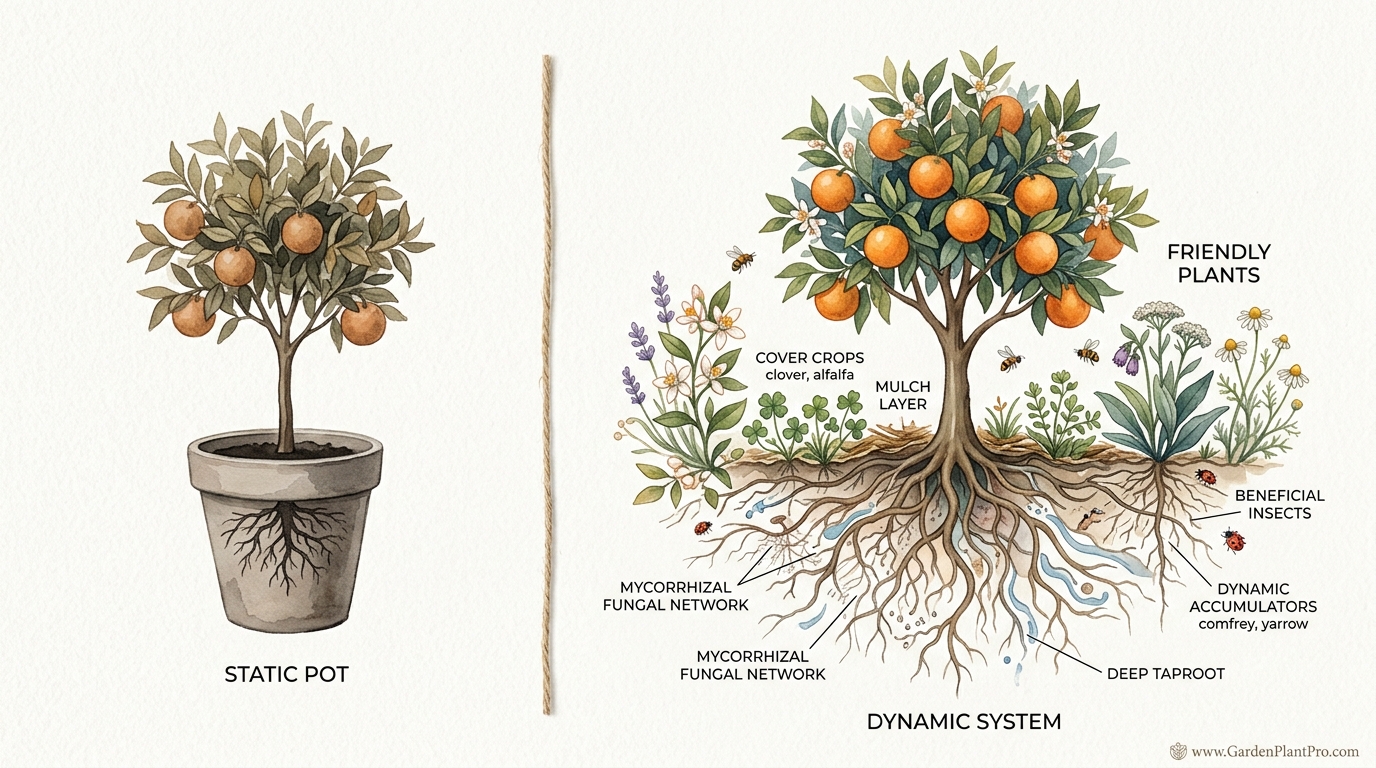
Most gardeners treat their orange tree like a prisoner in a cell rather than a participant in a living system. If your citrus is sitting in a pot of stagnant, sterile peat, it isn’t growing—it’s slowly dying. A dynamic system mimics the forest floor, using living biology to cycle nutrients and manage water. Switch from ‘holding’ your tree to ‘powering’ it with a self-sustaining ecosystem that does the feeding for you.
When you walk into a natural forest, nobody is out there with a bag of 10-10-10 fertilizer or a spray bottle of pesticide. The trees look healthy because they aren’t alone. They are surrounded by a community of plants, fungi, and insects that work together. In the gardening world, we call this a plant guild. It is a way of grouping species so that they help each other out, just like a good neighborhood.
If you have ever struggled with an orange tree that looks yellow, drops its fruit, or gets covered in aphids every spring, the problem likely isn’t the tree itself. The problem is the isolation. By surrounding your orange tree with specific “friends,” you can create a system that catches water, builds soil, and keeps the bad bugs away without you lifting a finger most of the year.
How To Create A Dynamic Orange Tree Guild
A dynamic orange tree guild is a purposeful community of plants centered around a citrus tree. Instead of a lonely trunk sticking out of a sea of mowed grass, you create a circle of life. This circle usually extends to the “dripline” of the tree—the point where the outermost leaves end—and often a bit beyond.
In the real world, these guilds are the backbone of permaculture and food forest design. They exist to solve the problems that usually require a trip to the garden center. Need nitrogen? We plant a legume. Need mulch? We plant something with big, juicy leaves that we can chop and drop. Need to keep the grass from stealing the tree’s water? We plant a ring of bulbs.
Think of it like a sports team. The orange tree is your star player, the one who scores the points (the fruit). But a star player can’t win without a defense to stop pests, a midfield to move nutrients around, and a coach to keep the soil structure in check. When these elements work together, the system becomes “dynamic”—it changes, grows, and sustains itself over time.
The Core Functional Roles in Your Guild
To make this work, you can’t just throw any random weeds under your tree. You need to pick plants that fill specific “jobs.” Each plant should ideally do more than one thing. This is what we call “stacking functions.”
The Nitrogen Fixers
Citrus trees are famously hungry for nitrogen. Most folks buy a bag of citrus food, but you can grow your own fertilizer. Nitrogen fixers are plants like clover, peas, beans, and lupines. They have a special relationship with bacteria in the soil that allows them to take nitrogen from the air and turn it into a form the tree can actually eat.
If you use white clover (Trifolium repens) as a ground cover, it stays low and constantly feeds the soil. For a bigger boost, you might plant a goumi berry (Elaeagnus multiflora) nearby. It’s a shrub that fixes massive amounts of nitrogen and gives you a tart little berry as a bonus.
The Dynamic Accumulators
Some plants have incredibly deep taproots that act like nutrient elevators. They reach down 3 to 6 meters (10 to 20 feet) into the subsoil where the orange tree’s roots can’t reach. They “mine” minerals like potassium, calcium, and magnesium, and store them in their leaves.
Comfrey (Symphytum officinale) is the undisputed king of this role. When you prune the comfrey leaves and drop them on the ground, they rot down and release those deep-mined minerals right where the orange tree can soak them up. Other good miners include yarrow, dandelions, and borage.
The Pest Repellents and Confusers
Pests like citrus psyllids or aphids find your tree by scent and sight. If your tree is a lone green target in a sea of brown mulch, it’s easy to find. But if you surround it with aromatic herbs like rosemary, lavender, and chives, the “smellscape” becomes confusing for the bad bugs.
Marigolds (Tagetes) are a classic choice here. They produce a chemical that deters nematodes in the soil and their bright flowers attract ladybugs and lacewings—the “lions” of the garden that eat aphids for breakfast.
The Pollinator Attractors
No bees means no oranges. While citrus trees are often self-fertile, having a high population of pollinators ensures better fruit set and larger harvests. Plants like borage, fennel, and dill have tiny, nectar-rich flowers that act like a landing strip for beneficial insects.
Step-by-Step: Building the Guild
Creating a guild isn’t something you have to finish in a single afternoon. It’s better to build it in layers as the tree grows.
Stage 1: The Site and the Centerpiece
Pick a spot with at least 6 to 8 hours of sun and good drainage. Citrus trees hate “wet feet.” If your soil is heavy clay, plant the tree on a slight mound. Once the tree is in the ground, mark out a circle about 1.5 to 2 meters (5 to 6 feet) in diameter. This is your initial “workspace.”
Stage 2: Suppressing the Grass
Grass is the enemy of a young orange tree. It is a “heavy feeder” that will steal every drop of water and every bit of nitrogen before the tree can get to it. Instead of digging it up and ruining the soil structure, use a technique called sheet mulching. Lay down 3 to 4 layers of plain brown cardboard over the grass, making sure to overlap the edges. Water the cardboard until it is soaking wet.
Stage 3: The First Support Plants
Cut small holes in the cardboard to plant your first round of helpers. In the first year, focus on nitrogen fixers and ground covers. Plant white clover or strawberries as a “living mulch” to cover the cardboard. This protects the soil from the sun and keeps it moist.
Tuck a few clumps of chives or garlic near the trunk. These alliums act as a barrier to keep grass from creeping back in and help deter borers.
DIY PROJECT: Collect rainwater no matter where you live...
This DIY project is the best way to legally collect rainwater NO MATTER where you live. Get chlorine-free water, cut down on your water bills, and have enough for an emergency situation or to water your garden. Read More Here...
Stage 4: Filling the Mid-Story
As the tree settles in, start adding your “heavy hitters.” Plant a few comfrey plants about 1 meter (3 feet) away from the trunk. Add some yarrow and marigolds in the gaps. If you have the space, a lavender bush on the sunny side of the tree adds beauty and keeps moths away.
Management and Ongoing Care
The beauty of a dynamic system is that it requires less “work” but more “observation.” You aren’t a laborer anymore; you’re a manager.
The Chop and Drop Method
This is the most important maintenance task. When your comfrey or borage gets big and starts to flower, take a pair of shears and cut the whole plant down to about 5 centimeters (2 inches) above the ground. Just drop the leaves right there on the soil.
It looks a bit messy for a week, but those leaves are basically high-grade organic fertilizer. The plant will grow back quickly, and you can repeat this 3 to 4 times a year. This constant cycling of organic matter builds a thick, spongy layer of soil called “humus” that holds water like a pro.
Watering Considerations
In the first two years, you’ll still need to water your tree during dry spells. However, as the ground cover fills in and the mulch layer thickens, you’ll find the soil stays moist much longer. A well-established guild can often survive on 30% less water than a lone tree in a grass lawn.
Benefits of the Dynamic System
Why go through all this trouble instead of just using a bag of fertilizer? The benefits are measurable and long-lasting.
- Self-Fertilization: By using nitrogen fixers and accumulators, you create a closed-loop system where the plants provide the nutrients.
- Pest Resilience: A diverse guild attracts predatory insects. You’ll see fewer outbreaks of scales, aphids, and mites because the “good guys” are already living on-site.
- Soil Health: The diverse root systems break up compaction and encourage mycorrhizal fungi, which help the orange tree absorb phosphorus and water.
- Multiple Yields: You aren’t just getting oranges. You’re getting culinary herbs, medicinal comfrey, and perhaps even strawberries from the same square meter of ground.
Common Mistakes to Avoid
Even with the best intentions, it’s easy to trip up. Here are a few things I’ve learned the hard way over the years.
Cramming too much too soon: It’s tempting to plant everything at once. But a young orange tree is easily overwhelmed. Give the tree a 30-centimeter (1-foot) “no-plant zone” directly around the trunk to ensure good airflow and prevent fungal rot. Focus on low-growing ground covers first, then add the bigger shrubs later.
Using invasive spreaders: Be careful with mint. While it’s a great pest repellent, it will take over your entire garden if you aren’t careful. If you want to use mint, plant it in a pot and bury the pot in the ground, or stick to less aggressive herbs like oregano or thyme.
Neglecting the “Chop”: If you let your dynamic accumulators grow into giant bushes and never cut them back, they can actually start competing with the tree for light and space. The magic happens when you prune them and return that energy to the soil.
Limitations and Constraints
This system isn’t a magic wand. There are times when it might not be the best fit.
If you are gardening in an extremely small space, like a tiny balcony, a full guild might be too much. In that case, you can use a “mini-guild” in a large pot by planting a few chives and a small marigold around the base of the tree.
In very arid climates, the support plants will compete with the tree for water until the mulch layer is thick enough to compensate. You might need to provide extra irrigation during the establishment phase. Also, if you live in an area with high fire risk, you’ll want to choose succulent ground covers (like purslane or sedum) rather than woody herbs that can become “ladder fuels.”
A Quick Comparison: Static vs. Dynamic
| Feature | Static Pot / Lawn Tree | Dynamic Guild System |
|---|---|---|
| Fertilizer | External (Chemical or Pellets) | Internal (Living Plants & Fungi) |
| Pest Control | Pesticide Sprays | Beneficial Insect Habitat |
| Water Needs | High (Frequent irrigation) | Moderate (Retained by living mulch) |
| Soil Quality | Degrades over time | Improves every year |
| Maintenance | Mowing, Spraying, Weeding | Pruning, Observing, Harvesting |
Practical Tips for Success
To get the most out of your orange tree guild, keep these best practices in mind:
- Use Bulbs as a Border: Plant a dense ring of daffodils or garlic chives at the very edge of your guild circle. Their thick root mats act like an underground fence that keeps invasive lawn grass from creeping in.
- Inoculate Your Legumes: When planting clover or peas, use a “rhizobium” inoculant (available at most garden stores). This ensures the plants have the right bacteria to actually fix nitrogen.
- Observation is Key: If the leaves of your orange tree are turning pale, you might need more nitrogen fixers. If the soil feels dry, you might need a thicker ground cover.
- Timing Matters: Try to plant your support species during the rainy season or in early spring. This gives them time to get their roots down before the heat of summer hits.
Advanced Consideration: The Anti-Greening Guild
If you live in a region like Florida or California where Citrus Greening (HLB) is a threat, you can adapt your guild for extra protection. Some research suggests that interplanting citrus with Guava trees can help repel the Asian Citrus Psyllid, the insect that carries the disease.
Adding Lemongrass in clumps around the perimeter can also provide a powerful scent barrier. While these plants take up more space, the trade-off is a significantly higher chance of your orange tree surviving into old age. This is a great example of how a guild can be customized to solve local environmental challenges.
Example Scenario: A 3-Meter Radius Guild
Imagine you have a medium-sized orange tree. Here is how you might lay out your guild:
Do you have some charcoal in your house right now? We call charcoal a “miracle leftover” for anyone who wants to be a little more self-sufficient and cut costs. That’s because it can help you with so many different things around the house and garden. You can even use it to make an energy-free fridge. Read More Here...
Directly under the tree, you have a thick carpet of Woodland Strawberries. They give you fruit in the spring and keep the soil cool. Scattered through the strawberry patch are clumps of Chives and Garlic to deter pests.
About 1 meter (3 feet) out from the trunk, you have three Comfrey plants spaced evenly around the tree. These are your fertilizer factories. Between the comfrey, you’ve tucked in some Marigolds and Borage to bring in the bees.
At the very edge of the circle, you have a solid ring of Daffodils. They bloom in the spring, signaling the end of winter, and their toxic bulbs keep gophers and grass away from the tree’s root zone. This entire system fits within a 3-meter (10-foot) circle and produces more food than most people’s entire vegetable gardens.
Final Thoughts
Moving from a static pot to a dynamic guild is a mental shift as much as a physical one. It’s about trusting the biology of the soil and the wisdom of the forest. When you stop fighting nature and start facilitating it, gardening becomes a joy instead of a chore.
Your orange tree will reward you with darker green leaves, more fragrant blossoms, and fruit that tastes like it actually came from the earth rather than a laboratory. Start small, maybe with just a few handfuls of clover seed and a couple of chive starts. Watch how the life returns to the soil.
Once you see the first ladybug hunting aphids on your orange leaves, or you feel the cool, damp soil under a thick layer of comfrey mulch, you’ll never go back to “prisoner” gardening again. You’re building a legacy in the soil, one plant at a time.