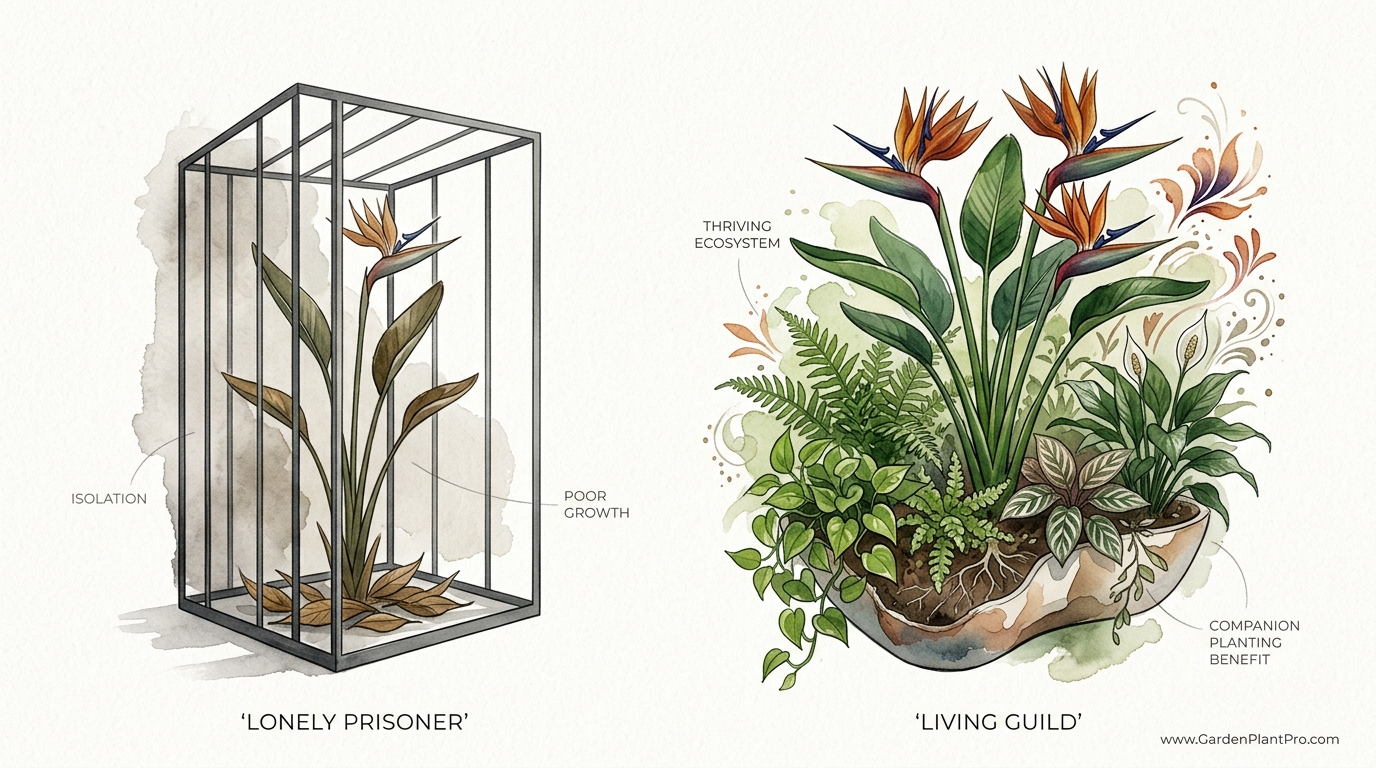
A plant in a corner is a prisoner; a plant in a guild is a powerhouse. Most indoor plants are treated like furniture. But in the wild, the Bird of Paradise is the anchor of a complex ecosystem. Recreating this ‘Guild’ energy in your living room is the secret to those massive 6-foot leaves you see in magazines.
I’ve spent the better part of forty years watching the way plants behave when they’re shoved into a lonely terracotta pot versus when they’re part of a community. There is a palpable difference in the way a Strelitzia (the botanical name for our Bird of Paradise) holds its head when it’s surrounded by “friends.” In the gardening world, we call this a guild—a group of plants that support each other’s growth, manage the local humidity, and even help keep pests at bay.
If you’ve ever wondered why your Bird of Paradise has those frustrating brown, crispy edges despite your constant misting, it’s likely because it’s living as a LONELY PRISONER. By shifting your mindset toward a LIVING GUILD, you aren’t just decorating a room; you’re managing a micro-environment. This guide is about how to choose the right partners for your Bird of Paradise to turn that static corner into a thriving, self-supporting indoor jungle.
Bird Of Paradise Companion Plants Indoor
When we talk about Bird Of Paradise Companion Plants Indoor, we are looking for species that can handle the specific, somewhat demanding lifestyle of the Strelitzia reginae (the orange variety) or the Strelitzia nicolai (the giant white variety). These plants are the sun-worshippers of the indoor world. They need bright, often direct light and a humidity level that would make most modern HVAC systems weep.
A companion plant isn’t just a neighbor; it’s a functional partner. In an indoor setting, these companions fall into two categories: Underplanting (growing in the same pot as the Bird of Paradise) and Grouping (placing separate pots in close proximity). Because the Bird of Paradise grows tall and develops a thick, “fountain” shape, it leaves a lot of “dead space” at the soil level. The right companions fill that space, acting as a living mulch that keeps the soil from drying out too fast while exhaling the moisture the Bird of Paradise craves.
Ideal companions share the Bird of Paradise’s love for temperatures between 65°F and 85°F (18°C–30°C) and a well-draining, slightly acidic soil. They should also be able to thrive in the “dappled shade” created by those massive, paddle-shaped leaves overhead. Think of the Bird of Paradise as the canopy tree and your companions as the forest floor.
Top Companion Candidates for Your Indoor Guild
- Pothos (Epipremnum aureum): The gold standard for underplanting. It’s tough, trails beautifully over the edge of large pots, and handles the high-light environment of a South-facing window with ease.
- Heartleaf Philodendron: Similar to Pothos but with a softer aesthetic. It loves the humidity boost it gets from sitting under the Bird of Paradise’s large leaves.
- Nerve Plants (Fittonia): If you’re looking for a “canary in the coal mine,” this is it. These stay low and love the damp, humid soil surface, quickly flagging (wilting) when the guild needs water.
- Peace Lilies (Spathiphyllum): Better for grouping rather than shared potting. They are humidity-making machines that complement the architectural lines of the Bird of Paradise.
- Bromeliads: These can be tucked into the base of a large Bird of Paradise container to add a splash of tropical color that mimics the Strelitzia’s own exotic blooms.
How the Indoor Guild System Works
The magic of a guild lies in a process called transpiration. Plants don’t just “sit” there; they are constantly moving water from their roots to their leaves, where it evaporates into the air. When you group a Bird of Paradise with several companions, you create a bubble of high humidity—a microclimate—that is significantly more stable than the rest of your house.
To build this system, you need to think in layers. I always suggest starting with the Anchor, which is your Bird of Paradise. Once you have your anchor in a large, sturdy pot (at least 12 to 14 inches or 30–35 cm in diameter), you look at the “floor.” The floor is the soil surface. By underplanting with something like Callisia repens (Turtle Vine) or a creeping Ficus pumila, you reduce the amount of bare soil exposed to the air. This slows down evaporation and prevents the soil from “crusting” over.
If you prefer not to share a pot—perhaps because your Bird of Paradise is still young and its roots are sensitive—you can achieve the same effect by “staged grouping.” Place your Strelitzia in the back, near the light source, and arrange mid-sized plants like Calatheas or Ferns in front of it. The large leaves of the Bird of Paradise will protect the more sensitive foliage of the companions from the harshest direct rays, while the companions provide a steady stream of moisture to keep the Bird of Paradise’s leaf tips from turning brown.
Step-by-Step Guild Assembly
- Select a “Mother Pot”: Use a heavy ceramic or stone pot with excellent drainage. Bird of Paradise plants get top-heavy, and they have powerful, tuberous roots that can crack thin plastic.
- Prepare the Mix: Use a high-quality potting soil amended with 20% perlite and 10% orchid bark. This provides the “breathing room” the roots need while supporting a community of plants.
- Position the Anchor: Place the Bird of Paradise slightly off-center if you plan to underplant. This leaves a wider “meadow” for your smaller companions.
- Tuck in the Companions: Choose 2–3 small plants with shallow root systems. Dig small holes in the surface of the BoP’s soil, being careful not to sever the thick, white roots of the main plant.
- Water as a Unit: Give the entire group a thorough soak until water runs out the bottom. This settles the roots together and starts the transpiration cycle.
The Practical Benefits of Indoor Companion Planting
The most immediate benefit I’ve noticed over the years is the reduction in leaf curling. In many homes, the air is simply too dry for a Bird of Paradise to unfurl its new leaves properly. Sometimes they get stuck in a tight cigar shape and eventually rip as they try to open. A guild provides the localized humidity needed to lubricate that process, ensuring those 3-foot (1-meter) leaves open smoothly.
Another advantage is nutrient cycling. While we often think of plants as “competing” for food, a diverse pot can actually manage soil health better. For instance, adding a light underplanting of clover (though more common in outdoor guilds) or certain legumes can help with nitrogen, but even just having a variety of root depths ensures that moisture is pulled evenly from all levels of the pot, preventing the bottom from becoming a “death zone” of stagnant water.
From an aesthetic standpoint, the guild transforms a single, “stalky” plant into a lush centerpiece. Let’s be honest: a mature Strelitzia nicolai can look a bit bare at the bottom as it grows taller. Filling that void with the silver-patterned leaves of a Scindapsus pictus or the deep purple of a Tradescantia creates a professional, high-end look that hides the “legs” of the main plant.
Challenges and Common Mistakes to Avoid
The most frequent error I see people make is over-crowding the root zone. Bird of Paradise roots are aggressive. They are thick, fleshy structures that store water like a camel. If you choose a companion with a similarly aggressive root system—like a large Monstera deliciosa—the two will eventually engage in a “pot-bound war” that usually ends with the pot cracking or one plant choking out the other.
Light Shadowing is another hurdle. Remember that your companions are living in the shade of the Bird of Paradise. If you pick a companion that needs 10 hours of direct sun, like a cactus or a succulent, it will grow leggy and weak sitting under those massive green umbrellas. Always match your underplanting to the “low-to-medium light” category, even though the main plant is in a “high light” spot.
Pest management also becomes a bit more complex. If one plant in the guild gets Scale or Mealybugs (the two arch-nemeses of the Bird of Paradise), it can spread to the companions before you even notice. I always tell my neighbors: check the undersides of the leaves once a week. If you find something on the Pothos, you can bet it’s heading for the Strelitzia.
Limitations of the Indoor Guild Method
While the guild is powerful, it isn’t a magic fix for poor environment. If you put a Bird of Paradise guild in a dark, windowless hallway, every single plant will fail. The system relies on light as the primary fuel. Without light, there is no transpiration; without transpiration, there is no microclimate.
Size is also a practical boundary. A Strelitzia nicolai can easily reach 10 feet (3 meters) indoors if it’s happy. At that scale, the “pot” becomes so heavy it’s impossible to move. If you have underplanted that giant, you are now committed to a very heavy ecosystem. I usually recommend that once a Bird of Paradise passes the 6-foot mark, you switch from “Shared Potting” to “Grouping” simply to make maintenance and seasonal cleaning easier.
Finally, there’s the issue of fungus gnats. More plants and more soil surface moisture can lead to a boom in gnat populations. You have to be careful to let the top inch (2.5 cm) of soil dry out between waterings, or use a layer of decorative sand or pebbles to discourage the gnats from laying eggs in your beautiful guild.
Grouping vs. Co-planting: Which Is Right for You?
Deciding whether to put everyone in one pot or just keep them close together depends on your experience level and the size of your space. Here is a breakdown of how the two methods compare:
DIY PROJECT: Collect rainwater no matter where you live...
This DIY project is the best way to legally collect rainwater NO MATTER where you live. Get chlorine-free water, cut down on your water bills, and have enough for an emergency situation or to water your garden. Read More Here...
| Feature | Co-planting (Shared Pot) | Grouping (Separate Pots) |
|---|---|---|
| Maintenance Level | Moderate – Must balance water for all. | Low – Each plant gets its own care. |
| Humidity Benefit | High – Maximum transpiration density. | Medium – Needs more plants to be effective. |
| Root Competition | High – Anchor plant will dominate over time. | None – Roots are isolated. |
| Ease of Cleaning | Difficult – Hard to move and wash leaves. | Easy – Can move plants individually. |
| Visual Impact | Seamless, “wild” look. | Modern, curated gallery look. |
Practical Tips for a Thriving Bird of Paradise Guild
If you’re ready to start, here are a few “old gardener” tricks I’ve picked up over the years to keep the system running like a well-oiled machine:
- The Finger Test: Don’t trust a schedule. Stick your finger two inches (5 cm) into the soil. If it’s bone dry, water the guild. If it’s still damp, wait. The companions will often tell you they’re thirsty before the Bird of Paradise does.
- Rotate for Even Growth: The side of the guild facing the window will grow faster. Give the whole pot a quarter-turn every time you water. This prevents the “prisoner” effect where the plant leans desperately toward the glass.
- Wipe the Leaves: Those big Bird of Paradise leaves are dust magnets. Dust blocks sunlight and clogs the pores (stomata). Once a month, use a soft, damp cloth to wipe every leaf in the guild. It’s tedious, but it’s the best “fertilizer” you can give them.
- Feeding Strategy: Use a balanced, water-soluble fertilizer (like a 10-10-10) at half strength every two weeks during the growing season. The companions will take what they need from the “overflow” of the main plant.
- The Humidity Tray: Even with a guild, winter air can be brutal. Place the entire group on a large tray filled with pebbles and water. As the water evaporates, it rises directly into the canopy of your guild.
Advanced Considerations: Scaling Your Guild
For the serious practitioner, you can take the guild concept further by introducing technological synergy. If you have a particularly large specimen, consider installing a “wicking system” or a self-watering reservoir. Because the Bird of Paradise and its companions like consistent moisture (but not soggy feet), a reservoir can provide a steady “bottom-up” hydration that prevents the leaf-curl caused by irregular manual watering.
You might also look into supplemental lighting. As your Bird of Paradise grows, its leaves become so thick they can actually create a “dead zone” of light for the companions below. I’ve seen great success with small, clip-on LED grow lights hidden among the lower foliage. This ensures the “floor” of your guild stays as vibrant as the “canopy.”
Lastly, consider the pH of your water. Bird of Paradise plants prefer a slightly acidic environment (pH 5.5 to 7.5). If your tap water is very hard (alkaline), you might notice the leaves of your companions yellowing first. Adding a tiny bit of organic compost or using filtered water can keep the entire community in balance.
Real-World Example: The “Jungle Corner” Setup
Let’s look at a practical scenario. Suppose you have a bright, West-facing corner in your living room. You start with a 4-foot (1.2-meter) Strelitzia reginae in a 14-inch (35-cm) pot. This is your Anchor.
To create the guild, you underplant with a Neon Pothos on the side facing the room (for color contrast) and a small Rabbit’s Foot Fern near the center. The Pothos will trail down the side of the pot, while the Fern’s fuzzy rhizomes will crawl across the soil surface, acting as a natural mulch. Around the base of this main pot, you place three smaller pots: a Snake Plant (for vertical contrast), a Maranta (for humidity contribution), and a Calathea.
In this setup, the Bird of Paradise receives the strongest light. The Maranta and Calathea benefit from the humidity “cloud” created by the large BoP leaves. The Pothos thrives in the “leftover” light. After six months, you’ll notice that you are watering less frequently than you did when the plants were separate, and the new leaves on the Bird of Paradise are coming in larger and without the characteristic rips of a dry-environment plant.
Final Thoughts
Building a guild around your Bird of Paradise is about more than just aesthetics; it’s about respect for the plant’s biology. When we move away from the LONELY PRISONER model of indoor gardening, we start to see our homes as living systems rather than just decorated boxes. The Bird of Paradise is a generous anchor, and in return for its height and grandeur, it only asks for the company of other plants to help it breathe.
I encourage you to start small. You don’t need a dozen plants to make a guild. Start with one good companion—a simple Pothos or a hardy Philodendron—and watch how the two interact. Notice the way the soil stays moist longer and how the leaves seem to reach for each other. This is the “Guild Energy” that makes indoor gardening a lifelong joy rather than a chore.
As you get more comfortable, you can experiment with more sensitive companions or advanced irrigation. Gardening is a conversation with the soil, and when you have a whole community of plants talking, the lessons come much faster. Happy planting, neighbor.