Why your energy bill is the most expensive way to keep an apple crisp. Our ancestors didn’t have 5-star energy-rated appliances, yet they ate crisp apples in April. The secret isn’t more electricity; it’s understanding thermal mass and humidity. Discover the passive storage method that outperforms your fridge.
If you have ever bitten into a grocery store apple in February only to find it mealy and flavorless, you have experienced the limitations of industrial storage. We have been conditioned to believe that preservation requires a constant hum of a compressor and a monthly utility bill. But for thousands of years, gardeners have used the earth’s natural stability to put the harvest to sleep.
The beauty of passive storage is that it works with the fruit’s biology rather than fighting it. An apple is a living thing, even after it leaves the tree. It “breathes,” taking in oxygen and exhaling carbon dioxide and ethylene gas. To keep it fresh, we simply need to slow that breathing down without stopping it entirely.
Store Apples Without Electricity For Months
Storing apples without electricity is the practice of utilizing natural cooling and humidity to preserve fruit. It primarily takes place in root cellars, basements, or specialized outdoor pits known as “clamps.” By harnessing the thermal mass of the earth, which stays at a consistent temperature regardless of the weather above, we can create a “natural refrigerator.”
In a real-world setting, this means your apples aren’t sitting in the dry, recirculated air of a modern frost-free fridge. Instead, they rest in a cool, damp environment that prevents the skin from shriveling and the flesh from turning soft. This method is used by homesteaders, backyard gardeners, and traditional orchardists who want to extend their harvest into the following spring.
Think of it as putting the apple into a deep hibernation. In the right conditions, a Winesap or an Arkansas Black apple can stay crisp for six months or more. This isn’t just about saving money; it’s about food security and enjoying a flavor profile that actually improves with age—something a high-tech fridge can rarely claim.
The Science of the Sleeping Apple
To master passive storage, you have to understand three critical factors: temperature, humidity, and air circulation. Each of these acts as a dial you can turn to control the speed of the apple’s metabolism.
Temperature: The Metabolism Brake
The ideal temperature for most apples is between 30°F and 32°F (-1°C to 0°C). Since apples have a high sugar content, they don’t actually freeze at 32°F (0°C); their freezing point is closer to 28°F (-2°C). Every degree above 32°F (0°C) speeds up the ripening process. For example, an apple stored at 40°F (4°C) will ripen twice as fast as one stored at 32°F (0°C).
Humidity: The Hydration Guard
Modern refrigerators are designed to remove moisture, which is the enemy of a crisp apple. Apples are roughly 85% water. If the air around them is dry, they will lose that water to the atmosphere, resulting in shriveled skin. You want a relative humidity (RH) of 90% to 95%. This feels “damp” but not “wet.”
Gas Management: The Ethylene Factor
Apples release ethylene gas, a natural ripening agent. In a sealed environment, this gas builds up and tells all the other apples to ripen and rot. Passive storage systems usually include a way to vent this gas out while keeping the cold air in.
How to Do It: Practical Passive Storage Methods
You don’t need a 19th-century stone cellar to make this work. Depending on your climate and backyard setup, there are several ways to create a passive “cold room.”
The Traditional Root Cellar
If you have an unheated basement, you are halfway there. The corner of a basement that is underground on two sides is naturally cooler. You can wall off this corner with insulated studs to keep the house heat out. Adding a vent to the outside—one low for intake and one high for exhaust—allows you to pull in cold night air during the autumn.
The Buried Barrel or Garbage Can
This is the “poor man’s root cellar.” You dig a hole deep enough to bury a galvanized metal garbage can or a heavy-duty plastic barrel. The lid should be about 6 inches (15 cm) below the soil line. After filling it with layers of apples and straw, you place the lid on and cover it with a thick “cap” of straw and a piece of plywood weighted with a stone. The earth provides the thermal mass, keeping the contents at a steady 35°F to 40°F (2°C to 4°C) even in a freeze.
The Outdoor Clamp
In regions with milder winters, you can build a clamp. You start by clearing a patch of well-drained ground and lining it with a thick layer of straw. Pile your apples in a cone shape, cover them with another 6 inches (15 cm) of straw, and then “plaster” the outside with a layer of soil. Be sure to leave a small tuft of straw poking out the top to act as a chimney for ethylene gas to escape.
Best Varieties for Long-Term Storage
Not all apples are created equal. An early-season apple like a Gala or Honeycrisp is wonderful for eating in September, but it won’t last until Christmas in a cellar. You want “winter apples”—varieties that are harvested late and have thick skins and high acid levels.
- Arkansas Black: These are rock-hard at harvest and almost inedible. After four months in storage, they turn deep purple-black and develop a sweet, complex flavor.
- Fuji: A modern favorite that stores exceptionally well due to its high sugar content. It can stay crisp for 5–6 months.
- Granny Smith: The thick skin and tartness make it a champion of the cellar.
- Winesap: An heirloom classic known for keeping its “snap” until late spring.
- Northern Spy: A traditional pie apple that actually improves in texture after a few months of cold.
Benefits of Passive Storage
Choosing a passive method over a dedicated “beer fridge” for your harvest offers more than just environmental satisfaction.
Superior Flavor Development
Many heirloom apples are “starch-heavy” at harvest. Cold storage allows those starches to slowly convert into sugars. In a passive cellar, this happens at a natural pace, leading to a depth of flavor that industrial flash-cooling often bypasses.
Resilience and Independence
When the power goes out during a winter storm, your electric fridge becomes a liability. A buried barrel or a basement cellar continues to work regardless of the grid. It is a set-it-and-forget-it system that relies on the laws of physics rather than a circuit board.
Massive Capacity
Unless you have three spare refrigerators, you cannot store 20 bushels (about 360 kg or 800 lbs) of apples. A root cellar or a series of outdoor clamps allows you to store the entire output of a home orchard without a second thought about space.
DIY PROJECT: Collect rainwater no matter where you live...
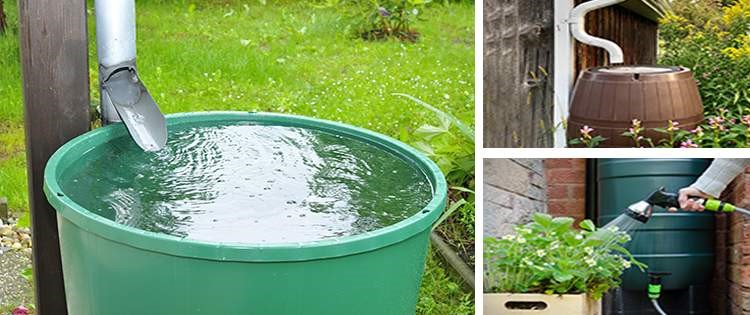
This DIY project is the best way to legally collect rainwater NO MATTER where you live. Get chlorine-free water, cut down on your water bills, and have enough for an emergency situation or to water your garden. Read More Here...
Challenges and Common Mistakes
The most frequent mistake I see is the “one bad apple” scenario. It’s a cliché for a reason. A single apple with a bruise or a wormhole will rot. As it rots, it releases a massive burst of ethylene gas and heat, which causes every apple touching it to rot as well.
Failure to Sort: You must be ruthless. Only “perfect” apples go into long-term storage. If an apple has no stem, use it for sauce today. If it has a tiny bird peck, dehydrate it. Only “Grade A” fruit earns a spot in the cellar.
Storing Near Potatoes: This is a classic gardening blunder. Potatoes and apples are the “star-crossed lovers” of the root cellar—they belong together in the kitchen but must stay apart in storage. Potatoes release gases that make apples taste earthy and rot faster, while apples release ethylene that makes potatoes sprout prematurely. Keep them in separate rooms or at opposite ends of a well-ventilated cellar.
Lack of Humidity: If you walk into your storage area and your skin feels dry, your apples are suffering. I often keep a few buckets of damp sand or a wet burlap sack on the floor of my cellar to keep the humidity up.
Limitations: When This May Not Be Ideal
Passive storage isn’t a universal solution. If you live in a tropical or subtropical climate where the ground temperature never drops below 60°F (15°C), a root cellar will simply be a dark room where fruit rots quickly.
Additionally, very wet environments with poor drainage can turn a buried barrel into a bucket of water. You must ensure your storage site is on high ground or has a gravel drainage bed. If your soil is heavy clay, you might find that an insulated above-ground shed works better than a pit.
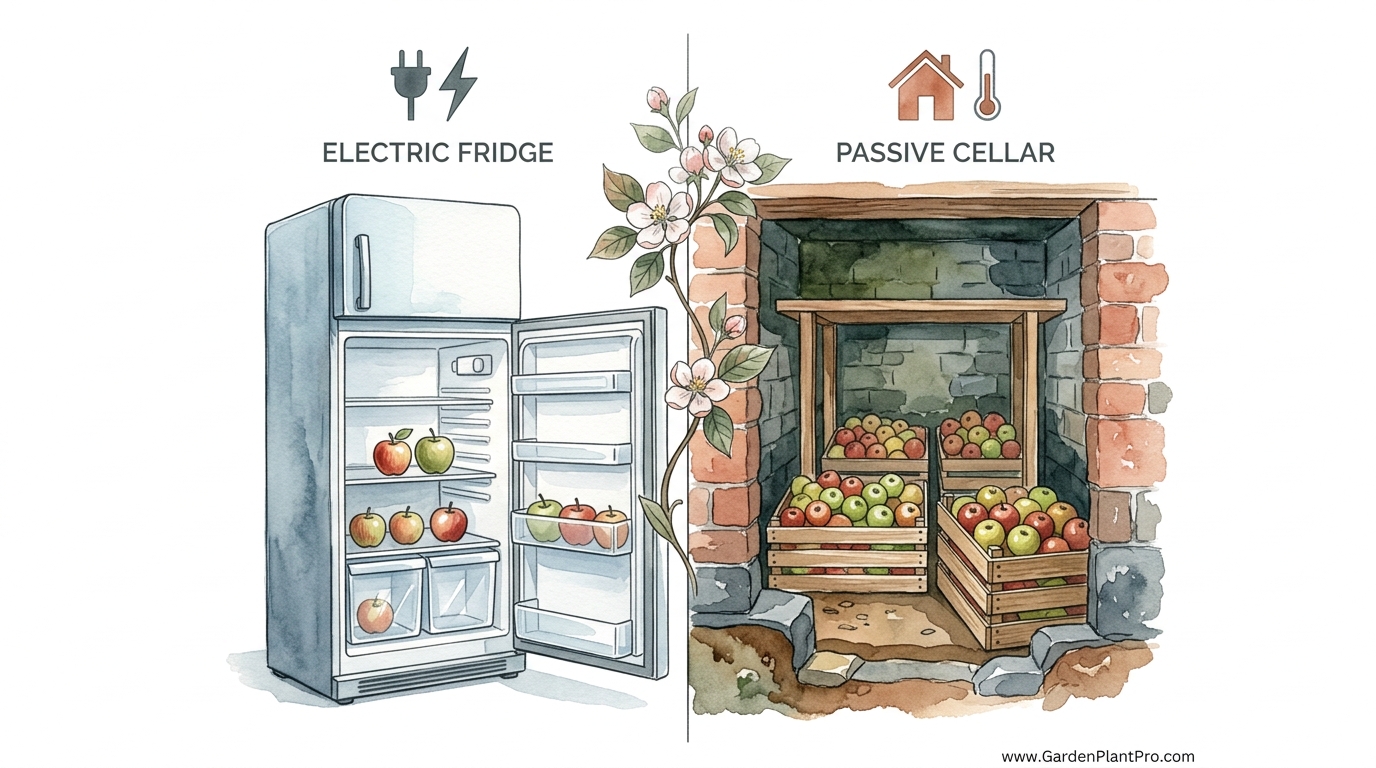
Electric Fridge vs. Passive Cellar
To help you decide which method fits your needs, let’s look at how these two “coolers” stack up against each other.
| Feature | Electric Refrigerator | Passive Cellar / Clamp |
|---|---|---|
| Operating Cost | $10–$20/month (Electricity) | $0 (Gravity and Earth) |
| Humidity Control | Poor (Dehumidifies air) | Excellent (Naturally moist) |
| Capacity | Limited to shelf space | Virtually unlimited |
| Maintenance | Mechanical checks needed | Ventilation and sorting only |
| Reliability | Fails during power outage | Works as long as earth is cool |
Practical Tips for Success
Over the years, I’ve picked up a few tricks that make the difference between a crisp March apple and a compost heap.
- Wrap individually: I use old, non-glossy newspaper to wrap each apple. This does two things: it prevents the apples from touching (stopping the spread of rot) and it helps retain a micro-climate of moisture around each fruit.
- Keep the stems on: An apple without a stem has an “open wound” where bacteria can enter. Always harvest by lifting and twisting, not pulling.
- Night cooling: If you are using a basement or shed, open the windows at night and close them at dawn. This “traps” the cold air inside for the day.
- Don’t wash them: Apples have a natural waxy coating called the “bloom.” This is their primary defense against dehydration and fungi. Leave it on until the moment you are ready to eat.
Advanced Considerations: Monitoring and Airflow
For those looking to take their storage to the next level, I recommend investing in a digital hygrometer with a remote sensor. You can place the sensor inside your buried barrel and keep the display in your kitchen. This allows you to monitor the temperature and humidity without constantly opening the lid and letting the cold air escape.
If you find your storage is consistently too warm, you can increase the “thermal lag” by adding more insulation to the top. Bags of dry leaves are an excellent, free insulation material. In very cold climates (Zone 3 or 4), you may actually need to add a “heat sink”—such as a few large jugs of water—which will release a small amount of heat as they freeze, preventing your apples from dropping below 28°F (-2°C).
A Winter Timeline Example
Imagine you harvest your Northern Spy and Fuji apples in late October. After sorting, you wrap them in newspaper and place them in wooden crates in your unheated basement corner.
By Christmas, you notice the Fuji apples are at their peak sweetness. You do a quick check, removing one apple that feels slightly soft.
In February, the outdoor temperatures are sub-zero, but your basement corner is holding steady at 34°F (1°C). You enjoy a fresh apple salad that tastes like it was picked yesterday.
By April, the skins of the remaining apples are a bit duller, and the texture is slightly “givey,” but they are still far superior to anything in the grocery store. You use the last few for a spring apple crisp, having successfully bypassed the energy grid for six months.
Final Thoughts
The transition from a mechanical mindset to a passive one is the hallmark of a seasoned gardener. We often think that “more control” means “more technology,” but the earth offers a level of stability that no machine can match. By understanding how an apple breathes and how the soil holds its temperature, you can turn a seasonal harvest into a year-round resource.
Don’t feel like you need to dig a massive bunker on day one. Start small. Try a “garbage can cellar” or simply clear out a corner of your crawlspace. Learn how your local soil behaves and which varieties in your area are the best “keepers.”
Whether you are looking to cut your carbon footprint or simply want to taste a real apple in the dead of winter, passive storage is a skill that pays dividends every time you open that cellar door. It’s a bit of ancient wisdom that remains just as practical in the modern world.
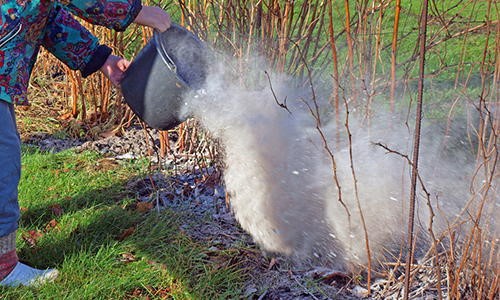
Do you have some charcoal in your house right now? We call charcoal a “miracle leftover” for anyone who wants to be a little more self-sufficient and cut costs. That’s because it can help you with so many different things around the house and garden. You can even use it to make an energy-free fridge. Read More Here...