
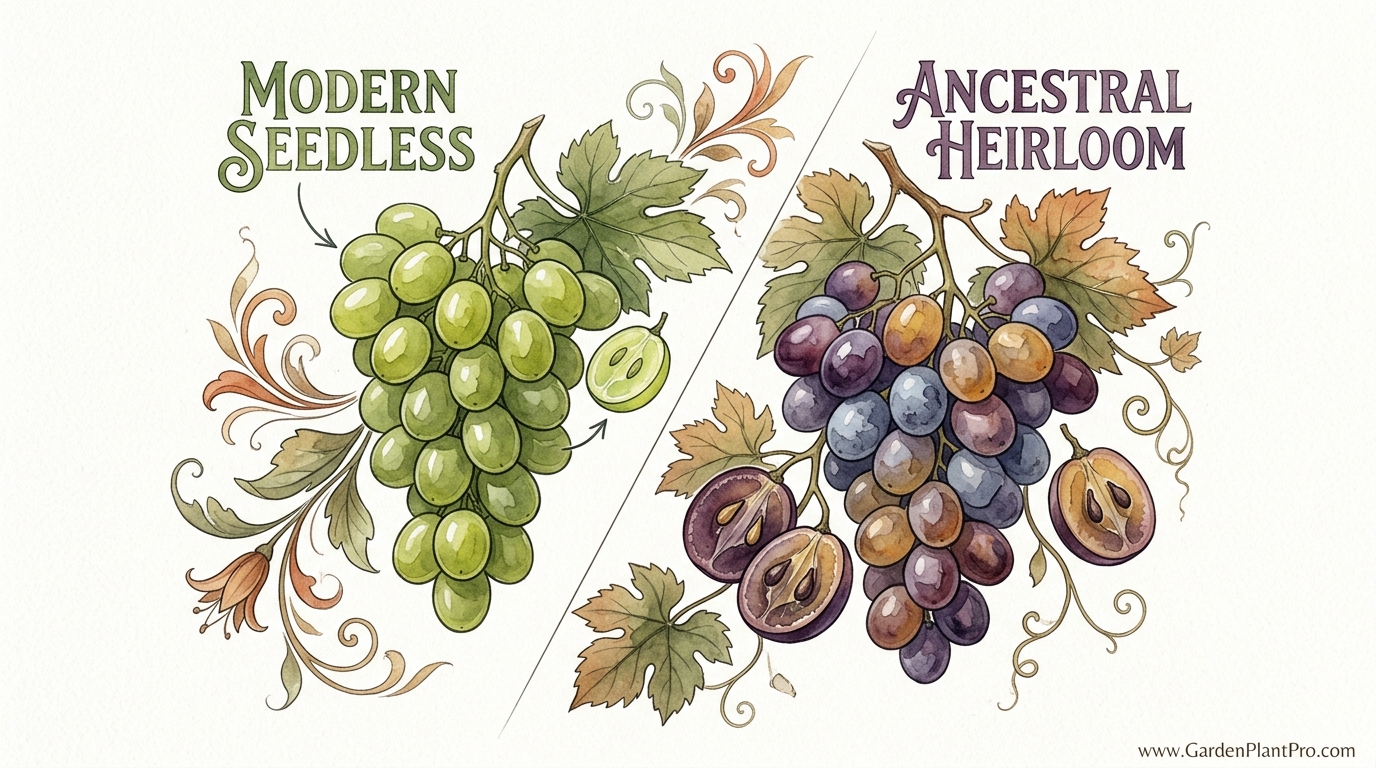
We traded 80% of the grape’s flavor and medicinal polyphenols just so we wouldn’t have to spit out a single seed. Modern grocery store grapes are a triumph of logistics, not flavor. To make them seedless and shippable, we bred out the very compounds that give grapes their soul. Heirloom seeded varieties contain more antioxidants in their skins and seeds than the entire pulp of a modern grape. It’s time to bring real flavor back to the garden.
Whenever you walk through a modern supermarket, you see rows of perfectly uniform, translucent green and red spheres. They are sweet, certainly, but they lack the punch, the musk, and the complexity that our grandparents used to find in their backyard arbors. Growing heirloom seeded grapes isn’t just about fruit; it is about reclaiming a part of our agricultural heritage that values depth of character over shelf life.
If you have ever bitten into a Concord and felt that “slip-skin” sensation—where the pulp slides right out of the thick, tart skin—you know exactly what I am talking about. That explosion of flavor is the result of thousands of years of evolution, not a laboratory experiment aimed at making a grape survive a three-thousand-mile truck ride. Let’s talk about how you can get these incredible vines established in your own soil.
Benefits Of Growing Heirloom Grapes
Heirloom seeded grapes represent the “ancestral” version of one of humanity’s oldest cultivated crops. Unlike modern cultivars that are often bred for “seedlessness”—a genetic mutation called stenospermocarpy—heirloom varieties retain their original biological blueprint. This blueprint includes a thick skin packed with resveratrol and a crunchy seed loaded with proanthocyanidins, which are powerful antioxidants that support heart and vascular health.
In the real world, these grapes offer a flavor profile that modern table grapes simply cannot match. Varieties like the Muscat or the Isabella possess “musky” and “floral” notes that are so intense they can perfume an entire garden on a warm afternoon. Gardeners choose these because they want a grape that actually tastes like a grape, not just a sugary water balloon.
Beyond the flavor, heirloom vines are often far more vigorous and resilient. Because many of these varieties, especially the American Vitis labrusca types, evolved in specific North American climates, they have natural defenses against local pests and diseases that fragile modern hybrids lack. Planting an heirloom is like inviting a seasoned veteran into your garden; it knows how to handle a tough summer.
Choosing Your Ancestral Variety
Selecting the right grape is the first and most important step in your journey. You cannot just pick any vine and hope for the best; you must match the variety to your specific “growing degree days” and your winter lows. Heirloom grapes are generally categorized into three main groups, and each has its own personality.
The American Heirlooms (Vitis labrusca)
These are the cold-hardy legends of the Northeast and Midwest. Concord is the most famous member of this family, known for its deep blue-black color and classic “grape jelly” flavor. It can handle temperatures down to -20°F (-29°C) without much fuss. Another great choice is the Catawba, a spicy, reddish-pink grape that was a staple of American viticulture in the 1800s. These are “slip-skin” grapes, meaning the skin is tough and tart while the inside is sweet and juicy.
The Southern Muscadines (Vitis rotundifolia)
If you live in the hot, humid Southeast, Muscadines are your best friends. Varieties like the Scuppernong are practically bulletproof against the heat and the devastating Pierce’s disease that kills other grapes. Muscadines grow in clusters rather than tight bunches and have incredibly thick skins that are essentially nature’s vitamin pills. They require a long, warm season and generally cannot survive winters where temperatures drop below 0°F (-18°C).
The European Classics (Vitis vinifera)
For those in Mediterranean-style climates like California or parts of the Southwest, the Vitis vinifera heirlooms are the gold standard. The Muscat of Alexandria is perhaps the oldest known grape still in cultivation. It offers an aroma of orange blossom and honey that will ruin supermarket grapes for you forever. These vines prefer dry heat and are more susceptible to fungal issues in humid regions, so site selection is critical for them.
Garden Conditions and Site Selection
Grapes are long-lived perennials—vines can easily live for 50 to 100 years—so you need to choose their “forever home” with care. They are sun-worshipers. To develop those complex sugars and medicinal polyphenols, they need a minimum of 7 to 8 hours of direct sunlight every day. Shady spots lead to watery fruit and a never-ending battle with powdery mildew.
Drainage is the second non-negotiable factor. Grapes hate “wet feet.” If your soil stays soggy after a rain, the roots will rot before the vine even has a chance to climb. Many experienced gardeners plant their vines on a slight slope or in raised beds to ensure that water moves away from the crown. Ideally, your soil should be a deep, well-drained loam, though grapes are surprisingly tolerant of rocky or sandy ground as long as it isn’t pure clay.
Check your soil pH before you plant. Most heirloom varieties prefer a slightly acidic to neutral range, typically between 5.5 and 7.0. American varieties tend to favor the lower end of that scale, while European types like a bit more lime. A quick soil test will tell you if you need to add elemental sulfur to lower the pH or lime to raise it. Do this work a few months before planting to let the amendments settle into the soil biology.
Planting and Initial Establishment
When the time comes to put your vines in the ground, usually in early spring while they are still dormant, you want to give the roots plenty of room. Most heirloom grapes are sold as bare-root plants. Before planting, soak the roots in a bucket of water for 3 to 4 hours (but no longer than 6) to rehydrate them. This gives them a vital head start after their journey from the nursery.
Dig a hole that is twice as wide as the root system and just as deep. Spread the roots out in a radial pattern rather than cramming them into a tight ball. For most varieties, you want to plant them so the lowest bud on the cane is just 2 to 3 inches (5 to 8 centimeters) above the soil line. If the vine is grafted, make sure the “graft union”—that bumpy scar near the base—is at least 2 inches (5 centimeters) above the soil to prevent the top part of the vine from growing its own roots.
Space your vines at least 8 to 10 feet (2.4 to 3 meters) apart. It might seem like a lot of empty space when they are just little sticks, but a mature heirloom vine can easily grow 10 to 15 feet (3 to 4.5 meters) in a single season. Crowding leads to poor air circulation, which is an open invitation for fungal diseases. Once they are in the ground, water them deeply to settle the soil and remove any air pockets.
Support Systems and Trellising
Grapevines are essentially climbing machines that need a sturdy skeleton to hold them up. Without a trellis, your grapes will sprawl across the ground, where they will be eaten by rot and rodents. You have several options, but the two most common for backyard growers are the High-Wire Cordon and the Four-Cane Kniffen system.
The Four-Cane Kniffen system is a classic for American heirlooms like Concord. You set two wires between your posts—one at 3 feet (0.9 meters) and another at 5 or 6 feet (1.5 to 1.8 meters). You then train the vine to have four “arms” (canes), two on each wire, extending in opposite directions. This maximizes sunlight exposure and makes harvesting much easier on your back.
Arbors and pergolas are also popular, especially if you want shade as well as fruit. Just remember that if you grow grapes over an arbor, you still have to prune them. It’s easy to let a vine turn into a tangled “bird’s nest” on top of a pergola, but you will pay for it later with smaller, sourer fruit. Keep your support structure simple and strong; a mature vine loaded with fruit can weigh several hundred pounds.
DIY PROJECT: Collect rainwater no matter where you live...
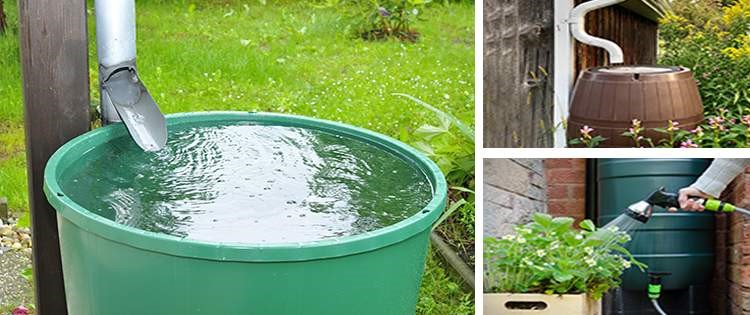
This DIY project is the best way to legally collect rainwater NO MATTER where you live. Get chlorine-free water, cut down on your water bills, and have enough for an emergency situation or to water your garden. Read More Here...
| System Type | Best For | Maintenance Level | Main Advantage |
|---|---|---|---|
| High-Wire Cordon | Muscadines & Hybrids | Moderate | Simple pruning; great for heat |
| Four-Cane Kniffen | Concord, Catawba | High | Maximum yield in small space |
| Arbor/Pergola | Ornamental/Table Grapes | Low to Moderate | Beautiful shade & easy reach |
The Art of Pruning Heirloom Vines
Pruning is the most intimidating part of growing grapes, but it is also the most necessary. Here is the golden rule: grapes fruit on wood that is one year old. If you don’t prune, the vine will focus all its energy on making more leaves and very little fruit. Every winter, while the vine is dormant, you should be removing about 80% to 90% of the previous year’s growth. It feels like a slaughter, but I promise the vine will thank you for it in June.
When you look at your vine in February, you will see long, reddish-brown canes that grew during the last summer. You want to select a few of the healthiest, most vigorous canes to be your “fruiting wood” for the coming year. Cut everything else away. If you are using the Four-Cane Kniffen system, you leave four canes, each about 8 to 10 buds long. These buds will sprout the new green shoots that carry the grape clusters.
Summer pruning is also helpful for managing the canopy. If the leaves become so thick that you can’t see the fruit, you should thin them out. Removing a few leaves from around the clusters—a process called “leaf pulling”—allows sunlight to hit the grapes directly and improves airflow. This simple trick can be the difference between a harvest of perfect grapes and a harvest of gray mold.
Maintenance and Long-Term Care
Once your vines are established, their needs are relatively simple, but consistency is key. During the first two years, you must ensure they get regular water—about 1 inch (2.5 centimeters) per week—to help those deep root systems develop. Mature vines are surprisingly drought-tolerant because their roots can go down 15 feet (4.5 meters) or more, but they still appreciate a deep soak during a dry spell in late summer when the fruit is swelling.
Fertilizing should be handled with a “less is more” attitude. Over-fertilizing with nitrogen will give you a massive, lush green vine but almost no grapes. I usually just top-dress the base of my vines with a couple of inches of good compost in the early spring. If your soil is particularly poor, a balanced organic fertilizer applied just as the buds begin to swell is plenty. Avoid fertilizing in late summer, as this encourages new growth that won’t have time to harden off before the first frost.
Mulching is a point of debate among grape growers. While mulch helps retain moisture and suppress weeds, it can also keep the soil too cool in the spring, which delays the start of the growing season. In cooler climates, many gardeners prefer to keep the soil bare under the vines to let the sun warm it up quickly. If you do mulch, use something light like straw or wood chips and keep it a few inches away from the trunk to prevent rot.
Managing Pests and Diseases Naturally
Growing heirlooms means dealing with the same challenges our ancestors faced. The big three diseases for grapes are black rot, powdery mildew, and downy mildew. Black rot is the most devastating; it causes the fruit to shrivel up into hard, black “mummies.” The best defense is sanitation. Always prune out and remove any old fruit or dead wood from the vineyard, as this is where the spores overwinter.
Japanese beetles and grape berry moths are common insect pests. For the beetles, I find that a daily morning walk with a bucket of soapy water is usually enough to keep them in check on a few backyard vines. For the berry moth, which lays eggs inside the developing grapes, you can use Bacillus thuringiensis (Bt), a naturally occurring bacteria that is safe for humans and pets but lethal to the larvae.
Birds and wasps are your final rivals as the harvest nears. As soon as the grapes start to change color—a stage called “veraison”—the local birds will take notice. The only 100% effective solution is netting. Cover your vines securely so that birds can’t get underneath. For wasps, you can hang “decoy” traps filled with sugar water away from the vines to lure them elsewhere, or harvest promptly as soon as the grapes are ripe.
Advanced Considerations: The Soil Microbiome
Serious practitioners know that a grape is only as good as the soil it grows in. Grapes have a symbiotic relationship with mycorrhizal fungi, which attach to the roots and help the plant absorb minerals and water from far beyond its reach. To support this “living soil,” avoid using harsh chemical fungicides or tilling the ground deeply around your vines. Instead, foster soil health by using organic matter and diverse cover crops between your rows.
Another advanced technique is “crop thinning.” In years when the vine produces an overwhelming number of clusters, you might actually want to cut some of them off while they are still small and green. This seems counterintuitive, but by reducing the “crop load,” you allow the vine to put all its energy and flavor into the remaining clusters. This leads to bigger, sweeter, and more nutrient-dense grapes with a much higher brix (sugar) level.
Challenges and Common Mistakes
The biggest mistake new grape growers make is being too timid with the pruning shears. They see a beautiful, long vine and can’t bear to cut it back. This leads to a massive, tangled mess of “shade” that eventually weakens the vine and produces inferior fruit. You must be bold. If you haven’t removed a mountain of wood by the time you are done pruning, you haven’t pruned enough.
Another pitfall is improper irrigation. Watering with an overhead sprinkler is a recipe for disaster, as it gets the leaves wet and practically invites mildew to take hold. Use a drip system or a soaker hose at the base of the vine. This keeps the moisture where the roots need it and the foliage dry, significantly reducing the need for any sprays or treatments.
Finally, don’t forget to check for “crown gall.” This is a bacterial disease that causes lumpy, woody growths to form at the base of the trunk, often after a particularly cold winter or mechanical damage. If you see these galls, they can eventually girdle the vine. Buying certified disease-free plants from a reputable nursery is the best way to avoid this problem from the start.
Practical Scenario: A Typical Year in the Vineyard
Imagine it is a crisp morning in late February. You are out in the garden with your sharpest bypass pruners. You look at your five-year-old Concord vine. Last year’s canes are sprawled across the wires. You identify four strong canes, each about the thickness of a pencil, and cut away everything else. You tie those four canes to the wires with garden twine. By noon, you have a pile of wood for the compost and a “clean” vine ready for spring.
Fast forward to July. The clusters are small and green. You notice the canopy is getting a bit crowded, so you spend thirty minutes pulling a few leaves away from each bunch of grapes to let the morning sun hit them. In September, the smell of “foxy” Concord grapes fills the air. You test a grape—it’s sweet, but the skin still has that sharp, medicinal bite. You wait one more week. Now, the sugar is perfect. You harvest thirty pounds of fruit from a single vine, enough for jelly, juice, and fresh snacking for the whole family.
Final Thoughts
Growing heirloom seeded grapes is a slow, rewarding process that connects you to the rhythms of the seasons. It requires a bit of work in the winter and a watchful eye in the summer, but the payoff is a flavor that is fundamentally different from anything you can buy in a store. You are not just growing fruit; you are growing medicine, history, and a sensory experience that has been nearly lost to modern convenience.
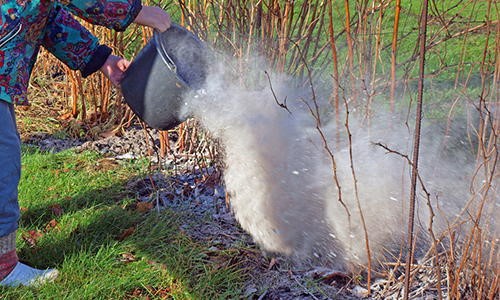
Do you have some charcoal in your house right now? We call charcoal a “miracle leftover” for anyone who wants to be a little more self-sufficient and cut costs. That’s because it can help you with so many different things around the house and garden. You can even use it to make an energy-free fridge. Read More Here...
Don’t be afraid to start with just one or two vines. Whether you choose the cold-hardy Concord, the fragrant Muscat, or the resilient Scuppernong, you are making a choice to prioritize quality and nutrition. Once you taste that first harvest, you will understand why our ancestors guarded these varieties so fiercely. It is time to let the seeds stay and let the flavor return to the garden.
If you find yourself falling in love with the process, you might want to look into other perennial systems like composting or soil health management. These practices work hand-in-hand with viticulture to create a resilient, productive backyard ecosystem. Your garden is waiting—go ahead and plant the vines that your grandchildren will be harvesting from decades from now.