
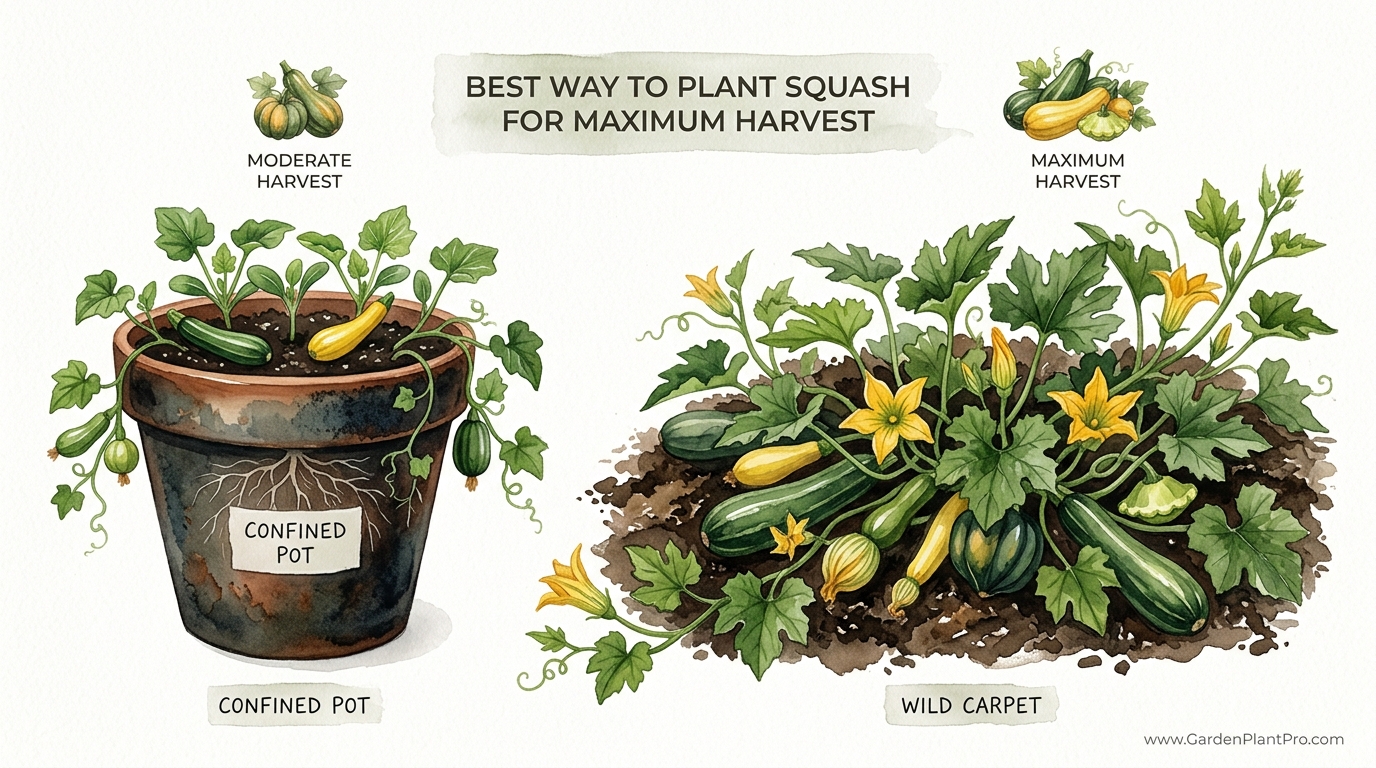
Is your squash plant a prisoner on your patio or the king of your garden? We’ve been taught to keep our gardens ‘tidy’ and ‘contained,’ but squash is a wild wanderer at heart. When you trap it in a plastic pot on concrete, you’re fighting its DNA. See how switching to a ‘Wild Carpet’ approach doesn’t just save space—it explodes your yield and builds your soil simultaneously.
For years, I followed the rules. I bought the biggest pots I could find, filled them with expensive potting mix, and tried to grow my zucchini and pumpkins in neat little rows on the porch. The result? A few measly fruits and a plant that looked like it was gasping for air by August. It wasn’t until I stopped fighting the plant’s natural urge to roam that I saw what a squash plant is truly capable of.
The “Wild Carpet” method is about more than just letting things get messy. It is a strategic way of gardening that leverages the plant’s own biology to create a self-sustaining, high-yield system. By understanding how these vines interact with the earth, you can turn a small patch of dirt into a literal fountain of produce.
Best Way To Plant Squash For Maximum Harvest
The best way to plant squash for a maximum harvest is to move beyond the traditional “hill” or “pot” mindset and embrace the Wild Carpet approach. This method involves allowing vining varieties to sprawl across the ground where they can develop adventitious roots at every node—the points where leaves meet the stem. This effectively turns one plant into a giant, multi-rooted network capable of drawing nutrients from a massive surface area.
In a typical container setup, the plant is limited by the volume of the pot. Even a 5-gallon (19-liter) container provides a finite amount of nitrogen and moisture. In contrast, a squash vine allowed to form a Wild Carpet can grow 10 to 15 feet (3 to 4.5 meters) long, rooting itself every 12 inches (30 cm). This creates a “backup system” for the plant; if the main stem is attacked by pests like the squash vine borer, the secondary roots keep the rest of the vine alive and productive.
This method is used primarily for “vining” types of squash, such as Butternuts, Pumpkins, and Hubbards. While “bush” varieties like most Zucchinis don’t travel as far, they still benefit from the soil-to-stem contact that the Wild Carpet philosophy encourages. Real-world applications of this method are seen in permaculture and the “Three Sisters” ancient gardening technique, where squash serves as a living mulch to protect the soil while it feeds.
The Biology of the Wanderer
To understand why this works, you have to look at the stem of a squash plant. If you’ve ever noticed little bumps or “spikes” along the vine, those are dormant root primordia. When these bumps touch moist soil, they quickly transform into functional roots. This is a survival mechanism designed to help the plant survive in the wild where soil conditions might be inconsistent.
By encouraging this rooting, you aren’t just giving the plant more “mouths” to eat with; you are also cooling the soil. The broad leaves of the squash act as a canopy, shading the ground and preventing moisture from evaporating. This creates a microclimate under the leaves where the soil stays 10 to 15 degrees cooler (5 to 8 degrees Celsius) than the surrounding air, which is perfect for root health during the peak of summer.
How To Implement The Wild Carpet Technique
Setting up a Wild Carpet isn’t about neglect; it’s about intentional guidance. You want to prepare a central “launchpad” where the seeds start, then manage the path the vines take as they grow. Here is how you can do it in your own backyard.
Step 1: The Launchpad Preparation
Start by digging a hole about 12 inches (30 cm) deep and wide. Fill this with a mix of aged compost, well-rotted manure, and your native soil. Squash are notoriously “heavy feeders,” meaning they require high levels of nitrogen and phosphorus to produce those big leaves and heavy fruits. Adding a handful of bone meal or a balanced organic fertilizer (like a 5-5-5 NPK) at this stage gives the plant the fuel it needs to start its journey.
Step 2: Direct Seeding vs. Transplants
I always recommend direct seeding squash. Their roots are incredibly sensitive to being moved, and a transplant often sits “stalled” for two weeks while a seed sown at the same time will zoom right past it. Plant 3 to 4 seeds about 1 inch (2.5 cm) deep in your launchpad. Once they are 3 inches (7.5 cm) tall, thin them down to the strongest single plant. This prevents competition and ensures the “King” of your garden has all the resources to itself.
Step 3: Guiding the Vines
As the vine begins to “run” (usually 3 to 4 weeks after sprouting), decide which direction you want it to travel. You can coil it in a circle or let it run in a straight line. Every 2 feet (60 cm) along the vine, clear a small patch of mulch and press the vine node firmly against the bare soil. You can even pile a small handful of compost over the node to “anchor” it. This encourages the adventitious roots to dive deep into the earth.
- Keep the soil moist: Roots won’t form on dry, baked clay. Keep the contact points damp for the first week after anchoring.
- Avoid walking on the carpet: Once the leaves fill in, the area becomes a “no-go zone” to prevent compacting the soil or snapping the hollow vines.
- Remove competing weeds: Do this early. Once the squash leaves are the size of dinner plates, they will shade out most competition naturally.
Benefits of the Wild Carpet Approach
Why would you choose this over a tidy trellis or a neat pot? The benefits are measurable in both the weight of your harvest and the health of your garden ecosystem. It is a more resilient way to grow food in an era of unpredictable weather.
1. Extreme Pest Resilience: The biggest heartbreak for a squash grower is the Squash Vine Borer. This moth lays eggs at the base of the plant, and the larvae eat the stem from the inside out, killing the entire plant. In a Wild Carpet system, even if the main base is destroyed, the 10 or 15 other root sites along the vine will keep the plant alive and the fruit ripening.
2. Superior Nutrient Uptake: A single root system can only reach so far. By having roots every few feet, the plant can tap into pockets of nutrients across a 50-square-foot (4.5-square-meter) area. This leads to larger fruits and higher concentrations of vitamins in the harvest.
3. Soil Building and Moisture Retention: The thick “carpet” of leaves acts as a living mulch. It prevents the sun from “cooking” the beneficial microbes in the top layer of your soil. By the end of the season, when you pull up the vines, you’ll find the soil underneath is crumbly, dark, and full of earthworms.
4. Natural Weed Suppression: If you hate weeding, this is the method for you. Once the canopy closes, almost no sunlight reaches the ground, effectively terminating any weed seeds that try to germinate in the patch.
Challenges and Common Mistakes
Even the best methods have their pitfalls. Most mistakes with the Wild Carpet happen because people forget that “wild” doesn’t mean “unattended.” You are essentially managing a small jungle, and that requires a bit of vigilance.
Overcrowding the Launchpad: Many gardeners plant too many seeds in one spot and never thin them. This leads to a tangled mess of weak vines that compete for the same initial nutrients. One strong plant is always better than four struggling ones. If the primary root system is weak, the plant may never have the energy to send out those secondary “anchor” roots.
DIY PROJECT: Collect rainwater no matter where you live...
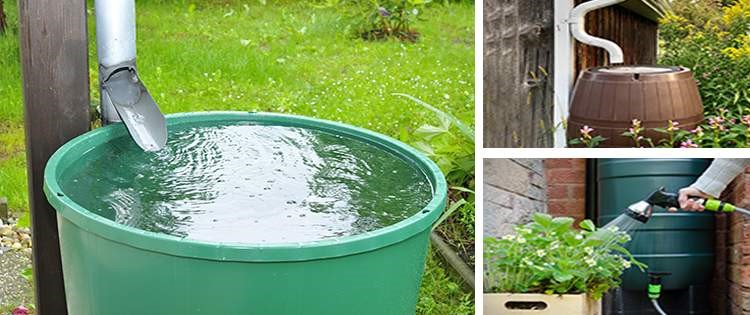
This DIY project is the best way to legally collect rainwater NO MATTER where you live. Get chlorine-free water, cut down on your water bills, and have enough for an emergency situation or to water your garden. Read More Here...
Watering the Leaves: Because the carpet is so dense, air circulation can be poor near the ground. If you use overhead sprinklers, you are inviting Powdery Mildew—that white, flour-like fungus that kills leaves. Always water at the base of the plant or use a soaker hose underneath the leaf canopy to keep the foliage dry.
Ignoring the “Egg Check”: Squash bugs love the protection of a dense carpet. They hide under the large leaves and lay clusters of bronze eggs. Because the plant is so large, it’s easy to miss an infestation until it’s too late. You must commit to flipping over a few leaves every few days to look for those egg clusters.
Limitations: When the Wild Carpet Isn’t Ideal
While I love this method, it isn’t for everyone. There are specific environments and situations where a more contained approach is actually smarter. Understanding these boundaries makes you a better gardener.
The most obvious limitation is space. If you have a 4×4 foot (1.2×1.2 meter) raised bed, a Wild Carpet of Butternut squash will quickly take over your tomatoes, peppers, and even the lawn. In small urban gardens, you might be forced to grow vertically on a trellis. While you lose the benefit of nodal rooting, you gain the benefit of airflow and “vertical real estate.”
Another factor is humidity. In regions with extremely high humidity and little wind, the Wild Carpet can become a breeding ground for fungal diseases. If you live in a swampy climate, the soil-level moisture trapped under those big leaves might rot the fruit before it can cure. In these cases, lifting the fruit off the ground with “squash cradles” or small pieces of wood can help, but it negates some of the “carpet” benefits.
Comparison: Confined Pot vs. Wild Carpet
If you’re still on the fence about which method to use, this table breaks down the practical differences I’ve observed over the years. It’s not just about yield; it’s about how much work you want to do on a Tuesday afternoon.
| Factor | Confined Pot | Wild Carpet |
|---|---|---|
| Yield per Plant | Low to Medium (2-4 fruits) | High (8-15+ fruits) |
| Watering Needs | Daily (sometimes twice) | Once or twice a week |
| Pest Defense | Vulnerable (Single point of failure) | Resilient (Multiple root sites) |
| Space Required | Minimal (2-3 sq ft) | Significant (20-50 sq ft) |
| Fertilizer Cost | High (requires frequent feeding) | Low (taps into natural soil) |
Practical Tips and Best Practices
After decades of watching vines crawl across my yard, I’ve picked up a few tricks that don’t always show up in the seed catalogs. These adjustments can make the difference between a good year and a legendary one.
- Use “Trap Crops”: Plant a few ‘Blue Hubbard’ squash on the edge of your garden. Squash bugs and vine borers find them irresistible. They will flock to the Hubbards, leaving your main Wild Carpet of Butternuts or Zucchini alone.
- The Duct Tape Trick: If you find squash bug eggs (small, bronze-colored clusters), don’t try to scrape them off with your fingers—they are glued on tight. Wrap a piece of duct tape around your hand with the sticky side out and pat the eggs. They will pull right off the leaf without damaging the plant.
- Pollination Assistance: Squash flowers are only open for a few hours in the morning. If you don’t see many bees, you can act as the “matchmaker.” Take a male flower (the one with the straight, thin stem), pull off the petals, and rub the pollen-covered center onto the middle of the female flower (the one with the tiny baby squash at the base).
- Late Planting: In many regions, waiting until mid-June to plant can help you avoid the first “wave” of squash vine borer moths. Check your local extension office for the “moth flight” dates in your area.
Advanced Considerations: Soil Microbiology
For those who want to take their garden to the next level, it’s time to talk about what’s happening beneath the carpet. The Wild Carpet isn’t just about roots; it’s about a relationship with Mycorrhizal fungi. These fungi attach to the squash roots and extend their own hyphae (filaments) far into the soil, effectively increasing the root surface area by 100 times.
To encourage this, avoid tilling the area where your carpet will grow. Tilling shreds the fungal networks that take months to build. Instead, use a “no-dig” approach by layering cardboard and compost over your grass a few months before planting. By the time the squash vines start to run, the soil will be a thriving metropolis of microbes ready to deliver phosphorus and water directly to your plant.
Additionally, consider the Cucurbitacin levels. Occasionally, a stressed plant or one cross-bred with wild gourds will produce extremely bitter fruit. This is a toxin called cucurbitacin. If you take a bite of your squash and it tastes intensely bitter (like a penny), spit it out and discard the fruit. This is rare but more common in plants that haven’t received consistent water or are grown from “mystery” seeds saved from last year’s garden.
Example Scenario: The 100-Square-Foot Patch
Let’s look at a real-world setup. Suppose you have a 10×10 foot (3×3 meter) area of lawn that you want to convert. Here is how you would manage a Wild Carpet for maximum efficiency:
Month 1 (Pre-Planting): Lay down cardboard over the grass and cover with 4 inches (10 cm) of compost. Water it well to start the decomposition process.
Month 2 (Planting): At the center of the patch, plant 3 ‘Waltham Butternut’ seeds. These are Cucurbita moschata, which have solid stems that are naturally more resistant to vine borers.
Month 3 (Vining): As the vines reach 3 feet (1 meter), guide them toward the corners of the 10×10 patch. Every 18 inches (45 cm), pin the vine to the soil with a small landscape staple or a heavy clod of dirt. At this stage, interplant some Nasturtiums around the edges. These act as a companion plant that repels squash bugs and adds a splash of edible color.
Month 4 (Harvest): By late summer, the 100 square feet is completely covered in green leaves. You should be able to harvest 15 to 20 large butternuts. Because the vines rooted at multiple points, the plants will stay green and healthy even when the first light frosts of autumn arrive.
Final Thoughts
Gardening is often a struggle between our desire for order and the plant’s desire for survival. The Wild Carpet method is a peace treaty. It allows the squash to be exactly what it was meant to be—a vigorous, sprawling, earth-covering powerhouse—while providing us with a harvest that far exceeds what any plastic pot could ever produce.
Switching to this approach requires a shift in mindset. You have to be okay with a garden that looks a bit “wild” for a few months. But when you’re hauling in baskets of heavy, sun-ripened squash in September, and your soil is healthier than when you started, you’ll realize that the “tidy” garden was the one that was truly failing.
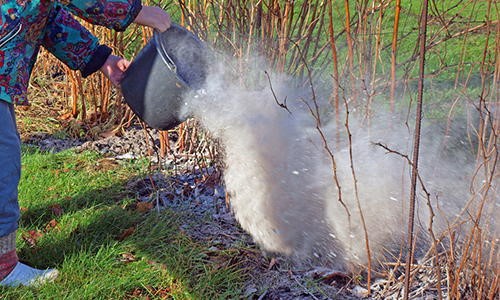
Do you have some charcoal in your house right now? We call charcoal a “miracle leftover” for anyone who wants to be a little more self-sufficient and cut costs. That’s because it can help you with so many different things around the house and garden. You can even use it to make an energy-free fridge. Read More Here...
Start small if you must. Pick one corner of your yard, clear some space, and let a single vine run free. Watch how it anchors itself, how the leaves shade the earth, and how the fruit grows larger than you ever thought possible. Once you see the King of the garden in its full glory, you’ll never want to keep it a prisoner again. For your next step, you might explore the world of cover cropping or vermicomposting to further enrich the soil for next year’s carpet.