
Why does rosemary thrive in a stone crack but die in a perfectly prepared open garden bed? I watched three years of rosemary growth vanish in a single frost until I learned the ‘Heat Battery’ secret. Rosemary isn’t just thirsty for sun; it’s thirsty for stored warmth. In an open field, its roots drown in cold dampness. But against a stone wall or rock pile, it absorbs thermal energy all day and radiates it back all night, creating a Mediterranean microclimate that survives even the harshest winters.
If you have ever found your favorite rosemary bush turned into a brittle, brown ghost by February, you know the frustration. We often treat rosemary like a typical perennial, but it is actually a woody shrub with a very specific biological memory of the dry, rocky coastlines of the Mediterranean. To keep it alive when the mercury drops, we have to stop thinking about just “the cold” and start thinking about the environment as a whole.
How To Protect Rosemary From Winter Frost
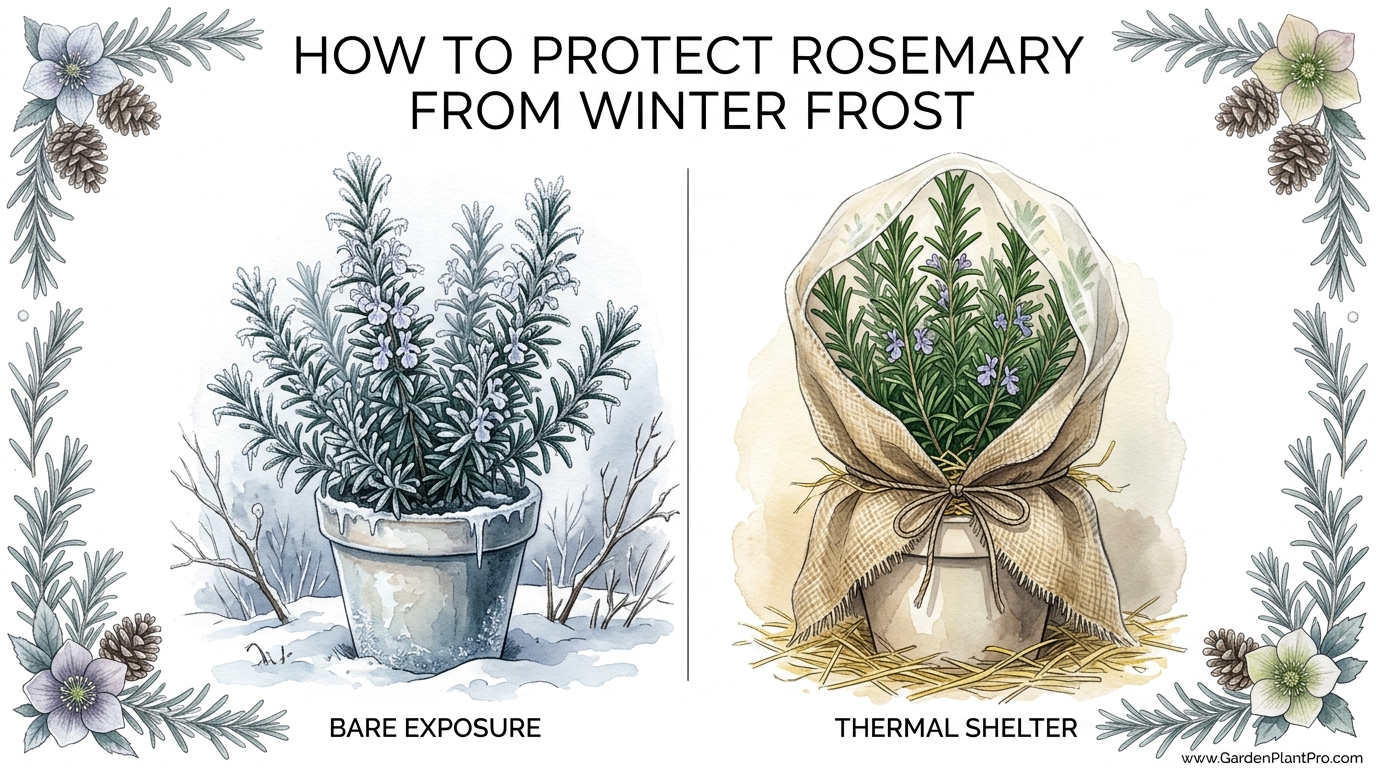
Protecting rosemary from winter frost is less about wrapping the plant in a blanket and more about managing the physics of heat and moisture. Frost damage occurs when the water inside the plant cells freezes, expands, and ruptures the cell walls. However, rosemary often dies in winter not from the frozen air, but from “wet feet” and desiccating winds. Protecting it requires a three-pronged approach: choosing a hardy variety, ensuring surgical-grade drainage, and utilizing thermal mass to buffer temperature swings.
Real-world success with rosemary depends on your USDA hardiness zone or regional equivalent. While standard rosemary (Salvia rosmarinus) is usually comfortable down to 20°F (-6°C), specialized cold-hardy varieties can withstand temperatures as low as -10°F to -15°F (-23°C to -26°C) if the conditions are right. Gardeners in colder regions typically use south-facing masonry walls or “heat sinks” made of stone or brick to create a pocket of warmth that stays several degrees higher than the rest of the yard.
Imagine your rosemary is a tiny outdoor furnace. It needs to keep its “pilot light” on all winter. If the ground stays too wet, that light goes out. If the wind is too sharp, it blows the heat away. By placing the plant strategically and preparing the soil, you are essentially building a small, natural insulator around the herb that works 24 hours a day without you having to lift a finger once the snow starts to fly.
The Heat Battery: How Thermal Mass Saves Plants
The secret to why rosemary lives in a stone crack is a concept called thermal mass. High-density materials like stone, brick, concrete, and even large bodies of water act as a “heat battery.” During a sunny winter day, these materials absorb solar radiation. Because they are dense, they hold onto that energy much longer than the surrounding air or light garden soil.
As the sun sets and the air temperature plummets, the stone wall or rock pile begins to release that stored energy through a process called radiation. This creates a tiny microclimate, often called a “heat island,” where the air immediately surrounding the rosemary can be 5°F to 10°F (3°C to 6°C) warmer than the open garden. This small margin is often the difference between a plant that survives and one that perishes.
Thermal lag is the secondary benefit. Dense materials don’t just get warm; they stay warm. This prevents the rapid freeze-thaw cycles that are so damaging to evergreen needles. When a plant freezes and thaws quickly multiple times in a week, the stress on the vascular system is immense. A stone “battery” slows down this process, allowing the plant to transition into and out of freezing temperatures more gradually.
Choosing the Right Armor: Cold-Hardy Varieties
Not all rosemary is created equal. If you buy a generic “rosemary” plant from a big-box store, you are likely getting a variety bred for the nursery trade in a warm climate. For those of us in Zone 6 or 7, we need the “tanks” of the rosemary world.
‘Arp’ Rosemary: This is the gold standard for cold hardiness. Discovered in Arp, Texas, by the legendary herbalist Madalene Hill, this variety can handle temperatures down to -10°F (-23°C). It has a slightly more grey-green hue and a hint of lemon in its scent. It grows upright and can reach 4 feet (1.2 meters) in height and width.
‘Madalene Hill’ (Hill Hardy): Often sold under both names, this variety is nearly as tough as ‘Arp’ but features a more traditional deep green needle and a more compact, mounding growth habit. It is reliably hardy to 0°F (-18°C) and often survives even lower if the drainage is perfect.
‘Blue Winter’: A newer favorite among northern gardeners, this variety was specifically selected for its ability to maintain its color and structure during long, snowy winters. It remains upright and reaches about 3 feet (1 meter) in height.
‘Alcalde Cold Hardy’: This variety was found in New Mexico and is built for high-altitude cold and dry winds. It is an excellent choice for gardeners in the American West or similar climates where the cold is accompanied by very low humidity.
The Soil Secret: Avoiding the “Bathtub Effect”
If you ask an experienced gardener why their rosemary died, they will usually say “the frost.” But if you dig up that dead plant, you will often find black, mushy roots. This is the “Bathtub Effect.” Rosemary evolved in rocky, coastal soils where water moves through the ground like it’s going through a sieve.
In many home gardens, we have heavy clay soil. When we dig a hole and fill it with “good” potting soil, we create a literal bathtub. The porous soil holds water, while the surrounding clay walls prevent it from draining away. In the winter, when the plant is dormant and not drinking, those roots sit in ice-cold water. This leads to root rot caused by pathogens like Pythium or Rhizoctonia.
To prevent this, you must prioritize drainage over fertility. Rosemary doesn’t need rich, black earth. It prefers lean, gritty soil. When planting, aim for a mix that is at least 30% grit, pea gravel, or coarse sand. If your soil is heavy clay, do not dig a hole; instead, build a mound or a raised bed. Planting the rosemary 6 to 12 inches (15 to 30 cm) above the surrounding grade ensures that excess water flows away from the crown of the plant.
Practical Winter Defense: Mulch, Shrouds, and Shelters
Once you have the right plant in the right spot, there are active steps you can take as winter approaches to give it an extra layer of protection.
The “Donut” Mulching Technique: Mulch is a double-edged sword for rosemary. It insulates the roots, which is good, but it also holds moisture against the woody stem, which is bad. Never pile mulch up against the base of the plant. Instead, create a “donut” of mulch. Apply 3 to 4 inches (7 to 10 cm) of straw, pine needles, or bark chips starting about 3 inches (7 cm) away from the stem and extending out to the drip line. This protects the root zone while allowing the crown to breathe.
Winter Shrouds: For young plants or during extreme cold snaps, a physical barrier against the wind is essential. Use burlap or a floating row cover (frost cloth). These materials allow air and some light to pass through while breaking the force of the wind. Avoid using clear plastic, as it can create a greenhouse effect on sunny days, causing the plant to wake up from dormancy, only to be hit by a hard freeze at night.
DIY PROJECT: Collect rainwater no matter where you live...
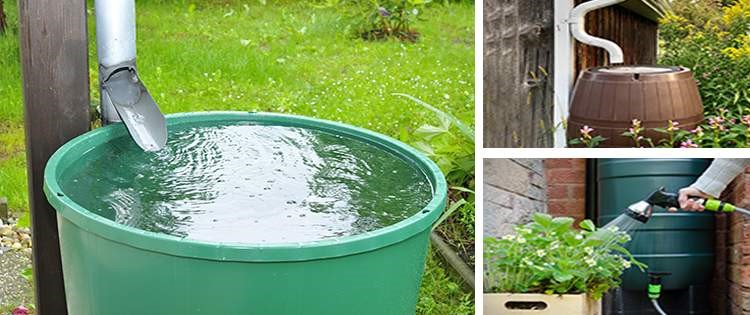
This DIY project is the best way to legally collect rainwater NO MATTER where you live. Get chlorine-free water, cut down on your water bills, and have enough for an emergency situation or to water your garden. Read More Here...
Windbreaks: If your rosemary is in an open area, consider building a temporary windbreak using hay bales or even a simple wooden lattice. Position the windbreak on the side of the prevailing winter winds. In many regions, this means the north or northwest side of the plant. Reducing the wind chill can prevent the needles from “burning” or drying out completely.
Common Mistakes to Avoid
Many well-meaning gardeners accidentally kill their rosemary by being “too helpful.” One of the most frequent errors is late-season pruning. You should never prune rosemary within 6 to 8 weeks of your first expected frost. Pruning encourages new, tender growth that has no “antifreeze” in its cells yet. This new growth will be the first to die, and the damage can travel down into the main woody stems.
Another mistake is over-fertilizing in the autumn. Just like pruning, nitrogen-rich fertilizer tells the plant to grow when it should be preparing for sleep. Stop all fertilization by late summer. You want the plant to “harden off,” meaning its cell walls thicken and its sap concentrates, which naturally protects it from freezing.
Finally, don’t forget that “dry” is different from “desiccated.” While rosemary hates wet feet, it is still an evergreen. It loses moisture through its needles all winter long. If the ground is frozen solid for weeks and the winter is particularly dry, the plant can actually die of thirst. On a day when the ground thaws, check the soil. If it is bone-dry several inches down, give the plant a very light drink.
Limitations and When This May Not Work
Despite our best efforts, there are limits to what rosemary can endure. If you live in USDA Zone 5 or colder, where temperatures regularly drop to -20°F (-29°C) or below, keeping rosemary alive outdoors year-round is an uphill battle that nature usually wins. In these climates, even the ‘Arp’ variety will struggle without a heated greenhouse or a permanent, insulated structure.
Environmental factors like humidity also play a role. Rosemary from the Mediterranean is used to dry air. If you live in a region with “wet” winters—frequent sleet, high humidity, and heavy, wet snow—the foliage is prone to fungal issues even if the temperature stays relatively mild. In these cases, the thermal battery of a stone wall is still helpful, but you must also ensure maximum airflow around the plant to prevent the needles from rotting.
Protected vs. Exposed: A Comparison
| Feature | Open Garden Bed (Exposed) | Stone Wall / Heat Battery (Protected) |
|---|---|---|
| Nighttime Temperature | Matches ambient air exactly. | Typically 3°F-8°F (2°C-5°C) warmer. |
| Root Moisture | High (risk of “Wet Feet”). | Lower (rocks/walls often improve runoff). |
| Wind Exposure | Full; high risk of desiccation. | Sheltered; wind is deflected. |
| Hardiness Zone Boost | None. | Effectively pushes the zone up by 0.5 to 1. |
Practical Tips for Immediate Application
If winter is knocking on your door and your rosemary is already in the ground, don’t panic. You can still apply “emergency” thermal mass. Gather several large, dark-colored rocks or even heavy bricks and place them in a ring around the base of the plant, about 6 inches (15 cm) from the stem. These will act as a temporary heat sink for the season.
If you are expecting a “Polar Vortex” or a record-breaking cold snap, you can use the “bucket method.” Place a large frost-proof pot or a plastic bucket over the plant at night to trap the earth’s heat. You must remove it the next morning as soon as the sun comes up to prevent overheating. This is a short-term survival tactic, not a long-term solution.
For those who are worried about their soil drainage, you can still improve it mid-season. Use a garden fork to gently aerate the soil around the drip line of the plant (being careful not to damage the main roots). Then, top-dress the area with a thin layer of poultry grit or fine gravel. As rain and snow fall, some of this grit will wash into the holes, slowly improving the structure of the soil.
Advanced Considerations for Serious Practitioners
For the gardener who wants to master the art of the Mediterranean microclimate, consider the color and texture of your “battery.” A dark basalt or granite stone will absorb more heat than a light-colored limestone. However, limestone is alkaline, and rosemary actually prefers a slightly higher pH (between 6.5 and 7.5). If you use limestone rocks, you are providing both thermal mass and a slow-release “vitamin” for the plant’s preferred soil chemistry.
You can also engineer a “Climate Battery” greenhouse on a small scale. By burying a perforated pipe 2 feet (60 cm) underground near your rosemary and using a small solar fan to pump warm daytime air into the soil, you can store heat directly in the root zone. This is a more complex setup, but for a prized, decades-old rosemary bush in a cold climate, it is a game-changer.
If you are planning a large herb garden, think about the “thermal shadow.” A tall stone wall on the north side of the garden doesn’t just protect the plants directly against it; it creates a wider zone of protection. Planting your most tender herbs, like rosemary and bay laurel, in this shadow increases their chances of survival significantly.
Examples and Scenarios
Consider the case of a gardener in Zone 6b. They planted two ‘Arp’ rosemary bushes. One was placed in the center of the vegetable garden, surrounded by soft, loamy mulch. The other was planted in a raised pocket of gravelly soil against the south-facing brick foundation of the house.
After a week-long cold snap where temperatures dipped to -5°F (-20°C), the plant in the vegetable garden turned a dull, sickly grey. By spring, it was brittle and dead. The plant against the brick wall showed some minor tip-burn on the needles but began pushing out new green growth by mid-April. The brick wall had provided just enough of a temperature buffer, and the raised gravel pocket had prevented the roots from freezing in a block of ice.
Another scenario involves potted rosemary. If you must keep yours in a container, the “pot-in-pot” method is a lifesaver. Place your rosemary pot inside a much larger container and fill the gap with dry leaves or straw. This adds a layer of insulation to the roots, which are far more vulnerable in a pot than they are in the ground.
Final Thoughts
Learning to grow rosemary in cold climates is a journey of understanding how nature manages energy. It teaches us that “hardiness” isn’t a fixed number on a tag, but a relationship between the plant, the soil, and the architecture of our gardens. When we stop fighting the cold and start inviting the sun to stay a little longer through stone and soil, we open up a world of possibilities for our herb gardens.
I encourage you to look at your yard with new eyes this winter. Where does the snow melt first? Where does the cat like to sun itself on a chilly afternoon? Those are your natural heat islands. By placing your rosemary there and giving it the “armor” of gritty soil and a stone battery, you can enjoy that fresh, piney aroma all year long, regardless of the frost outside.
Do you have some charcoal in your house right now? We call charcoal a “miracle leftover” for anyone who wants to be a little more self-sufficient and cut costs. That’s because it can help you with so many different things around the house and garden. You can even use it to make an energy-free fridge. Read More Here...
Experiment with different varieties and don’t be afraid of a little trial and error. Gardening is a conversation with the earth, and sometimes it takes a few winters to learn the language. Once you master the heat battery secret, you’ll find that rosemary isn’t just a guest in your garden—it’s a permanent resident.