
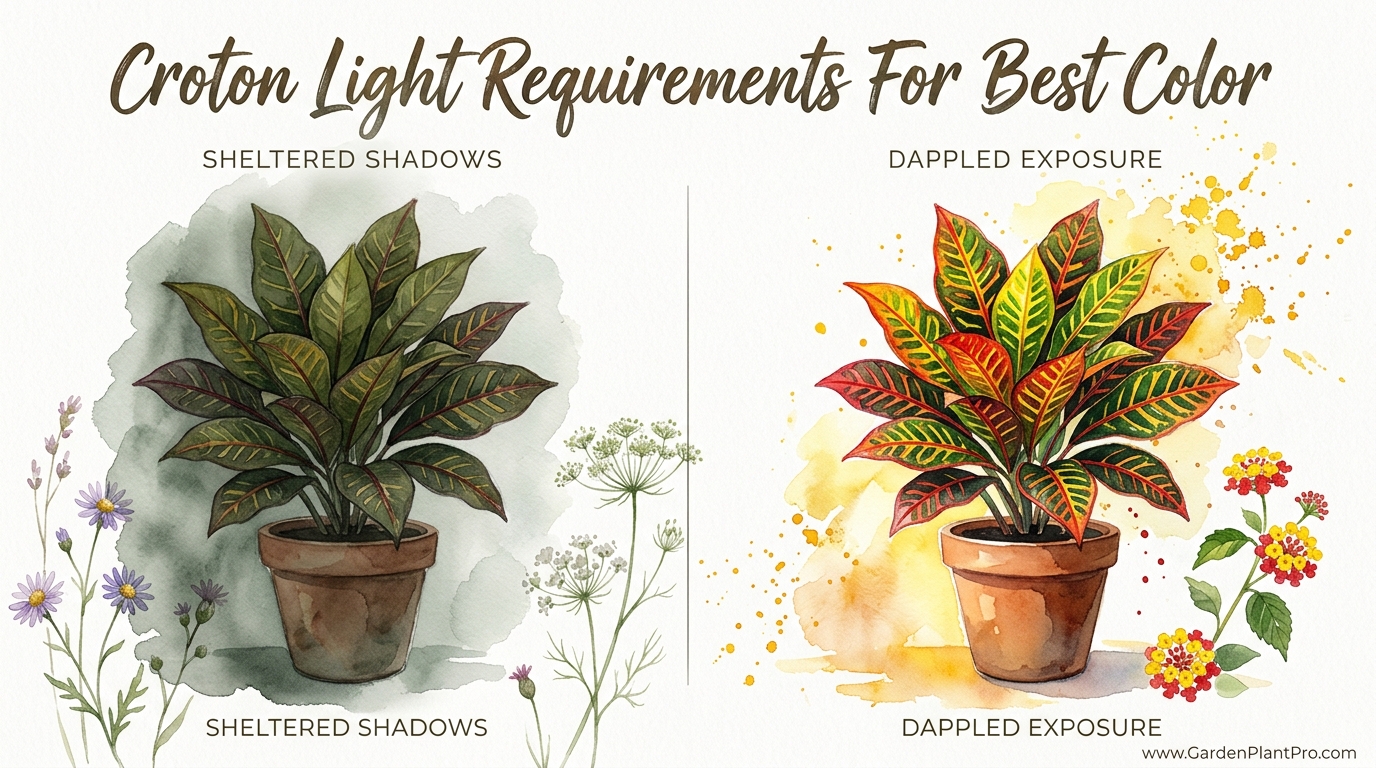
Your Croton isn’t ‘reverting’ to green—it’s just hiding its true colors from the shadows. Most people ‘shelter’ their Crotons in a safe corner, but these plants are sun-worshippers at heart. Without the ‘exposure’ to bright, filtered light, the plant stops producing its famous red and orange pigments to maximize its green chlorophyll. If your plant is turning green, it is literally starving for light. Here is how to find the perfect ‘Sweet Spot’.
I remember the first time I brought home a ‘Petra’ Croton. It was a riot of sunset oranges and deep burgundy reds, looking more like a piece of stained glass than a living plant. I put it in a cozy corner of my living room, thinking I was protecting it from the harsh elements. Within three months, that fiery beauty had turned into a plain, dull green shrub. I felt like a failure until an old neighbor told me, “Son, you’ve put a race car in a dark garage. It’s got nowhere to go.”
That conversation changed how I looked at my garden. You see, a Croton (Codiaeum variegatum) doesn’t just want light; it survives on it. Those vibrant colors aren’t just for show; they are a response to high-intensity solar energy. When we tuck them into the shadows, we are essentially telling the plant to go into survival mode. It ditches the “expensive” red pigments and cranks up the green chlorophyll just to keep its head above water. Understanding the light requirements of these tropical wonders is the difference between a drab houseplant and a living masterpiece.
Croton Light Requirements For Best Color
Crotons are unique in the plant world because their appearance is a direct reflection of their environment. In the wild, they grow in the tropical sun of Southeast Asia and the Pacific Islands, where the light is intense and consistent. To get those same results at home, you need to provide what I call “high-octane” light. Ideally, a Croton needs between 4 and 6 hours of bright, indirect sunlight every single day. If you can provide some gentle morning sun directly on the leaves, you’ll see those reds and oranges pop like never before.
Light is measured in foot-candles (FC) or lux, and while you don’t need a fancy meter to grow a nice plant, knowing the numbers helps. For a Croton to maintain its size and health, it needs a minimum of 400 FC. However, if you want it to actually grow and produce those spectacular variegated patterns, you should aim for closer to 800 FC. To put that in perspective, a dark corner might only have 50 FC, while a spot right next to a sunny window can easily hit 1,000 FC or more.
The “why” behind this is fascinating. The plant uses three main pigments: chlorophyll (green), carotenoids (yellow and orange), and anthocyanins (red and purple). Chlorophyll is the workhorse that turns light into food. Carotenoids and anthocyanins act like a “sunscreen” for the plant, protecting the delicate internal structures from too much energy. When light levels are low, the plant doesn’t need protection—it needs food. It stops making the colorful pigments and focuses entirely on chlorophyll, which is why your plant “reverts” to green.
Real-world application means placing your Croton where it can see the sky but isn’t being baked by the high-noon sun. Imagine a bright porch with a roof or a spot indoors where the sun beams hit the floor near the pot but don’t stay on the leaves for more than an hour or two. This balance is the “Sweet Spot” every gardener looks for.
The Science of the Paintbox
Inside every Croton leaf, there is a biological struggle between different pigments. Chlorophyll is always present—without it, the plant couldn’t eat. However, the other colors are facultative, meaning the plant produces them based on need. High light levels trigger a chemical signal that tells the leaf to produce more anthocyanins and carotenoids. This isn’t just for decoration; these pigments actually help the plant manage the massive amounts of solar radiation found in the tropics.
When you move a plant into a darker room, that signal stops. The plant realizes it isn’t getting enough energy to sustain its metabolism. It begins to break down the “luxury” pigments and replaces them with more chlorophyll to capture every stray photon. This is why the bottom leaves of a Croton are often greener than the top ones; the top leaves are “shading” the bottom ones, forcing them to adapt to lower light levels.
Finding the Right Window: Indoor Light Placement
Indoors, the quality of light changes based on which way your window faces. This is the most common place where new gardeners get tripped up. Not all “bright rooms” are created equal, and your Croton knows the difference better than you do.
- South-Facing Windows: These are the gold standard for Crotons. They provide the most consistent and intense light throughout the day. In the northern hemisphere, a south-facing window is where your Croton will produce the deepest reds and brightest yellows. Just keep an eye out for “glass heat”—sometimes the window itself can get hot enough to scorch the leaves if they are touching it.
- West-Facing Windows: These offer very intense light, particularly in the late afternoon. This light is often “hotter” than morning light. While Crotons love the brightness, the sudden heat spike can be stressful. If you notice the leaves looking a bit bleached or gray, you might need a sheer curtain during the hottest two hours of the day.
- East-Facing Windows: These are perfect for younger plants or more sensitive varieties like ‘Gold Dust’. The morning sun is gentle and cool, providing enough energy to start the day without the risk of burning. While the colors might not be as “fiery” as those in a south window, the plant will be very stable and healthy.
- North-Facing Windows: Generally, I tell people to avoid north windows for Crotons. The light is soft and consistent, but it’s rarely strong enough to keep the plant from turning green. If a north window is your only option, you will almost certainly need a supplemental grow light to keep the colors vibrant.
The Impact of Distance
Light intensity drops off incredibly fast the further you move away from a window. This is known as the inverse square law, and it’s a plant killer. A Croton sitting directly on a windowsill might be getting 1,000 foot-candles of light. Move it just 3 feet (about 1 meter) back into the room, and that light level can drop by 75% or more. If your Croton is sitting on a coffee table in the middle of a room, it’s likely living in what the plant perceives as “twilight,” even if the room feels bright to your eyes.
Outdoor Living: The Power of Dappled Exposure
In many climates, Crotons thrive when moved outdoors for the summer. There is simply no substitute for real sunlight and fresh air. However, you can’t just take an indoor plant and plop it onto a sunny patio in July. It will burn to a crisp in hours. The secret to outdoor success is what I call “Dappled Exposure.”
Dappled exposure is the kind of light you find under a large tree or a pergola. It’s a mix of bright shade and moving patches of direct sun. This mimics the Croton’s natural habitat in the jungle understory. When grown this way, the plant has time to cool down between sun hits, allowing it to process the energy without the leaf tissue overheating. Temperatures between 60°F and 85°F (15°C to 29°C) are the “Goldilocks zone” for these plants.
If you live in a very humid area, like Florida or Southeast Asia, Crotons can often handle much more direct sun because the moisture in the air helps keep the leaves cool. In drier climates, like the American Southwest, you have to be much more careful. Low humidity and high sun will cause the leaf edges to turn brown and crispy almost overnight.
How to Acclimatize Your Croton
Moving a Croton is like moving a sensitive toddler—they don’t like change and they will let you know it. Usually, they “protest” by dropping their leaves. If you want to move your plant from a dark corner to a sunny window, or from indoors to outdoors, you must do it slowly over the course of 10 to 14 days.
- Days 1-3: Move the plant to a slightly brighter spot than it’s used to. If it was in a dark corner, move it near a window but not in the direct sun. If moving outdoors, start in a spot that is 100% shade, like a covered porch.
- Days 4-7: Introduce “gentle” light. This means an hour of morning sun or a spot where the light is filtered through a screen. Watch for “fainting”—if the leaves droop significantly, they aren’t ready yet.
- Days 8-10: Increase the sun exposure to 2-3 hours. This is the stage where the plant starts building up those protective pigments. You’ll see the new growth looking a bit more colorful.
- Day 11 and beyond: Move it to its permanent “Sweet Spot.” Always monitor the leaves for the first few days in a new location. If you see bleached spots or blackening, move it back a step.
I always suggest choosing a cloudy day for the final move. It gives the plant a “soft landing” into its new environment. Once a Croton is settled and happy, stop moving it! These plants value stability. Find a spot where it thrives and let it stay there for the season.
Benefits of High Light for Crotons
The most obvious benefit of proper light is the aesthetic. A well-lit Croton is a showstopper, with patterns of yellow, orange, red, and sometimes even purple or black. But the benefits go deeper than just looks.
- Compact Growth: Plants in high light stay “bushy.” They have short spaces between the leaves (internodes), which creates a full, lush appearance. Low-light plants become “leggy” as they stretch toward the light, eventually losing their lower leaves and looking like a stick with a few green feathers on top.
- Pest Resistance: A healthy, high-light plant has thicker, waxy leaves. This makes it much harder for pests like spider mites to get a foothold. Spider mites love dusty, dry, low-light plants. By keeping your Croton in bright light and maintaining humidity, you are building a natural defense system.
- Faster Recovery: If your plant does suffer a setback—like a missed watering or a cold draft—a plant that has been living in high light will have more stored energy in its roots to bounce back and grow new leaves.
Challenges and Common Mistakes
The biggest mistake I see gardeners make is confusing “bright light” with “heat.” While Crotons love the light, they can be sensitive to the heat that comes with it, especially in a closed-up room. A south-facing window in the summer can act like a magnifying glass, baking the plant even if it technically has enough light.
Another common pitfall is the “Weekend Warrior” move. This is when a gardener notices their plant is green and suddenly moves it into the hot afternoon sun for a whole Sunday to “fix” it. This almost always results in leaf drop and sunburn. You cannot rush the pigment process. It takes weeks for the plant to build up the chemistry needed to handle intense sun.
DIY PROJECT: Collect rainwater no matter where you live...

This DIY project is the best way to legally collect rainwater NO MATTER where you live. Get chlorine-free water, cut down on your water bills, and have enough for an emergency situation or to water your garden. Read More Here...
Lastly, don’t forget the dust. Large, leathery leaves are magnets for household dust. A layer of dust acts like a window shade, blocking the very light you are trying to provide. I make it a habit to wipe my Croton leaves with a damp cloth once a month. It keeps the “solar panels” clean and allows the plant to breathe through its stomata.
Limitations: When High Light Isn’t Possible
Sometimes, your home just doesn’t have the right windows. Maybe you live in a basement apartment or have a yard shaded by giant oaks. In these cases, you have to adjust your expectations. You can still grow a Croton, but you might have to choose specific varieties or use technology.
Some varieties, like ‘Gold Dust’, actually handle lower light better than the broad-leafed ‘Petra’. They might not get that deep red, but they will keep their yellow spots even in medium light. If you are stuck with a dark room, your only real option is a full-spectrum LED grow light. Modern LEDs are fantastic because they provide the exact wavelengths (red and blue) that the plant needs to stay colorful without producing the intense heat that burns leaves.
Practical Tips for Success
Over the years, I’ve found a few “pro-tips” that make a huge difference in how a Croton responds to its light environment:
- Rotate Weekly: Give your pot a quarter-turn every time you water. This ensures that all sides of the plant get equal light exposure, preventing it from leaning or becoming one-sided.
- The “Hand Test”: If you aren’t sure if the sun is too hot, put your hand in the light where the leaves are. If the sun feels uncomfortably hot on your skin after a minute, it’s too hot for the Croton.
- Winter Adjustments: Remember that the sun’s path changes. A spot that is perfectly dappled in the summer might be in total shade in the winter. You may need to move your plant closer to the glass during the short days of December and January.
- Humidity Matters: High light increases the rate of transpiration (water loss from leaves). If you have your Croton in a very sunny spot, you must increase the humidity. A pebble tray or a humidifier nearby will prevent the tips from browning.
The Relationship Between Light, Water, and Food
You can’t talk about light without talking about the other two legs of the stool: water and fertilizer. In a high-light environment, the plant is working at “full throttle.” This means it will drink more water and use up nutrients faster than a plant in the shade.
Check the soil more frequently if your plant is in a sunny window. I usually wait until the top inch (2.5 cm) is dry, but don’t let it go bone-dry. A thirsty Croton will wilt dramatically, and while they usually perk up after a drink, doing this too often will lead to leaf loss. As for feeding, use a balanced liquid fertilizer (like a 3-3-3 or 20-20-20 at half strength) once a month during the growing season. Just be careful not to over-fertilize with nitrogen, as too much nitrogen can actually suppress those red pigments and encourage more green growth.
Advanced Considerations: Using Light Meters
If you’re a serious practitioner, I highly recommend downloading a light meter app on your phone. While they aren’t as accurate as a $200 professional meter, they give you a very good ballpark. Hold your phone where the leaves are and point the camera toward the window.
If you see readings below 200 foot-candles, your Croton is essentially in “stasis” and will eventually lose its color. If you see 1,000+ foot-candles, you are in the “high performance” zone. Using a meter helps you realize that even a foot of difference in placement can change the light levels by hundreds of foot-candles. It’s an eye-opening experience for any gardener.
Varietal Nuances
| Variety | Light Preference | Color Response |
|---|---|---|
| ‘Petra’ | High/Direct Morning | Turns deep burgundy and bright orange. |
| ‘Mammy’ | High/UV-B Exposure | The corkscrew leaves turn fiery red at the tips. |
| ‘Gold Dust’ | Medium to High | Stays green but maintains bright yellow speckles. |
| ‘Zanzibar’ | Medium/Filtered | Narrow leaves show purple and gold splashes. |
| ‘Oakleaf’ | High | Broad lobes turn yellow and red along the veins. |
Examples: Real-World Scenarios
The “Green” Office Plant: A friend had a Croton in her office that had turned completely green. It was about 10 feet (3 meters) away from a window. We moved it right onto the windowsill of an east-facing window. Within six weeks, the new leaves emerging from the top were bright yellow with red veins. The old green leaves stayed green—once a leaf is fully formed and has adapted to low light, it rarely “changes back.” The lesson? Be patient and look for the new growth to see your progress.
The “Scorched” Patio Survivor: I once moved a ‘Mammy’ Croton outside in June without acclimatizing it. By the next afternoon, several leaves had large, bleached white patches in the center. I immediately moved it to the full shade of a porch for a week, then slowly moved it back toward the sun. The damaged leaves eventually fell off, but the plant survived because I caught the mistake early. If you see white or gray “bleaching,” get that plant into the shade immediately!
Final Thoughts
Mastering Croton light requirements isn’t about following a rigid set of rules; it’s about learning to read the plant. Your Croton is constantly talking to you. If the leaves are turning green and stretching out, it’s begging for more light. If they are curling, browning at the edges, or looking bleached, it’s asking for a little relief from the heat.
I’ve spent forty years watching these plants dance with the sun. There is a deep satisfaction in finding that “Sweet Spot” where the leaves look like they’ve been dipped in paint. It reminds me that nature is always trying to show us its best side—we just have to provide the right stage for it to perform.
Don’t be afraid to experiment. Move your plant a few inches this way or that, and watch how it responds. Gardening is a lifelong conversation with the soil and the sky, and the Croton is one of the most expressive partners you can have. Keep it bright, keep it humid, and let those true colors shine.