
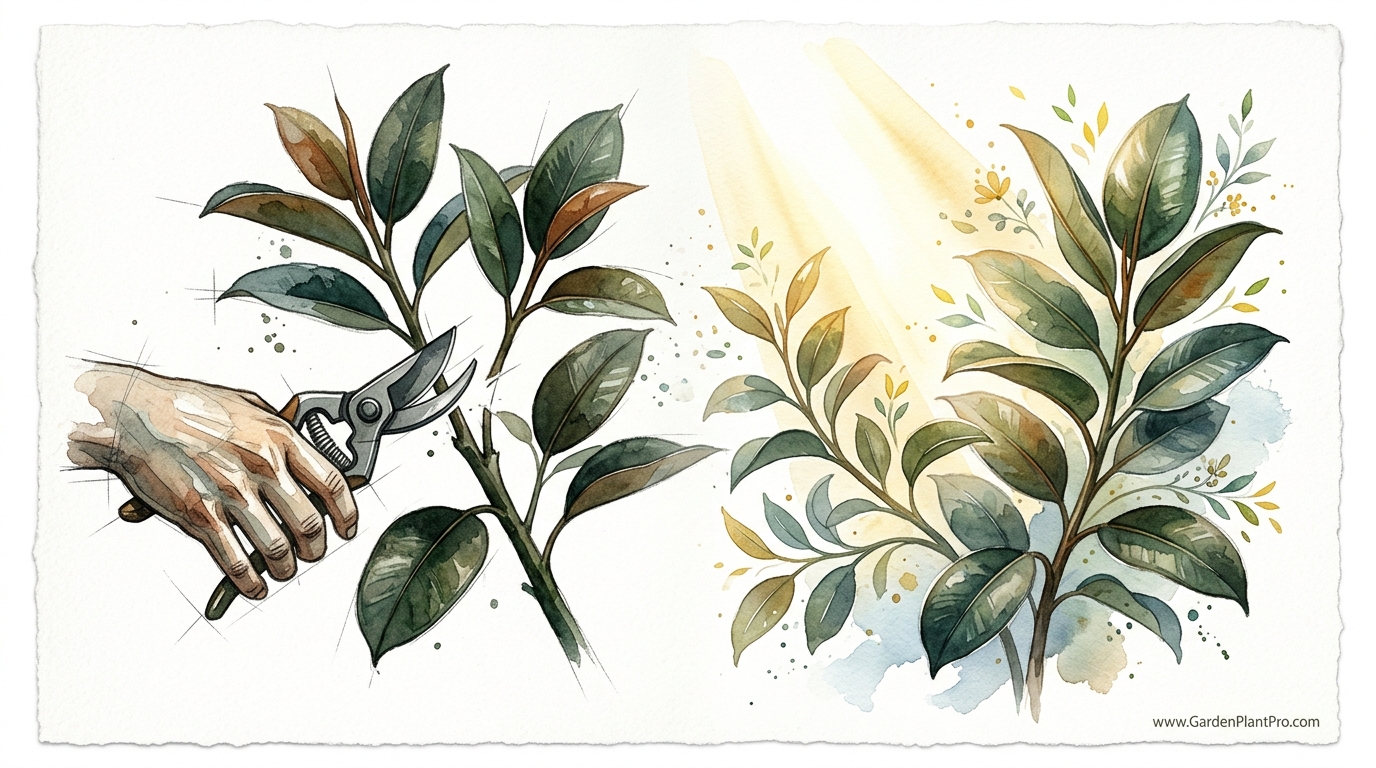
You don’t need to ‘hack’ your plant to make it bushy – you just need to move your lamp. Most people think ‘notching’ or ‘topping’ is the only way to get a multi-stem Rubber Plant. But why risk infection and sap-mess when you can use the plant’s own hormones? By strategically rotating your plant and managing light intensity, you can trigger ‘passive’ branching that looks far more natural than a forced cut.
I have spent years watching the Ficus elastica—that is the Rubber Plant to you and me—stretch its neck toward my living room ceiling. It is a stubborn creature that naturally wants to be a single, towering column. In its native home in Southeast Asia, these trees can reach 100 feet (30 meters) tall. Inside our homes, they often become a “stick on a stick,” losing their lower leaves and looking more like a flagpole than a lush interior tree.
You might have seen videos of people “notching” their plants with a kitchen knife or “topping” them with shears. While those methods work, they are aggressive. They leave scars and that sticky, white latex sap gets everywhere. If you have the patience of a true gardener, you can achieve the same bushy result using nothing but the physics of light and the chemistry of the plant itself.
This approach is about working with the plant instead of against it. We are going to dive deep into how you can manipulate the invisible signals inside your Rubber Plant to wake up those sleeping buds. You do not need a degree in botany, just a good window or a decent lamp and a bit of “neighborly” observation.
Encourage Rubber Plant Growth Without Cutting
Encouraging branching without cutting is the practice of using environmental triggers—specifically light direction, intensity, and gravity—to override a plant’s natural hormonal focus. In the world of Ficus, the plant follows a rule called apical dominance. This is a survival strategy where the very top bud produces a hormone that tells all the other buds further down the stem to stay asleep. The plant does this because it wants to reach the sunlight in the forest canopy as fast as possible.
We use “passive branching” techniques to disrupt this signal. Instead of cutting the top off to stop the hormone flow, we trick the plant into thinking the top is no longer the most important part. This is done by changing where the light hits the stem or by slightly altering the plant’s angle relative to the ground. It is a slow-burn method that results in a stronger, more resilient plant structure.
Think of it like a conversation. A pruning cut is a shout; it is a sudden, violent command for the plant to change. Light manipulation is a gentle persuasion. Over several months, the plant realizes it has enough energy and the right environment to support side branches. This creates a much more balanced look because the plant only grows where it actually has the resources to survive.
This method is ideal for gardeners who want to maintain the height of their plant while filling in the middle. It is also the safest way to handle variegated varieties, like the ‘Tineke’ or ‘Ruby,’ which can be more sensitive to the stress of a heavy prune. By avoiding the open wounds of a cut, you also keep the plant’s immune system intact and avoid the risk of fungal infections that often follow a “hacking” session.
The Science of Sleeping Buds: Auxins and Cytokinins
To understand why moving a lamp works, you have to understand the two main hormones at play: auxins and cytokinins. Auxins are produced in the growing tip (the apical meristem). These hormones travel downward through the stem. Their primary job is to tell the lateral buds—the tiny bumps at the base of every leaf—to stay dormant. As long as the flow of auxins is strong, your Rubber Plant will stay a single trunk.
Cytokinins are the “wake-up” hormones. They are often produced in the roots and move upward. They want to trigger cell division and new branch growth. In a healthy Rubber Plant, the auxins from the top usually win the battle. However, certain conditions can weaken the auxin signal or strengthen the cytokinin response without needing to cut the plant.
Light is the master controller of these hormones. High-intensity light helps the plant produce more overall energy in the form of sugars. When a plant has an excess of sugar and a high concentration of cytokinins, it can overcome the “sleep” signal of the auxins. This is why you rarely see a bushy Rubber Plant in a dark corner. The plant simply doesn’t have the “budget” to support extra branches, so it sticks to its primary goal: growing up.
Gravity also plays a part. Auxins are sensitive to gravity; they tend to settle on the lower side of a leaning stem. If you tilt a plant, the “top” side of the stem becomes lower in auxin concentration. This creates a window of opportunity for those lateral buds to break through and start growing. By combining a tilt with high-intensity light, you give those buds everything they need to start a new branch.
Three Practical Techniques for Passive Branching
There are three main ways I have found to trigger this growth without ever touching a pair of shears. Each one requires a different level of space and equipment, but they all rely on the same biological principles we just discussed.
1. The Horizontal Light Lure
Most people hang their grow lights directly over the top of their plants. This actually reinforces apical dominance because the top bud is getting the most “food.” To encourage side branches, you should place your light source to the side of the plant, aimed at the middle of the trunk. I recommend placing a full-spectrum LED panel about 12 to 18 inches (30 to 45 cm) away from the side of the stem.
This side-lighting does two things. It provides direct energy to the dormant nodes, and it makes the “top” bud slightly less dominant compared to the rest of the plant. When the middle of the stem receives more photons than the top, the plant often decides to sprout a branch there to capture that energy. It is essentially “luring” the growth out of the stem.
2. The Strategic 180-Degree Rotation
If you have your plant in a window, it likely leans toward the glass. Many people rotate their plants by 90 degrees every week to keep them straight. If you want branching, however, try waiting until the plant has a noticeable lean toward the light, then rotate it a full 180 degrees. This creates a “stress” on the hormones as they have to redistribute to the other side of the stem.
During this redistribution period, the lateral buds on the dark side (which is now the light side) often get a temporary surge of growth activity. Rotating aggressively—waiting for a lean and then flipping it—disrupts the “comfortable” flow of auxins. I have seen many ‘Burgundy’ Rubber Plants throw out a side branch exactly at the curve of the lean after a big rotation.
3. The 45-Degree Lean (The Gravity Trick)
This is perhaps the most effective method, though it looks a bit strange in your living room. You can prop one side of the pot up so the entire plant sits at a 45-degree angle. Alternatively, you can use a soft garden tie to gently pull the top of the plant toward a wall or a hook, creating a bend in the stem. You aren’t trying to break it; you are just changing its relationship with gravity.
When the stem is at an angle, the auxins pool on the “bottom” side of the branch. The “top” side of that same branch now has a very low concentration of the “stay asleep” hormone. If that top side is also facing a bright light source, the buds there will almost certainly wake up. Once the new branch is about 2 inches (5 cm) long, you can straighten the plant back up, and the new branch will continue to grow.
DIY PROJECT: Collect rainwater no matter where you live...
This DIY project is the best way to legally collect rainwater NO MATTER where you live. Get chlorine-free water, cut down on your water bills, and have enough for an emergency situation or to water your garden. Read More Here...
Light Quality: Not All Photons are Equal
If you are serious about making your Rubber Plant bushy, you cannot just use a standard desk lamp. The plant needs a specific “quality” of light to trigger branching. In the gardening world, we talk about the light spectrum. Blue light (wavelengths around 400-500nm) is responsible for compact growth and strong leaf development. Red light (600-700nm) tends to encourage stretching and height.
A plant grown under mostly red light will become “leggy,” with long gaps between the leaves. This is the opposite of what we want. To encourage side shoots, you want a “Cool White” or “Daylight” spectrum, usually around 5000K to 6500K. This higher concentration of blue light signals to the plant that there is plenty of sun, allowing it to grow “thick” rather than just “tall.”
Intensity is the other half of the equation. We measure light intensity in foot-candles or lux. For a Rubber Plant to simply survive, it needs about 100 to 200 foot-candles (1,000 to 2,000 lux). But to trigger the massive energy expenditure required for a new branch, you really want to be in the 800 to 1,500 foot-candle range (8,000 to 15,000 lux) at the stem surface. You can measure this easily with a free light meter app on your phone—it’s not perfect, but it’s close enough for us backyard gardeners.
Placement is key. If you are using a grow light, keep it close. The power of light drops off significantly with every inch of distance. If you double the distance from the lamp to the leaf, the plant only gets a quarter of the light. Keep those bulbs close enough to be bright, but check with the back of your hand to make sure they aren’t throwing off enough heat to burn the glossy leaves.
The Role of Nutrients and Soil in Branching
Light provides the signal and the energy, but the soil provides the “bricks and mortar” for new branches. You cannot expect a plant in old, exhausted soil to grow a new limb. It would be like trying to build an extension on your house with no lumber in the yard. When you start your “light manipulation” journey, you should also look at your feeding schedule.
Nitrogen is the primary nutrient for foliage and stem growth. Use a balanced, water-soluble fertilizer—something like a 10-10-10 or a 20-20-20 NPK ratio—diluted to half strength. During the spring and summer, feed your plant every two to four weeks. This ensures that when the light triggers a bud to wake up, the plant has the nitrogen and potassium ready to build those new cells.
Humidity is often overlooked, but it is vital for Ficus elastica. These are tropical trees. If your air is too dry (below 40% humidity), the “sheath” that protects the new growth can become hard and stuck. This can cause the new branch to abort before it even starts. Use a pebble tray or a small humidifier nearby to keep the air around the stem at 50% to 60% humidity. This keeps the tissue soft and makes it easier for a new branch to “pop” through the bark.
Clean leaves are also a secret weapon. Dust acts like a literal shade cloth. A thin layer of dust on those big Rubber Plant leaves can block 20% to 50% of the light. Every two weeks, take a damp cloth and gently wipe down every leaf. This maximizes the plant’s ability to photosynthesize, giving it the extra “profit” in its energy budget to invest in side branches.
Benefits of the No-Cut Method
Choosing light manipulation over pruning has several distinct advantages for the long-term health of your indoor garden. While pruning is faster, it isn’t always “better” for the plant’s biology.
- No Sap Mess: Rubber Plants are famous for their white, sticky latex. It is irritating to the skin and can stain carpets or furniture. The no-cut method keeps the sap inside the plant where it belongs.
- Zero Infection Risk: Every cut is an open door for bacteria and fungus. By keeping the “skin” of the plant intact, you don’t have to worry about stem rot or pathogens.
- Natural Growth Patterns: Pruning often results in “V-shaped” branching that looks artificial. Light manipulation triggers nodes according to the plant’s own logic, leading to a more organic, tree-like silhouette.
- Stronger Main Trunk: Because you aren’t removing the “engine” (the top leaves), the main trunk continues to thicken and strengthen as it supports the new side growth.
- Better for Variegated Varieties: Variegated plants have less chlorophyll and grow more slowly. Cutting them can be a major setback. Light manipulation is a low-stress way to guide them.
Challenges and Common Mistakes
Patience is the biggest challenge here. In a world of “overnight results,” waiting three months for a bud to swell can feel like an eternity. Most people give up too soon and reach for the scissors. If you are going to use light to move your hormones, you have to be prepared to wait at least one full growing season to see the results.
One common mistake is “Light Shock.” If your plant has been sitting in a dim corner for a year and you suddenly blast it with a high-powered LED for 14 hours a day, the leaves will burn. They will turn yellow or develop brown, crispy spots. You must introduce the higher light levels gradually. Start with 4 hours of the new light position and increase it by an hour every few days.
Another error is overwatering to “compensate” for the extra light. Yes, a plant in higher light will use more water, but it isn’t a swamp plant. You should still wait until the top 2 inches (5 cm) of soil are dry before watering. If you keep the soil soggy, the roots will struggle to breathe, and the plant will prioritize survival over branching. Always use lukewarm water; cold water can shock the tropical roots of a Ficus.
Limitations: When This May Not Work
There are times when even the best lighting setup won’t be enough to make a Rubber Plant bushy. Understanding these limits will save you a lot of frustration and help you decide if you actually do need to make a cut.
If your plant is “root-bound”—meaning the roots are circling the inside of the pot like a ball of yarn—it will likely refuse to branch. A root-bound plant is in “stasis mode.” It doesn’t have the room to expand its root system to support new foliage. If you haven’t repotted in three years, move the plant to a pot that is 2 inches (5 cm) wider before you start the light treatments.
Extremely old, woody stems also respond poorly to light manipulation. If the trunk of your Rubber Plant looks like grey, hard bark rather than green or brown flexible tissue, the “sleeping buds” might be buried too deep under the bark to wake up. In these cases, “notching” (making a small physical nick) might be necessary to help the light and hormones reach the target.
Winter dormancy is another hurdle. If you live in a region with short, dark days, your plant will naturally slow down its metabolism. Trying to force branching in December or January is a bit like trying to wake someone up at 3:00 AM for a marathon. You will have much better luck starting your light manipulation in early spring, just as the plant is naturally waking up for the year.
Comparison: Light Direction vs. Manual Pruning
To help you decide which path is right for your specific plant, let’s look at how these two approaches compare across the factors that matter most to home gardeners.
Do you have some charcoal in your house right now? We call charcoal a “miracle leftover” for anyone who wants to be a little more self-sufficient and cut costs. That’s because it can help you with so many different things around the house and garden. You can even use it to make an energy-free fridge. Read More Here...
| Feature | Light Manipulation (Passive) | Manual Pruning (Active) |
|---|---|---|
| Speed | Slow (3–6 months) | Fast (2–4 weeks) |
| Complexity | Medium (Requires light setup) | Low (Requires shears) |
| Risk of Death | Very Low | Low to Medium (Infection) |
| Aesthetics | Natural, Balanced | Angular, Structured |
| Tool Requirement | Grow light or Window | Sterilized Pruners |
Practical Tips for Success
If you are ready to start, here are a few “neighborly” tips I’ve picked up over the years to make the process smoother. These are the small adjustments that turn a “maybe” into a “definitely” when it comes to new growth.
- Use a Mirror: If you have a plant in a window, place a mirror on the “room side” of the plant. This reflects the natural sunlight back onto the stem, effectively doubling the light exposure to those dormant nodes.
- The “Warm Stem” Trick: Gentle warmth can sometimes help stimulate cell division. I’ve found that keeping the room at a steady 70°F to 75°F (21°C to 24°C) during the day makes the hormonal shift happen faster.
- Shake the Tree: In the wild, wind creates “thigmomorphogenesis,” which strengthens the trunk and can trigger branching. Gently shaking your Rubber Plant for 30 seconds a day mimics this and tells the plant it needs to grow a sturdier, bushier base.
- Check for Pests: Spider mites love the high-light, warm conditions we are creating. Check the undersides of the leaves once a week. A pest infestation will sap the energy your plant needs for its new branches.
- Group Your Plants: Placing other plants around the base of your Rubber Plant creates a “micro-climate” with higher humidity. This keeps the stem tissue supple and ready for new growth.
Advanced Consideration: The 12-Month Growth Plan
For the serious practitioner, think of this as a year-long project. You aren’t just “moving a lamp”; you are managing a biological cycle. A successful multi-stem Rubber Plant is the result of consistent, seasonal care that aligns with the plant’s natural rhythms.
In the Spring, focus on intensity. This is when the plant is most “plastic” and ready to change. Move it to your brightest spot and begin your heavy feeding. This is the time to implement the “45-degree lean” to break the initial apical dominance.
During the Summer, focus on maintenance. Once you see the green nubs of new branches appearing, straighten the plant back up. Ensure the light is hitting those new shoots directly so they don’t wither away. The plant is making a lot of “decisions” right now about which branches to keep and which to abandon based on available light.
As Autumn approaches, slow down the fertilizer but keep the light levels high. You want the new branches to “harden off”—meaning the soft green tissue turns into sturdy wood—before the slow growth of winter. This ensures the branches won’t droop or snap under their own weight when the plant enters its rest period.
Example Scenario: The Five-Foot Flagpole
Let’s look at a real-world example. Imagine a five-foot (1.5 meter) Ficus elastica ‘Burgundy’ that has no branches. It is in a standard pot and sits three feet away from a North-facing window. It hasn’t grown a new leaf in six months.
First, we move the plant to an East-facing window where it gets 4 hours of direct morning sun. We add a 36-watt LED grow light positioned to hit the side of the trunk at the three-foot mark. We prop the pot up on a brick so it leans at a 30-degree angle. We start feeding it a balanced 10-10-10 fertilizer every two weeks.
By week four, the leaves start to look glossier. By week eight, the “sheath” at the very top opens, and a new leaf emerges. More importantly, at the three-foot mark where the light is most intense and the lean is most pronounced, two small green “pimples” appear on the stem. These are the lateral buds waking up. By month four, those pimples have become two-inch branches with their own tiny leaves. The “flagpole” is now a tree.
Final Thoughts
Growing a bushy Rubber Plant doesn’t have to involve the “violence” of pruning. By understanding that light and gravity are the languages your plant speaks, you can guide its growth into a beautiful, multi-stemmed form. It is a rewarding process that teaches you more about the secret life of plants than any “hack” or “shortcut” ever could.
Remember that every plant is an individual. Some will respond to a simple rotation, while others might need the full “45-degree lean” and high-intensity LED treatment. The key is to watch and listen. When you see a bud swell or a leaf turn toward the light, the plant is telling you it’s working. Stay consistent, keep those leaves clean, and give it the “neighborly” care it deserves.
Once you master this “passive” approach, you can apply it to almost any Ficus variety, including the Fiddle Leaf Fig or the Weeping Fig. You’ll find that your indoor garden becomes more vibrant and structurally interesting, all without ever having to draw a drop of sap. Happy growing, and may your Rubber Plants be as lush as a tropical jungle.