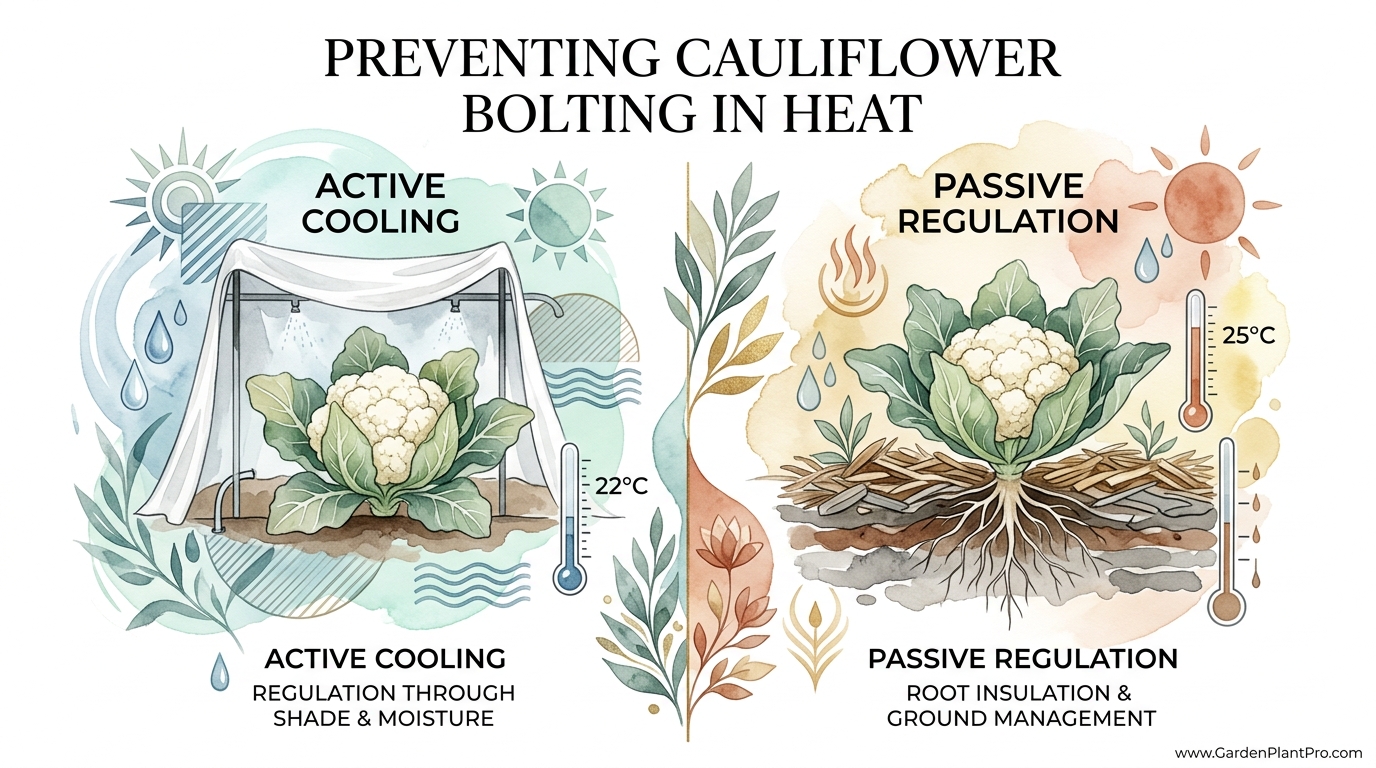
One of these gardeners is fighting the sun every hour, while the other let nature build its own air conditioning system. Are you stuck in a cycle of constant misting and monitoring just to keep your cauliflower from bolting? Most gardeners think heat is the enemy, but it’s actually the lack of thermal stability. While the ‘Active’ gardener wastes hours and water, the ‘Passive’ strategist uses deep mulch and companion canopy to create a permanent microclimate. Learn how to let your garden regulate itself so you can finally step away from the hose.
There is a certain heartbreak in watching a cauliflower plant you have nurtured for weeks suddenly stretch toward the sky, its tight white curd opening up into a loose, bitter mess of yellow flowers. In the gardening world, we call this bolting. To the plant, it is a survival mechanism— a race to produce seeds before the rising temperatures of summer make life impossible. To the gardener, it feels like a failure of timing or a betrayal by the weather.
I have spent many seasons leaning over the fence talking to neighbors who are convinced they just “can’t grow cauliflower” because their climate is too temperamental. The truth is that cauliflower is one of the most sensitive residents of the vegetable patch. It craves a steady hand and a stable environment. While you cannot control the sun, you can control how your soil and your garden layout respond to it. By shifting from an active mindset of “fighting” the heat to a passive mindset of “regulating” the environment, you can harvest dense, sweet heads even when the mercury starts to climb.
Understanding this transition requires looking at the garden not as a collection of individual plants, but as a living system. When we focus on thermal stability—maintaining a consistent temperature in the root zone—we remove the primary trigger that tells the cauliflower its time is up. This guide will walk you through the practical, hands-on methods to achieve that stability, drawing on years of trial and error in the dirt.
How To Prevent Cauliflower Bolting In Heat
To prevent cauliflower bolting, you must understand that the plant is reacting to stress, specifically the stress of temperature fluctuations and water scarcity. Cauliflower (Brassica oleracea var. botrytis) is a cool-season specialist that performs best when temperatures remain between 60°F and 70°F (16°C to 21°C). Once the ambient temperature consistently exceeds 75°F (24°C), or if the soil temperature spikes suddenly, the plant enters a state of panic.
Bolting is the physiological process where the plant transitions from vegetative growth (growing leaves and a tight head) to reproductive growth (producing flowers and seeds). In cauliflower, the “head” or “curd” is actually a cluster of immature flower buds. When heat triggers the bolting response, these buds begin to elongate and separate, a condition often referred to as “ricing” because the head takes on a fuzzy, grain-like appearance. If left unchecked, the central stalk shoots upward, and the plant becomes inedible and bitter.
Prevention is centered on “tricking” the plant into believing it is still in its ideal cool-weather window. This is achieved through a combination of variety selection, strategic planting timelines, and environmental manipulation. In real-world terms, this means keeping the roots cool even when the air is warm and ensuring the plant never experiences a “thirst event” that could trigger a stress response.
Think of your cauliflower as a high-performance athlete. It can handle a certain amount of exertion (sunlight), but only if it has an elite cooling system and constant hydration. If either of those systems fails for even a few hours during a heatwave, the athlete “bonks,” and in the cauliflower’s case, it bolts. Our goal is to build that cooling system into the very structure of the garden bed.
The Biology of the “Bolt”
It helps to know exactly what is happening under the leaves. Cauliflower has a relatively shallow root system compared to other brassicas like kale or collards. Because these roots sit in the top few inches of soil, they are the first to feel the impact of a hot afternoon sun. When the soil temperature reaches a certain threshold—often around 80°F (27°C)—the roots send a chemical signal to the rest of the plant that the environment is no longer hospitable for long-term growth.
This hormonal shift happens quickly. In some cases, a single afternoon of 90°F (32°C) heat followed by dry soil can be enough to start the process. Once the switch is flipped from “grow curd” to “grow seeds,” it is nearly impossible to reverse. This is why the most successful gardeners focus on the soil temperature rather than just the air temperature. If the roots stay cool, the plant can often tolerate much higher air temperatures without panicking.
Choosing the Right Varieties for Thermal Resilience
The first step in preventing bolting starts long before you ever pick up a trowel. Not all cauliflower is created equal. Some heirloom varieties are strictly bred for the short, reliably cool springs of Northern Europe, while newer hybrids have been engineered to withstand the erratic heat of a North American summer or the humidity of the Southeast.
If you live in an area where spring transitions quickly into a scorching summer, you should look for “heat-tolerant” or “bolt-resistant” varieties on the seed packet. These plants have been selected for their ability to maintain a tight curd structure even when temperatures exceed the traditional 75°F (24°C) limit. Some proven performers include:
- Snow Crown: One of the most popular and dependable varieties. It is famously adaptable and can handle moderate heat spikes without immediate bolting. It typically matures in about 50 to 60 days from transplanting.
- Fujiyama: A variety specifically bred for warm-weather performance. It produces high-quality white heads and is an excellent choice for summer-to-fall transitions in warmer climates.
- Flame Star: This is a pastel-orange hybrid that is exceptionally heat-resistant. It actually stands up to stress better than many white varieties and adds a beautiful color to the garden.
- White Contessa: A heat-tolerant variety that produces beautiful, domed heads even in challenging conditions. It is often recommended for regions with extended warm seasons.
- Amazing: A aptly named variety that is known for its ability to hold its head quality in a range of temperatures. It is a favorite for both spring and fall crops.
When selecting seeds, also pay attention to the “Days to Maturity.” In a warming climate, a faster-maturing variety (50-55 days) is often safer than a long-season variety (80+ days) for spring planting. The goal is to get that head harvested before the “heat floor” of July arrives. For fall planting, longer-season varieties are often preferred as they can take advantage of the cooling autumn air to produce massive, high-quality heads.
The Passive Regulation Strategy: Building a Microclimate
This is where we distinguish the ‘Active’ gardener from the ‘Passive’ strategist. An active gardener sees a heatwave coming and runs out to mist the plants with a hose. This provides temporary relief but causes massive evaporation and can lead to fungal issues like downy mildew. The passive strategist has already built a system that buffers the heat without human intervention.
Deep Mulching for Root Insulation
Mulch is your most powerful tool for thermal stability. In a bare-soil garden, the sun hits the dark earth and turns it into a radiator. By mid-afternoon, the soil 2 inches (5 cm) down can be significantly hotter than the air. By applying a thick layer of organic mulch, you create a physical barrier that reflects sunlight and traps moisture.
I recommend a “Deep Mulch” approach of at least 3 to 4 inches (7.5 to 10 cm). Straw is an excellent choice because it is light-colored and reflects heat. Wood chips, shredded leaves, or even grass clippings (if they are free of herbicides) also work well. Research has shown that soil under a 3-inch layer of mulch can stay up to 20°F (11°C) cooler than bare soil on a 100°F (38°C) day. That difference is often the “bolt line” for cauliflower.
When applying mulch, be sure to keep it an inch or two away from the main stem of the plant to prevent rot. You want to mulch the “drip line” where the roots are most active. Apply the mulch in the early morning while the soil is still cool from the night; this “locks in” the lower temperature for the rest of the day.
Utilizing a Companion Canopy
In nature, few plants grow in isolation on a patch of bare dirt. They grow in layers. You can mimic this by using taller companion plants to provide “dappled shade” during the hottest part of the day. This is a form of passive cooling that requires no electricity or monitoring.
Planting cauliflower on the north side of a row of tall peas, trellised cucumbers, or even sunflowers can provide a vital break from the intense afternoon sun (typically between 2 PM and 5 PM). You don’t want to block the sun entirely—cauliflower still needs 6 to 8 hours of light to form a large head—but “filtering” that light through a leaf canopy can drop the leaf temperature of the cauliflower significantly. Corn is another fantastic companion; as it grows tall in the early summer, it creates a moving shadow that protects the developing cauliflower heads below.
DIY PROJECT: Collect rainwater no matter where you live...
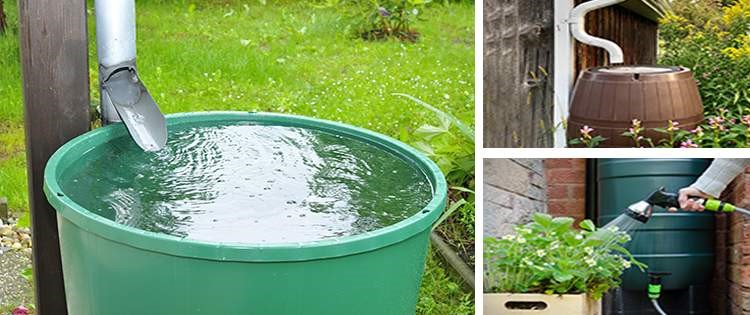
This DIY project is the best way to legally collect rainwater NO MATTER where you live. Get chlorine-free water, cut down on your water bills, and have enough for an emergency situation or to water your garden. Read More Here...
Watering Wisdom: Consistency Over Quantity
If you ask a cauliflower plant what it hates most, it isn’t necessarily heat—it’s interruption. An interrupted water supply is a guaranteed trigger for bolting. When the soil dries out, the plant cannot move nutrients, and it perceives a life-threatening crisis. Even if you drench it the next day, the damage to its internal “stress clock” may already be done.
Consistent moisture is the goal. For cauliflower, this usually means 1 to 1.5 inches (2.5 to 3.8 cm) of water per week, but in a heatwave, that may need to be delivered in smaller, more frequent doses. The best way to achieve this is through drip irrigation or soaker hoses buried under that deep layer of mulch we discussed. This delivers water directly to the root zone without wetting the foliage or the developing head, which helps prevent disease.
Avoid overhead watering in the middle of a hot day. While it might seem like a good way to cool the plant, the water droplets can actually act as tiny magnifying glasses, and the rapid evaporation can lead to salt buildup on the leaves. If you must water by hand, do it at the base of the plant in the very early morning. A deep, slow soak is always better than a quick splash.
The Finger Test
Don’t rely on a schedule; rely on the soil. Stick your finger through the mulch and into the dirt. It should feel like a wrung-out sponge. If it feels dusty or hard at the 2-inch (5 cm) mark, you are already in the danger zone. If it feels muddy, you are overwatering and risking root rot. That middle ground of “consistently damp” is where cauliflower thrives.
Feeding for Strength, Not Stress
Nutrition plays a subtle but critical role in how a plant handles heat. A plant that is deficient in key nutrients will have thinner cell walls and a weaker vascular system, making it more prone to wilting and bolting. However, over-fertilizing with high-nitrogen products once the head has begun to form can actually cause “ricing” or loose heads.
The best approach is to build a high-organic-matter soil with compost before you ever plant. Cauliflower is a “heavy feeder,” meaning it needs plenty of fuel to build those massive leaves that protect the head. A balanced, slow-release organic fertilizer at planting time is usually sufficient. Once the plant is established, a monthly dose of liquid seaweed or fish emulsion can provide the micronutrients, like Boron, that are essential for cauliflower health.
Boron deficiency is a common but often overlooked cause of poor head formation and browning. If your cauliflower heads are hollow-stemmed or showing brown patches on the curd, it may be a sign of low Boron. A very dilute spray of a Boron-containing product can help, but a healthy dose of compost is usually the best long-term fix.
Challenges and Common Mistakes
Even with the best intentions, gardeners often fall into traps that inadvertently cause their cauliflower to bolt. Recognizing these early can save your harvest.
- Transplanting Stress: Cauliflower is notoriously sensitive to root disturbance. If you buy “leggy” or root-bound transplants from a big-box store, they are already stressed. These plants often “button” (produce a tiny, golf-ball-sized head) or bolt immediately after being put in the ground. Tip: Grow your own starts and transplant them when they have only 4 or 5 true leaves, ensuring the root ball stays intact.
- Waiting Too Long to Harvest: In hot weather, a cauliflower head can go from “perfect” to “bolted” in 48 hours. Many gardeners wait for the head to get “just a little bigger.” If a heatwave is forecast and your head is 5 to 6 inches (12 to 15 cm) wide, harvest it now. A small, sweet head is infinitely better than a large, bitter, flowered one.
- Ignoring the “Blanching” Phase: While this doesn’t directly stop bolting, exposing the white curd to direct sun causes it to turn yellow and develop off-flavors. When the head is about 2 inches (5 cm) wide, pull the outer leaves up and over it, securing them with a clothespin or twine. This keeps the head cool and white. Some varieties are “self-blanching,” meaning their leaves naturally curl inward, but it’s always worth checking.
- Poor Airflow: While we want to protect the plants from heat, we don’t want to suffocate them. If plants are spaced too closely, humidity builds up, and the soil stays too wet, leading to rot. Space your cauliflower at least 18 to 24 inches (45 to 60 cm) apart to allow for proper air circulation.
Limitations: When the Weather Wins
It is important to have a realistic understanding of climate boundaries. If you live in a region where nighttime temperatures do not drop below 80°F (27°C) for weeks at a time, even the most resilient cauliflower will struggle. High nighttime temperatures prevent the plant from “recovering” and transpiring properly, which can lead to internal physiological breakdown.
In extremely hot climates (Zone 9 and above), it is often better to skip the spring crop entirely and focus on a fall or winter crop. Planting in late September or October allows the plant to grow its large leaf structure during the warm autumn days, but perform its delicate curd formation during the cool, lengthening nights of late autumn. This “reverse” season is often the only way to get high-quality cauliflower in tropical or semi-tropical regions.
Additionally, if you are gardening in containers, you face a unique challenge. Pots heat up much faster than the ground. A black plastic pot in the sun can act like an oven for cauliflower roots. If you must grow in containers, use large, light-colored pots (at least 5 gallons or 19 liters per plant) and consider “pot-in-pot” planting to create an insulating air gap.
Practical Comparison: Active vs. Passive Management
| Feature | Active Cooling (The Hose Fighter) | Passive Regulation (The Strategist) |
|---|---|---|
| Primary Tool | Hand-watering, misting, manual shade moving. | Deep mulch, companion canopy, drip irrigation. |
| Time Commitment | High (daily monitoring and physical labor). | Low (setup at planting, then observation). |
| Water Efficiency | Low (high evaporation and runoff). | High (moisture trapped under mulch). |
| Root Temperature | Fluctuates wildly with air temp. | Remains stable and cool. |
| Plant Stress Levels | Spikes during heat of the day. | Buffered and minimized. |
| Harvest Quality | Variable; prone to ricing and bitterness. | Consistent; tight, sweet curds. |
Advanced Considerations for the Serious Grower
For those looking to truly master the art of the summer cauliflower, consider the role of Vernalization. Some cauliflower varieties require a specific period of cool temperatures (usually below 50°F or 10°C) to “trigger” the formation of the head. If you transplant too late and the plant never experiences these cool nights, it may simply grow massive leaves and never produce a head at all—a condition called “blindness.”
Another advanced technique is the use of Seaweed and Humic Acid. These biological stimulants have been shown to help plants handle abiotic stress (like heat and drought). Applying a foliar spray of liquid kelp every two weeks during the transition into summer can improve the plant’s internal osmotic pressure, allowing it to hold onto water more effectively. It’s like giving your plant a sports drink to help it through the marathon of a heatwave.
Finally, consider the Photoperiod. While heat is the primary driver of bolting, day length also plays a role. As days get longer toward the summer solstice, the plant’s internal clock is nudged toward seed production. Using a 40% to 50% shade cloth doesn’t just lower the temperature; it also subtly reduces the light intensity, which can buy you an extra week of growth before the plant feels the urge to bolt.
Example Scenario: The 90-Degree Week
Let’s look at how these principles apply in a real-world scenario. Imagine it is late May, and your cauliflower heads are about the size of a baseball. A surprise heatwave is forecasted with five days of 92°F (33°C) weather.
The Wrong Move: You panic and start spraying the plants with a hose at noon. The sun dries the water instantly, leaving salt spots. You haven’t mulched, so the soil temperature hits 85°F (29°C) by 3 PM. By day three, the cauliflower heads begin to “rice,” and by the end of the week, the central stalks have shot up 6 inches. The crop is lost.
The Right Move: You already have 4 inches (10 cm) of straw mulch in place. The night before the heat hits, you run your drip irrigation for two hours to deeply saturate the subsoil. You drape a 40% shade cloth over a simple PVC frame above the bed, ensuring it is at least 12 inches (30 cm) above the plants for airflow. You also go through and “blanch” any exposed heads by tying the leaves. During the 92°F peak, the soil under the mulch stays at a comfortable 72°F (22°C). The plants wilt slightly in the afternoon but recover fully by dusk. You harvest beautiful, tight heads the following week.
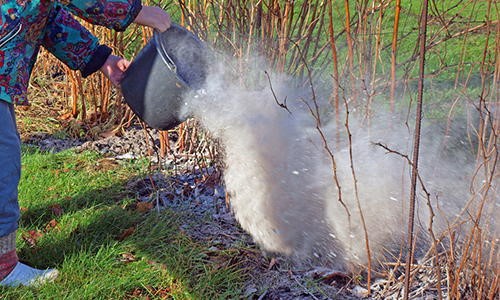
Do you have some charcoal in your house right now? We call charcoal a “miracle leftover” for anyone who wants to be a little more self-sufficient and cut costs. That’s because it can help you with so many different things around the house and garden. You can even use it to make an energy-free fridge. Read More Here...
Final Thoughts
Preventing cauliflower from bolting is not about outsmarting nature; it is about working within its rules. By focusing on thermal stability and consistent moisture, you take the pressure off the plant and allow it to complete its life cycle on your terms rather than the sun’s. It takes a little more planning at the start of the season, but the reward is a harvest of sweet, crisp florets that no grocery store can match.
Don’t be discouraged if you lose a few plants along the way. Gardening is a conversation with the land, and sometimes the land speaks louder than we’d like. Each failed crop is a data point—a lesson in timing, variety, or soil health. Take those lessons, apply a thicker layer of mulch next year, and keep experimenting with different heat-tolerant varieties.
As you master these techniques, you’ll find that the same principles apply to much of the garden. Whether you are protecting lettuce, spinach, or broccoli, the secret is always the same: keep the roots happy, keep the water steady, and give the plants a little shade when the world gets too bright. Happy growing, neighbor!