Is your ‘fresh’ potting soil actually a death sentence for your Pothos? Ever wonder why your grocery store Pothos looks amazing for two weeks and then slowly turns into a yellowing mush? It’s not your thumb; it’s the ‘modern’ peat-heavy soil designed for greenhouse speed, not home longevity. Our grandparents used chunky, breathable mixes that let roots live for decades. It is time to go back to the future.
Walking through the garden center today, you are surrounded by bags of “premium” potting soil that look dark, rich, and moist. To the untrained eye, this looks like black gold. But to a seasoned gardener who has seen hundreds of Pothos plants come and go, that fine-textured, heavy soil is a ticking time bomb. Modern commercial mixes are often engineered for one thing: keeping a plant alive just long enough to get it from the nursery to your living room. They hold onto water like a sponge, which works wonders under the high-intensity lights and industrial fans of a commercial greenhouse, but in the stagnant air of a modern home, it is a recipe for root rot.
Pothos plants, or Epipremnum aureum, are far more resilient than we give them credit for, provided we respect their history. These are not swamp plants; they are hemiepiphytic climbers native to the tropical forests of French Polynesia and Southeast Asia. In their natural habitat, they spend their lives scrambling up tree trunks, their roots tucked into crevices of bark and pockets of decaying leaf litter. They thrive on “fast water”—moisture that rushes past the roots and disappears, leaving behind humid air. When we shove those same roots into a dense brick of wet peat moss, we are essentially asking a mountain climber to live at the bottom of a lake. If you want a Pothos that grows into a floor-to-ceiling legacy plant, you have to stop thinking about “dirt” and start thinking about “structure.”
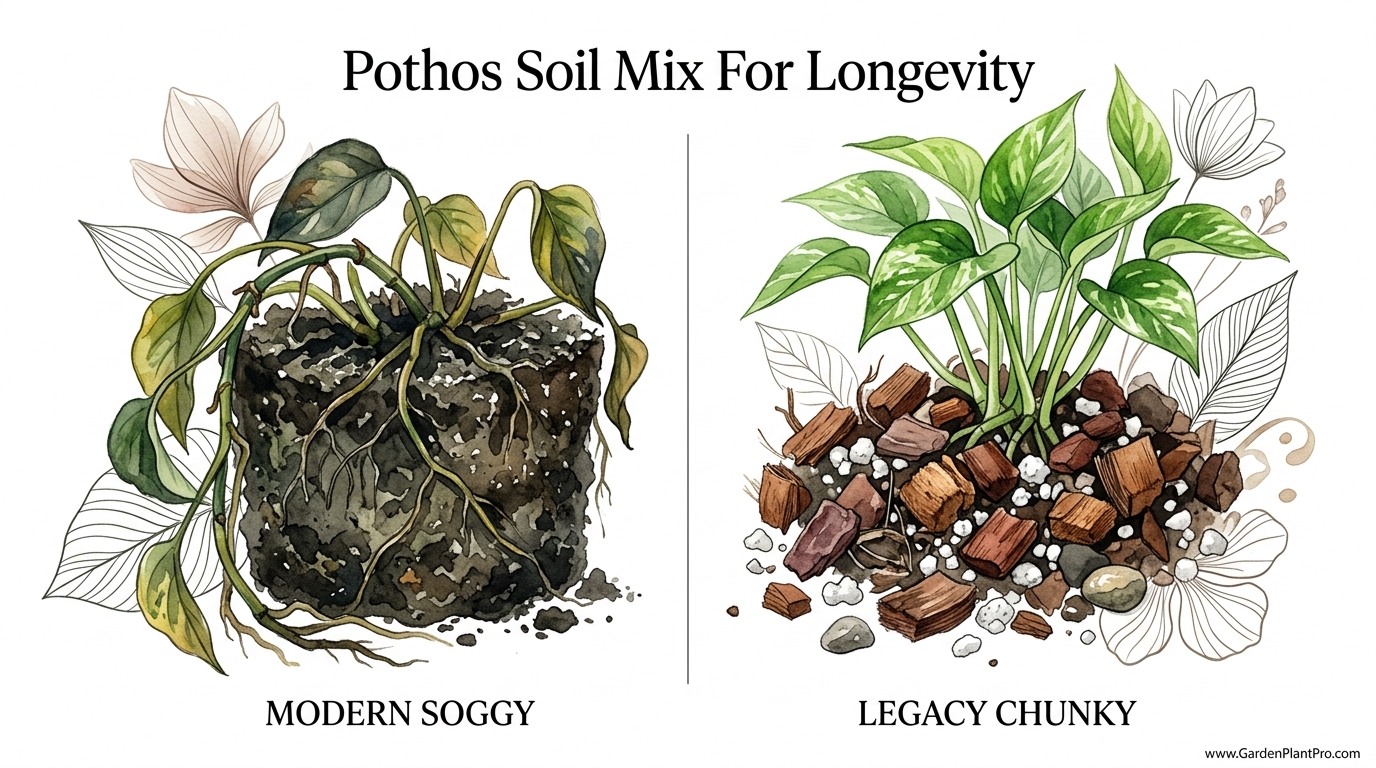
Pothos Soil Mix For Longevity
A Pothos soil mix for longevity is a substrate specifically designed to maintain its physical structure and oxygen-carrying capacity for three to five years, rather than collapsing after six months. Unlike standard potting soil, which relies on fine particles of peat moss or compost, a longevity mix uses large, inorganic and rot-resistant organic components. The goal is to create a “chunky” environment that mimics the forest floor. This ensures that even if you get a little heavy-handed with the watering can, the roots still have access to the 20% oxygen levels they need to stay healthy.
Think of this mix as a skeletal framework for the roots. In a standard bag of soil, the particles are so small that they eventually settle into every available space, squeezing out the air. This is known as compaction. In a longevity mix, ingredients like orchid bark and pumice act as “spacers.” They create permanent macropores—relatively large gaps—where air can sit even when the rest of the mix is damp. This is why seasoned collectors often refer to these as “aroid mixes.” Pothos belong to the Araceae family, and like their cousins the Monstera and Philodendron, they have thick, fleshy roots that are highly susceptible to suffocating in dense media.
This approach exists because the home environment is vastly different from the wild. Inside a house, we have lower light levels, lower humidity, and less airflow. These factors mean that water evaporates from the soil much slower than it would outdoors. By using a mix that drains in seconds rather than minutes, we compensate for the indoor environment. We move the “danger zone” of overwatering further away, giving the plant a much wider margin for error. In the real world, this is used by conservatory curators and serious hobbyists who don’t want to disturb their plants with frequent repotting, which can often set growth back by several months.
The Anatomy of a Longevity Mix
To understand why this works, you have to look at the ingredients as functional tools. A longevity mix usually discards the idea of “universal soil” and instead builds a recipe based on three pillars: Aeration, Drainage, and Sustainable Nutrition. By choosing materials that decompose slowly, such as fir bark or coconut husk chips, you ensure the pot doesn’t turn into a mucky mess of “fines” after a year of watering. It is the difference between a gravel path that stays clear after a storm and a dirt road that turns into a mud pit.
How to Create the Ultimate Pothos Mix
Creating your own mix is surprisingly simple once you move past the fear of “making a mess.” You don’t need a degree in soil science; you just need a bucket and a few key ingredients. The most reliable “Legacy Chunky” recipe I have used over the last thirty years follows a simple 3-2-1-1 ratio. This provides the perfect balance of moisture retention and air space for almost any Pothos variety, from the common Golden to the slower-growing Marble Queen.
- 3 Parts Orchid Bark: Use medium-grade fir or pine bark (about 0.5 to 1 inch or 1.25 to 2.5 cm in size). This provides the “chunk” and mimics the tree trunks Pothos love to climb.
- 2 Parts Perlite or Pumice: These are volcanic stones that never break down. They act as permanent air pockets. Pumice is heavier and won’t float to the top like perlite does.
- 1 Part Coco Coir or Peat Moss: This is your moisture reservoir. Coco coir is generally preferred because it is more pH-neutral and breaks down slower than peat moss.
- 1 Part Horticultural Charcoal: This is the “secret weapon.” It helps filter impurities, discourages fungal growth, and adds even more aeration.
- A Handful of Worm Castings: This provides a gentle, slow-release organic fertilizer that won’t burn the roots.
To put this together, find a large container or a tarp on the lawn. Measure out your components using a simple scoop or garden pot. Do not worry about being exact with the measurements; gardening is more like making a stew than baking a cake. Mix the ingredients thoroughly with your hands until the texture is uniform. When you grab a handful and squeeze it, it should feel springy and loose. If you let go and it stays in a tight ball, you need more bark or perlite. If it falls apart instantly and feels dry, you might need a touch more coco coir. This “hand test” is the best way to gauge if your mix is ready for planting.
When you are ready to repot, make sure the Pothos is hydrated but not soaking wet. Gently remove the old, soggy soil from the root ball. You don’t have to get every single speck of peat off, but try to remove at least 70-80% of it. Place a layer of your new chunky mix at the bottom of the pot, set the plant in, and fill the gaps. Give the pot a few firm taps on the table to help the soil settle around the roots. Avoid pressing down hard with your thumbs; let gravity and the first watering do the work of settling the soil so you don’t crush those vital air pockets you just created.
The Measurable Benefits of Chunky Soil
The most immediate benefit you will notice is the “Watering Peace of Mind.” In a standard peat-heavy mix, the line between “sufficiently moist” and “lethal swamp” is razor-thin. With a chunky longevity mix, you can pour a whole liter of water into a pot and watch it run straight through the drainage holes in seconds. This means the roots are hydrated, but they aren’t sitting in a stagnant pool. This drastically reduces the risk of Pythium and Phytophthora, the common fungi responsible for root rot.
Another practical advantage is the “Oxygen Flush.” Every time you water a chunky mix, the moving water pulls fresh air down into the root zone as it drains out. This is a vital biological process. Roots breathe in oxygen and exhale carbon dioxide. In dense soil, that CO2 gets trapped, acidifying the soil and suffocating the plant. In a breathable mix, the gas exchange is constant. You will see this reflected in the plant’s growth: leaves will often come out larger, variegation will stay more vibrant, and the stems will feel thicker and more turgid.
Finally, there is the benefit of “Physical Stability.” Standard potting soil shrinks as it dries, often pulling away from the sides of the pot and becoming “hydrophobic”—meaning it actually repels water the next time you try to drink it. Chunky ingredients like bark and charcoal don’t shrink. The mix stays in contact with the pot and the roots at all times, ensuring that when you do water, it actually reaches the plant rather than just running down the inside of the pot and out the bottom. This leads to a much more resilient plant that can handle a week of neglect far better than one in “modern” soil.
Challenges and Common Mistakes
The most common mistake gardeners make when switching to a chunky mix is failing to adjust their watering frequency. Because this soil drains so efficiently, it dries out faster than the heavy peat-based stuff you might be used to. If you water on a strict “once every 14 days” schedule, your plant might start to wilt. You have to learn to listen to the plant again. In a chunky mix, you might find yourself watering every 5 to 7 days during the height of summer (25-30°C / 77-86°F), and that is perfectly healthy.
Another pitfall is using “Beauty Bark” or unwashed wood chips from the landscaping section. Garden-grade mulch is often treated with dyes or contains high levels of tannins and resins that can be toxic to delicate indoor roots. Furthermore, raw wood chips use up nitrogen as they decompose, which can lead to your Pothos leaves turning a pale, sickly yellow. Always use horticultural-grade orchid bark; it has been aged or steamed to remove these harmful substances and is the right size for container gardening.
Many beginners also forget to “charge” their soil. Because ingredients like bark and pumice don’t hold many nutrients on their own, a chunky mix is relatively “inert.” If you don’t add worm castings or use a balanced liquid fertilizer during the growing season, your Pothos will eventually run out of fuel. It won’t die, but it will stop growing and the new leaves will be tiny. Think of the soil as the house and the fertilizer as the groceries; you need both for a happy home.
Limitations: When This Mix May Not Be Ideal
While I believe 90% of Pothos benefit from this mix, there are a few scenarios where it might not be the best choice. If you live in an extremely arid climate—think Arizona or the Australian Outback—and you don’t have a humidifier, a very chunky mix might dry out too fast. In these conditions, the constant evaporation can lead to salt buildup from tap water on the bark, which can eventually “burn” the roots. In desert-like environments, you might want to increase the coco coir to 40% of the total volume to hold a bit more moisture.
Another limitation is for very small cuttings or “prop box” starts. If you have a tiny Pothos cutting with roots only an inch (2.5 cm) long, a mix with large 1-inch (2.5 cm) bark chunks might be too “gappy.” The tiny roots might find themselves dangling in an air pocket without enough contact with moist media to stay hydrated. For these “babies,” it is better to use a finer version of the mix—perhaps using perlite and finely chopped sphagnum moss—until they have a robust enough root system to “grip” the larger chunks of the longevity mix.
Comparing Modern vs. Legacy Soil Philosophy
To see the difference clearly, let’s look at how these two approaches handle the basic needs of a Pothos plant. Standard potting soil focuses on the *now*—providing a lush look for the sale. Legacy chunky soil focuses on the *decades*.
DIY PROJECT: Collect rainwater no matter where you live...
This DIY project is the best way to legally collect rainwater NO MATTER where you live. Get chlorine-free water, cut down on your water bills, and have enough for an emergency situation or to water your garden. Read More Here...
| Feature | Modern Peat-Heavy Mix | Legacy Chunky Mix |
|---|---|---|
| Aeration | Low (particles fill air gaps) | High (permanent macropores) |
| Decomposition | Fast (collapses in 12-18 months) | Slow (lasts 3-5 years) |
| Rot Risk | High (retains stagnant water) | Very Low (drains instantly) |
| Watering Ease | Tricky (easy to overwater) | Forgiving (hard to overwater) |
| Growth Pattern | Fast initial burst, then stalls | Steady, long-term vigor |
Practical Tips for Soil Management
If you want to keep your Pothos thriving in this mix for the long haul, there are a few “pro-tips” from the backyard over-the-fence school of gardening. First, always pre-soak your bark. If you mix dry orchid bark into your soil, it can actually act like a desiccant, pulling moisture away from the roots for the first few days. Put your bark in a bucket of water for an hour before mixing your soil to ensure it is fully hydrated and ready to support the plant.
Second, consider the “Finger Test 2.0.” In dense soil, we are told to water when the top inch (2.5 cm) is dry. In a chunky mix, the top will always look dry because of the large air gaps. Instead, look at the weight of the pot. Pick up the pot after a fresh watering and feel its weight. Pick it up again three days later. You will quickly learn the “lightweight” feel of a pot that needs water. It is a much more accurate gauge for chunky mixes than poking the soil surface.
Finally, don’t be afraid to top-dress with mulch. Adding a thin layer of cypress mulch or even decorative pebbles on top of your chunky mix can help slow down evaporation from the surface. This keeps the humidity higher right at the base of the plant, which encourages those “aerial roots” at the nodes to grow. When those aerial roots find the soil, your Pothos will take off like a rocket because it essentially has a secondary straw to drink from.
Advanced Considerations for Serious Growers
For those who want to take their Pothos game to the professional level, you can start tweaking your mix based on the specific cultivar. For instance, the Neon Pothos is notoriously more sensitive to wet feet than the Golden variety. I often add an extra part of pumice to my Neon mix to ensure even more drainage. Conversely, the Cebu Blue (Epipremnum pinnatum) tends to like a bit more organic matter, so I might toss in a bit of leaf mold or extra worm castings to keep it happy.
You can also introduce Mycorrhizal fungi to your mix. These are beneficial fungi that form a symbiotic relationship with the roots. They essentially act as an extension of the root system, reaching into tiny crevices in the bark chunks to pull out nutrients and water that the plant couldn’t reach on its own. It’s a “biological insurance policy” that makes your plant much more drought-tolerant and disease-resistant. You can find these in powder form at most high-end garden centers; just sprinkle a teaspoon (5 ml) onto the roots during repotting.
A Realistic Scenario: The Rescue Mission
Let’s look at how this soil works in a real-world “emergency.” Imagine a neighbor brings over a Golden Pothos they bought at a big-box store. The leaves are yellowing, the soil feels like a wet sponge, and it smells slightly musty. This is classic “Modern Soil Syndrome.”
The first step is to unpot the plant and wash away that heavy, suffocating peat. You’ll likely find some mushy, brown roots. Snip those off with clean scissors. Now, instead of putting it back into more “premium” bag soil, you move it into the 3-2-1-1 chunky mix. Because the new mix is so airy, the remaining healthy roots can finally breathe. The charcoal begins to absorb some of the “rotting” odors and toxins left behind by the dying roots. Within two weeks, you’ll see the wilting stop. Within a month, you’ll see new, bright green growth emerging from the tips. The chunky mix didn’t just provide “dirt”; it provided a life-support system that allowed the plant to heal itself.
Final Thoughts
The secret to a Pothos that outlives your furniture isn’t a “magic” fertilizer or a high-tech grow light. It is simply a return to the fundamentals of how these plants grow in the wild. By stepping away from the “soggy convenience” of modern peat-heavy soils and embracing a chunky, breathable mix, you are giving your plant the one thing it craves most: oxygen. It is the foundation of every healthy root system and the primary driver of those long, lush vines we all love.
I encourage you to experiment. Next time you see a bag of orchid bark or a bag of charcoal, grab them. Mix up a small batch and try it on just one of your plants. Watch how the water flows through, notice how the leaves respond, and feel the difference in the soil texture over several months. Once you see a Pothos thriving in a “legacy” mix, you’ll never go back to the standard bag again. You are not just a plant owner; you are a steward of the soil. Happy planting, neighbor.