
Why your kiwi vine is failing despite your best efforts, and the one ‘neighbor’ it’s dying to meet. Most gardeners treat their kiwi vine like a prisoner in a cell, then wonder why the fruit never comes. Kiwis are social plants—they thrive in a community. Surrounding your vine with ‘living’ support like nitrogen-fixers and pollinator-attractors turns a high-maintenance chore into a self-watering, self-fertilizing fruit forest that yields five times the harvest.
I remember the first time I put a kiwi vine in the ground over thirty years ago. I treated it like a prize specimen, clearing every weed for three feet (0.9 meters) around it and giving it nothing but a lonely wooden post to climb. That vine struggled for years, producing stunted leaves and exactly zero fruit. It wasn’t until I visited an old friend’s orchard and saw her vines tangled up with clover, comfrey, and wild herbs that I realized my mistake. I was growing a plant, but she was growing an ecosystem.
Gardening isn’t just about the one plant you want to eat; it is about the relationships happening beneath the soil and in the air around it. Kiwi vines (Actinidia species) are particularly sensitive to these relationships because they are vigorous, hungry, and somewhat picky about their “roommates.” When you understand how to pair them with the right companions, you stop fighting against nature and start letting it do the heavy lifting for you.
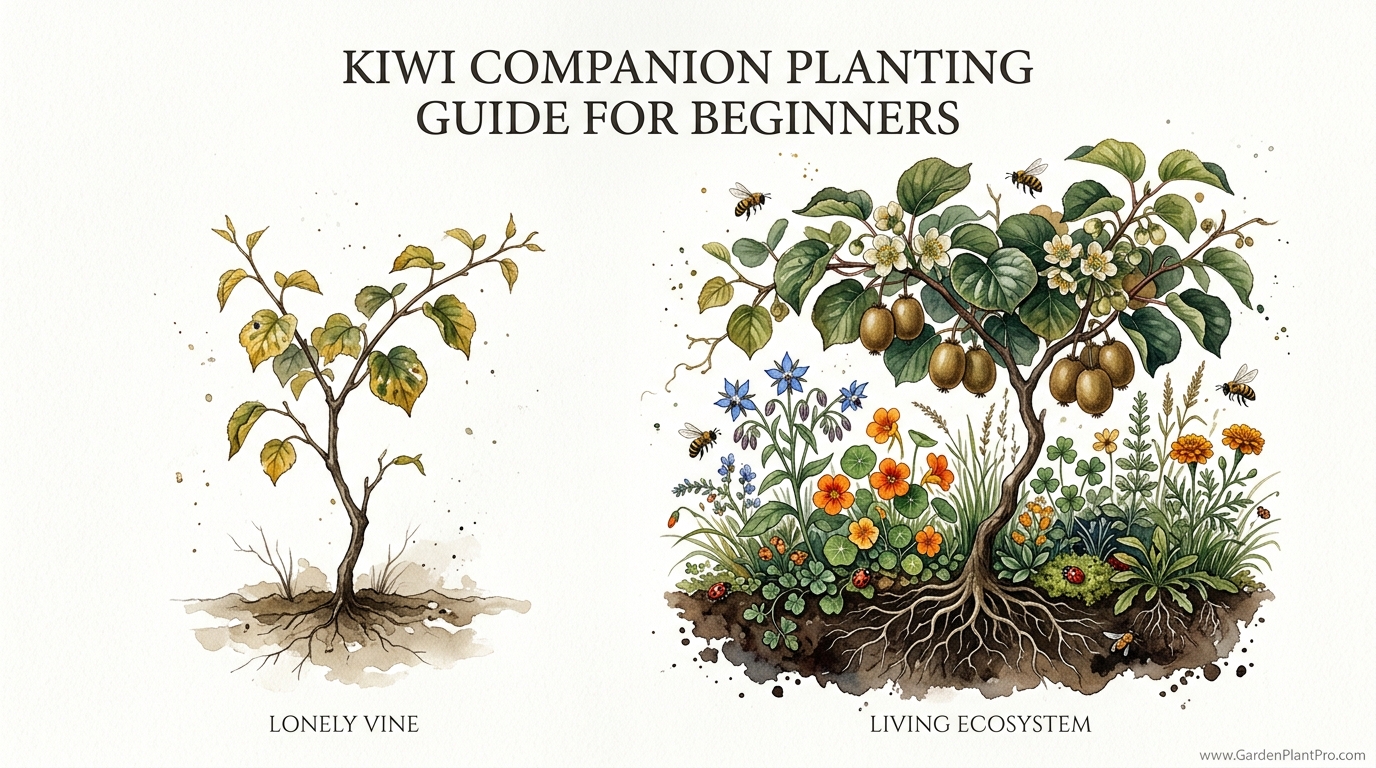
This guide comes from decades of dirt under my fingernails and plenty of failed experiments. We are going to look at why the “lonely vine” approach fails and how to build a thriving kiwi guild that stays healthy and productive for generations. Whether you are growing the common fuzzy kiwi or the cold-hardy varieties, these principles will change how you look at your garden layout forever.
Kiwi Companion Planting Guide For Beginners
Companion planting is the practice of placing different plant species close together so they can help each other thrive. In the world of kiwi vines, this means moving away from the “row crop” mentality and toward a “guild” mentality. A guild is a group of plants that support a central crop—in this case, your kiwi—by performing specific jobs like fixing nitrogen, attracting bees, or shading the soil.
Think of your kiwi vine as the “king” or “queen” of a small territory. To stay healthy, the royalty needs a court of advisors and workers. Nitrogen-fixing plants act like the kitchen staff, constantly preparing food (fertilizer) for the vine. Pollinator-attractors are the matchmakers, ensuring the male and female flowers actually meet. Ground covers are the security team, protecting the shallow roots from the scorching sun and keeping weeds from invading the territory.
Real-world gardening often ignores these social needs. We plant a vine, throw some chemical fertilizer at it once a year, and hope for the best. But kiwis are heavy feeders that require massive amounts of nitrogen and potassium to produce those heavy clusters of fruit. They also have very shallow, fleshy roots that can dry out or overheat in a matter of hours if the ground is bare. Companion planting solves these problems naturally, creating a more resilient system that requires less intervention from you.
Where is this used most effectively? You will see these principles in permaculture designs and “food forests.” Instead of a sterile backyard, these gardeners create layered landscapes. Underneath the massive kiwi trellis, you might find a carpet of strawberries and clover, with tall stalks of comfrey nearby and garlic tucked into the corners. This diversity creates a buffer against pests and disease, making the garden much more stable than a single-species plot.
How to Design and Build Your Kiwi Guild
Building a kiwi guild starts with understanding the vine’s physical footprint. Most fuzzy kiwis (Actinidia deliciosa) and hardy kiwis (Actinidia arguta) need a sturdy trellis and about 15 feet (4.5 meters) of horizontal space. Because they are dioecious, meaning you need both a male and a female plant to get fruit, your companion planting plan must account for both vines.
First, evaluate your soil drainage. Kiwis absolutely hate “wet feet.” If your soil stays soggy for more than a couple of days after a rain, the roots will rot. I’ve found that planting companions that help with drainage, like deep-rooted daikon radishes or comfrey, can help open up heavy clay soils. You want the soil to be rich, slightly acidic (pH 5.5 to 6.5), and full of organic matter.
Step one is to plant your “inner circle” of nitrogen fixers. Since kiwis need about 1 to 1.5 lbs (0.45 to 0.7 kg) of nitrogen a year once they are mature, you want plants that pull nitrogen from the air and store it in their roots. White clover is my favorite choice for this. It stays low, doesn’t compete for the trellis, and its flowers bring in the bees your kiwi desperately needs. Sow this directly under the trellis as a permanent living mulch.
Step over to the “outer ring” and plant your dynamic accumulators. Comfrey (specifically the Bocking 14 variety, which doesn’t spread by seed) is the gold standard here. Its roots go down 10 feet (3 meters) or more, mining minerals like potassium from deep in the earth. Every few months, you can chop the leaves off and lay them right on the soil surface as a “chop and drop” fertilizer. This releases potassium exactly when the kiwi is getting ready to set fruit.
Strategic placement of aromatic herbs is the third step. Lavender, rosemary, and sage should be planted on the sunnier edges of the kiwi’s footprint. These herbs don’t just smell good; they confuse pests like the leafroller moth, which can sometimes plague kiwi vines. They also provide a steady supply of nectar for beneficial insects throughout the season.
Recommended Spacing for Companions
| Companion Category | Best Examples | Placement Relative to Vine |
|---|---|---|
| Living Mulch | Clover, Strawberries | Directly under the vine canopy |
| Nutrient Miners | Comfrey, Dandelion | 3-4 feet (1 meter) from the main trunk |
| Pest Deterrents | Garlic, Chives, Marigolds | Between the vine and the garden edge |
| Pollinator Magnets | Borage, Bee Balm, Lavender | On the south or sunny side of the trellis |
The Measurable Benefits of a Living Ecosystem
The most immediate benefit you will see is a dramatic reduction in water stress. Kiwi vines have very large leaves that transpire water quickly. On a hot summer day, the soil around a “lonely” vine can bake, causing the shallow roots to shrivel. A thick ground cover of clover or strawberries acts as a biological insulation, keeping the soil temperature significantly lower and retaining moisture for days longer than bare earth.
Nitrogen fixation is another major win. Instead of buying bags of synthetic fertilizer that can wash away into the groundwater, your clover and vetch are constantly trickle-feeding the vine. This leads to more consistent growth and less “sap-sucking” pest pressure, as many pests are actually attracted to the soft, weak growth caused by synthetic nitrogen spikes.
Increased pollination rates are the “secret sauce” for a big harvest. Kiwi flowers are not particularly attractive to all bees—they don’t produce a lot of nectar. By planting borage or phacelia nearby, you bring the bees into the neighborhood. Once they are there for the nectar-rich companions, they are much more likely to stumble across the kiwi blossoms and move pollen from the male to the female vines. I’ve seen fruit size double just by improving the bee traffic in the area.
Biodiversity also helps manage common pests like spider mites and thrips. In a sterile garden, these pests have no natural enemies, so their populations explode. In a living guild, you provide a home for predatory mites, ladybugs, and lacewings. These “good guys” patrol your kiwi vines for you, often solving a pest problem before you even notice it exists.
Challenges and Common Mistakes to Avoid
One of the biggest blunders I see is gardeners planting aggressive root competitors too close to the kiwi trunk. Because kiwi roots are shallow, they don’t like fighting for space with heavy-duty shrubs or trees. Avoid planting things like blackberries or large ornamental bushes within 5 feet (1.5 meters) of the kiwi vine base. They will quickly out-compete the kiwi for both water and nutrients.
Ignoring the “gender gap” is another classic mistake. You can have the most beautiful garden in the world, but if you don’t have at least one male vine for every 6 to 8 female vines, you won’t get fruit. Some folks try to plant “self-fertile” varieties like ‘Issai,’ which are great for small spaces, but even those perform better with a male nearby. Ensure your companion plants aren’t so tall that they block the “line of sight” for bees moving between the male and female flowers.
DIY PROJECT: Collect rainwater no matter where you live...
This DIY project is the best way to legally collect rainwater NO MATTER where you live. Get chlorine-free water, cut down on your water bills, and have enough for an emergency situation or to water your garden. Read More Here...
Another pitfall is using “companion” plants that are actually hosts for the same diseases. Avoid planting potatoes, tomatoes, or peppers near your kiwis. These plants can carry Verticillium wilt, a soil-borne fungus that can be devastating to kiwi vines. It is much safer to stick with herbs, legumes, and flowers.
Over-mulching with wood chips right against the trunk can also lead to trouble. While mulch is good, piling it up against the base of the vine invites crown rot (Phytophthora). Always leave a small “breathing room” of 2 to 3 inches (5 to 7 cm) around the main stem where the soil is clear or covered only by a light living mulch like clover.
Limitations: When This Approach Might Not Work
Companion planting isn’t a magic wand that works in every single situation. If you are growing in a very small urban container, for example, you simply don’t have the “root real estate” to support a full guild. In a pot, the kiwi vine needs every bit of soil and water for itself. Trying to cram in comfrey or large herbs will only stunt the vine. In these cases, you are better off using “companion pots” placed nearby rather than planting in the same container.
Environmental limitations like extreme shade can also break the system. Kiwis need at least 6 to 8 hours of sun to fruit well. If your trellis is in a dark corner, the companions you choose must also be shade-tolerant. Most common nitrogen fixers like clover prefer sun. If you have shade, you’ll need to shift to plants like hostas or ferns, which don’t provide the same nutrient benefits as traditional guild plants.
There are also trade-offs in terms of maintenance. A “living ecosystem” looks more wild than a manicured garden. If you live in an area with strict Homeowners Association (HOA) rules about “weeds,” a patch of comfrey and clover might cause some friction with the neighbors. You’ll need to be more intentional about how you design the guild so it looks like a deliberate flower bed rather than an abandoned lot.
Practical Tips for Immediate Application
Start small if you are feeling overwhelmed. You don’t have to plant twenty different species today. If you have an established kiwi vine, the very first thing you should do is clear out the grass for a few feet around the base and sow some white clover. This single act will improve soil health and provide a nitrogen boost within one growing season.
If you are in a region with cold winters, remember that hardy kiwis (A. arguta) are much more resilient than the fuzzy ones. When choosing companions for hardy kiwis, you can look for plants that also have high cold-tolerance. For example, Siberian pea shrubs are excellent nitrogen-fixing companions for hardy kiwis because they can both handle temperatures well below zero (-18°C).
Consider the timing of your “chop and drop” sessions. I like to cut my comfrey back right when the kiwi vines are starting to flower. This sends a surge of nutrients into the topsoil just as the vine is putting its energy into fruit production. It’s like giving your plant a high-protein meal right before a marathon.
Keep a close eye on the moisture levels during the first year of establishing your guild. While the companions will eventually help save water, they are also thirsty while they are young. Make sure you are deep-watering the whole area once or twice a week during the summer until the root systems have fully integrated.
Advanced Considerations for Serious Practitioners
For those who want to take their kiwi forest to the next level, let’s talk about mycorrhizal fungi. These beneficial fungi form a secondary root system for your kiwi, helping it absorb phosphorus and water. You can “inoculate” your guild by adding a handful of forest soil or a commercial mycorrhizal powder when you plant your companions. Clover is an excellent host for these fungi and will help spread the network throughout your kiwi’s root zone.
Think about “vertical stacking” in your guild. Since the kiwi occupies the high trellis, you have empty space in the “mid-story.” You can plant smaller berry bushes like currants or gooseberries on the north side of the trellis where they will get partial shade. These plants love the same slightly acidic soil as kiwis and don’t have aggressive enough roots to bother the vine.
Nutrient cycling can be optimized by using “nutrient-hungry” plants as indicators. If the dandelions in your guild are looking pale or stunted, it’s a sign that your soil’s mineral levels are dropping. Dandelions are excellent “soil testers”—they show symptoms of deficiency long before the hardy kiwi vine does. Paying attention to these smaller players allows you to address soil issues before they affect your fruit harvest.
Scenario: The “Urban Pergola” Example
Imagine you have a small backyard with a 10-foot by 10-foot (3m x 3m) pergola over a patio. You’ve planted one male and one female kiwi vine at opposite corners. Instead of just letting them grow over bare concrete or gravel, you create a “border guild” around the base of the pergola posts.
On the sunny side, you plant a cluster of lavender and chives. This protects the base of the vine and smells wonderful when you sit on the patio. Underneath the vines, you plant a “living carpet” of alpine strawberries. These don’t spread by aggressive runners like regular strawberries, making them perfect for a tidy urban space. They stay green almost year-round and provide a secondary harvest of tiny, sweet fruit.
In the corners where the soil is deepest, you tuck in two comfrey plants. Throughout the summer, you trim the large comfrey leaves and tuck them under the strawberry plants where they rot down into rich soil. By the third year, the kiwi vines have completely covered the pergola, providing deep shade for the patio, and the “community” of plants below ensures the vines stay lush and productive without you ever having to buy a bag of fertilizer.
Final Thoughts
Transitioning from a “lonely vine” to a “living ecosystem” is the single best thing you can do for your kiwi harvest. It’s a shift in perspective—moving from being a “manager” of a plant to being a “steward” of a habitat. When you let nature do what it does best, the results are always more flavorful and abundant than anything a chemical bottle can provide.
Start by observing your garden’s patterns. Where does the sun hit the most? Where does the water sit? Use that knowledge to place your nitrogen-fixers, miners, and pollinators. Don’t be afraid to experiment; gardening is a conversation between you and the earth, and every backyard has its own unique dialect.
Do you have some charcoal in your house right now? We call charcoal a “miracle leftover” for anyone who wants to be a little more self-sufficient and cut costs. That’s because it can help you with so many different things around the house and garden. You can even use it to make an energy-free fridge. Read More Here...
The first time you sit under a heavy canopy of kiwis, watching bees dance between the lavender and clover while you pick a sun-warmed fruit, you’ll know exactly why this social way of gardening is so much better. It’s more than just fruit; it’s a vibrant, buzzing piece of the world that you helped bring back to life.