Are you working a night shift as a human moth, or is your garden working for you? If you are still out in the yard at midnight with a paintbrush, your dragon fruit is ‘Isolated.’ Integrated gardens use night-scented ‘pollinator magnets’ to bring the moths and bats to the party. Let nature handle the midnight shift so you can stay in bed.
I have spent more nights than I care to admit standing on a milk crate with a headlamp, tickling dragon fruit flowers with a makeup brush. In those early years, I thought that was just part of the deal. I figured if I wanted those 1-pound (450-gram) fruits, I had to be the one doing the heavy lifting. But as the years have rolled on and my knees have started to complain about the midnight garden strolls, I realized that I was trying to do a job that local wildlife was already hired for.
The secret to a truly productive dragon fruit patch isn’t in the softness of your bristles; it is in the complexity of your garden ecosystem. When we talk about “Attracting Night Pollinators To Dragon Fruit Gardens,” we are really talking about transforming an isolated plant into an integrated part of a guild. It is about creating a landing strip for hawk moths and a nectar buffet for bats so that while you are dreaming, your fruit is setting.
In practical terms, this means moving away from a sterile, monoculture row of dragon fruit on posts and toward a lush, layered environment. I have seen the difference firsthand. A dragon fruit plant tucked into a corner with moonflowers and night jasmine will almost always out-produce a solitary plant on a concrete patio. It is not just about the convenience—it is about the fruit quality. Let’s look at how we can get your garden working that graveyard shift for you.
Attracting Night Pollinators To Dragon Fruit Gardens
Attracting night pollinators to dragon fruit gardens is the practice of using specific “magnet plants,” habitat features, and lighting choices to draw in the creatures that naturally handle nocturnal pollination. In the wild, dragon fruit (the genus Selenicereus or Hylocereus) evolved alongside specific partners. Their massive, white blooms—sometimes reaching 14 inches (35 cm) in diameter—are essentially giant neon signs for the night shift.
Most dragon fruit varieties are nocturnal bloomers. They open their petals between 8:00 PM and 10:00 PM and close them forever by the first light of dawn. This 11-to-13-hour window is the only chance the plant has to reproduce. In their native lands of Central and South America, nectar-feeding bats and massive sphinx moths are the primary workers. Here in our backyards, we have to convince our local versions of these creatures that our dragon fruit is the best restaurant in town.
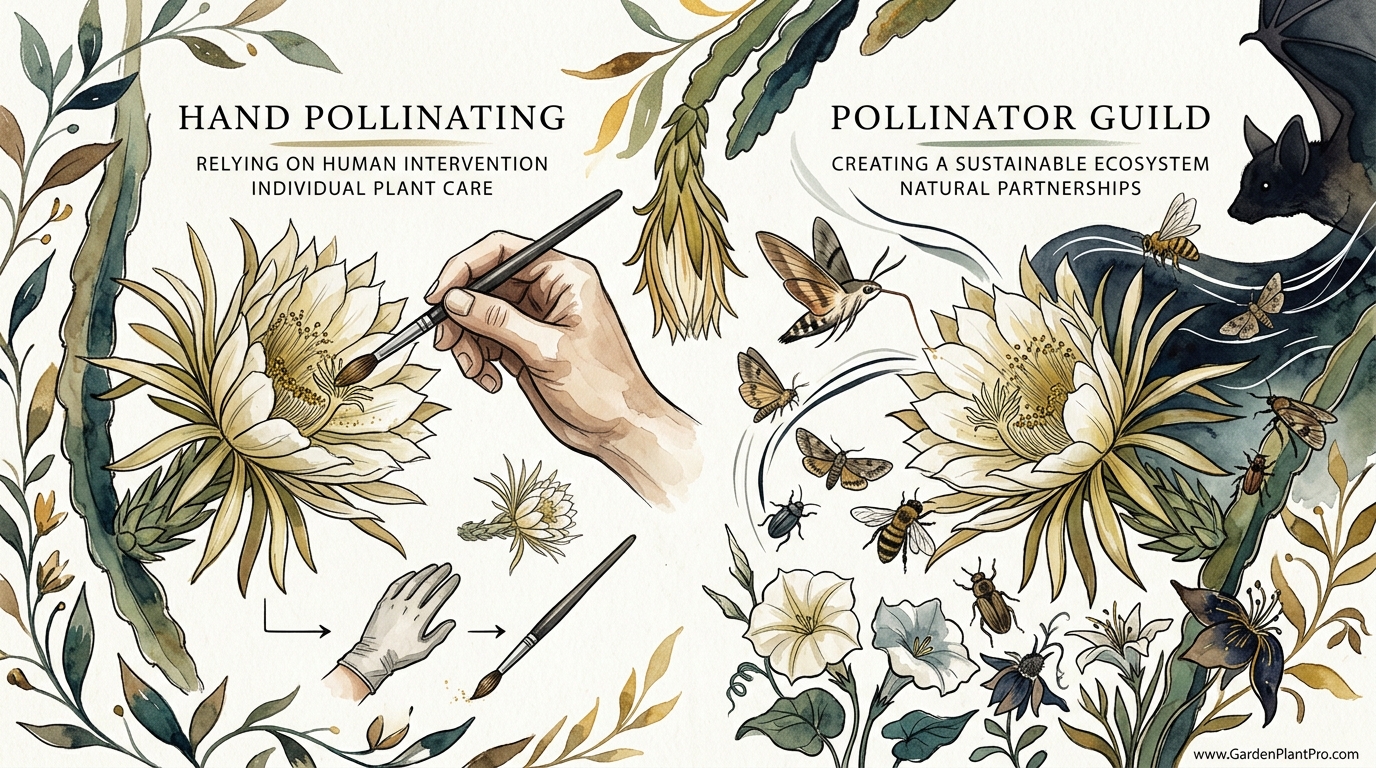
An “Isolated” dragon fruit is one that sits in a space where these pollinators don’t feel safe or can’t find the scent trail. Maybe there is a bright LED floodlight nearby that confuses them, or perhaps there is nothing else in the yard to keep them coming back when the dragon fruit isn’t in bloom. An “Integrated” garden, by contrast, uses a “Pollinator Guild”—a team of plants that bloom at different times and provide habitat for the entire life cycle of the moth or bat.
Think of it like a truck stop on a long highway. If there is only one pump and it is only open one night a month, the drivers will skip it. But if there is a 24-hour diner, a comfortable place to rest, and plenty of fuel, they will make it a regular stop. We want our gardens to be the premium truck stop for the local hawk moth population.
Designing the Midnight Buffet: How to Do It
Building a pollinator guild isn’t as complicated as it sounds. You don’t need a degree in entomology; you just need to think like a moth. Moths and bats are attracted to two primary signals: scent and visibility. Since they can’t see the bright reds and purples that attract butterflies during the day, they look for pale, white, or light-yellow flowers that reflect the moon’s glow.
Step 1: The Scent Trail
You need plants that “pump” scent into the air as soon as the sun dips below the horizon. These plants act as a beacon, calling pollinators from blocks away. Some of the most effective night-scented plants include Night-Blooming Jasmine (Cestrum nocturnum), Moonflower (Ipomoea alba), and Evening Primrose (Oenothera biennis). I like to plant these in a “V” formation that funnels the wind toward my dragon fruit trellis.
Step 2: The Color Palette
Stick to “Moon Garden” colors. White, cream, and pale yellow are the stars here. Silver-leafed plants like Lamb’s Ear or Artemisia are also fantastic because they shimmer under moonlight, helping pollinators navigate the physical layout of your garden without getting disoriented by shadows. If you have a dark fence, a white-flowering climber like Star Jasmine (Trachelospermum jasminoides) creates a high-contrast backdrop that makes the dragon fruit blooms pop.
Step 3: Creating the Habitat
Pollinators need a reason to stay in your yard when the dragon fruit isn’t blooming. Dragon fruit typically flowers in 4 to 7 “flushes” throughout the warm season. If you don’t have other food sources available between those flushes, the pollinators will move on. Host plants are vital here. For instance, the sphinx moth caterpillars (often called hornworms) need specific plants like tomatoes, grapes, or four-o’clocks to grow. If you are too quick with the pesticide, you are killing tomorrow’s pollinators.
- Plant in Clumps: Don’t just put one jasmine bush in the corner. Plant in groups of 3 or 5 to create a more powerful “scent cloud.”
- Layer the Heights: Use ground covers like evening primrose, mid-sized shrubs like nicotiana, and high climbers like moonflower to fill the vertical space around your dragon fruit.
- Provide Water: A shallow dish with stones (so they don’t drown) gives moths a place to hydrate.
The Strategic Benefits of Natural Pollination
The most obvious benefit of an integrated garden is that you get to sleep. But the advantages go much deeper than personal comfort. When a hawk moth visits a dragon fruit flower, it doesn’t just dab a bit of pollen here and there. These moths are powerful flyers; they hover in place, their wings beating so fast they create a literal wind that swirls the pollen around the interior of the bloom. This often results in a more thorough “coverage” of the stigma than a human with a brush can achieve.
Research has shown that “Natural Pollination”—the combination of nocturnal moths and the early-morning bees that catch the last hour of the bloom—often leads to significantly larger fruit. In some studies, natural pollination resulted in fruit that was 10% to 15% heavier than self-pollinated fruit. This is because the pollinators are often carrying “cross-pollen” from other dragon fruit varieties in your garden or even a neighbor’s yard, which boosts genetic diversity and fruit size.
Furthermore, an integrated garden is a resilient garden. If you rely entirely on hand pollination and you get sick, or you are away on a trip during a major bloom, you lose the harvest. In a guild-based system, the garden carries on without you. You are essentially building a self-sustaining food forest where the “overhead” of labor is shifted from the gardener to the ecosystem.
There is also the benefit of Integrated Pest Management (IPM). Many of the plants that attract moths also attract beneficial insects like lacewings and parasitic wasps during the day. These “good bugs” keep the aphids and mealybugs on your dragon fruit in check. By inviting the moths, you are inadvertently hiring a security team for your garden.
Common Pitfalls: What Scares the Moths Away?
The biggest mistake I see gardeners make is “Light Pollution.” We love our outdoor LED floodlights and solar-powered garden path lights, but to a moth, these are weapons of mass distraction. A standard white LED light can reduce moth visits by over 60%. The moths get caught in the “flight-to-light” trap, circling the bulb until they die of exhaustion or get picked off by a predator, rather than doing their job on your flowers.
Another frequent error is the “Clean Garden Syndrome.” If your garden is perfectly manicured with no leaf litter and no “weeds,” you have removed the habitat for moth larvae. Many moths pupate in the soil or in the fallen leaves at the base of plants. If you rake everything to the curb, you are throwing away your next generation of pollinators. I always tell my neighbors: a little bit of “mess” under the hedge is where the magic happens.
Finally, there is the issue of broad-spectrum pesticides. If you are spraying for ants or beetles, you are likely killing the moths too. Even “organic” sprays like Neem oil can be disruptive if applied while the moths are active. Always spray in the late afternoon, well before the blooms open, and try to use targeted treatments rather than covering the whole plant.
DIY PROJECT: Collect rainwater no matter where you live...
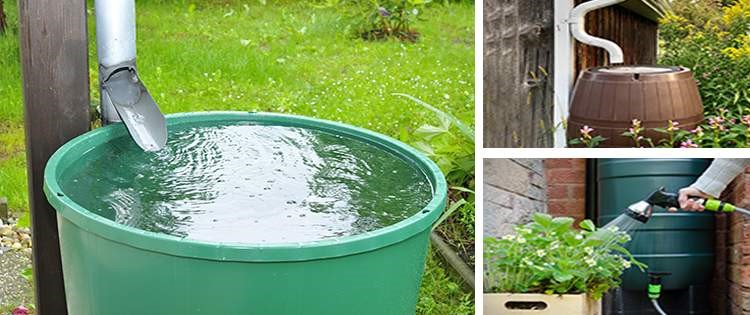
This DIY project is the best way to legally collect rainwater NO MATTER where you live. Get chlorine-free water, cut down on your water bills, and have enough for an emergency situation or to water your garden. Read More Here...
Limitations: When the Guild Isn’t Enough
While I’m a huge advocate for integrated gardens, I have to be honest: there are times when the nature-only approach fails. If you live in a region where natural night pollinators are in severe decline—which is sadly the case in parts of Australia and some urban centers in the US—a guild might not be enough to ensure a 100% fruit set. In these situations, you have to find a balance between the “Integrated” and “Isolated” methods.
Environmental factors like heavy rain can also throw a wrench in the works. Rain doesn’t just stop moths from flying; it physically washes the pollen off the anthers and can dilute the nectar, making the flower less attractive. If you see a big storm coming during a flush, you might need to step in and hand pollinate early in the evening, or even “bag” the flowers with a mesh cover to protect the pollen.
There is also the matter of self-incompatibility. Some dragon fruit varieties, like ‘Vietnam White’ or many of the red-fleshed types, are self-sterile. They must have pollen from a different variety to set fruit. Even the best moth in the world can’t make a fruit happen if there isn’t a compatible pollen source nearby. In these cases, your guild must include multiple varieties of dragon fruit that bloom at the same time.
Hand Pollinating vs. Pollinator Guilds
It is helpful to compare these two approaches side-by-side to see how they fit into your lifestyle and garden goals. Most serious growers eventually land somewhere in the middle, using a guild to do the bulk of the work and manual intervention for rare or difficult varieties.
| Feature | Hand Pollinating (Isolated) | Pollinator Guild (Integrated) |
|---|---|---|
| Labor Level | High (Requires nightly visits) | Low (Self-sustaining once established) |
| Precision | Very High (100% fruit set possible) | Moderate (Depends on visitor frequency) |
| Fruit Size | Good (Limited by variety) | Excellent (Boosted by cross-pollination) |
| Cost | Low (Cost of a brush) | Medium (Cost of companion plants) |
| Ecosystem Health | Neutral | High (Supports local biodiversity) |
Practical Tips for the Midnight Shift
If you want to start integrating your garden today, start with the “Big Four” plants. I have found that a combination of Moonflower, Night-Blooming Jasmine, Four O’Clocks, and Nicotiana (Flowering Tobacco) provides a scent profile that no hawk moth can resist. Plant the moonflowers so they can climb the same trellis as your dragon fruit; their white trumpets will act as a “shout” to pollinators while the dragon fruit is still in the bud stage.
Regarding your lighting: if you must have lights for safety, switch your bulbs to amber or red-spectrum LEDs. These are much less attractive to insects and won’t pull them away from your flowers. Position your garden lights low to the ground and point them away from the blooming dragon fruit. This keeps the “flight paths” dark and accessible for the moths.
Don’t forget the timing. Dragon fruit flowers start to “move” around 7:00 PM and are usually fully open by 10:00 PM. This is when the scent is strongest. If you are out in the garden at this time, try not to wear heavy perfumes or smoke, as these can mask the floral scents the moths are tracking. Just sit quietly in the dark for ten minutes; you’ll be amazed at how much “buzzing” you actually hear once your ears adjust.
- Temperature Watch: Most night pollinators are most active when temperatures are between 65°F and 85°F (18°C to 29°C). If it is a cold night, they may stay in their shelters, and that is when you should bring out the brush.
- Mulch Deeply: Use wood chips or straw around the base of your companion plants. This provides the “cool, moist” environment that many moth larvae need to survive the day.
- Space for Flight: Keep a clear “flight corridor” at least 3 feet (1 meter) wide leading to your dragon fruit. Moths like the White-Lined Sphinx need space to hover and maneuver their 5-inch (12 cm) wingspan.
Advanced Considerations: The Role of Bats
For the gardener who wants to go truly professional, we have to talk about bats. In many regions, nectar-feeding bats are the “heavy hitters” of pollination. They carry more pollen, travel further, and can pollinate dozens of flowers in a single night. To attract bats, you need more than just scent; you need structure. Bats use echolocation to navigate, so they like “echo-acoustic” markers—large, flat leaves or vertical structures that help them map the garden.
Providing a bat house on a nearby pole (at least 15 feet or 4.5 meters high) can give them a reason to colonize your area. Just be careful with the placement; you want the bat house to have a clear drop-off for them to take flight, but you don’t want it directly above your patio furniture for obvious reasons. A single bat can eat thousands of mosquitoes in a night, so they are the ultimate “two-for-one” garden companion.
Also, consider the “Succession of Scent.” Different moths are active at different times of the night. Some are crepuscular (active at dusk), while others wait until the dead of night. By planting a variety of night-bloomers, you ensure that there is a constant stream of “pollinator traffic” through your yard from 6:00 PM until 6:00 AM.
Example: The “Double-Trellis” System
I once helped a neighbor set up what we called the “Double-Trellis” system. He had a 10-foot (3-meter) row of ‘American Beauty’ dragon fruit that wasn’t producing much. We installed a second, lighter trellis about 2 feet (60 cm) behind the main one. On this second trellis, we grew Moonflowers and Star Jasmine.
The results were almost immediate. The jasmine provided a dense green wall that blocked the neighbor’s porch light, creating a dark “pollinator pocket.” The moonflowers provided the visual “glow” and early-evening scent, while the dragon fruit provided the midnight nectar reward. Within one season, his fruit set jumped from roughly 40% to over 90% without him ever picking up a paintbrush. He even noticed that the fruit was more uniform in shape—a sign of better pollination.
This setup works because it addresses all three needs: Darkness, Scent, and Visibility. It also makes the garden a beautiful place for a human to sit with a cup of tea after the sun goes down. The “Integrated” approach isn’t just better for the plants; it’s better for the gardener’s soul.
Final Thoughts
Moving from an isolated dragon fruit setup to an integrated pollinator guild is a journey of observation. It requires you to stop looking at your dragon fruit as a “crop” and start seeing it as a member of a community. When you plant that first moonflower or turn off that bright security light, you are signing a contract with the local wildlife. You provide the habitat, and they provide the harvest.
The practical value is undeniable—bigger fruit, less work, and a more resilient garden. But the real joy comes from those quiet nights when you step outside and see a hawk moth the size of a hummingbird hovering over a giant white bloom. It’s a reminder that nature is incredibly efficient if we just get out of the way. I encourage you to experiment with your own “magnet plants” and see which ones your local night shift prefers.
As your garden matures, you might find yourself exploring other integrated practices like soil health through mulching or water conservation through olla irrigation. The more you lean into these natural systems, the more your garden will reward you with abundance. So, put down the paintbrush, turn off the floodlights, and let the moths take it from here.