
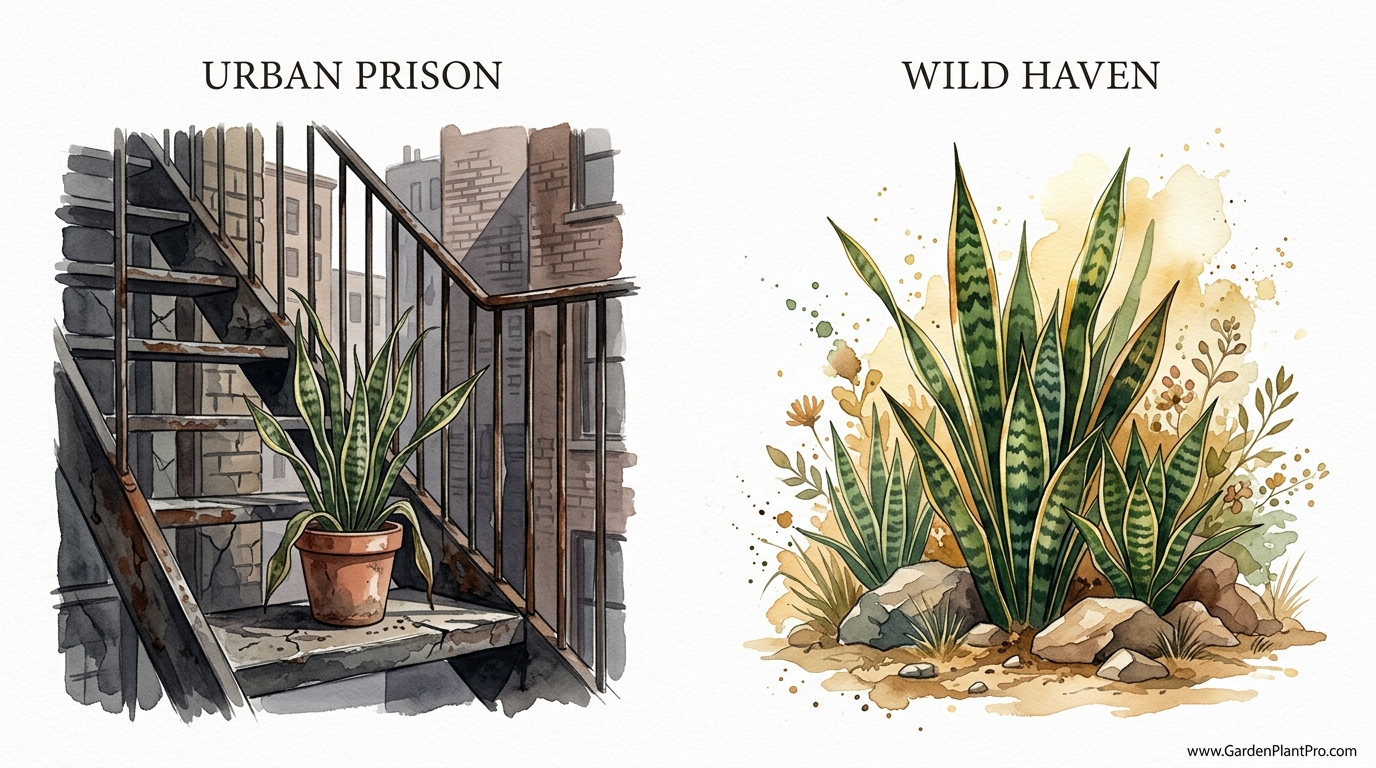
Your snake plant is a survivor of the African plains—why are you treating it like a piece of office furniture? Born in the rocky, sun-drenched plains of West Africa, the Snake Plant is a biological masterpiece of resilience. But in our modern homes, we often trap them in ‘Urban Prisons’—dark corners, stagnant air, and swampy soil. Discover the ‘Wild Haven’ method: mimicking the gritty, airy, and bright conditions of the savannah to trigger growth you never thought possible in a houseplant.
Most of us have been told that snake plants are the ultimate “low-light” plants. While it is true they can endure a dark hallway for a long time, there is a massive difference between a plant that is merely surviving and one that is truly thriving. When we treat these plants like plastic decor, we miss out on the vertical explosion of growth and the unique, structural beauty they are capable of achieving.
I have spent decades watching these plants in my own sunrooms and backyards, and the secret to a happy snake plant is simple: treat it like it’s back home in Nigeria or the Congo. By moving away from the “Urban Prison” mindset and toward a “Wild Haven” approach, you can turn a stagnant, dusty plant into a vigorous, pup-producing machine.
Snake Plant Natural Habitat Guide
The snake plant, botanically known as Dracaena trifasciata (and formerly as Sansevieria), is a child of the tropics and the arid scrublands of West Africa. Its native range stretches from Nigeria eastward to the Democratic Republic of the Congo. In these regions, the plant does not grow in the rich, loamy soil we often find in temperate gardens. Instead, it anchors itself into rocky crevices, sandy plains, and dry thickets.
In the wild, the snake plant deals with intense heat, high-intensity sunlight, and long periods of drought followed by heavy tropical rains. The ground it calls home is gritty and highly mineral-heavy, allowing water to flush through the root system almost instantly. There is no such thing as “stagnant water” in the rocky outcrops where these plants evolved. This is why they have developed such thick, succulent leaves; those leaves are the plant’s personal water reservoirs, designed to keep it alive during the “hungry months” of the dry season.
Understanding this habitat is the key to successful indoor care. When you realize that your plant is built to withstand a 90°F (32°C) African afternoon, you stop worrying about it being “too hot” near a window. When you see it growing in the shade of a thorn tree but still under a bright tropical sky, you understand that “low light” in Africa is still much brighter than a dim corner in a suburban living room.
The Biology of Resilience: How It Works
The primary reason a snake plant can survive in your home while other plants wilt is a specialized form of photosynthesis called Crassulacean Acid Metabolism (CAM). Most plants open their pores, called stomata, during the day to take in carbon dioxide. However, in a hot environment, opening those pores during the heat of the day would cause the plant to lose all its moisture to evaporation.
Snake plants have solved this by flipping the script. They keep their stomata closed tight during the day to hold onto every drop of water. At night, when the air is cooler and more humid, they open up to “breathe.” They take in carbon dioxide and store it as malic acid. The next day, when the sun comes out, they use that stored acid to perform photosynthesis with their pores safely shut.
This biological trick is why your snake plant is so drought-tolerant. It is also why they are famous for releasing oxygen at night, making them popular bedroom companions. However, this system is a slow-burn strategy. Because they have to store their “food” overnight, they don’t grow as fast as a tropical fern or a vine. If you want to speed things up, you have to provide the one thing that fuels this entire process: light.
Recreating the Wild Haven: Light and Environment
The biggest mistake gardeners make is putting their snake plant in a dark corner. This is the “Urban Prison.” In low light, the plant’s metabolic rate drops to almost zero. It enters a state of “survival mode” or CAM-idling, where it barely uses any resources but also produces no new leaves.
The Golden Rule of Lighting
If you want your snake plant to grow 2 to 3 feet (60 to 90 cm) in a single season, you must give it bright indirect light. Ideally, it should receive about 6 to 8 hours of daylight. In the northern hemisphere, an east-facing window is perfect, as it provides gentle morning sun. A west-facing window works too, but you might need a sheer curtain to prevent the intense afternoon sun from scorching the leaves.
Temperature and Airflow
Think of the African savannah—it is breezy and warm. Indoors, snake plants prefer temperatures between 65°F and 85°F (18°C to 29°C). They are quite sensitive to cold; anything below 50°F (10°C) can cause the cells in the leaves to collapse, leading to mushy, scarred foliage.
Good airflow is equally important. In a stagnant corner, humidity can settle at the base of the leaves, encouraging fungal growth. A “Wild Haven” has moving air that helps the soil dry out after a watering. If your home feels stuffy, a small fan or even just being near an open window (during warm months) can make a world of difference.
The “No Sips” Watering Strategy
I often tell my neighbors that the quickest way to kill a snake plant is with kindness—specifically, the kindness of a weekly “little sip” of water. In the wild, these plants experience a cycle of Drench and Drought. To mimic this, you must change how you water.
Step-by-Step Watering Process
- Test the soil: Never water on a schedule. Stick your finger or a wooden skewer all the way to the bottom of the pot. If it comes up with any damp soil attached, wait. The soil must be 100% dry from top to bottom.
- The Drench: When the soil is dry, take the plant to the sink. Pour water in until it runs out of the drainage holes at the bottom. You want to make sure the entire root ball is saturated.
- Drain Completely: This is the most important part. Let the pot sit in the sink for 20 minutes to ensure no standing water remains in the saucer.
- The Drought: Forget about the plant for 3 to 4 weeks (or even 6 weeks in the winter). Let the roots breathe in the dry soil, just as they would in the African dust.
The Gritty Soil Recipe
Standard potting soil is designed to hold moisture, which is the exact opposite of what a snake plant needs. To create a “Wild Haven” in a pot, you need a mix that is gritty, airy, and well-draining.
| Component | Ratio | Purpose |
|---|---|---|
| Standard Potting Soil | 40% | Provides basic nutrients and structure. |
| Coarse Sand or Horticultural Grit | 30% | Increases drainage and prevents compaction. |
| Perlite or Pumice | 30% | Adds air pockets for root respiration. |
If you prefer a simpler route, a high-quality cactus and succulent mix works well, but I always recommend throwing in an extra handful of perlite just to be safe. Avoid using “moisture-control” soils at all costs; they are a death sentence for a Dracaena.
Benefits of the Wild Haven Method
When you move your plant from an Urban Prison to a Wild Haven, the results are measurable and often surprising. You aren’t just keeping a plant alive; you are allowing it to reach its full biological potential.
The most immediate benefit is upright structural integrity. Plants grown in low light often become “leggy” or floppy as they stretch for light. A well-lit snake plant produces thick, rigid leaves that stand perfectly vertical. You will also notice a return of vibrant variegation. The yellow borders and silvery “tiger stripes” on the leaves are more pronounced when the plant has enough energy to produce those pigments.
Perhaps the most rewarding benefit is the production of pups. These are small baby plants that sprout from the underground rhizomes. A healthy, thriving snake plant will eventually fill its pot with these offsets, giving you a lush, dense look that a single-leaf plant can never achieve.
DIY PROJECT: Collect rainwater no matter where you live...
This DIY project is the best way to legally collect rainwater NO MATTER where you live. Get chlorine-free water, cut down on your water bills, and have enough for an emergency situation or to water your garden. Read More Here...
Common Mistakes and Challenges
Even the most seasoned gardeners trip up on a few things when it comes to these African survivors. The most common pitfall is watering the center of the rosette.
When you pour water directly into the middle of the leaves, it can get trapped in the tight “cups” where the leaves meet. Because there is no African sun to evaporate it quickly, this standing water leads to crown rot. Always water the soil at the edges of the pot, keeping the foliage dry.
Another mistake is using a pot that is too large. Snake plants actually prefer to be a bit “root-bound.” Their root systems are relatively small compared to their height. If you put a small plant in a giant pot, the excess soil will hold onto moisture for too long, leading to root rot before the plant can ever drink it. Choose a pot that is only 1 to 2 inches (2.5 to 5 cm) wider than the root ball.
Limitations of the Method
While the Wild Haven method works for most situations, there are realistic constraints. If you live in a basement apartment with no windows, no amount of “gritty soil” will make your snake plant thrive. In these cases, you are forced to use artificial grow lights.
Additionally, if you live in a region with extremely high humidity (consistently above 70%), the soil will take much longer to dry out. You may need to increase the percentage of grit in your soil mix to 50% or more to compensate for the lack of evaporation.
Lastly, remember that while they love warmth, they are not desert cacti. They cannot handle 110°F (43°C) sun in a southern window without some acclimation. If you move a plant from a dark corner directly into scorching sun, the leaves will develop white, papery “sunburn” patches that never heal.
Practical Tips for Success
- Dust the leaves: In the wild, rain washes away dust. Indoors, a layer of dust blocks sunlight and clogs the plant’s pores. Wipe the leaves with a damp cloth every month.
- Use Terracotta: I swear by unglazed terracotta pots. The porous clay “breathes,” helping the soil dry out faster than plastic or glazed ceramic.
- Fertilize Sparingly: These aren’t heavy feeders. Use a balanced, water-soluble fertilizer diluted to half-strength once in the spring and once in the mid-summer. Skip it entirely in the winter.
- Check the Tips: The very tip of a snake plant leaf is its growth point. If you break the tip, that specific leaf will stop growing taller forever. Handle with care!
Advanced Considerations: Propagation and Flowering
For the serious practitioner, the ultimate goal is often seeing a snake plant bloom. It is a rare sight indoors, but it happens when a plant is mature and slightly stressed by being root-bound in a very bright spot. The flowers grow on a long stalk and smell incredibly sweet, similar to jasmine or honeysuckle.
If you want to expand your collection, division is the most reliable method. When your pot is full of pups, simply slide the plant out and use a sterilized knife to cut the thick, white rhizome connecting the baby to the mother. Make sure each division has at least one healthy root.
You can also propagate from leaf cuttings, but be warned: if you have a variegated variety like ‘Laurentii’ (the one with yellow edges), a leaf cutting will revert to plain green. To keep the yellow edges, you must propagate by division. If you do use leaf cuttings, let them “callus” or dry out for two days before putting them in soil to prevent rot.
Example Scenario: The Office Rescue
Imagine a snake plant that has sat in a cubicle for three years. It has two leaves, they are dusty, and it hasn’t grown an inch. To apply the Wild Haven method:
First, you would remove it from its swampy peat-based soil and check the roots. If they are brown and mushy, trim them back to the firm, white parts. Repot it into a small terracotta pot using the 40-30-30 soil recipe mentioned above.
Instead of putting it back in the cubicle, place it on a windowsill that gets bright morning light. Don’t water it for the first week to let the roots settle. After that, give it one deep drenching. Within three to four months, you will likely see a bright green “spike” emerging from the soil—a new pup—signaling that the plant has finally escaped its prison.
Final Thoughts
The snake plant is a testament to the endurance of nature. It has spent millions of years perfecting the art of surviving on the edge of the desert, and when we bring it into our homes, we owe it a bit of that heritage. By moving away from the “piece of furniture” mindset and embracing the “Wild Haven” method, you create an environment where the plant doesn’t just sit there—it lives.
Focus on the essentials: gritty soil that never stays soggy, bright light that fuels its night-time breathing, and the patience to let it experience the dry cycles it craves. Gardening is often about knowing when to step in and when to step back, and the snake plant is the perfect partner for learning that balance.
I encourage you to take a look at your own plants today. If they are tucked away in the shadows, move them toward the light. If their soil feels like a wet sponge, give them some grit. You’ll find that once you treat them like the African survivors they are, they will reward you with a structural elegance and vitality that few other houseplants can match. Experiment with your soil mixes, watch for those rare blooms, and enjoy the process of turning your home into a thriving sanctuary.