
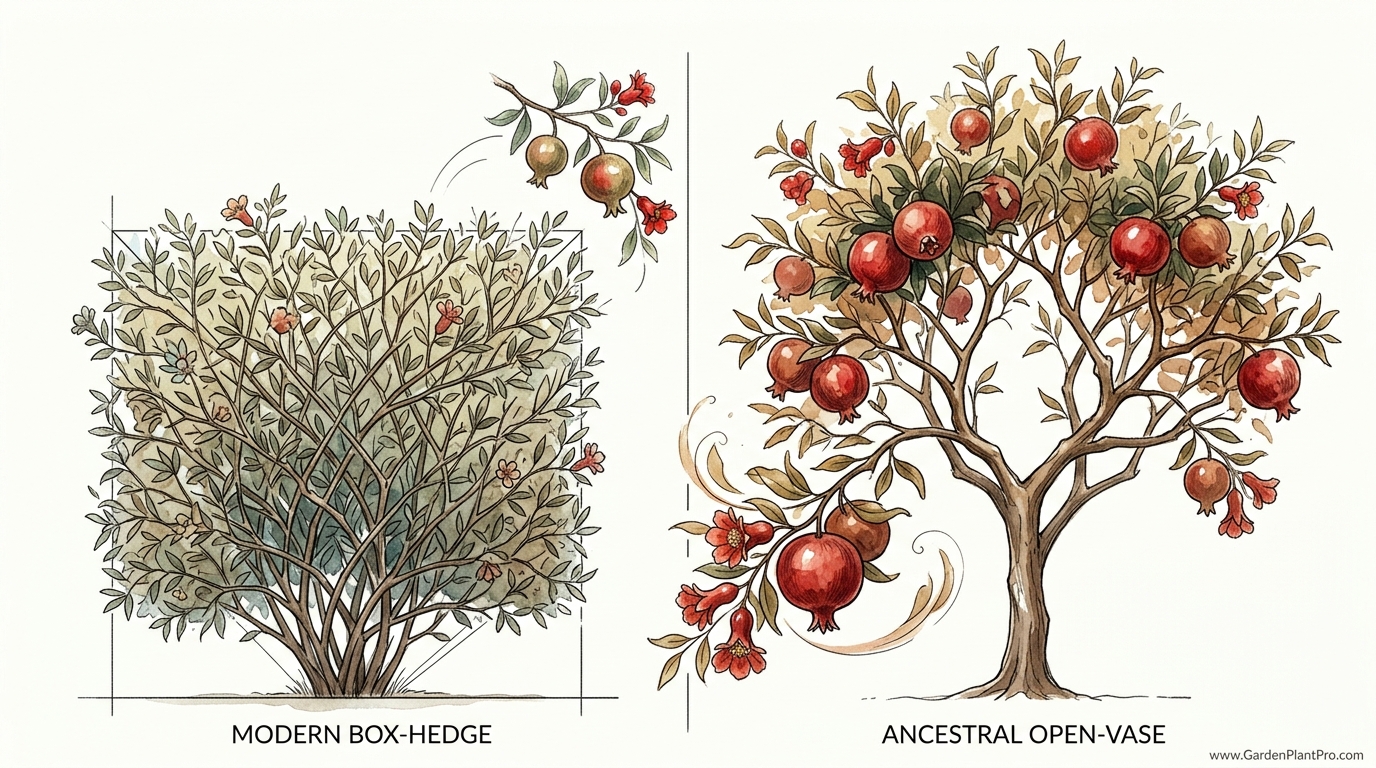
If your pomegranate tree looks like a perfect green box, you have accidentally pruned away your entire harvest. Modern gardening prioritizes neatness, but the ancients knew the secret was light. If you are pruning your pomegranates like a hedge, you are starving the fruit of the sun it needs to form.
I have seen many a neighbor take their electric shears to a pomegranate bush in an attempt to make it look like a tidy boxwood. It looks clean, certainly, but come autumn, they are left wondering why their branches are empty while mine are bowing under the weight of ruby-red fruit. Pomegranates do not behave like a privet or a box-hedge. They are wild, expressive creatures that fruit on the tips of new growth and on short spurs of older wood. When you shear the outside of the plant to keep it “neat,” you are quite literally cutting off every potential flower bud.
The goal here is a shift in perspective. Instead of thinking about the outside shape, we need to think about the inside space. We want to move from that modern, suffocating box-hedge toward an ancestral open-vase. This allows the sun to reach into the heart of the plant, ripening the fruit and keeping the wood healthy.
In this guide, I will walk you through the way I have tended my pomegranates for decades. We will talk about the timing, the specific cuts, and the fundamental choice between a tree and a shrub. It is not difficult once you understand the “why” behind the wood.
How To Prune Pomegranates For Fruit
To prune a pomegranate for fruit, you must move beyond aesthetic shaping and focus on the plant’s unique fruiting habit. Pomegranates naturally want to be multi-stemmed shrubs, constantly sending up new shoots from the base called suckers. In the wild, this makes them incredibly resilient to fire or frost, but in a garden, it creates a dense thicket that shades itself out. When the interior of the plant is dark, the wood inside becomes weak and unproductive.
Fruit production in pomegranates occurs on the tips of current season’s growth and on specialized “spurs” that develop on two-to-three-year-old wood. If you understand this, you realize that a heavy hand can be a harvest-killer. If you prune too much, you stimulate a massive flush of vegetative growth—long, whip-like branches that look green and healthy but won’t produce a single fruit for years.
Instead, we use selective thinning to open the canopy. This “open-vase” structure is a practice passed down through generations. By removing the center branches and keeping only a few main trunks, you allow sunlight to bathe the interior of the plant. This light is what triggers the formation of flower buds. Furthermore, an open structure allows for better air circulation. In many climates, pomegranates can struggle with fungal issues or fruit spots; a breezy, sun-drenched center is your best defense against these problems.
Whether you are growing a ‘Wonderful’ variety for juice or a ‘Parfianka’ for fresh eating, the principles remain the same. We are not just cutting wood; we are managing energy. We want the plant’s energy to go into developing heavy, sweet fruit rather than a thousand tiny, useless suckers at the base.
The Best Time to Prune
Timing is perhaps the most important lesson I learned the hard way. Early in my gardening days, I thought a quick trim in late autumn would tidy things up before winter. I quickly learned that pruning in the fall is a mistake.
Pomegranates are deciduous, meaning they drop their leaves and go dormant. You should wait to prune until the tree is fully dormant, typically in late winter or very early spring—around February or early March in the Northern Hemisphere, or August to September in the Southern Hemisphere.
The danger of pruning in the autumn is that it can stimulate a late flush of new growth. This tender new wood has no time to “harden off” before the first hard freeze. If a frost hits that new growth, it can cause dieback that travels deep into the main branches, sometimes killing the entire plant. By waiting until the end of winter, you can clearly see the structure of the branches without the leaves in the way, and the plant will be ready to heal its wounds as soon as the spring sap begins to flow.
If you live in a region with late spring frosts, wait until the very last threat of a deep freeze has passed but before the buds have fully broken open. A dormant plant is a resilient plant.
Essential Tools and Preparation
You wouldn’t use a butter knife to carve a turkey, and you shouldn’t use dull shears on your pomegranate. Pomegranate wood is surprisingly hard and can be quite brittle. It also has thorns—not the long, visible thorns of a rose, but sharp, spur-like points that can catch your skin and clothes.
Before you step into the garden, make sure you have:
- Bypass Pruners: These are for the smaller twigs and branches up to about 1 cm (roughly 1/2 inch) thick. Bypass shears work like scissors and make a clean, sharp cut.
- Loppers: You will need these for the larger branches and for reaching into the center of the bush. Look for loppers that can handle branches up to 4 cm (1.5 inches).
- Pruning Saw: If you are renovating an old, overgrown pomegranate, a small folding saw is indispensable for removing thick trunks at the base.
- Protective Gear: Wear long sleeves made of a heavy fabric like denim or canvas, and sturdy leather gloves. Those thorns are no joke.
- Disinfectant: I always keep a jar of rubbing alcohol (70% isopropyl) or a 10% bleach solution handy.
Sterilizing your tools is a step many beginners skip, but it is vital. Fungal diseases and bacterial blights can hitch a ride on your blades. I wipe my shears down with alcohol before I start and again between every single tree. It takes ten seconds and can save you years of headache.
Choosing Your Form: Single Trunk vs. Multi-Trunk
One of the most frequent questions I get over the fence is whether a pomegranate should be a tree or a bush. The answer depends entirely on your climate and how much work you want to do.
The Single-Trunk Tree
Training a pomegranate into a single-trunk tree (like an apple or a peach) is popular for its aesthetic appeal. It looks formal and makes it very easy to mow or garden around the base. However, this is a “modern” approach that requires constant vigilance. Pomegranates naturally want to be shrubs. If you choose a single trunk, you will be fighting the plant’s nature every single year as it tries to send up suckers from the roots.
Additionally, a single-trunk system is risky in areas prone to hard freezes. If a freak cold snap kills that one main trunk, the whole tree is gone. You will have to wait for a new sucker to grow and start the training process all over again.
The Multi-Trunk Shrub (The Ancestral Way)
This is how pomegranates have been grown for thousands of years in the Mediterranean and Middle East. You select 3 to 6 main trunks and let them grow into a large, vase-shaped shrub.
DIY PROJECT: Collect rainwater no matter where you live...
This DIY project is the best way to legally collect rainwater NO MATTER where you live. Get chlorine-free water, cut down on your water bills, and have enough for an emergency situation or to water your garden. Read More Here...
I prefer this method for several reasons. First, it is much more productive. More trunks usually mean more fruiting wood. Second, it is safer. If one trunk becomes diseased or is damaged by a freeze, you can simply remove it and let a new sucker take its place. The plant continues to produce fruit on the other trunks while the new one matures. For most backyard gardeners, a multi-trunk system of 5 or 6 main stems is the sweet spot for health and harvest.
Step-by-Step Pruning Technique
When you finally stand in front of your dormant tree, don’t just start hacking. Take a moment to look at the overall shape. I like to follow a simple mental checklist I call the “3Ds + C,” followed by the “Open Center” rule.
Step 1: The 3Ds (Dead, Damaged, Diseased)
Start by clearing away the obvious problems. Remove any wood that is brittle and dry (dead), any branches that were broken by wind or heavy fruit (damaged), and any wood showing signs of canker or fungal spotting (diseased). Always cut these back to healthy wood. If a branch is diseased, make your cut at least 15 cm (6 inches) below the visible signs of the problem to ensure you’ve removed the infection.
Step 2: The C (Crossing and Rubbing)
Pomegranate branches grow in every which way. When two branches cross and rub against each other, the friction wears away the bark. This creates an open wound—a literal doorway for pests and diseases. Identify these “confrontational” branches and remove the weaker or less ideally placed one. We want every branch to have its own clear path toward the sun.
Step 3: Clear the Suckers
Look at the very base of the plant. You will likely see dozens of thin, straight shoots growing directly out of the ground or from the lower 30 cm (12 inches) of the main trunks. These are suckers. They are “water sprouts” that steal nutrients from the fruiting wood above.
Cut these suckers off as close to the ground as possible. If they are growing from the roots, you might even need to dig down an inch or two to cut them at the point of origin. Clearing the base is a yearly chore, but it is the single most important thing you can do to keep the plant’s energy focused on fruit.
Step 4: Thinning the Interior
This is where the magic happens. Imagine a bird needs to be able to fly through the center of your tree without hitting its wings. If the center is a tangled mess of small, spindly twigs, cut them out.
We use “thinning cuts” here—this means removing a branch entirely at its base where it joins a larger limb. Avoid “heading cuts” (cutting off just the tip) in the interior, as this will only cause the branch to fork and create even more clutter. We want to create a hollowed-out “vase” shape that allows light to hit the inner parts of the remaining main branches.
Step 5: Managing the Height and Tips
Once the center is open, look at the overall height. If the tree is getting too tall for you to harvest safely, you can head back the primary branches. However, be careful! Remember that pomegranates fruit on the tips. If you cut back every single tip, you won’t get fruit this year.
I like to use a “renewal” strategy. Every year, I head back about one-third of the longest branches to encourage new growth for next year, while leaving the other two-thirds alone to produce fruit this year. This ensures a consistent harvest year after year.
Benefits of Proper Pruning
Why go through all this trouble? After all, a wild pomegranate will still produce some fruit. But for the home gardener, the benefits of a disciplined approach are measurable and rewarding.
First and foremost is Fruit Quality. When a tree is properly thinned, the remaining fruits receive more nutrients and, more importantly, more sunlight. Sunlight is what develops the deep red color in the skin and the high sugar content in the arils. A pomegranate ripened in the shade is often pale and tart, whereas one kissed by the sun is dark, sweet, and complex.
Second is Pest and Disease Management. Many pomegranate pests, such as the pomegranate butterfly (Deudorix isocrates) or various scale insects, thrive in the dark, humid interior of a dense bush. By opening the canopy, you make the environment less hospitable for them. It also makes it much easier for you to spot any issues early and, if necessary, apply organic treatments more effectively.
Third is Structural Integrity. Pomegranates are heavy. A single fruit can weigh half a kilogram (over a pound). If you have too many thin, weak branches, they will sag to the ground or snap under the weight of a good harvest. Pruning encourages the development of thick, sturdy “scaffold” branches that can support the weight of the fruit without breaking.
Common Mistakes to Avoid
Even experienced gardeners can get tripped up by the pomegranate’s unique personality. Here are the most common pitfalls I see.
The “Hedge-Trimmer” Trap
As I mentioned at the start, using shears to create a flat surface on the outside of the bush is the quickest way to end up with zero fruit. This removes all the terminal buds where the flowers form. Always use hand pruners to make individual cuts rather than shearing the whole plant.
Over-Pruning (The 25% Rule)
It can be tempting to go wild once you have the saw in your hand, especially if you’re tackling an old, overgrown tree. However, you should never remove more than about 25% to 30% of the total canopy in a single year. If you prune too heavily, the plant goes into “survival mode.” It will stop producing fruit and instead send up a forest of aggressive suckers. If a tree is truly a mess, renovate it over a three-year period rather than all at once.
Do you have some charcoal in your house right now? We call charcoal a “miracle leftover” for anyone who wants to be a little more self-sufficient and cut costs. That’s because it can help you with so many different things around the house and garden. You can even use it to make an energy-free fridge. Read More Here...
Ignoring the Thorns
Many people start pruning in a T-shirt and quickly give up because they are getting scratched. This leads to a half-finished job where the difficult-to-reach center of the tree is left untouched. Dress for the job so you can get deep into the plant where the real work needs to happen.
Leaving Stubs
When you remove a branch, always cut it flush (but not into) the “branch collar”—that slightly swollen area where the branch meets the trunk. If you leave a 5 cm (2-inch) stub, it cannot heal over properly. The stub will rot, providing an entry point for wood-boring insects and fungi.
Environmental Considerations
Your pruning strategy should shift slightly depending on where you live. Pomegranates are tough, but they react differently to different environments.
In Hot, Arid Climates (like the American Southwest, parts of Australia, or the Mediterranean), sunburn can actually be an issue for the fruit. While we want an open center, you shouldn’t “strip” the branches entirely. Leave some light foliage to act as a “lace curtain,” dappling the sun so the fruit doesn’t get scorched.
In Humid Climates (like the Southeast US or parts of Southeast Asia), air circulation is your number one priority. You may need to prune more aggressively to keep the interior open and dry. Fungal diseases like Cercospora fruit spot love stagnant, damp air. In these regions, a wider spacing between the main trunks is essential.
In Cold-Margin Zones (USDA Zones 7 and 8), always stick to the multi-trunk method. This is your insurance policy. If a winter is particularly brutal and kills the top growth, the root system (which is often hardier) will send up new shoots. If you have multiple trunks, the chances of the entire crown dying are much lower.
Comparison: Open Vase vs. Natural Shrub
To help you decide which path to take, let’s look at how these two common approaches compare in a practical sense.
| Feature | Open-Vase (Pruned) | Natural Shrub (Unpruned) |
|---|---|---|
| Fruit Size | Large and uniform | Small to medium |
| Harvest Ease | Easy (clear access to center) | Difficult (tangled and thorny) |
| Pest Resistance | High (good airflow) | Low (perfect habitat for pests) |
| Yield per Branch | High (sun-triggered buds) | Low (inner wood is barren) |
| Maintenance | Yearly dormant pruning required | Minimal (only clearing dead wood) |
Practical Tips for Success
Over the years, I’ve picked up a few tricks that make the job easier and the results better.
The Tap Test for Dead Wood
Sometimes, during dormancy, it’s hard to tell if a branch is dead or just sleeping. Take the back of your pruners and give the branch a light tap. Dead wood has a hollow, “clacking” sound and feels brittle. Living wood has a duller “thud” and feels more substantial. If you’re still not sure, use your thumbnail to scratch a tiny bit of the bark. If it’s green underneath, it’s alive. If it’s brown or gray, it’s gone.
Angle Your Cuts
Always make your cuts at a 45-degree angle, about 6 mm (1/4 inch) above an outward-facing bud. The angle allows rainwater to run off the wound rather than pooling on top, which prevents rot. The “outward-facing” part is crucial—the new branch will grow in the direction the bud is pointing. By choosing buds that point away from the center of the tree, you naturally encourage the vase shape.
Mulch After Pruning
Once you have finished pruning and cleared away the debris, it is the perfect time to apply a fresh layer of organic mulch around the base of the tree. I like to use compost or aged wood chips. Keep the mulch about 10 cm (4 inches) away from the actual trunks to prevent bark rot. This boost of nutrients helps the tree as it wakes up from dormancy and begins the heavy task of flowering.
Advanced Consideration: Renewal Pruning
If you have a pomegranate that has been neglected for ten or twenty years, you are looking at a giant, thorny mountain. Don’t despair—pomegranates are incredibly resilient and can be brought back to life through renewal pruning.
In the first year, don’t worry about the small stuff. Focus on the “bones.” Identify the 4 or 5 thickest, healthiest-looking trunks and remove everything else. You might need a chainsaw for this. Cut the unwanted trunks right down to the ground. Then, head back the remaining trunks by about a third to bring the height down.
In the second year, the tree will react with a massive flush of suckers. Most of these must be removed. Only keep a few to replace any of the old trunks that look weak. This is the year you start thinning the interior twigs to let light back in.
By the third year, the tree will have stabilized. You will likely see a massive increase in fruit production as the “new” wood starts to develop those crucial fruiting spurs. It takes patience, but seeing an old, “dead” tree produce gallons of juice again is one of the most satisfying things in gardening.
Final Thoughts
Pruning a pomegranate is a conversation between you and the plant. It isn’t about imposing a rigid, artificial shape; it is about helping the tree be the best version of itself. When you clear away the suckers and open up the heart of the bush to the sun, you are following a tradition as old as agriculture itself.
The reward for this yearly effort is more than just a bucket of fruit. It is the health of the tree, the ease of the harvest, and the simple joy of watching the sun filter through the branches to hit those developing red globes. Your pomegranate doesn’t want to be a box; it wants to be a fountain of fruit.
CASE STUDY: We've been living off the grid for the last 40 years...

In all that time an electric wire has never been connected to our house. We haven’t gotten or paid an electricity bill in over 40 years, but we have all the electricity we want. We grow everything we need, here, in our small backyard. We also have a small medicinal garden for tough times. Read More Here...
Take your time, keep your tools sharp, and don’t be afraid to make a mistake. The pomegranate is a forgiving friend. If you cut too much this year, it will grow back next year. Just remember the secret the ancients knew: follow the light, and the fruit will follow. Give it a try this winter, and by next autumn, you’ll be sharing the harvest with your neighbors just like I do.