Why did we trade a plant that lives 50 years for one that barely survives the car ride home? We have traded genetic resilience for fast-tracked nursery growth. Discover why the Strelitzia in your grandmother’s living room is a completely different beast than the one you just bought at the big-box store. It is time to return to legacy gardening.
When I look over my fence and see the neighbors struggling with a Bird of Paradise that looks like it’s given up the ghost after only six months, I can’t help but think about the massive, trunk-forming giants I’ve seen in old estates. Those plants weren’t pampered with artificial growth hormones or forced to grow in pure peat moss under industrial grow lights. They were grown slow, deep-rooted, and intended to last for generations.
Modern nursery practices often prioritize “shelf appeal”—vibrant green leaves and a quick bloom to catch your eye in the garden center. But that fast-tracked growth often comes at the expense of a robust rhizome system. If you want a plant that will be part of your family history, you have to look beyond the shiny plastic pot and understand the genetics of longevity.
Legacy gardening is about planting something once and watching it thrive for half a century. It requires a bit more patience in the beginning, but the reward is a plant that laughs at a week of missed watering or an unusually cold snap. Let’s dig into which varieties actually have the stamina to go the distance.
Longest Living Bird Of Paradise Varieties
The genus Strelitzia contains five distinct species, and while they all share that iconic avian-shaped bloom, their lifespans and growth habits vary significantly. If your goal is a plant that outlives your mortgage, you need to choose based on structural resilience rather than just flower color.
Strelitzia reginae (The Classic Orange) is the most common variety, and for good reason. In the right soil, these clumping perennials can easily live for 50 years or more. They don’t form a “trunk” in the traditional sense but rather a massive, interlocking system of fleshy rhizomes that store water and nutrients for the long haul. I’ve seen clumps in 80-year-old gardens that have become so large they practically form their own microclimate.
Strelitzia nicolai (The Giant White) is the true marathon runner of the family. Research from the Cal Poly Urban Forest Ecosystems Institute suggests these tree-like giants can live anywhere from 50 to 150 years. They grow to massive heights, sometimes reaching 9 meters (30 feet), and develop thick, woody “stems” that are actually composed of overlapping leaf bases. These are the plants you see in botanical gardens that look like they’ve seen multiple centuries pass.
Strelitzia juncea (The Leafless Bird) is perhaps the hardiest of them all when it comes to environmental stress. Because it lacks the broad, moisture-losing leaf blades of its cousins, it is incredibly drought-tolerant. This architectural marvel is slower to grow than S. reginae, taking 3 to 4 years just to produce its first flower, but that slow metabolism is exactly why it can endure for decades in harsh, rocky soils where other plants would wither.
Strelitzia caudata (The Mountain Strelitzia) and Strelitzia alba (The Cape White) are the rarer, tree-forming relatives. S. caudata is particularly interesting for those in slightly cooler regions, as it naturally grows in the mountainous areas of southern Africa and can handle a bit more “weather” than the coastal varieties. These species aren’t just plants; they are structural investments that provide shade and habitat for decades.
The Science of Resilience: Rhizomes and Genetic Legacy
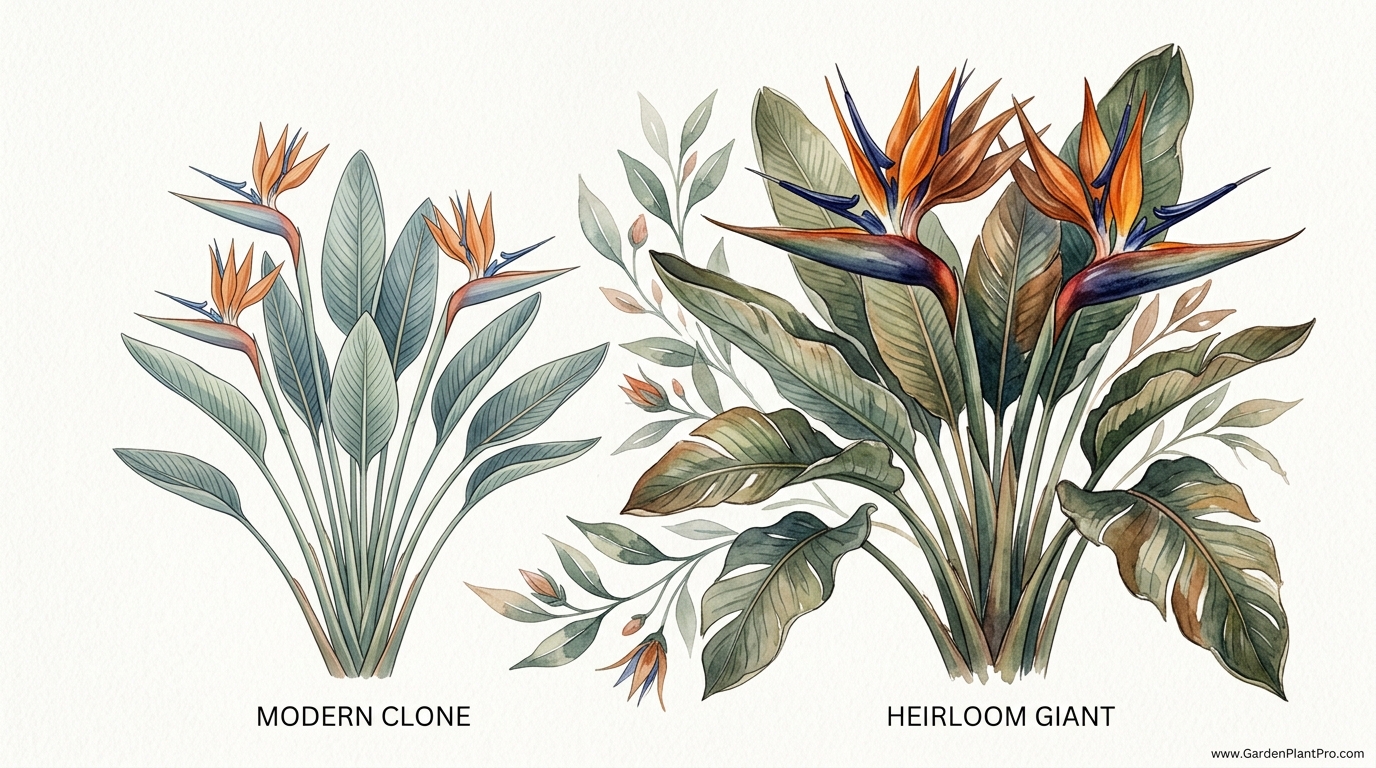
To understand why an heirloom Bird of Paradise survives while a modern “clone” fails, we have to look underground. The secret is the rhizome—a horizontal underground stem that serves as the plant’s primary survival organ. In older, seed-grown varieties, these rhizomes are thick, dense, and packed with starches.
Modern tissue-cultured plants (clones) are often produced in a lab to ensure every plant looks identical. While this is great for uniformity, it can sometimes result in a plant that lacks the “ruggedness” of a seedling. A seedling has to fight from day one, developing a deep taproot and a complex network of mycorrhizal associations in the soil. This struggle creates a plant that is genetically programmed for a 50-year life cycle rather than a 2-year retail cycle.
When you plant a legacy variety, you are planting a reservoir. During times of drought, the plant draws from the moisture stored in those thick, fleshy roots. In my experience, a well-established *Strelitzia* can survive months without supplemental irrigation once its root system has hit that “legacy” stage of maturity.
Modern Clone vs Heirloom Giant: The Nursery Industry Shift
In the past, gardeners bought “divisions” from a neighbor’s mature clump or waited years for a seed to sprout. Today, most plants are grown in sterile, soilless media like peat and perlite. This is fine for a temporary houseplant, but it’s a death sentence for a long-term garden specimen. Peat moss eventually collapses and becomes hydrophobic, meaning it actually repels water away from the roots.
The “Heirloom Giant” approach involves using real mineral soil—clay, silt, and sand. It’s heavier, slower to work with, and doesn’t look as “clean” in a nursery pot, but it provides the trace minerals and structural stability that a 150-pound (68 kg) plant needs to keep from toppling over in a windstorm. If you’re buying a new plant, look for one that feels heavy for its size; that weight usually indicates a developed root system rather than just a pot full of airy fluff.
Planting for the Next Half-Century
If you want your Bird of Paradise to reach its 50th birthday, the first hour of its life in your garden is the most important. You aren’t just digging a hole; you are building a foundation. I always tell folks to “dig a ten-dollar hole for a five-dollar plant.”
Start by selecting a site with maximum sun exposure. While *Strelitzia nicolai* can handle some partial shade, the orange *S. reginae* needs at least 6 hours of direct sun to produce the energy required for its massive blooms. In cooler climates, planting near a south-facing wall (in the Northern Hemisphere) provides a “heat sink” that can keep the root zone a few degrees warmer during winter nights.
Soil drainage is the make-or-break factor. These plants love water, but they hate “wet feet.” If your soil is heavy clay, don’t just dig a hole that acts like a bathtub. Build a mound or install a raised bed. I like to use a mix of roughly 50% native soil, 25% coarse sand or grit, and 25% well-rotted compost. This provides the aeration the roots need to breathe while the native soil offers the mineral depth that nursery mixes lack.
- Step 1: Clear an area at least 1 meter (3 feet) wide. These plants spread.
- Step 2: Dig down 60 cm (24 inches) to loosen the subsoil.
- Step 3: Mix in organic matter like composted manure, but avoid high-nitrogen chemical fertilizers at planting.
- Step 4: Set the plant so the crown (where the leaves meet the roots) is exactly at soil level. Planting too deep is the number one cause of rot.
The Hydration Balance: Irrigation and Root Health
Watering a long-lived *Strelitzia* is a bit of a paradox. When they are young, they need consistent moisture to establish that taproot. However, once they reach maturity (around year 5 or 6), they prefer a “soak and dry” cycle. This mimics the natural rainfall patterns of South Africa, where they might experience heavy summer rains followed by dry winters.
During the growing season—which varies by region but generally spans the warmer months—I give my established plants a deep drenching once a week. You want the water to penetrate at least 30 cm (12 inches) deep. This encourages the roots to grow downward into the cooler, moister subsoil. Shallow, frequent watering keeps the roots near the surface, making the plant vulnerable to heatwaves and frost.
DIY PROJECT: Collect rainwater no matter where you live...
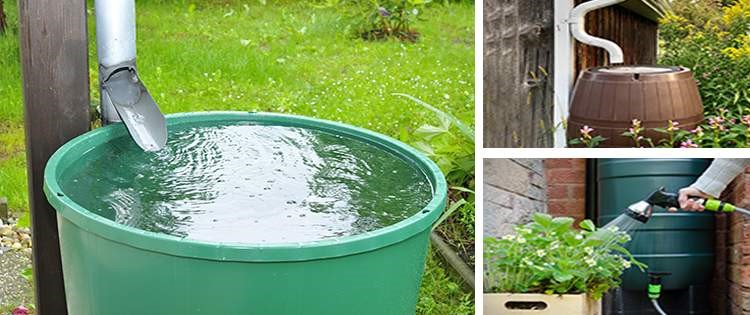
This DIY project is the best way to legally collect rainwater NO MATTER where you live. Get chlorine-free water, cut down on your water bills, and have enough for an emergency situation or to water your garden. Read More Here...
If you see the leaves curling inward like a cigar, the plant is telling you it’s thirsty. If the leaf tips are turning crunchy and brown, it might be a sign of salt buildup from tap water or over-fertilization. In these cases, a long, slow “flush” with rainwater or filtered water can help reset the soil chemistry.
Challenges and Common Mistakes
Even the toughest plants have an Achilles’ heel. For the Bird of Paradise, it’s often the gardener’s desire to “help” too much. Over-parenting is the fastest way to kill a legacy plant.
Over-potting: If you are growing your *Strelitzia* in a container, do not give it a massive pot right away. These plants actually bloom better when their roots are slightly crowded. A plant in a pot that is too large will spend all its energy growing roots into the empty space, and the excess soil often stays too wet, leading to root rot. Wait until the roots are literally pushing the plant out of the pot or cracking the plastic before you move up one size.
The “Green Leaf” Trap: Gardeners often prune away any leaf that isn’t perfectly green. On a long-lived plant, those older, tattered leaves are still providing energy. Only prune leaves when they are completely brown and dry. When you do prune, cut the stem as close to the base as possible with a clean, sharp knife. Leaving “stubs” can create entry points for pests and fungal pathogens.
Chemical Burn: Avoid using heavy synthetic fertilizers, especially those high in phosphorus, which can accumulate in the soil over decades. Stick to organic options like fish emulsion, seaweed extract, or a simple top-dressing of compost each spring. These feed the soil life, which in turn feeds the plant.
Limitations and Environmental Constraints
While we want these plants to live forever, Mother Nature has the final say. *Strelitzia* are subtropical plants. They can handle a light frost—down to about -2°C (28°F) for short periods—but a sustained freeze will turn those water-filled leaves into mush.
| Variety | Min. Temp (Approx) | Max Height | Best Use |
|---|---|---|---|
| S. reginae | -2°C / 28°F | 1.5m / 5ft | Small gardens, pots, focal points |
| S. nicolai | -1°C / 30°F | 9m / 30ft | Privacy screens, large estates |
| S. juncea | -4°C / 25°F | 1.2m / 4ft | Xeriscaping, modern architecture |
If you live in a region with hard winters, you have two choices: grow them in large pots that can be wheeled into a frost-free garage, or treat them as a “die-back perennial.” In some areas, the leaves will freeze, but the underground rhizome survives and pushes out new growth in the spring. However, this cycle of freezing and regrowing prevents the plant from ever reaching its full “legacy” size and reduces its lifespan.
Practical Tips for Ongoing Care
Maintenance for a 50-year plant isn’t about daily chores; it’s about seasonal observations. Every spring, I take a walk around my garden and look at the “base” of my Birds. If I see the rhizomes starting to heave out of the ground, I add a fresh layer of mulch. This protects the delicate new growth from the sun and helps maintain soil moisture.
- Mulching: Use a coarse wood chip or bark mulch. Avoid fine mulches that can mat down and prevent oxygen from reaching the roots. Keep the mulch a few inches away from the plant’s stems to prevent rot.
- Cleaning: Giant White Birds of Paradise (*S. nicolai*) collect a lot of dust on their broad leaves. A quick spray with the hose once a month keeps the “pores” (stomata) clear and helps the plant photosynthesize more efficiently.
- Pest Management: Watch for scale and mealybugs. They love to hide in the tight crevices where the leaf meets the stem. A simple spray of neem oil or insecticidal soap usually does the trick if caught early.
Advanced Considerations: Dividing the Giant
Eventually, a healthy Bird of Paradise will become too large for its space. This usually happens around the 15-to-20-year mark. Dividing a mature clump is a “serious gardener” task that requires a sharp spade and sometimes a second set of hands.
The best time to divide is in early spring, just before the main growing season begins. You have to dig up the entire clump—which can be heavy—and look for natural “seams” in the rhizome. Using a clean saw or a heavy-duty spade, cut through the rhizome, ensuring each new section has at least three or four healthy leaves and a good portion of the root system. Replant immediately and keep the new divisions well-watered for the first six months. This isn’t just maintenance; it’s how you share the plant’s legacy with friends and family.
Example Scenario: The 30-Year Transformation
Consider a gardener who planted a single *Strelitzia reginae* in a well-prepared spot in 1994. For the first three years, the plant produced only leaves. By year five, it offered its first few orange blooms. By year fifteen, the single plant had become a clump 1.5 meters (5 feet) wide with dozens of flowers every spring.
Now, thirty years later, that plant has survived three major droughts and a record-breaking heatwave. Because the gardener prioritized soil health and deep watering early on, the plant’s rhizome system is now a massive, self-sustaining battery. It requires almost no fertilizer and only occasional pruning of old leaves. This is the definition of legacy gardening—effort spent upfront for decades of effortless beauty.
Final Thoughts
Returning to legacy gardening means shifting our perspective from the “instant garden” to the “enduring landscape.” The Bird of Paradise is one of the few plants that can truly bridge the gap between generations, standing as a living witness to decades of family life. By choosing the right variety and planting it with the next fifty years in mind, you are doing more than just landscaping; you are creating a heritage.
Don’t be discouraged if your plant doesn’t look like a magazine cover in the first year. The most resilient things in nature take time to find their footing. Focus on what’s happening beneath the soil, and the flowers will eventually take care of themselves. Whether you choose the towering *S. nicolai* or the architectural *S. juncea*, you are inviting a long-term companion into your garden.
As you continue your journey, keep exploring other aspects of garden longevity, such as soil health and efficient irrigation methods. The more you understand the ecosystem of your backyard, the better you can support these tropical giants. Happy planting, neighbor.