
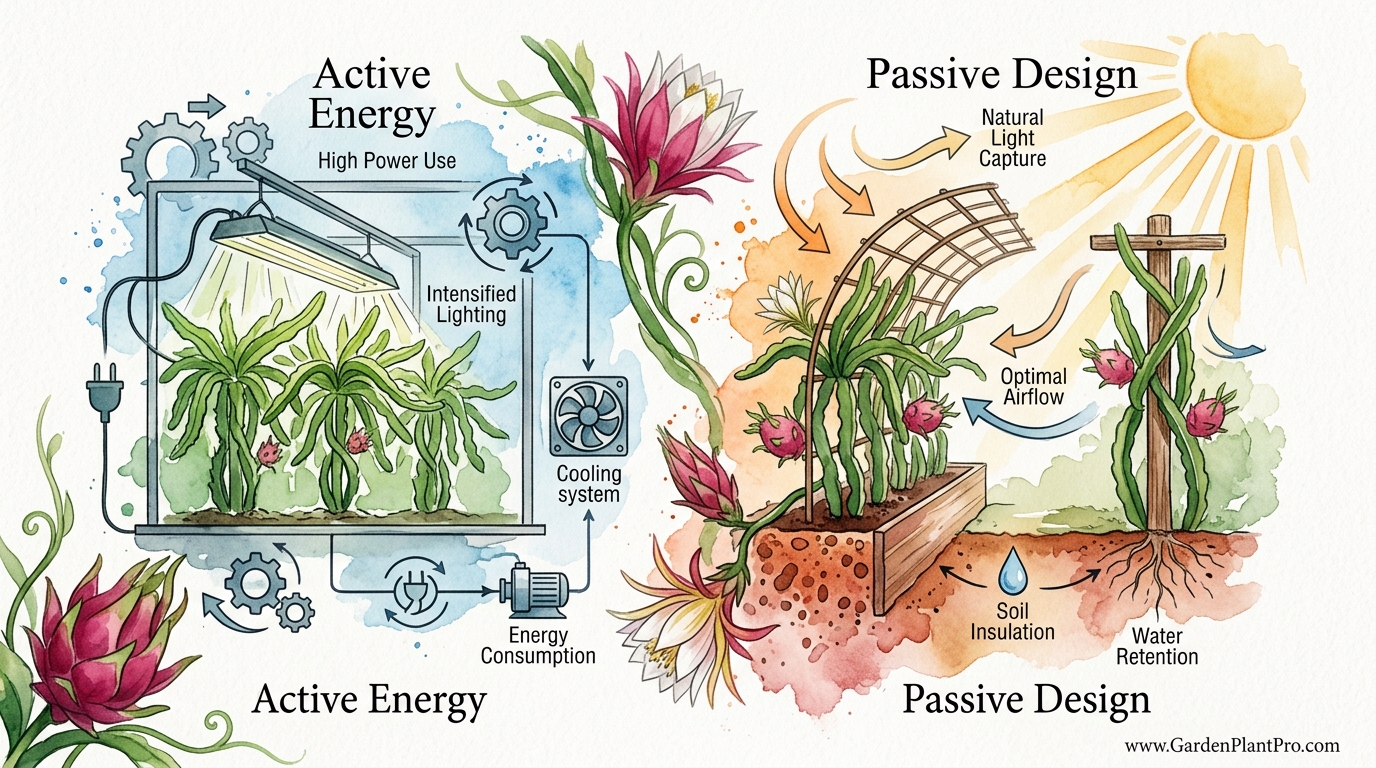
Are you paying the electric company to do what a well-placed tree can do for free? Most indoor growers think they need 24/7 grow lights and industrial humidifiers to get fruit. The secret isn’t more technology—it’s better design. By creating a passive microclimate that mimics its jungle home, you can get 3x the yield with 0% of the electric bill. Stop fighting nature and start using it.
Growing these exotic cacti feels like holding a piece of the tropics in your own backyard. These plants are tough, but they are also particular about their comforts. If you treat them like a desert cactus, they will survive, but they won’t thrive. If you treat them like a jungle epiphyte—which is what they actually are—they will reward you with buckets of fruit.
The journey from a simple cutting to a heavy, fruiting canopy doesn’t require a degree in engineering. It just requires a bit of observation and a willingness to work with the sun instead of against it. Let’s look at how we can turn your garden into a low-energy sanctuary for dragon fruit.
Low Energy Dragon Fruit Growing
Low energy dragon fruit growing is an approach that prioritizes natural systems and passive design over mechanical inputs like heaters, fans, and artificial lights. This method exists because dragon fruit (Hylocereus and Selenicereus species) evolved in tropical and subtropical regions where temperatures stay mild and humidity is relatively high.
In the real world, this looks like choosing the right spot next to a thermal mass, such as a brick wall, rather than installing a space heater in a flimsy plastic greenhouse. It means using the shade of a deciduous tree to protect your plants from the 100°F (38°C) mid-summer sun instead of running an evaporative cooler.
Gardeners use these techniques to grow dragon fruit in regions where the climate might be slightly too cold or too dry. By creating a microclimate, you can essentially “trick” the plant into thinking it is back in its native Central American forest. This approach is sustainable, cost-effective, and often leads to healthier plants because it reduces the stress caused by artificial environments.
The Mechanics of Passive Design
Passive design is all about capturing and holding the energy that the sun provides for free. The most critical factor is orientation. In the Northern Hemisphere, you want your dragon fruit facing south to catch the maximum amount of winter sun. If you are in the Southern Hemisphere, you’ll look for a north-facing aspect.
Thermal mass is your best friend when the sun goes down. Materials like stone, concrete, and water have a high “heat capacity,” meaning they soak up heat during the day and radiate it slowly at night. I’ve seen growers place 55-gallon (208-liter) dark-colored water barrels within 3 feet (1 meter) of their plants. These barrels can bump up the temperature in that immediate area by 5°F to 7°F (3°C to 4°C) overnight, which is often the difference between a thriving plant and one damaged by frost.
Airflow is the other half of the equation. While we want to trap heat, stagnant air is a recipe for fungal issues like cactus rust. A passive system uses natural convection—warm air rising and pulling in cool air—to keep the canopy dry. This is why a “lean-to” structure against a house wall works so well; the wall provides heat, while the open ends allow the breeze to move through.
Agroforestry: The Jungle Mimicry Technique
Dragon fruit are naturally climbers. In the wild, they don’t grow on concrete poles; they scale trees. Growing dragon fruit on live trees is a classic agroforestry technique that can actually increase your yields. Certain trees, like the Moringa or Ravenala, provide a “living trellis” that offers several passive benefits.
The leaves of a companion tree provide filtered light, which is exactly what dragon fruit wants. While they need 6 to 8 hours of sun, intense direct light can cause sunscald, especially in arid regions. A tree canopy acts as a natural 30% shade cloth. Research in some tropical regions has shown that integrating specific trees can boost dragon fruit yields by nearly 20% by maintaining higher localized humidity and protecting the stems from extreme heat.
Intercropping with shorter plants also helps. Low-growing herbs or vegetables like basil and spinach act as a “living mulch.” They keep the soil surface cool and moist, reducing the need for frequent irrigation. This polyculture setup mimics a forest floor, recycling nutrients and supporting a healthy population of beneficial insects that keep pests in check.
Seasonal Care and Protection
Winter is the biggest hurdle for low-energy growers. Dragon fruit are mostly water, and when temperatures dip below 40°F (4°C), that water can freeze and expand, turning the plant’s flesh into mush. Instead of a heater, I recommend the “black trash bag teepee” for smaller plants or frost blankets for larger ones.
Covering the soil surface is just as important as covering the stems. A thick layer of organic mulch, such as straw or wood chips, prevents “cold collaring.” This is when the stem freezes right at the soil line, cutting off the plant’s circulation even if the top stays green. Mulch keeps the root zone several degrees warmer than the ambient air.
In the summer, the focus shifts to hydration and shade. If you see your dragon fruit stems turning yellow or developing white, “bleached” spots, they are getting too much sun. A temporary piece of burlap or a light-colored lattice can provide the necessary relief. Remember, a hydrated plant handles heat much better than a thirsty one. Keeping the soil consistently moist (but never soggy) is your best defense against heat stress.
Pruning for Maximum Productivity
Pruning is one of the few “active” tasks you must do, but it requires no electricity—just a sharp pair of shears. The goal is to manage the plant’s energy. In the first year, you should allow only one or two main stems to grow up your support. Remove every side shoot that appears. You want the plant’s energy going into a thick, sturdy “trunk.”
Once the stem reaches the top of your trellis (usually around 5 to 6 feet or 1.5 to 1.8 meters), you “tip” it by snipping off the growing end. This signals the plant to start branching out, forming the umbrella canopy where the fruit will grow. A mature plant can handle 120 to 160 branches, but you must keep them thinned out.
Sunlight needs to reach the inner parts of the canopy. If the branches are too crowded, they will shade each other out, and only the outermost ones will produce fruit. Removing thin, weak, or overlapping branches every winter ensures that when spring arrives, the plant is ready to push its energy into flower buds rather than just more green growth.
The Role of Natural Pollinators
Dragon fruit flowers are famous for being “Ladies of the Night.” They open after dusk and usually wilt by the next morning. In a low-energy system, we want to attract natural pollinators like hawk moths and bats to do the work for us. You can encourage these visitors by planting fragrant, night-blooming companion plants nearby.
DIY PROJECT: Collect rainwater no matter where you live...
This DIY project is the best way to legally collect rainwater NO MATTER where you live. Get chlorine-free water, cut down on your water bills, and have enough for an emergency situation or to water your garden. Read More Here...
Bees will often visit the flowers in the very early hours of the morning before they close. If you are growing a self-sterile variety, you need these insects to move pollen from one variety to another. Growing at least two or three different varieties increases your chances of a successful fruit set significantly.
If you don’t have a lot of natural pollinators yet, a simple paintbrush can serve as your backup. Hand-pollination is a 5-minute task at dusk or dawn. Just collect the yellow dust (pollen) from the outer parts of the flower and dab it onto the central “stigma” that pokes out. This small effort ensures that every flower becomes a fruit, effectively doubling or tripling your harvest compared to leaving it entirely to chance.
Benefits of the Passive Approach
Choosing a passive, low-energy method offers several measurable advantages over high-tech growing:
- Zero Electric Costs: You aren’t tied to the grid for heating, cooling, or lighting, which makes your garden resilient to power outages.
- Water Conservation: Using mulch and companion planting can reduce water evaporation by up to 20%, a huge benefit in drought-prone areas.
- Superior Fruit Quality: Slow, natural growth often results in higher “Brix” levels (sugar content). Store-bought fruit is often picked green, but your sun-ripened backyard fruit will be much sweeter.
- Reduced Pest Pressure: A diverse garden ecosystem attracts predatory insects like ladybugs and lacewings, which naturally manage aphids and thrips.
Challenges and Common Mistakes
The most common mistake I see is overwatering during the winter. Because dragon fruit are cacti, their metabolism slows down significantly when it’s cool. If the soil stays wet for too long, the roots will rot. I always tell folks: “If you aren’t sure if it needs water in January, wait another week.”
Another pitfall is neglecting the trellis. A mature dragon fruit canopy can weigh several hundred pounds (over 100 kg). If you use a flimsy wooden stake or a thin PVC pipe, it will eventually snap, usually right when it’s loaded with fruit. Invest the time in a sturdy concrete or pressure-treated wood support from day one.
Lastly, don’t forget to acclimate new plants. If you buy a cutting that was grown in a greenhouse and put it directly into the hot afternoon sun, it will sunscald within hours. Give it “dappled” shade for at least two weeks before letting it take the full force of the sun.
Limitations of Low Energy Systems
Passive design has its limits. If you live in a region where temperatures regularly stay below freezing for weeks at a time (USDA Zone 7 and below), a purely passive outdoor setup likely won’t work. In these cases, the “low energy” compromise is to grow in large 20-gallon to 25-gallon (75 to 95 liter) pots on wheels.
This allows you to keep the plants outside for 9 months of the year and roll them into a garage or a basement for the coldest 3 months. While this uses a bit of “human energy,” it still avoids the high cost of heating a greenhouse all winter.
Extremely humid environments can also be a challenge. If your air is constantly at 90% humidity, you’ll need to prune more aggressively to ensure massive airflow. Without the help of electric fans, you are relying entirely on the wind to prevent fungal rot, so spacing your plants further apart becomes essential.
Comparison: Passive Design vs. Active Energy Systems
| Feature | Passive Microclimate | Active Tech Setup |
|---|---|---|
| Monthly Cost | $0 (Free) | $50 – $200+ (Electricity/Water) |
| Maintenance | Low (Pruning/Mulching) | High (Monitor systems/Repairs) |
| Initial Effort | Moderate (Design/Tree planting) | High (Equipment installation) |
| Resilience | Very High (Works without power) | Low (Fails during outages) |
Practical Tips for Success
If you want to start today, here are some actionable steps:
- Check your pH: Dragon fruit love slightly acidic soil (pH 5.5 to 6.5). If your soil is too alkaline, add a bit of elemental sulfur or use coffee grounds as a top dress to lower the pH naturally.
- Use “Liquid Thermal Mass”: Paint a few 5-gallon (19-liter) buckets black, fill them with water, and place them at the base of your trellis. They are cheap, portable, and effective.
- Morning Sun is King: If you have to choose between morning sun and afternoon sun, pick morning. It warms the plant up after a cold night and is less likely to cause sunscald than the harsh 3 PM rays.
- Fertilize with Biology: Instead of synthetic salts, use worm castings or well-rotted chicken manure. These provide slow-release nutrients and support the beneficial microbes that keep roots healthy.
Advanced Considerations
For those looking to push their harvest further, variety selection is the most important decision you’ll make. Varieties like ‘Vietnamese White’ are the gold standard for beginners because they are incredibly vigorous and disease-resistant. However, if you want sweetness, look for ‘Sugar Dragon’ (also known as S8), which is a universal pollinator and handles both heat and cold better than many other types.
If you are building a more permanent structure, consider a “Climate Battery.” This involves burying pipes about 3 feet (1 meter) underground. A tiny, low-wattage solar fan can push warm daytime air into these pipes, where the earth stores the heat. At night, the fan pulls that warmth back up. It’s an advanced passive technique that can keep a greenhouse frost-free even in very cold climates with almost zero energy usage.
Also, keep an eye on your stems’ “powder.” Many hardy varieties develop a waxy, white coating (glaucous) on their stems. This is a natural sunscreen and helps the plant retain moisture. If your variety doesn’t have this, it will likely need more shade during the peak of summer.
Example: The Southern California Backyard
Let’s look at a typical 1/4-acre backyard. A gardener plants four dragon fruit poles along a south-facing block wall. This wall acts as a massive radiator, holding the day’s heat. Between the poles, they plant Moringa trees.
In the summer, the Moringa provides light shade, keeping the dragon fruit from yellowing. In the winter, the Moringa loses some leaves, letting more sun reach the cactus stems. The gardener lays 4 inches (10 cm) of wood chip mulch around the base and places a dark water barrel next to each pole.
This setup requires zero electricity. During a surprise frost, the wall and the water barrels keep the air near the plants at 36°F (2°C) while the rest of the lawn is at 30°F (-1°C). The result? The dragon fruit survives without a scratch and produces three flushes of fruit between July and October.
Final Thoughts
Nature has already designed the perfect system for growing fruit; we just have to learn how to step out of the way. By focusing on thermal mass, natural shade, and healthy soil biology, you can produce an abundance of dragon fruit without the stress of high energy bills or complicated technology.
Do you have some charcoal in your house right now? We call charcoal a “miracle leftover” for anyone who wants to be a little more self-sufficient and cut costs. That’s because it can help you with so many different things around the house and garden. You can even use it to make an energy-free fridge. Read More Here...
Start by observing your yard. Where does the frost linger longest? Where does the sun hit first in the morning? These small details are the blueprints for your passive microclimate. Once you get the design right, the plants will do the rest of the work for you.
Don’t be afraid to experiment with different varieties and companion plants. Gardening is a conversation with the land, and every season is a chance to learn something new. Soon enough, you’ll be the neighbor sharing buckets of sweet, home-grown fruit over the fence, all thanks to the power of a little bit of sunshine and a whole lot of good design.