
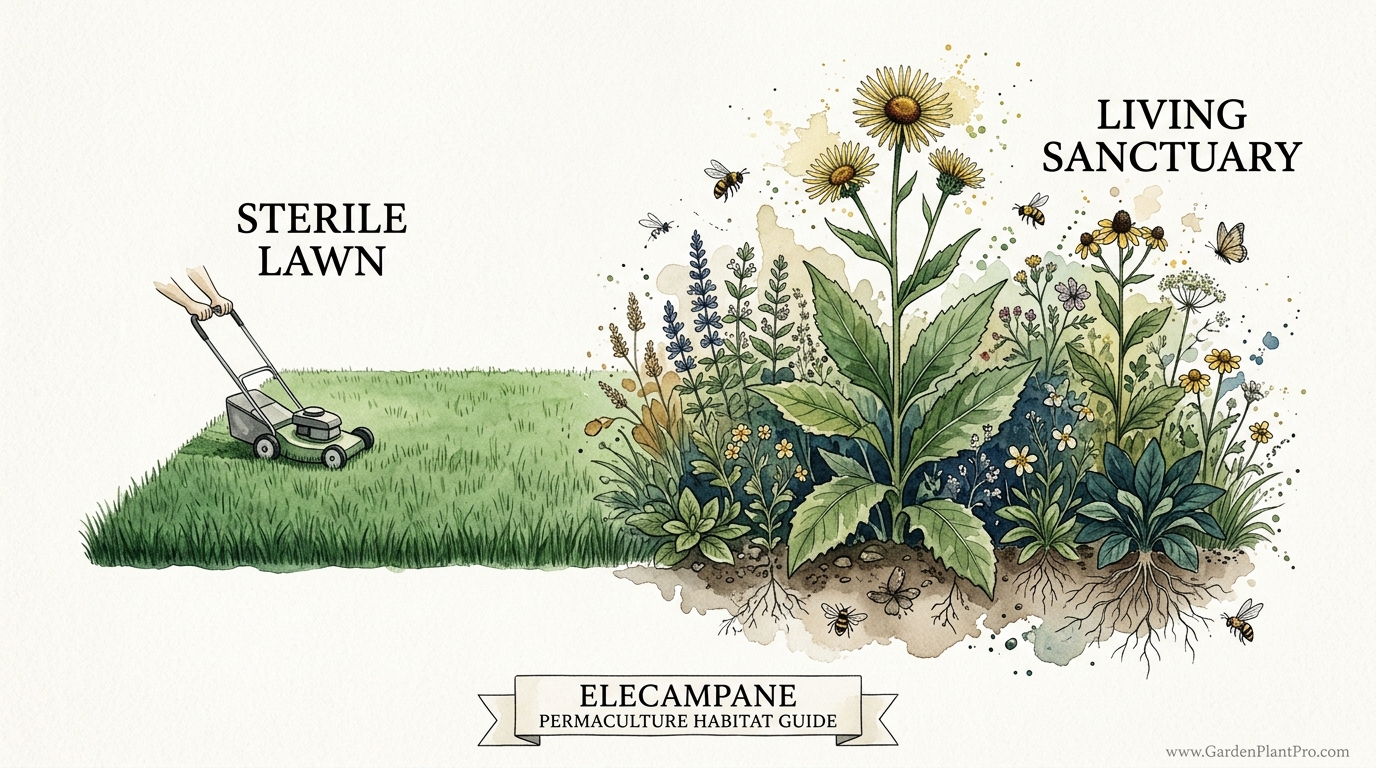
Your lawn is starving the local ecosystem, but this ancient herb can bring it back to life in just one season. We’ve been taught that a ‘clean’ yard is a good yard, but nature disagrees. Introducing the towering Elecampane means you’re not just planting a flower; you’re installing a high-speed refueling station for pollinators and a medicinal goldmine for your family. Break the cycle of the sterile urban lawn and embrace a garden that actually breathes.
Step into the shoes of someone who sees the garden not as a chore, but as a conversation between the soil and the sky. Elecampane, known scientifically as Inula helenium, is a plant that demands respect. It stands nearly 2.5 meters (about 8 feet) tall with leaves as large as a hiker’s backpack. This plant carries the weight of history and the vigor of a wild thing, yet it sits comfortably in the corner of a suburban backyard.
Working with this herb over the years has taught me that the best gardens are those that provide multiple layers of value. A sterile lawn offers nothing to the bees and nothing to your medicine cabinet. Elecampane, on the other hand, anchors the soil with deep roots and reaches for the sun with bright, yellow, shaggy blossoms. It is the bridge between a decorative border and a functional permaculture system.
Elecampane Permaculture Habitat Guide
Elecampane is a hardy, herbaceous perennial that belongs to the Asteraceae family. Its presence in a garden signifies a shift from high-maintenance turf to a resilient, self-sustaining habitat. Native to Europe and Asia, it has spent centuries migrating across the globe, following humans who valued its roots for healing and its flowers for beauty. In a permaculture setting, this plant serves as a “central pillar” in a guild, providing structure and resources for a variety of living organisms.
This plant thrives in USDA hardiness zones 3 through 7 or 8. It loves a spot where the ground remains consistently moist but not swampy. You will often find it flourishing in the dappled sunlight of a woodland edge or standing proud in the full sun of a damp meadow. It is a plant of the “middle ground”—not a swamp dweller, but certainly not a desert survivor. Its massive leaves act as a natural umbrella, shading the soil at its base and keeping the ground cool for beneficial microbes and earthworms.
Real-world applications for Elecampane are diverse. Gardeners use it as a living windbreak for more delicate vegetables, a source of nutrient-dense mulch, and a premier attractor for beneficial insects like hoverflies and solitary bees. It occupies a space in the garden that few other herbs can fill, bridging the gap between small culinary herbs and large shrubs or small trees.
How to Establish the Giant in Your Garden
Starting an Elecampane patch requires patience and an understanding of its reproductive cycle. You can begin from seed or root division, and each method offers its own set of rewards and challenges.
Sowing the Seeds of Transformation
Fresh seeds often have the highest germination rates. If you are starting from seed, remember that they require a period of cold stratification to break their dormancy. This mimics the natural winter they would experience in the wild. You can sow them directly into the soil in late autumn, or place them in a damp paper towel inside a refrigerator for 4 to 6 weeks before sowing in early spring.
Place the seeds on the surface of the soil. They need light to germinate, so do not bury them deep under the earth. A light dusting of fine compost or vermiculite is enough to keep them from blowing away while still allowing the sun to trigger their growth. Germination typically occurs within 14 to 21 days when temperatures are between 18°C and 22°C (64°F to 72°F).
Propagation Through Root Division
Dividing an established plant is the fastest way to expand your sanctuary. In early spring or late autumn, when the plant is dormant, use a sharp spade to lift the entire root crown. Look for the “eyes” or buds on the thick, fleshy rhizomes. Each section of the root that contains at least one healthy bud can be replanted to create a new individual.
Space these new plantings at least 60 centimeters to 90 centimeters (2 to 3 feet) apart. They might look small at first, but within two years, they will easily occupy a circle nearly a meter wide. Deep, fertile soil is the best medium for these root cuttings, as it allows them to establish the massive taproots required to support their towering stems.
The Multifaceted Benefits of Growing Elecampane
The advantages of welcoming this herb into your space go far beyond simple aesthetics. It is a workhorse of the permaculture world, performing several jobs at once without requiring much from you in return.
Ecological Fueling Station
Bees and butterflies flock to the bright yellow rays of the Elecampane flower. Each blossom is a complex landing pad filled with nectar and pollen. The flowers bloom from mid-summer into early autumn, a critical time when many other spring-blooming plants have already faded. Native bees, hoverflies, and even some species of moths rely on these late-season flowers to build up their energy reserves.
A Medicinal Goldmine
The roots of the Elecampane contain high concentrations of inulin, a prebiotic fiber that supports gut health. They also harbor volatile oils like alantolactone, which give the plant its characteristic spicy, warming scent. Historically, these roots have been used to treat “wet” coughs and respiratory congestion. They act as an expectorant, helping to clear the lungs and soothe the bronchial tubes. For a family gardener, having a steady supply of this “deep breather” herb is like having a private pharmacy in the backyard.
Soil Building and Biomass
Large leaves mean high biomass. When you practice “chop and drop” mulching, you cut the massive leaves in late summer and lay them directly on the soil surface. They decompose quickly, returning nitrogen and organic matter to the earth. This process feeds the soil food web, encouraging fungal growth and providing a habitat for predatory beetles that keep garden pests in check.
Challenges and Common Mistakes to Avoid
Even a plant as robust as Elecampane has its quirks. New gardeners often run into trouble because they underestimate the sheer scale of the plant or its water requirements.
Underestimating Space Requirements
Crowding is the most common error. When Elecampane is planted too close to smaller, less vigorous herbs, it will simply shade them out of existence. Its leaves are broad and heavy; they can easily smother a patch of thyme or oregano in a single afternoon. Always give it the “back of the border” position or a dedicated corner where it can reach its full potential without bullying its neighbors.
Ignoring Soil Moisture
Elecampane is not a plant for a dry, sandy hillside. If the soil dries out completely during the heat of summer, the large leaves will wilt and turn brown at the edges. This stress weakens the plant and makes it susceptible to aphids. Maintaining a thick layer of mulch around the base of the plant helps retain moisture, but in periods of drought, you must provide supplemental water. Aim for about 2.5 centimeters to 5 centimeters (1 to 2 inches) of water per week during the peak growing season.
Harvesting Too Early
Digging up the roots in the first year is a mistake. The plant needs that first full season to establish its energy reserves. For the best medicinal quality, wait until the second or third autumn after planting. This allows the roots to grow thick and accumulate the maximum amount of inulin and essential oils. Roots older than four years can become woody and difficult to process, so timing the harvest is a skill that comes with experience.
DIY PROJECT: Collect rainwater no matter where you live...
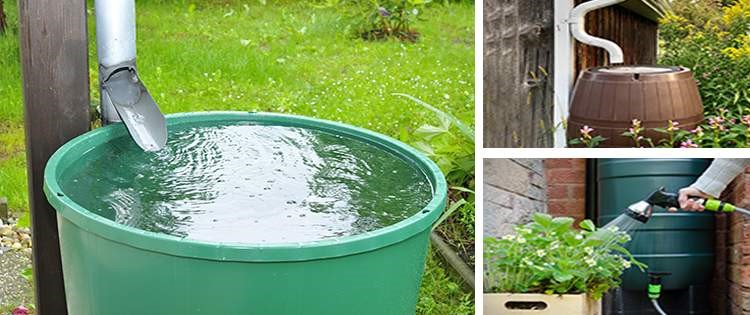
This DIY project is the best way to legally collect rainwater NO MATTER where you live. Get chlorine-free water, cut down on your water bills, and have enough for an emergency situation or to water your garden. Read More Here...
Limitations and Environmental Constraints
While I love this plant, it is important to recognize where it might not be the best fit for your land. No single plant is a universal solution, and Elecampane has specific boundaries.
Temperature and Climate Sensitivity
Heat is the primary enemy of this northern herb. In regions with scorching summers and high night-time temperatures, Elecampane may struggle to stay upright. It prefers the cool, damp climates of the Pacific Northwest, the Northeast, or Northern Europe. If you live in a Mediterranean or desert climate, you will need to provide significant shade and constant irrigation to keep it alive.
Potential for Aggression
In certain disturbed soils or damp meadows, Elecampane can become “weedy.” It produces a large number of seeds that are easily carried by the wind. While it is rarely classified as a noxious invasive species, it can certainly dominate a small garden if you do not deadhead the flowers before they go to seed. If your goal is a tidy, controlled space, you will need to be diligent about removing the spent blossoms.
Comparing Elecampane to Other Permaculture Giants
Gardeners often wonder whether they should plant Elecampane or its more famous cousin, Comfrey. Both are stars of the permaculture movement, but they serve slightly different purposes.
| Feature | Elecampane (Inula helenium) | Comfrey (Symphytum officinale) |
|---|---|---|
| Height | 1.5 – 2.5 meters (5 – 8 feet) | 0.6 – 1 meter (2 – 3 feet) |
| Primary Use | Respiratory Medicine / Pollinators | Soil Building / Topical Healing |
| Flowering Style | Showy, Sunflower-like | Bell-shaped, clusters |
| Internal Safety | Safe for teas/syrups (moderate use) | Contains PAs (use with caution) |
| Spread | Moderate (mostly by seed) | Aggressive (mostly by root fragments) |
Choosing between them often depends on your specific needs. If you want a tall architectural feature that feeds the bees and offers a safe internal medicine, Elecampane is the winner. If you need a rapid producer of leaf mulch that can be mowed down multiple times a year, Comfrey is hard to beat.
Practical Tips for Ongoing Care
Managing a large perennial requires a different mindset than tending to a row of annual tomatoes. Think of yourself as an editor, refining the growth of the plant to suit your garden’s story.
- Stake the giants: In areas with high winds, the flower stalks can sometimes topple over. Using a simple bamboo stake or a sturdy tomato cage early in the season provides the support they need.
- Mulch heavily: Apply 5 to 10 centimeters (2 to 4 inches) of wood chips or straw around the base. This mimics the forest floor and keeps the roots cool.
- Deadhead for control: If you do not want hundreds of seedlings next spring, cut the flower heads off as soon as they begin to fade. This also encourages the plant to put more energy into its roots.
- Watch for powdery mildew: Late in the season, the large leaves can develop a white, dusty coating. Improving airflow by spacing plants properly is the best prevention. If it appears, simply prune off the affected leaves and compost them—the plant will return healthy in the spring.
Advanced Considerations: The Medicine of the Soil
Experienced practitioners often look at Elecampane as more than just a plant; they see it as a biological tool. One advanced technique is using Elecampane to open up heavy clay soils. The taproot of a three-year-old plant can be as thick as a man’s wrist and penetrate deep into the subsoil. When you eventually harvest that root, the massive hole it leaves behind becomes a channel for air and water.
This creates a “biological tilling” effect. Instead of using a machine to break the soil, you use the life cycle of the herb. The decaying root fragments and the channels they leave behind become superhighways for earthworms and beneficial fungi. Over several years, a patch of land dominated by Elecampane will transform from compacted clay into a rich, friable loam.
Furthermore, serious herbalists pay close attention to the lunar and seasonal cycles during harvest. Digging the roots on a cool, dry autumn morning after the first frost ensures that the volatile oils are at their peak. Processing them immediately—slicing them into thin rounds and drying them at a low temperature—preserves the potency of the alantolactone. These small details separate the casual gardener from the true steward of the land.
Example Scenario: The Fruit Tree Guild
Let’s look at how this works in a real design. Imagine you have a young apple tree. Planting it in a sea of grass is a recipe for slow growth and pest problems. Instead, you create a guild.
On the north side of the tree, where the shade is most consistent, you plant three Elecampane starts. They grow tall, acting as a backdrop that reflects light onto the lower branches of the tree. Their deep roots do not compete with the shallow, spreading roots of the apple tree. In fact, they act as “nutrient miners,” bringing minerals up from the depths that the tree cannot reach.
Around the base of the Elecampane, you plant clover to fix nitrogen and yarrow to attract predatory wasps. Every autumn, you chop the Elecampane leaves and lay them around the base of the apple tree. This “living mulch” suppresses weeds and feeds the tree exactly what it needs to produce fruit the following year. This is how you build a living sanctuary.
Final Thoughts
The transition from a sterile lawn to a living sanctuary is a journey of many small steps. Introducing Elecampane is perhaps the boldest step you can take. It changes the vertical profile of your yard, draws in a chorus of insects, and provides a harvest that can actually help your family breathe easier.
Gardening is a craft learned through observation and the steady rhythm of the seasons. There is a deep satisfaction in watching a tiny seed turn into a two-meter giant in the span of a few months. It reminds us that nature is not something to be controlled and “cleaned,” but something to be nurtured and participated in.
Take the leap this season. Find a corner of your yard that feels empty and offer it to the Elecampane. You might be surprised at how quickly the local ecosystem responds. The bees will find it first, the soil will follow, and eventually, you will find yourself standing before these golden towers, realizing that your garden is finally alive.