
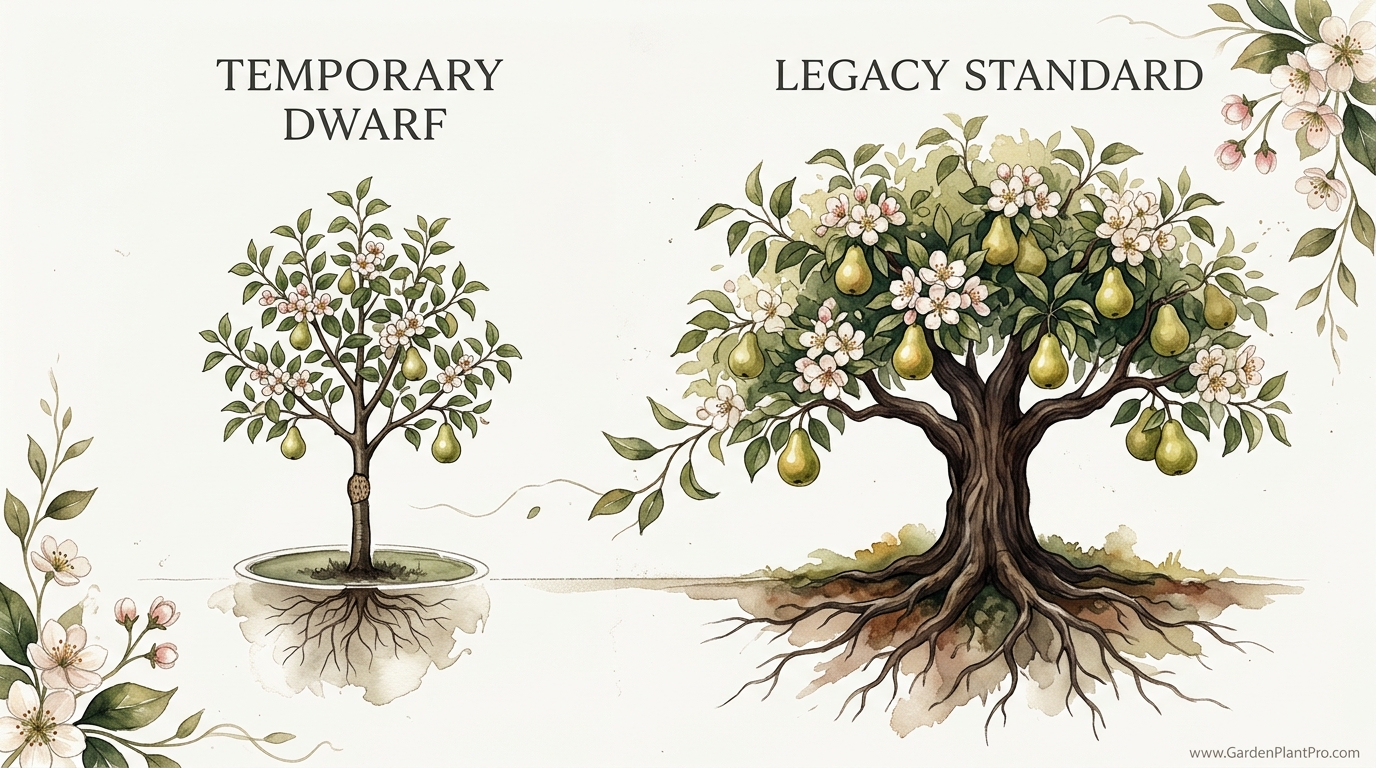
Are you planting a temporary garden ornament or a living inheritance that will feed your great-grandchildren? Modern gardening focuses on ‘fast and small’ with dwarf trees that often burn out in 15 years. But the ‘Legacy’ pear tree—a full standard—is a 100-year investment. It builds its own resilient root system, survives droughts, and becomes a pillar of your property’s ecosystem. Plant for the future, not just the season.
When I look across my fence at the neighborhood gardens, I see a lot of folks rushing to get fruit as fast as they can. They buy those little dwarf trees that fit in a whiskey barrel, hoping for a harvest by next summer. There is nothing wrong with wanting a quick snack, but there is a profound difference between a tree that lives as long as a dog and one that lives as long as a dynasty.
A true standard pear tree is a creature of patience and power. It spends its first decade quietly claiming the earth beneath it, pushing roots deep into the subsoil where the water is cool and the minerals are rich. While the neighbor’s dwarf tree is struggling through a dry August, the standard tree is barely noticing the heat. This is the difference between a temporary fixture and a legacy.
Choosing to plant a long-lived variety is an act of faith. You are deciding that your piece of land deserves something permanent. In this guide, I want to share what I have learned from decades of watching these giants grow, so you can pick a variety that will still be dropping fruit long after we are all gone.
Longest Living Pear Tree Varieties
Standard European pear trees (Pyrus communis) are the champions of longevity in the orchard world. While a typical dwarf tree might give up the ghost after 15 or 20 years, a well-sited standard pear on its own roots or a vigorous seedling rootstock can easily pass the 100-year mark. Some have even been known to reach 300 or 400 years of age under the right conditions.
The most famous example of this endurance is the Endicott Pear Tree in Danvers, Massachusetts. Planted around 1630 by Governor John Endicott, this tree has survived hurricanes, earthquakes, and even acts of vandalism for nearly four centuries. It is a European “sugar pear” variety, likely a ‘Bon Chrétien,’ and it still produces fruit today. This tree proves that a pear is not just a seasonal crop; it is a historical landmark.
Several specific varieties are renowned for their ruggedness and ability to withstand the test of time:
- Seckel: Often called the “sugar pear,” this is one of the hardiest and most disease-resistant heirloom varieties. It is a slow grower that builds exceptionally strong wood. Because it has high natural resistance to fire blight, it avoids the primary killer of younger, weaker trees.
- Kieffer: This is a hybrid between European and Asian pears. It is almost indestructible. It grows vigorously, handles heavy clay soils better than most, and is famous for its “bulletproof” nature against pests and diseases. A Kieffer planted today is a safe bet for a century-long lifespan.
- Bosc: Known for its long neck and bronze russeting, the Bosc is a sturdy, large-growing tree. It prefers slightly warmer climates but, once established, develops a massive canopy that can produce hundreds of pounds of fruit annually for generations.
- Anjou: Both Green and Red Anjou varieties are exceptionally cold-hardy. They are slower to come into production than some modern hybrids, but that slow start contributes to a denser, more resilient wood structure that resists breaking in heavy snow or high winds.
- Perry Pears: These are specialized varieties used for making pear cider. Ancient perry trees in England and parts of Europe are frequently 200 to 300 years old. Varieties like ‘Barland’ or ‘Butt’ grow into immense, oak-like trees that become the focal point of a landscape.
Rootstock: The Hidden Foundation
The variety of the fruit is only half the story. The rootstock is what determines the lifespan. If you buy a “Dwarf Bartlett,” you are getting a Bartlett branch grafted onto a rootstock that is genetically programmed to stay small and die young. To get a legacy tree, you must ensure your variety is grafted onto “Standard” rootstock, often Pyrus communis or Pyrus calleryana (though be careful with the latter in areas where it is invasive).
How the Century Tree Builds Its Legacy
A standard pear tree operates on a biological timeline that is much slower than our modern pace. During the first five to eight years, you might feel like nothing is happening. The tree grows upward, but fruit is sparse. This is because the tree is prioritizing its “anchorage” and “storage” systems.
Standard trees develop a taproot-dominant system initially, which eventually expands into a wide network of lateral roots. These roots can extend two to three times the width of the tree’s canopy. This massive subterranean footprint allows the tree to find moisture during severe droughts that would kill a shallow-rooted dwarf tree. It also allows the tree to store vast amounts of carbohydrates, which it uses to recover from late spring frosts or pest attacks.
Structural strength is another key factor. Standard trees produce “heartwood” that is much denser than that found in fast-growing, pampered dwarfs. As the tree ages, the trunk girth increases significantly, often reaching 5 to 8 feet (1.5 to 2.4 meters) in circumference. This massive trunk acts as a stabilizing pillar against the elements.
Step-by-Step Selection Process
- Identify your goal: If you want a tree for your children’s children, skip the big-box store “patio” trees. Search for specialized nurseries that offer “Full Standard” or “Seedling Rootstock” options.
- Check your soil: Pears love deep, well-drained loam but can tolerate heavier clay than apples. Ensure the site does not have a high water table that stays saturated for months, as even a legacy tree needs to breathe.
- Choose for disease resistance: Fire blight is the Achilles’ heel of the pear. Selecting a variety with “High Resistance” is the single best way to ensure the tree reaches its 100th birthday.
- Plan for space: A standard tree will eventually reach 30 to 40 feet (9 to 12 meters) in height and nearly as much in width. Give it at least 25 feet (7.5 meters) of clearance from buildings and other large trees.
The Practical Benefits of Planting Big
Landowners often worry about the size of a standard tree, but that size comes with measurable advantages. A single mature standard Kieffer or Seckel can produce 10 to 15 bushels of fruit in a good year. That is enough to feed a family, provide for the local food bank, and still leave plenty for the wildlife. You would need six or seven dwarf trees to match the output of one well-managed legacy tree.
Environmental resilience is another massive plus. These trees create their own microclimate. Their large canopies provide deep shade that keeps the soil cool and reduces evaporation for nearby plants. They also serve as vital habitat for beneficial insects and birds. Owls and hawks prefer the high vantage points of a standard pear tree to hunt for orchard pests like voles and mice.
Standard trees are also much more “forgiving” of neglect. If you miss a year of pruning or a week of watering during a heatwave, a century-old tree will hardly notice. Its deep reserves allow it to coast through human error. A dwarf tree, by contrast, is often just one missed irrigation cycle away from permanent damage.
Challenges and Common Pitfalls
The most common mistake gardeners make is planting a legacy tree in a “temporary” spot. You cannot easily move a standard pear tree once it has been in the ground for more than three years. Its root system becomes too extensive. Choosing the wrong location—one that might be cleared for a shed or a driveway in ten years—is a waste of the tree’s potential.
Pruning is another area where folks stumble. Because the tree gets so tall, people often stop pruning the top. This leads to “shading out,” where the lower branches die because they cannot get sunlight. To keep a legacy tree productive for a century, you must learn to prune for “light penetration.” This often involves using long-reach poles or even ladders, which can be a challenge for some gardeners.
Harvesting from a 30-foot (9-meter) tree is not as simple as picking from a bush. You will need a fruit picker pole and a willingness to let some fruit fall for the compost pile. If you are strictly looking for “easy” harvest, a standard tree might feel like a burden. But for the serious practitioner, the sheer volume of fruit makes the extra effort worthwhile.
Limitations and Environmental Constraints
Standard pear trees are not suitable for every yard. If you live on a 1/8-acre suburban lot, a standard tree will eventually take over the entire space. It may also drop fruit on the sidewalk or your neighbor’s roof, which can lead to complaints or pest issues like wasps and rats. In these cases, a “Semi-Dwarf” on a rootstock like OHxF 87 might be a better compromise, as it can still live 40 to 60 years without the extreme height.
Climate is also a boundary. While European pears are cold-hardy down to -20°F (-29°C), they require a certain amount of “chill hours” to fruit. If you live in a tropical climate, a legacy pear might never produce a single blossom. Conversely, in the extreme North, only the hardiest varieties like ‘Ure’ or ‘Golden Spice’ will survive the deep freezes of winter.
DIY PROJECT: Collect rainwater no matter where you live...
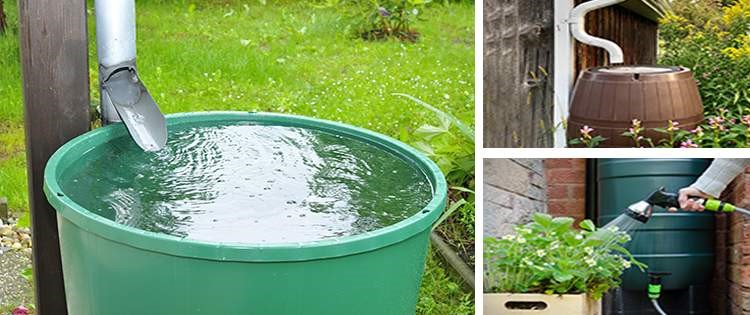
This DIY project is the best way to legally collect rainwater NO MATTER where you live. Get chlorine-free water, cut down on your water bills, and have enough for an emergency situation or to water your garden. Read More Here...
Comparing Pear Tree Life Tiers
Understanding the trade-offs between different tree sizes helps you decide where to invest your time and soil. Use this table as a general guide for what to expect over the decades.
| Feature | Dwarf Tree | Semi-Dwarf Tree | Standard (Legacy) Tree |
|---|---|---|---|
| Typical Lifespan | 15–20 Years | 35–60 Years | 80–300+ Years |
| Height at Maturity | 8–12 ft (2.5–3.6m) | 12–18 ft (3.6–5.5m) | 25–40 ft (7.6–12m) |
| Years to First Fruit | 2–3 Years | 4–6 Years | 7–10 Years |
| Drought Resistance | Low (Needs irrigation) | Moderate | High (Once established) |
| Maintenance Level | High (Pruning/Water) | Moderate | Low (Except for harvest) |
Practical Tips for Planting a Legacy
Planting a tree that you intend to stand for 100 years requires more care in the first hour than a temporary tree does in a lifetime. You are setting the trajectory for a century of growth.
- Dig a “Wide” Hole, Not Just Deep: The roots need loose soil to spread laterally. Dig a hole twice as wide as the root ball. This ensures the young roots can easily penetrate the surrounding earth in their first spring.
- Avoid Over-Fertilizing: Too much nitrogen in the early years creates “soft” growth that is highly susceptible to fire blight. Use aged compost or a slow-release organic amendment. You want steady, strong growth, not a sudden growth spurt.
- The “One-Inch” Rule: When planting, ensure the graft union (that bump at the base of the trunk) is at least 1 to 2 inches (2.5 to 5 cm) above the soil line. If the variety is buried, it might grow its own roots and bypass the rootstock’s benefits, or worse, develop collar rot.
- Mulch Like a Forest Floor: Apply a thick layer of wood chips or straw in a 4-foot (1.2-meter) circle around the base, but keep it a few inches away from the bark. This mimics the natural leaf litter of a forest and keeps the soil biology thriving.
Advanced Considerations: Fire Blight and Soil pH
Serious practitioners know that the “silent killer” of pear trees is Fire Blight (Erwinia amylovora). This bacterial disease can travel through an orchard like a wildfire. On a standard tree, a small infection on a twig can eventually travel down into the main scaffold limbs. Pruning out infections 12 inches (30 cm) below the visible damage and disinfecting your shears between every single cut is the only way to save a legacy tree from an outbreak.
Soil chemistry also plays a role in longevity. Pears prefer a slightly acidic pH between 6.0 and 6.5. If your soil is too alkaline, the tree may suffer from iron chlorosis, which weakens its immune system over time. Testing your soil every few years and adjusting with elemental sulfur or organic matter ensures the tree has the “nutritional stamina” to reach old age.
Grafting is another advanced skill worth learning. If you have a wild pear tree growing on your property, it is likely a “standard” with incredibly resilient roots. You can graft a high-quality dessert variety like ‘Conference’ or ‘Comice’ directly onto that wild base. This gives you the best of both worlds: gourmet fruit on a root system that was born for your specific soil.
Scenario: The 50-Year Orchard Plan
Imagine you have a half-acre of land. A smart way to plan for the future is to use a “staggered” planting approach. You might plant three dwarf trees in a sunny corner for immediate fruit within two years. At the same time, you plant one standard Seckel pear in a permanent spot 30 feet away.
After 15 years, those dwarf trees will likely be declining. Their production will slow, and they may show signs of trunk rot or viral stress. But your Seckel pear will just be entering its prime. By the time you are ready to remove the tired dwarf trees, the standard tree will be a massive producer, providing more fruit than all the dwarfs combined. You have successfully transitioned from a high-maintenance “fruit garden” to a low-maintenance “food forest.”
Final Thoughts
Planting a legacy pear tree is one of the few things a person can do today that will be tangibly useful in the year 2124. It is a quiet rejection of our “disposable” culture. Instead of a plastic ornament or a short-lived shrub, you are creating a biological engine that converts sunlight and rain into sweetness for generations to come.
Every time you prune a standard tree or check its bark for health, you are participating in a tradition that stretches back to the earliest orchards of the Old World. These trees ask for very little—just a bit of space, some decent soil, and the patience to let them grow at their own pace. In return, they offer a lifetime of shade, beauty, and abundance.
I encourage you to look at your garden not just as it is this spring, but as it could be when your grandchildren are grown. Find a spot for a standard pear. It is the best gift you can leave behind. If you want to continue improving your land, consider looking into soil health and permanent irrigation methods to give your new legacy tree the best start possible.