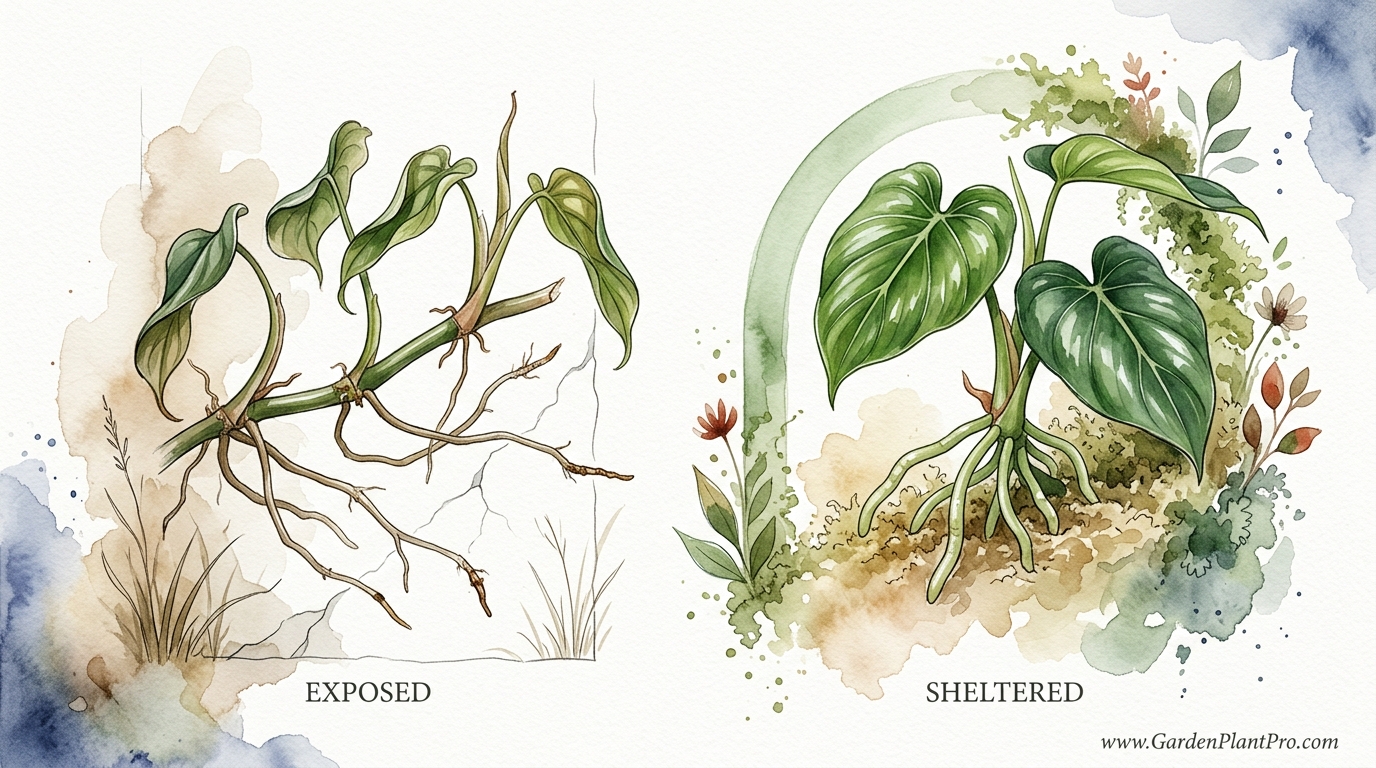
Your Philodendron’s aerial roots are its high-speed nutrient straw – if you stop letting them dry out in the open air. Most indoor gardeners treat aerial roots like a messy nuisance to be ignored or trimmed. But in the rainforest, these roots are the secret to those massive, floor-to-ceiling leaves we all want. When you ‘shelter’ these roots in a moist moss pole instead of ‘exposing’ them to dry AC air, you trigger a growth hormone shift that tells the plant it’s safe to produce giant foliage.
Many of us started our journey by letting these plants trail down from a bookshelf. It looks nice for a while, but eventually, the leaves get smaller and the stems get leggy. That is because the plant thinks it is still on the forest floor, searching for something to climb. Giving those roots a home changes everything.
I have spent years watching how these plants behave when they find a bit of damp bark or a mossy branch. They do not just hold on for dear life; they start drinking. Once that connection is made, the plant stops putting energy into long, searching stems and starts pumping it into those big, beautiful leaves.
Philodendron Aerial Root Care Tips
Aerial roots are adventitious roots that grow from the nodes of your Philodendron stem, rather than from the main root ball under the soil. In their natural habitat, these plants are often hemiepiphytes, meaning they spend part of their life growing up the trunks of trees. These roots serve three main purposes: stability, hydration, and nutrient collection.
In the wild, an aerial root will latch onto the rough bark of a tree using a sticky mucilage. Once it is secure, it begins to draw in moisture from the humid jungle air and dissolved minerals from decaying organic matter on the tree. Indoors, we often lose out on this because our homes are much drier than a rainforest.
If you see brown, woody “fingers” reaching out from your plant, do not panic. These are a sign of a healthy, maturing plant. You can leave them alone, but if you want to see the plant reach its full potential, you should give those roots a place to grow into.
How Sheltering Roots Triggers Growth
When an aerial root makes contact with a moist, textured surface, it sends a signal to the rest of the plant. This contact activates specific hormonal pathways involving cytokinins and gibberellins. These hormones are responsible for leaf expansion and the transition from juvenile to mature foliage forms.
Research shows that aerial roots are actually more efficient at nitrogen uptake than subterranean roots in some conditions. By providing a moist moss pole, you are essentially giving your plant a second “mouth” to feed through. This supplemental hydration allows the plant to support larger leaf surface areas without wilting.
The transition is often visible in the thickness of the stem. A Philodendron that has successfully “sheltered” its roots will develop a much thicker main vine. This structural integrity tells the plant it can safely support the weight of heavy, mature leaves without snapping.
The “Sheltered” vs. “Exposed” Approach
The way you manage these roots depends on your goals for the plant. If you want a tidy, trailing plant, you might let them stay exposed or even trim them. But if you are chasing “unicorn” leaf sizes, sheltering is the only way to go.
| Feature | Exposed (Air Roots) | Sheltered (Moss Pole) |
|---|---|---|
| Leaf Size | Generally stays small or juvenile. | Increases significantly as the plant climbs. |
| Growth Rate | Steady, but often becomes leggy over time. | Rapid vertical growth once established. |
| Maintenance | Low; just occasional dusting or misting. | Moderate; requires regular pole watering. |
| Hormonal State | Searching/Juvenile mode. | Anchored/Mature mode. |
| Root Function | Mostly structural or minimal hydration. | Active nutrient and water absorption. |
How to Shelter Your Aerial Roots
Setting up a moss pole is the most effective way to shelter these roots. You want to use long-fiber sphagnum moss because it holds moisture while still allowing oxygen to reach the roots. Avoid coco coir poles if your goal is root penetration; coco coir is often too dense and dry for delicate root tips to enter.
Start by soaking your sphagnum moss in water until it is fully saturated, then squeeze out the excess. Pack it firmly into a mesh or wire frame. When you attach your plant, ensure the nodes—the bumps where the leaves and aerial roots emerge—are pressed directly against the damp moss.
You can use soft plant ties or garden velcro to secure the stem. I like to use the “two-finger rule”: leave enough space between the tie and the stem to fit two fingers. This prevents the tie from cutting into the tissue as the stem thickens. Within a few weeks of consistent moisture, you will see the aerial roots dive into the moss and disappear.
Benefits of Proper Root Management
The most obvious benefit is the maturation of the foliage. Species like the Philodendron dubium or Philodendron erubescens look completely different in their mature forms compared to the small plants we buy at the garden center. Sheltering the roots is the “fast-forward” button for this process.
Another major advantage is stability. As these plants grow, they can become quite top-heavy. A plant that has rooted itself into a sturdy pole is much less likely to topple over or suffer stem damage from its own weight. It acts like a natural scaffolding system that grows with the plant.
Finally, having an active secondary root system makes the plant much more resilient. If you ever experience issues with the soil roots—like accidental overwatering or soil-borne pests—the aerial roots in the moss pole can keep the plant hydrated while the bottom half recovers.
Challenges and Common Mistakes
The biggest mistake I see folks make is letting the moss pole dry out completely. When sphagnum moss gets bone-dry, it becomes hydrophobic, meaning it actually repels water. You will try to water it from the top, and the water will just run off the surface without soaking in.
Another issue is using the wrong ties. Wire or thin string can easily slice through the soft tissue of a new node. Always use something wide and flexible. I have seen plants lose entire top sections because a wire tie acted like a saw during a growth spurt.
Lastly, do not forget that a moss pole needs nutrients too. Since the aerial roots are actively drinking from the pole, you should occasionally use a very diluted liquid fertilizer when you hydrate the moss. This mimics the nutrient-rich runoff they would find on a tree trunk in the wild.
DIY PROJECT: Collect rainwater no matter where you live...
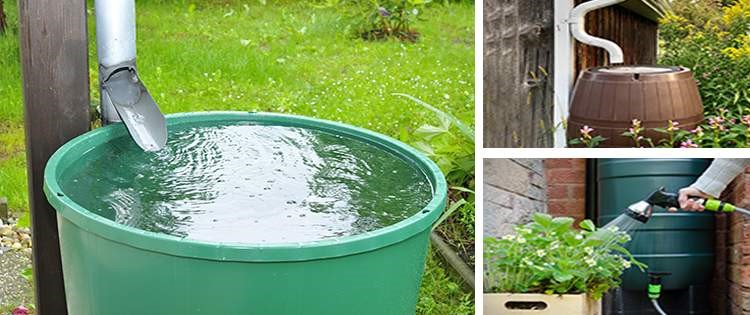
This DIY project is the best way to legally collect rainwater NO MATTER where you live. Get chlorine-free water, cut down on your water bills, and have enough for an emergency situation or to water your garden. Read More Here...
Limitations: When This May Not Work
Not every Philodendron is a climber. If you have a “self-heading” variety, like a Philodendron ‘Birkin’ or ‘Prince of Orange’, a moss pole will not do much for you. These plants grow in a rosette pattern and do not have the long, vining stems needed to scale a support.
Environmental humidity also plays a role. If your home is extremely dry (below 30% humidity), keeping a moss pole moist can be a full-time job. In these cases, you might be better off focusing on subterranean root health and using a simple trellis for support instead of a functional moss pole.
Advanced Techniques: Air Layering
Once you get comfortable with aerial roots, you can use them for propagation. This is called air layering. If you have a particularly valuable or leggy plant, you can wrap a specific node in damp moss and plastic wrap while it is still attached to the mother plant.
This encourages the aerial roots to develop into a full root system before you ever make a cut. It is a much safer way to propagate rare species like a Philodendron ‘Pink Princess’ because the cutting already has a “head start” on life. Once you see a thick cluster of white roots through the plastic, you can snip the stem and pot it up immediately.
Example Scenario: The Scaling Heartleaf
Imagine you have a standard Heartleaf Philodendron (P. hederaceum) that has been trailing for years. The leaves are about 3 inches (7.6 cm) long. You decide to move it onto a 4-foot (1.2 m) moss pole.
For the first month, you keep the pole damp and tie the nodes every 6 inches (15 cm). By month three, the new leaves emerging near the top of the pole are already 5 inches (12.7 cm) long and much thicker. By the time it reaches the top of that 4-foot pole, those heart-shaped leaves could easily be 8 to 10 inches (20-25 cm) wide, simply because the plant feels “sheltered” and secure.
Final Thoughts
Treating your Philodendron’s aerial roots as a vital organ rather than a cosmetic flaw is the key to unlocking the giant, tropical growth we all admire. It takes a bit more effort to maintain a moist pole than it does to let a vine hang, but the rewards are written in the leaves.
Start small by guiding just one or two roots into the soil or onto a damp support. You will soon see the plant respond with more vigor and larger foliage. Gardening is often about listening to what the plant is trying to do naturally, and these roots are practically screaming for a place to call home.
Experiment with different mosses and supports to see what your specific plant prefers. Every home environment is a little different, but the basic biological need for “shelter” remains the same for these jungle climbers. Give them that security, and they will transform your space into a true indoor forest.