
A tree in a lawn is a tree in a desert, but a tree in a guild is a fruit-bearing powerhouse. Most gardeners treat their lychee tree like a statue in a lawn, wondering why it never fruits. In nature, lychees thrive in complex ecosystems. By surrounding your tree with a ‘guild’ of support plants, you create a self-fertilizing, pest-resistant system that produces more fruit than you’ll know what to do with.
The secret to a heavy lychee harvest is not a blue bag of synthetic fertilizer. It is the soil life and the community of plants working together beneath the canopy. Lychees have shallow, brittle root systems that hate competition from turf grass but love the cool, moist environment of a forest floor. Designing a guild is simply the process of rebuilding that forest floor in your own backyard.
Lychee Companion Planting Guide
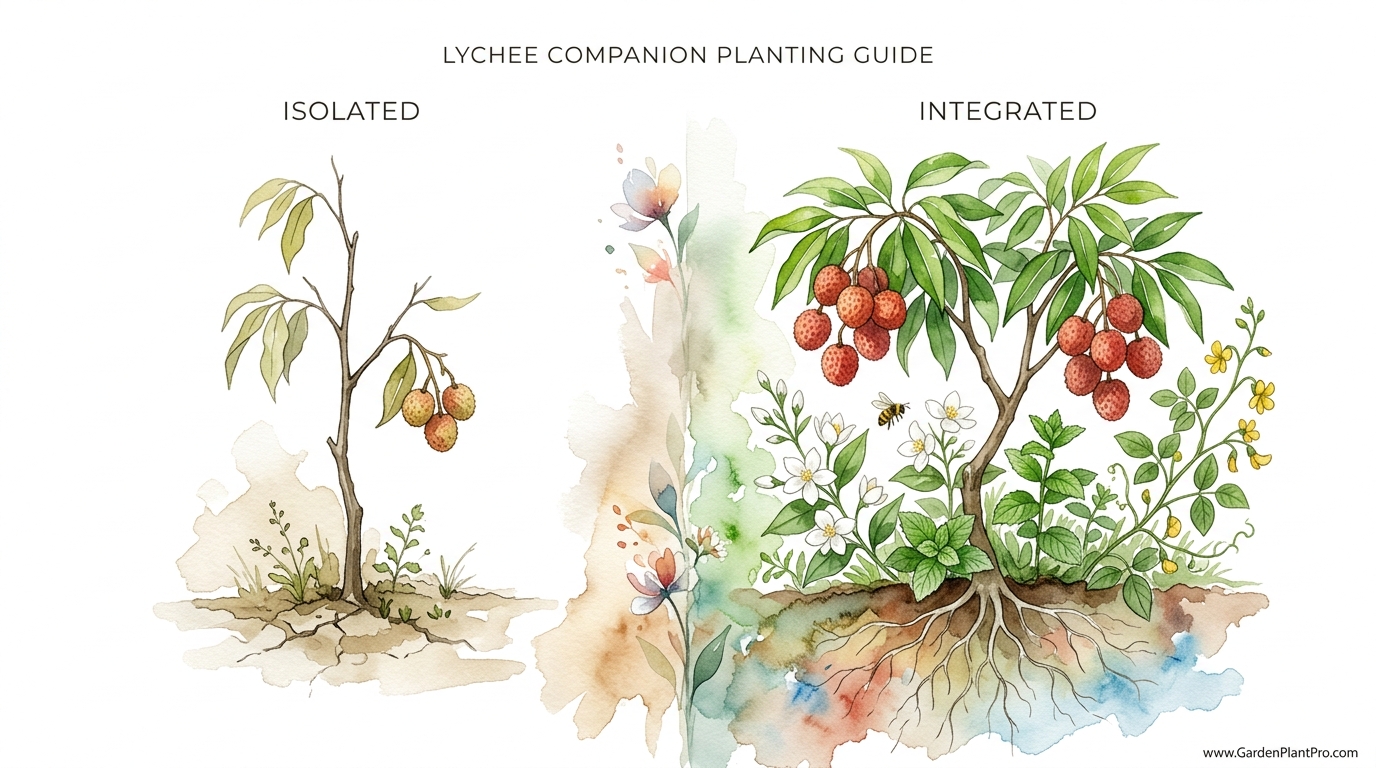
Lychee companion planting is the practice of surrounding a lychee tree with a specific set of plants that provide nutrients, manage pests, and improve the soil. This is often called a “guild” in permaculture circles. Instead of an isolated tree struggling against a thick mat of grass, an integrated guild functions like a miniature ecosystem.
Lychees (Litchi chinensis) are native to the subtropical rainforests of southern China. In their natural habitat, they do not grow in a vacuum. They are surrounded by nitrogen-fixing shrubs, ground-covering vines that keep the soil cool, and aromatic herbs that confuse pests. When we replicate this in our gardens, the tree spends less energy fighting for survival and more energy pushing out those sweet, translucent fruits.
A successful guild typically includes several layers of plants. You might have a nitrogen fixer to feed the soil, a dynamic accumulator to pull up minerals, an insectary to attract pollinators, and a groundcover to act as living mulch. This combination protects the lychee’s sensitive surface roots from the baking sun and drying winds, which are the two biggest killers of home-grown lychee trees.
Building the Layers of Your Lychee Guild
Designing a guild is like building a family. Each member has a job to do. When you choose your companions, think about the specific needs of the lychee tree: it loves acidic soil (pH 5.0 to 6.5), consistent moisture, high humidity, and protection from strong winds.
The Nitrogen Fixers
Lychees are heavy feeders, especially during the spring flush. Nitrogen-fixing plants have a symbiotic relationship with bacteria in their roots that allows them to pull nitrogen from the air and store it in the ground.
Pigeon Pea (Cajanus cajan) is perhaps the best “nurse plant” for a young lychee. It grows quickly, provides dappled shade that protects young lychee leaves from sunburn, and can be chopped back to provide nitrogen-rich mulch. Planting these about 4 to 5 feet (1.2 to 1.5 meters) away from the trunk provides a steady supply of nutrients as the leaves drop.
Perennial Peanut (Arachis glabrata) serves as a permanent, low-growing nitrogen-fixing groundcover. It creates a thick green carpet that suppresses weeds while constantly feeding the soil. Unlike turf grass, which competes aggressively for nitrogen, perennial peanut shares its wealth with the lychee.
The Dynamic Accumulators
These plants have deep taproots that act like nutrient mines. They reach deep into the subsoil to pull up minerals like potassium and calcium that the lychee’s shallow roots cannot reach.
Comfrey is the gold standard for this role. Its leaves are incredibly rich in potassium, which is critical for fruit development and flavor. Growing comfrey around the drip line allows you to “chop and drop” the leaves three or four times a year. Laying these leaves directly on the soil surface provides a slow-release fertilizer that the lychee roots will find and absorb.
In warmer, more tropical climates where comfrey might struggle, the Mexican Sunflower (Tithonia diversifolia) is a fantastic alternative. It grows rapidly and produces massive amounts of biomass. Regular pruning keeps it in check and gives you a mountain of high-phosphorus mulch to tuck under your lychee tree.
The Groundcovers and Living Mulch
The soil under a lychee should never be bare. Bare soil heats up, killing the beneficial mycorrhizal fungi that lychees depend on for nutrient uptake.
Sweet potato vines make an excellent seasonal groundcover. They spread quickly, shading the soil and keeping it moist. They also provide a secondary harvest for the gardener. If you prefer something more permanent, Gotu Kola or even a thick layer of perennial peanut will do the trick.
The Insectaries and Pest Confusers
Aromatic plants are your first line of defense against the dreaded Lychee Erinose Mite and fruit flies. Pests often navigate by scent. Pungent herbs create an “aromatic smokescreen” that makes it harder for pests to find your tree.
Lemongrass is a sturdy companion that can be planted on the windward side of the tree. It helps break the wind while releasing citronella-like scents that many pests dislike. Basil, mint, and marigolds are also great additions. Marigolds, in particular, produce root exudates that help manage harmful nematodes in the soil, protecting the lychee’s delicate root system.
Advantages of an Integrated Guild System
Moving away from a monoculture lawn and toward a guild offers measurable benefits for the backyard grower. The most immediate change is usually seen in soil moisture retention. A shaded, mulched guild can reduce water needs by as much as 30% to 50% during the hot summer months.
Biodiversity is the greatest advantage. When you have flowers blooming at different times of the year, you maintain a steady population of beneficial insects like ladybugs, lacewings, and hoverflies. These “good bugs” act as a standing army, ready to pounce on aphids or scale before they can damage your lychee’s new growth flushes.
Soil structure also improves significantly in a guild. The action of various root types—taproots, fibrous roots, and spreading rhizomes—helps break up compaction. This allows for better oxygen penetration and prevents the “wet feet” (root rot) that often occurs in heavy clay soils. Lychees require well-drained soil, and the biological activity in a guild helps create the pore space necessary for healthy drainage.
DIY PROJECT: Collect rainwater no matter where you live...
This DIY project is the best way to legally collect rainwater NO MATTER where you live. Get chlorine-free water, cut down on your water bills, and have enough for an emergency situation or to water your garden. Read More Here...
How to Install Your Lychee Guild
Starting a guild is best done when you first plant the tree, but you can retroactively “guild” an established tree as well. If you are starting fresh, follow these steps to ensure a strong foundation.
First, clear a circle of grass at least 6 to 10 feet (1.8 to 3 meters) in diameter. Digging a wide, shallow hole is better than a deep, narrow one, as lychee roots prefer to spread horizontally. Ensure the soil is slightly acidic; if your soil is too alkaline, mixing in some peat moss or elemental sulfur can help lower the pH.
Plant the lychee tree in the center, making sure the top of the root ball is level with or slightly above the surrounding soil. Planting too deep is a common mistake that leads to trunk rot. Once the tree is in, install your nitrogen fixers like Pigeon Pea about 4 feet (1.2 meters) out.
The next step is to lay down a “sheet mulch” barrier. Covering the bare soil with several layers of plain brown cardboard or thick newspaper will kill off any remaining grass. Wet the cardboard thoroughly, then cover it with 4 to 6 inches (10 to 15 centimeters) of high-quality organic mulch or compost.
Finally, plant your smaller companions. Cut small holes through the cardboard to tuck in your comfrey, lemongrass, and groundcovers. Space them according to their mature size, ensuring they won’t completely crowd the lychee trunk. Keeping a 12-inch (30-centimeter) mulch-free ring around the base of the tree trunk is vital for preventing fungal issues.
Challenges and Common Mistakes
One of the most frequent errors is planting companions too close to the trunk of a young tree. While the goal is to create a community, the young lychee still needs a bit of breathing room to establish its own root system without being smothered by aggressive vines like sweet potato.
Competitive grasses are the enemy. Lawns are composed of “hungry” grasses like Bermuda or St. Augustine that are bred to be aggressive. These grasses will dive under your mulch and steal the nitrogen meant for your tree. Maintaining a clean edge around your guild—either with a physical border or a regular trench—is necessary to keep the grass at bay.
Over-fertilizing with synthetic NPK is another pitfall. High-nitrogen chemical fertilizers can burn the sensitive roots of a lychee and actually make the tree more attractive to pests like aphids. In a guild, the goal is “slow food”—the steady decomposition of organic matter that mimics a forest floor. If you feel the need to supplement, use organic kelp meal or fish emulsion.
Limitations and Environmental Constraints
While guilds are powerful, they aren’t magic. If you live in an area that gets hard freezes (below 25°F / -4°C), a guild will not save a tropical lychee tree without additional protection like frost blankets or heat lamps. Lychees are subtropical and generally perform best in USDA Zones 10 and 11, though they can survive in Zone 9b with a sheltered microclimate.
Space can also be a limitation. A fully realized guild for a mature lychee can easily take up a 20-foot (6-meter) circle. For gardeners with tiny urban lots, you may need to choose a “mini-guild” consisting only of a groundcover like perennial peanut and a few potted herbs to save space.
Water availability is the final constraint. During the establishment phase (the first 1-2 years), the entire guild will need more water than a single tree would, as the companion plants are also thirsting for a drink. However, once established, the living mulch will actually help conserve water for the long term.
Comparing the Isolated Tree vs. The Integrated Guild
| Feature | Isolated (Statue in Lawn) | Integrated (Guild) |
|---|---|---|
| Fertility Source | Store-bought synthetic fertilizers. | In-situ nitrogen fixation and mineral mining. |
| Pest Management | Reliance on chemical sprays. | Beneficial insect habitat and scent confusion. |
| Soil Health | Compacted, low organic matter. | Rich, fungal-dominant, moist soil. |
| Maintenance | Frequent mowing, weeding, and spraying. | Seasonal “chop and drop” pruning. |
| Yield Potential | Moderate; susceptible to stress flushes. | High; consistent nutrient and water access. |
Practical Tips and Best Practices
Managing a guild is less about “work” and more about “observation.” Walking your garden with a pair of pruners in hand is the best way to keep the system in balance.
- The 2-Foot Rule: Always keep a 2-foot (0.6-meter) radius around the trunk of the lychee free of any tall or climbing plants. This prevents moisture from being trapped against the bark, which can lead to Gummosis or other fungal diseases.
- Timing the Chop: Cut your dynamic accumulators (like comfrey) back just as they start to flower. This is when their nutrient content is highest. Lay the wilted leaves directly over the root zone.
- Observe the Flush: Lychees produce new growth in “flushes” of reddish-pink leaves. These are the most vulnerable to wind and pests. If you see a flush coming on, check your insectaries to ensure ladybugs are active and ready.
- Winter Dormancy: In late fall, stop fertilizing and reduce watering. Lychees need a period of “stress” (cool and dry) to trigger flowering. A guild helps by slowly drying out, providing a more natural transition into the dormant phase than a lawn with an automatic sprinkler system.
Advanced Considerations: Mycorrhizal Networks
Serious practitioners often look beyond the plants and into the soil biology. Lychees have a very specific relationship with mycorrhizal fungi. These fungi attach to the tree’s roots, effectively extending the root system by hundreds of times.
Incorporating “fungal-friendly” companions is a pro move. Plants like Native Ginger or Turmeric thrive in the shade of the lychee and support a healthy fungal network. When you avoid tilling the soil and keep it covered with mulch, you allow these fungal “highways” to flourish. This network allows the lychee to share nutrients with its companions and receive minerals in return, creating a truly communal underground economy.
If you are planting in “dead” soil—such as a site that was previously a construction zone or a heavily sprayed lawn—consider adding a mycorrhizal inoculant at planting time. Tucking some forest soil from a healthy, established orchard into the planting hole can also jumpstart this biological engine.
Example: The Backyard Lychee Oasis
Imagine a single ‘Mauritius’ lychee tree in a suburban backyard in Florida or Queensland. Instead of a patch of brown grass, there is a vibrant 12-foot (3.6-meter) circle of life.
At the edge of the circle, a row of Pigeon Pea shrubs stands tall, acting as a windbreak against the afternoon gusts. Beneath them, a carpet of Perennial Peanut creates a sea of yellow flowers that are constantly buzzing with honeybees. Near the drip line, three large Comfrey plants provide massive green leaves that the gardener chops down every 8 weeks to feed the tree.
Do you have some charcoal in your house right now? We call charcoal a “miracle leftover” for anyone who wants to be a little more self-sufficient and cut costs. That’s because it can help you with so many different things around the house and garden. You can even use it to make an energy-free fridge. Read More Here...
Tucked into the shadiest spot under the canopy, a patch of Turmeric grows, its large tropical leaves adding to the humidity the lychee craves. When the spring flush arrives, the gardener notices very few mites because the Lemongrass and Basil growing nearby have attracted a population of predatory mites that keep the pests in check. By mid-summer, the tree is drooping under the weight of hundreds of bright red lychees, and the soil beneath is cool, dark, and smelling like a forest floor.
Final Thoughts
Creating a lychee guild is one of the most rewarding projects a subtropical gardener can undertake. It transforms a high-maintenance “diva” of a tree into a resilient, self-sustaining part of a backyard food forest. By stepping away from the “lawn and statue” mentality, you open the door to a much more natural and productive way of growing.
The transition doesn’t have to happen overnight. You can start by simply clearing a wider mulch ring and planting a few pigeon peas this weekend. As the soil improves and the beneficial insects move in, you will see the tree respond with more vigorous growth and eventually, a harvest that far exceeds what a lone tree could ever provide.
Experiment with different combinations of plants. Every garden has its own unique microclimate and soil chemistry, so what works for your neighbor might need a slight adjustment for you. The key is to keep the soil covered, keep the biodiversity high, and let nature do the heavy lifting. Once you see your first heavy harvest from a healthy guild, you’ll never look at a tree in a lawn the same way again.