
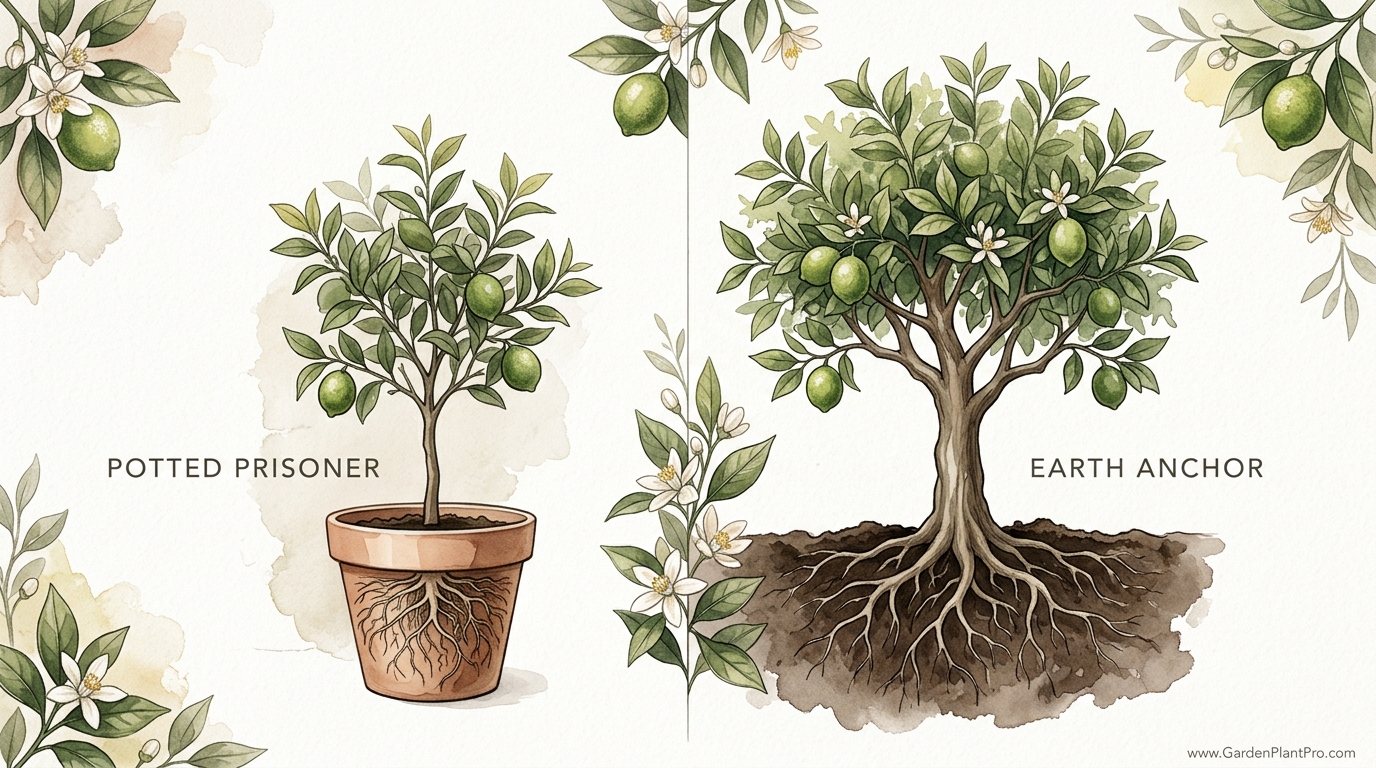
One missed watering will kill the tree on the left, but the tree on the right hasn’t been watered by a human in three months. Potted limes are fragile systems on life support. They depend entirely on you for every drop of water and every gram of nutrient. But when you plant into the earth and establish a biological buffer, the tree stops being a pet and starts being a producer. Discover how to transition from fragile containers to resilient earth-grown citrus.
I remember standing in my backyard twenty years ago, looking at a Bearss lime tree that looked like it was auditioning for a role in a tragedy. It was in a beautiful 15-gallon (57-liter) ceramic pot, but if I went away for a weekend in July, the leaves would curl into tight cigars. It lived on a knife-edge. Every time I watered it, I was just resetting a countdown clock until the next crisis. That is the reality of being a “potted prisoner.”
Eventually, I got tired of the stress and dug a hole. Moving that tree into the ground changed everything. It wasn’t just that the tree grew bigger; its personality changed. It became self-sufficient, rugged, and vastly more productive. If you have been hesitant to put your citrus in the ground, or if you are wondering why your potted tree is struggling while your neighbor’s tree is a green giant, we need to talk about the difference between life support and an established ecosystem.
Growing Lime Trees In Ground Vs Pots
Growing a lime tree in a pot is essentially a high-stakes hobby. In a container, the root system is confined to a tiny volume of media—often a mix of peat, perlite, or bark. This media has very little “buffering capacity.” This means it cannot hold onto nutrients for long, and it dries out at the speed of the afternoon sun. You are the tree’s only source of survival. You are the rain, the windbreak, and the soil biology all rolled into one.
When we talk about growing in the ground, we are talking about “Earth Anchors.” An in-ground lime tree has access to a massive reservoir of moisture and a complex web of fungal and bacterial life. In the ground, the roots can travel 10 to 15 feet (3 to 4.5 meters) wide and several feet deep to find what they need. If the top few inches of soil dry out, the deeper roots are still sipping cool moisture from the subsoil. This is why a ground-grown tree can handle a heatwave that would turn a potted tree into kindling.
However, the ground isn’t a magic fix for everyone. If you live in a region where the ground freezes solid for months, the pot is your only option. Limes are among the most cold-sensitive of all citrus varieties. While a lemon might survive a brief dip to 28°F (-2°C), a Key lime starts dropping leaves and taking damage at 32°F (0°C). Growing in the ground is for those who have the climate to support it, or the determination to build the infrastructure to protect it through the winter.
The Physics of the Root System
To understand why the ground is superior, you have to look at the roots. In a pot, roots eventually hit the wall. They begin to “girdle,” circling the inside of the container until they become a tangled, woody knot. This structure is inefficient. It restricts the flow of water and nutrients to the canopy. Even if you upsize the pot, those old circling roots can eventually choke the tree’s own trunk.
In the ground, roots grow in a “flare” pattern. They move outward to provide structural stability and downward to access minerals. This open architecture allows the tree to grow a massive canopy. More leaves mean more photosynthesis, and more photosynthesis means more limes. A potted lime might give you 20 or 30 fruits a year if you’re lucky; an in-ground tree can easily produce 500 to 1,000 limes once it hits its five-year mark.
The Role of Rootstocks
Most lime trees you buy are actually two trees in one: the “scion” (the top part that grows the limes you want) and the “rootstock” (the bottom part that handles the soil). When growing in a pot, nurseries often use “Flying Dragon” trifoliate orange, which is a naturally dwarfing rootstock. It keeps the tree small and manageable. But if you want a producer in the ground, you often look for rootstocks like Carrizo citrange or Swingle citrumelo. These are vigorous and provide the “engine” necessary to push a big tree to its full potential.
How to Transition from Pot to Earth
Transitioning a tree from a container to the ground is more than just digging a hole. It is a biological handoff. If you do it wrong, the tree will suffer from “transplant shock,” where it drops all its leaves and sits dormant for a year while it tries to figure out its new surroundings. If you do it right, the tree will explode with new growth within weeks.
Step 1: Timing is Everything
The best time to plant is in late winter or early spring, just before the new growth starts. This allows the roots to establish themselves in cool, moist soil before the heat of summer arrives. In tropical climates, you can plant almost any time, but avoiding the peak of the dry season is usually wise.
Step 2: Preparing the “Million Dollar Hole”
There is an old saying: “Don’t put a ten-dollar tree in a two-dollar hole.” For a lime tree, the hole should be twice as wide as the root ball but no deeper. This is critical. You want the soil around the roots to be loose and easy for new roots to penetrate, but you want the bottom of the hole to be firm so the tree doesn’t sink over time.
Step 3: Managing the Root Flare
The number one killer of in-ground citrus is planting too deep. Look for the “root flare”—the spot where the trunk widens out into the roots. This flare must be at or slightly above the soil line (about 1–2 inches or 2.5–5 cm). If you bury the trunk, the bark will rot, and the tree will eventually die. I always tell folks to “plant high” in heavier clay soils to ensure the crown stays dry.
Step 4: The Backfill Process
Don’t just fill the hole with pure compost. Use the native soil you dug out. If you create a pocket of super-rich soil in the hole, the roots might never want to leave it, creating a “pot in the ground” effect. Mix in about 10–20% organic matter if your soil is very sandy or heavy clay, but otherwise, let the tree get used to the dirt it will be living in for the next thirty years.
Benefits of Earth-Grown Citrus
Once established, the benefits of the ground are massive. The first is **Thermal Mass**. The earth stays much warmer than the air during a cold snap. A potted tree’s roots are exposed to the ambient air temperature, which can freeze the delicate feeder roots through the side of the pot. In the ground, the soil radiates heat upward, often keeping the canopy 2–4 degrees warmer than a nearby container plant.
The second benefit is **Nutrient Buffering**. In a pot, you have to use synthetic fertilizers because there isn’t enough soil volume to support a healthy microbial population. In the ground, you can use compost, mulch, and organic fertilizers. Worms and mycorrhizal fungi do the heavy lifting, breaking down organic matter and delivering it directly to the roots. This results in fruit with a much more complex, “terroir” flavor than the often-sour fruit from a stressed potted tree.
Finally, there is **Water Resilience**. An established in-ground lime tree can go weeks without rain in most climates. Its root system is deep enough to find moisture pockets that a pot simply doesn’t have. This means you stop being a slave to the watering can and start being a manager of the harvest.
Challenges and Common Mistakes
The biggest challenge with in-ground limes is **Drainage**. Citrus trees hate “wet feet.” If your soil has a lot of clay and holds water like a bathtub, the roots will drown and rot. Always perform a drainage test before planting: dig a hole, fill it with water, and see how long it takes to drain. If it takes more than 24 hours, you need to plant on a mound or choose a different spot.
Another common mistake is **Over-Mulching**. While mulch is great for retaining moisture, never let it touch the trunk of the tree. Keep a “donut” of bare soil about 6 inches (15 cm) around the trunk. If mulch sits against the bark, it traps moisture and invites fungal diseases like Phytophthora gummosis, which can girdle and kill the tree.
DIY PROJECT: Collect rainwater no matter where you live...
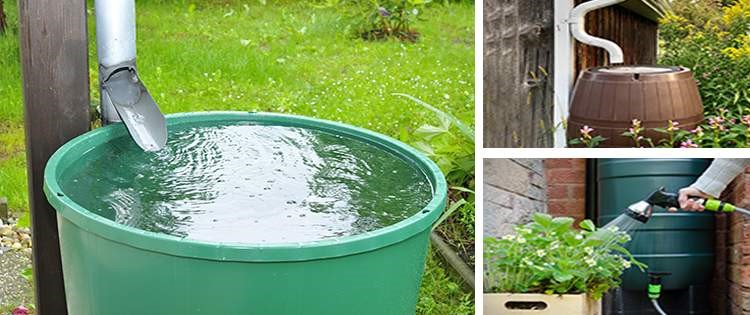
This DIY project is the best way to legally collect rainwater NO MATTER where you live. Get chlorine-free water, cut down on your water bills, and have enough for an emergency situation or to water your garden. Read More Here...
Lastly, watch out for **Rootstock Suckers**. In the ground, vigorous rootstocks often try to send up their own branches from below the graft union. These branches usually have three leaves (trifoliate) and huge thorns. If you don’t prune them off immediately, they will outgrow the lime tree and eventually “swallow” it, leaving you with a thorny bush of bitter, inedible fruit.
Limitations: When Pots are Better
I love the ground, but it’s not for everyone. If you live in a USDA Zone 8 or lower (where temperatures regularly drop below 20°F / -6°C), a lime tree in the ground is a recipe for heartbreak. Even with frost blankets and lights, a hard freeze can kill a mature tree in a single night. In these climates, the pot is a lifesaver because it allows you to move the tree into a garage or greenhouse for the winter.
Pots are also better for those with **Limited Space**. A standard lime tree in the ground can reach 15 to 20 feet (4.5 to 6 meters) in height and width. If you only have a small patio, a dwarfed tree in a pot is the only way to go. You sacrifice yield, but you gain the ability to garden in tight quarters.
Comparison Table: Pots vs. In-Ground
| Factor | Potted (Pet) | In-Ground (Producer) |
|---|---|---|
| Watering Frequency | Daily to every 3 days in summer. | Every 1–2 weeks once established. |
| Nutrient Source | Liquid/Slow-release fertilizers. | Soil biology, mulch, and organic matter. |
| Cold Tolerance | Low; roots freeze easily. | Higher; benefits from ground heat. |
| Fruit Yield | Small; usually 10–50 fruits. | Large; can exceed 500+ fruits. |
| Maintenance | High; repotting every 2-3 years. | Low; mostly pruning and mulching. |
Practical Tips for Success
- Whiteboard the Trunk: For young trees in the ground, the sun can actually scald the thin bark. Paint the trunk from the soil line to the first branch with a 50/50 mix of white interior latex paint and water. It’s like sunscreen for your tree.
- The Finger Test: Don’t water on a schedule. Stick your finger 2 inches (5 cm) into the soil. If it’s dry, water. If it’s damp, walk away. This applies to both pots and the ground, but you’ll find you walk away more often with a ground tree.
- Deep Soaks: When you do water an in-ground tree, don’t just sprinkle the surface. Use a slow trickle from a hose for an hour to ensure the water reaches the deep roots. This encourages the tree to grow roots downward rather than staying near the surface.
- Avoid Grass: Keep grass and weeds at least 3 feet (1 meter) away from the trunk. Grass is a greedy competitor for nitrogen and water, and it can significantly stunt a young lime tree’s growth.
Advanced Considerations: Soil pH and Microlife
For the serious gardener, the real game is played at the microscopic level. Citrus trees prefer a slightly acidic soil, ideally between 6.0 and 7.0 pH. In a pot, you can control this perfectly with your potting mix. In the ground, you have to work with what you’ve got. If your soil is very alkaline (common near concrete foundations where lime leaches into the dirt), your tree might struggle to take up iron and manganese, leading to yellow leaves with green veins.
You can adjust in-ground pH using elemental sulfur or by applying chelated iron. However, the most sustainable way to manage this is by building up the organic matter. Compost acts as a “buffer,” helping the tree access nutrients even if the pH isn’t perfect. This is the beauty of the biological buffer; a healthy soil ecosystem can “correct” minor environmental imbalances that would kill a tree in a sterile plastic pot.
Example Scenario: The Weekend Vacation
Let’s look at two neighbors: Sarah and Jim. Sarah has a Bearss lime in a 20-inch (50 cm) pot on her deck. Jim has the same variety planted in his yard. They both go away for a four-day weekend in August when the temperature hits 95°F (35°C).
When they return, Sarah’s tree has dropped half its leaves and all its small fruitlets. the soil in the pot reached 100°F (38°C), cooking the feeder roots. It will take two months of babying for the tree to recover. Meanwhile, Jim’s tree looks exactly the same as when he left. Its roots were 18 inches (45 cm) deep in 75°F (24°C) soil, pulling moisture from a deep clay pocket. Jim picks a lime for his drink that night; Sarah has to go to the grocery store.
Final Thoughts
There is a unique satisfaction in watching a tree grow out of its “pet” phase and into its role as a permanent part of the landscape. Transitioning from pots to the ground is about moving from a system of constant intervention to one of stewardship. It requires a bit of upfront work—digging the right hole, testing the drainage, and protecting it through its first winter—but the payoff is a resilient, productive tree that can outlive you.
If you have the space and the climate, I encourage you to take the plunge. Start small, perhaps with a single tree in a well-prepared spot. Once you see the difference in vigor and fruit quality, you’ll likely find yourself looking at your remaining potted plants and wondering where else you can dig a hole. Gardening is a long game, and the earth is the best partner you’ll ever have.
For those who want to keep learning, explore topics like soil health and mulching techniques. Understanding how to manage the irrigation methods that best suit your specific soil type will help you fine-tune your garden into a truly self-sustaining producer.