
Ancient wisdom outperforms modern chemistry when it comes to the world’s favorite grain. Modern agriculture relies on heavy chemicals to feed ‘hungry’ corn. But for centuries, indigenous farmers used the ‘Three Sisters’ method—corn, beans, and squash—to create a self-fertilizing ecosystem. Here is why the natural way wins every time.
You might have seen those heavy bags of synthetic fertilizer at the garden center, promising a bumper crop with just a few handfuls of blue crystals. It looks easy on the surface, but anyone who has spent years with their hands in the dirt knows that shortcuts often come with a hidden price. Real soil health isn’t something you can buy in a plastic bag; it is something you cultivate over seasons of observation and patience.
The Three Sisters method—a symbiotic planting of corn, beans, and squash—was perfected by the Haudenosaunee (Iroquois) and other Indigenous peoples of North America long before industrial labs existed. This system doesn’t just grow food; it builds a community. Each plant has a role to play, supporting the others in a way that synthetic NPK (nitrogen, phosphorus, and potassium) pellets simply cannot replicate. When you plant these three together, you aren’t just a gardener; you are the conductor of a biological orchestra.
Today, we are going to look at why this ancient polyculture is making a massive comeback among serious backyard growers and homesteaders. We will explore the science of how these plants talk to each other and why your soil will thank you for ditching the chemical salts in favor of this living, breathing system.
Three Sisters Planting Method Vs Fertilizer
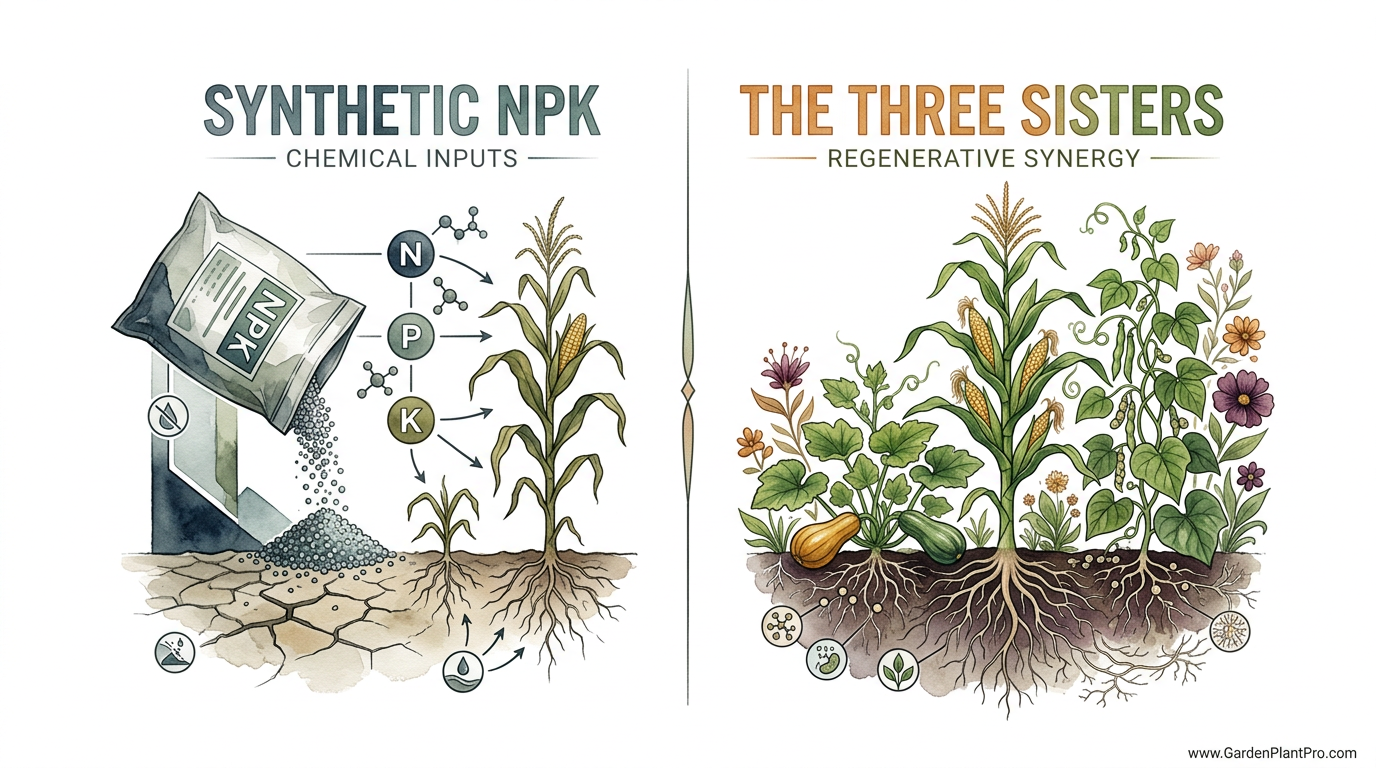
The Three Sisters planting method is a form of companion planting where three distinct crops are grown in the same space to maximize yield and soil health. In this system, corn acts as the structural support, pole beans provide essential nitrogen, and squash serves as a living mulch to protect the soil. This creates a self-sustaining loop that mimics the natural diversity of a forest floor rather than the sterile environment of a monoculture field.
Synthetic fertilizers are designed to provide an immediate “hit” of nutrients, primarily nitrogen. While this can lead to rapid green growth, it often ignores the long-term vitality of the soil’s microbial life. The Three Sisters method focuses on building a “soil bank.” Instead of dumping minerals onto the surface, the beans use specialized bacteria to pull nitrogen directly from the air and deposit it into the root zone where the corn needs it most. This process, known as nitrogen fixation, provides a slow-release, high-quality nutrient source that doesn’t wash away in the first heavy rain.
Think of synthetic fertilizer like a caffeine pill; it gives the plant a temporary boost but leaves the soil exhausted afterward. The Three Sisters method is more like a well-balanced, home-cooked meal. It provides the energy needed for a harvest while simultaneously improving the “gut health” of your garden through increased organic matter and microbial diversity. This system is used today in organic small-scale farms and backyard gardens to reduce costs, eliminate chemical runoff, and produce more nutrient-dense food per square foot (0.09 square meters).
How the Three Sisters Work Together
The magic of this system lies in the specific biological traits of each “sister.” To get this right, you have to understand the job descriptions of each participant. Without one, the others struggle to reach their full potential.
The First Sister: Corn (The Support)
Corn is the backbone of the operation. Because it is a heavy feeder and grows tall and straight, it provides a perfect natural trellis. Indigenous varieties like flint corn or dent corn were traditionally used because they have thick, sturdy stalks that can handle the weight of climbing vines. In a modern backyard, you can use sweet corn, but you must ensure it has a head start so the beans don’t pull it down before it is established.
The Second Sister: Beans (The Giver)
Beans are the engine of the ecosystem. Most plants can only take nutrients from the soil, but legumes like pole beans have a “superpower.” They form a symbiotic relationship with Rhizobium bacteria in the soil. These bacteria live in small nodules on the bean roots and “fix” atmospheric nitrogen into a form the corn can actually use. As the beans climb the corn, they also help stabilize the stalks against high winds, acting like living guy-wires.
The Third Sister: Squash (The Protector)
Squash is the ground cover that keeps everything cool. The large, broad leaves of squash or pumpkins create a “living mulch” over the mounds. This shade prevents soil moisture from evaporating and suppresses weed growth by blocking out the sun. Furthermore, the prickly hairs on squash stems act as a natural deterrent for small pests like raccoons or rabbits, who find the texture uncomfortable on their paws.
How to Plan and Plant Your Three Sisters Garden
Success with this method depends almost entirely on your timing. You cannot simply throw all the seeds in a hole at once and expect them to thrive. If the beans grow too fast, they will choke the young corn. If the squash is too aggressive, it might shade out the emerging seedlings. Following a specific sequence is the secret to a high-yielding plot.
Step 1: Preparing the Mounds
Start by creating mounds of soil about 12 inches (30 cm) high and 3 to 4 feet (90 to 120 cm) wide. Space the centers of these mounds about 4 to 5 feet (120 to 150 cm) apart. This mounding technique helps with drainage and allows the soil to warm up faster in the spring. If you are in a particularly dry climate, you might choose to plant in “craters” instead of mounds to catch every drop of rain, but for most temperate regions, the mound is king.
Step 2: Planting the Corn
Wait until the danger of frost has passed and the soil temperature is consistently at least 60°F (15°C). Plant 5 to 6 corn seeds in the center of each mound, about 1 inch (2.5 cm) deep. Space them in a small circle roughly 6 inches (15 cm) in diameter. Once they reach about 4 inches (10 cm) tall, thin them out to the 3 or 4 strongest plants.
Step 3: Introducing the Beans
Timing is critical here. You must wait until the corn is at least 6 to 10 inches (15 to 25 cm) tall before planting the beans. This ensures the corn stalk is sturdy enough to act as a trellis. Plant 4 bean seeds around each corn stalk, about 3 inches (7.5 cm) away from the base. Look for pole bean varieties, as bush beans will not climb and will instead get lost under the squash leaves.
Step 4: Sowing the Squash
Approximately one week after the beans have sprouted, it is time for the final sister. Plant 2 or 3 squash seeds at the edge of the mound, away from the corn and beans. As they grow, you can gently direct the vines to circle the mound or fill in the spaces between the mounds. This creates a seamless carpet of green that protects the root systems of all three plants.
Benefits of the Natural Approach
Switching from synthetic NPK to the Three Sisters method offers more than just a lower fertilizer bill. It changes the very nature of your harvest. Researchers have found that this intercropping system actually produces more total energy (calories) and protein per acre than any of the three crops grown alone in a monoculture.
- Superior Nutrition: Corn provides carbohydrates, beans offer protein and essential amino acids (like lysine and tryptophan), and squash is packed with Vitamin A and healthy fats from the seeds. Together, they form a complete human diet.
- Water Conservation: The “living mulch” of the squash leaves can reduce soil temperature by several degrees and significantly slow down evaporation, which is a lifesaver during July and August heatwaves.
- Pest Management: Biodiversity is the best pesticide. Because the plants are intermingled, it is harder for specialist pests to find their “target” plant. The prickly squash vines also act as a physical barrier against larger garden raiders.
- Soil Structure: Unlike chemical salts that can lead to soil compaction and crusting, the organic matter from decaying bean roots and squash vines creates a loamy, aerated soil structure full of beneficial fungi.
Challenges and Common Mistakes
Even though this is a “natural” system, it isn’t “set it and forget it.” I’ve seen plenty of neighbors try this and end up with a tangled mess because they skipped a few basic rules. The most frequent error is planting everything at the same time. If those beans get a head start, they will wind around a 2-inch corn sprout and pull it right into the dirt. Patience is your best friend during the first month.
Another common pitfall is variety selection. You cannot use modern, “heavy” hybrid pumpkins like a 50-pound Atlantic Giant. The vines will be too heavy, and they will literally crush the other sisters. Stick to smaller vining squash or traditional pumpkins like ‘Connecticut Field’ or ‘Small Sugar.’ Similarly, if you choose a corn variety that only grows 4 feet (120 cm) tall, the beans will quickly run out of room and start tangling with each other, leading to poor airflow and potential mildew issues.
Lastly, keep an eye on pollination. Corn is wind-pollinated, which means it needs to be planted in blocks rather than single long rows. If you only have one or two mounds, the pollen might blow right past the silks, leaving you with cobs that have missing kernels. I always recommend at least four mounds arranged in a square to ensure the wind can do its job effectively.
DIY PROJECT: Collect rainwater no matter where you live...
This DIY project is the best way to legally collect rainwater NO MATTER where you live. Get chlorine-free water, cut down on your water bills, and have enough for an emergency situation or to water your garden. Read More Here...
Limitations and When This May Not Be Ideal
While I love the Three Sisters, it isn’t a magic bullet for every garden. If you are working with a very small space, like a few 4×4 foot (120×120 cm) raised beds, the squash can quickly take over your walkways and overwhelm your other vegetables. Squash is a “space hog” by design, and you need to be prepared for it to travel 10 to 15 feet (3 to 4.5 meters) in every direction.
Environmental factors also play a huge role. If you live in an area with extremely high humidity and frequent rain, the dense foliage created by the squash can lead to powdery mildew. In these cases, you might need to thin the squash leaves or choose varieties specifically bred for mildew resistance. Additionally, if your soil is already extremely high in nitrogen (perhaps from years of heavy manuring), the beans may focus on leaf growth rather than fixing more nitrogen, which can lead to an “over-greened” garden with lower fruit yields.
Comparing Three Sisters to Synthetic NPK
| Factor | Three Sisters Method | Synthetic NPK Fertilizer |
|---|---|---|
| Cost | Low (Seeds + Compost) | Moderate to High (Recurring purchase) |
| Soil Health | Improves structure and microbial life | Can lead to salt buildup and acidity |
| Labor | High initial setup, low maintenance | Low initial setup, recurring applications |
| Sustainability | High; self-fertilizing ecosystem | Low; relies on fossil fuels for production |
| Yield Type | Diverse; multi-crop harvest | Single-crop focus (Monoculture) |
Practical Tips for Best Results
If you want to take your Three Sisters garden to the next level, there are a few “pro” tricks I’ve picked up over the years. First, consider the “Fourth Sister.” Many Indigenous traditions also included a fourth plant, often a sunflower or bee balm (Monarda), planted on the north side of the mounds. Sunflowers attract pollinators and provide an additional trellis, while bee balm helps deter pests with its strong scent.
When it comes to watering, try to avoid overhead sprinklers once the squash has filled in. The dense canopy traps moisture, which is great for the soil but can be a nightmare for leaf diseases. Aim your hose or soaker lines at the base of the mounds. This keeps the roots hydrated while keeping the leaves dry. If you notice the corn leaves curling up into tight straws, that is a sign they are thirsty—even if the squash looks fine.
Don’t be afraid to mulch the paths between your mounds with straw or wood chips before the squash vines take over. Once those vines start moving, you won’t be able to step in there without damaging them. Having a thick layer of mulch in the walkways will keep the area tidy and help retain even more moisture for the entire system.
Advanced Considerations: Varieties and Seed Saving
Serious practitioners often move away from store-bought seeds and toward heirloom varieties that were specifically bred for this system. Looking for “flint” or “flour” corn varieties like ‘Painted Hill’ or ‘Hopi Blue’ is a great start. These have much stronger stalks than your average grocery store sweet corn. For beans, ‘Scarlet Runner’ is a fantastic choice because it has beautiful flowers that attract hummingbirds, and the beans can be eaten fresh or dried for winter storage.
Scaling this method is also an interesting challenge. If you have a larger field, you don’t necessarily need to use mounds. You can plant in “inter-rows,” where you have two rows of corn and beans followed by a wider row of squash. This allows for slightly easier harvesting and better airflow. Just remember that the goal is always to keep the soil covered; if you see bare dirt, you have room for more squash!
A Real-World Example: The 10×10 Plot
Let’s imagine you have a 10×10 foot (3×3 meter) patch in your backyard. Instead of planting four straight rows of corn and hoping for the best, you could install four Three Sisters mounds. Each mound would have 4 corn stalks, 12-16 bean vines, and 2 squash plants. By the end of the season, that 100 square foot area could yield 40-50 ears of corn, several pounds of dry beans, and 8-10 large winter squashes.
In a monoculture setup using synthetic fertilizer, you might get more corn, but you would have zero beans and zero squash. You would also have spent more money on chemicals and more time weeding the bare soil between the corn rows. When you look at the total “basket” of food produced, the Three Sisters plot almost always provides a more diverse and valuable harvest for the home cook.
Final Thoughts
Ancient wisdom outperforms modern chemistry because it understands that a garden is a living system, not a factory. The Three Sisters method is more than just a way to grow vegetables; it is a lesson in cooperation and balance. By letting the plants support each other, you reduce your own workload and create a more resilient garden that can handle the ups and downs of a changing climate.
As you plan your next season, I encourage you to set aside even a small corner of your garden for this experiment. Watch how the beans find the corn stalks without any help from you. Feel how cool the soil remains under those giant squash leaves on a blistering afternoon. Once you see this synergy in action, those bags of blue fertilizer crystals will start to look a lot less impressive.
If you find yourself enjoying this approach, you might want to look into other traditional practices like composting or no-till gardening. Every step we take toward working with nature rather than against it makes our soil richer and our food more meaningful. Happy planting, neighbor—I think you’re going to love what these three sisters can do for your patch of earth.