
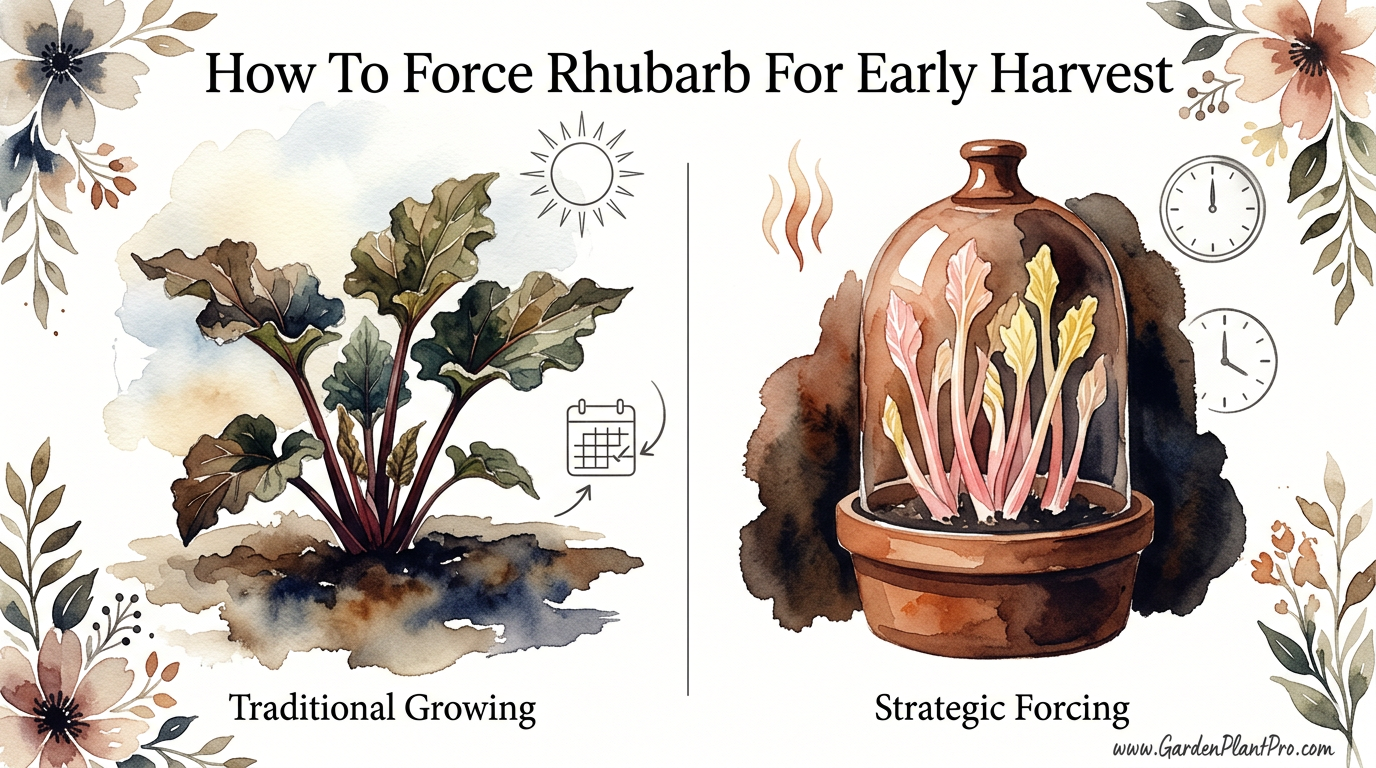
Why do the world’s most expensive rhubarb stalks never see a single ray of sunlight? Most gardeners wait until mid-summer for a harvest that can be tough and stringy. But the ‘Strategic Forcing’ method uses darkness to trick the plant into producing the most tender, neon-pink stalks you’ve ever tasted. It’s the difference between a grocery store staple and a gourmet delicacy.
Step into any serious gardener’s patch in the dead of winter, and you might see strange terracotta bells or upturned buckets scattered across the soil. It looks like a graveyard of pottery, but underneath those covers, a quiet miracle is happening. While the rest of the garden is shivering in dormancy, these crowns are working double time. They are reaching upward in total darkness, stretching their stems in a desperate search for light that never comes.
The result is something you simply cannot buy at a standard market. These stalks are candy-pink, hair-thin, and so tender you could almost snap them with a whisper. If you’ve ever found traditional rhubarb a bit too “aggressive” or stringy, forcing is the technique that will change your mind forever. It’s an old-school trick, passed down from the commercial sheds of Yorkshire to the backyard plots of folks who just want a taste of spring a month or two early.
How To Force Rhubarb For Early Harvest
Forcing rhubarb is the practice of depriving a mature rhubarb crown of light while providing a slightly warmer microclimate. This process, technically known as etiolation, tricks the plant into thinking it is still underground. In its biological panic to reach the surface and find the sun, the plant puts all its stored energy into rapid, vertical growth.
Because the plant cannot photosynthesize without light, it doesn’t produce chlorophyll. This is why forced rhubarb isn’t green; it stays a brilliant, pale pink or deep crimson. This lack of light also prevents the development of the tough, fibrous structures and the heavy concentrations of oxalic acid that give outdoor rhubarb its famous “pucker” and stringy texture.
In the real world, you’ll see this done in two ways: “in situ” (right where the plant grows) or by lifting the crowns and moving them into a dark shed or cellar. For most of us backyard growers, forcing the plants right in the garden bed is the easiest and most sustainable way to get that early harvest without risking the long-term health of our favorite perennials.
The Science of Growing in the Dark
When we cover a rhubarb crown, we are essentially hacking the plant’s internal clock. Typically, a rhubarb plant requires a period of “vernalization”—a fancy word for a cold snap—to break its dormancy. Once it has felt the winter chill, it’s ready to explode into growth the moment the soil warms up.
By covering the crown with a heavy pot and perhaps some insulating straw or manure, we create a pocket of warmth that is about 5°C to 10°C (10°F to 20°F) higher than the surrounding air. The plant senses this warmth and thinks spring has arrived early. However, because it’s pitch black, the plant doesn’t produce the large, green leaves that usually act as solar panels. Instead, it focuses every ounce of its stored carbohydrate reserves into the petioles (the stalks).
During this race for the light, the starches stored in the roots are converted into glucose much faster than they would be in the sun. This is why forced rhubarb is naturally sweeter. You’ll find that you need about half the sugar you’d normally use in a crumble or pie when you’re working with forced stalks. It’s a chemical transformation that turns a hardy, sour vegetable into a refined, delicate fruit substitute.
Step-by-Step: The Outdoor Forcing Method
This is my preferred way to do it because it’s less stressful for the plant. You aren’t digging anything up; you’re just giving it a “hat” for a few weeks.
First, wait for the plant to go fully dormant. You’ll know this has happened when the previous year’s leaves have turned to mush and disappeared. In most temperate regions, this happens by late autumn or early winter. Let the crown feel at least one or two good hard frosts; it needs that “cold unit” accumulation to trigger the growth response later.
In late January or February (depending on how brave your local weather is), clear any remaining debris or weeds from around the crown. Give it a little “breakfast” by spreading a thick layer of well-rotted manure or garden compost around the base. Just be careful not to bury the actual growing points (the “eyes”) too deep, as that can lead to crown rot in damp winters.
Place your chosen cover over the crown. Traditionalists love the tall, bell-shaped terracotta forcers, but a heavy-duty plastic bin or a large bucket works just as well. The key is to make sure it is 100% light-proof. If your bucket has drainage holes, cover them with black duct tape.
To really speed things up, pile straw, bracken, or even more manure around the outside of the pot. This provides the insulation needed to keep the temperature steady. Now comes the hard part: waiting. It usually takes 6 to 9 weeks for the stalks to reach the top of the container.
Indoor Forcing: The “Yorkshire” Style
If you want rhubarb in the middle of winter—say, late February—you’ll need to lift the crowns entirely. This is a bit more work and is harder on the plant, but the results are legendary.
Start by digging up a mature crown (at least 3 years old) in early winter. Leave it sitting on the surface of the soil for a week or two to get “frosted.” This exposure to freezing temperatures is the “on” switch for the plant’s growth engine.
Once frosted, move the crown into a dark, cool place like a cellar, basement, or a corner of the garage where you can maintain a temperature of around 10°C to 15°C (50°F to 60°F). Place the crown in a large crate or pot and pack the roots with moist compost or peat-free potting mix.
Keep the area completely dark. Commercial growers in the famous “Rhubarb Triangle” of West Yorkshire actually harvest these plants by candlelight. If you let even a sliver of light in, the leaves will start to turn green and the stalks will toughen up. You’ll be able to harvest your first stalks in about 5 weeks.
Benefits of Strategic Forcing
Why go through all the trouble of covering your plants and checking them in the dark? The benefits are both culinary and practical.
Unrivaled Texture: Because the plant grows so quickly and without light, the stalks don’t have time to develop the stringy, woody fibers found in mid-summer crops. They have a crispness that almost melts when cooked.
DIY PROJECT: Collect rainwater no matter where you live...
This DIY project is the best way to legally collect rainwater NO MATTER where you live. Get chlorine-free water, cut down on your water bills, and have enough for an emergency situation or to water your garden. Read More Here...
Delicate Flavor: The reduction in oxalic acid means you get a much smoother taste. The “earthy” or bitter notes are replaced by a bright, clean tartness that pairs beautifully with delicate flavors like vanilla, ginger, or orange blossom.
Early Harvest: In a world where the “hungry gap” (that period in late winter when the garden is empty) is very real, forced rhubarb is often the first fresh thing you can eat. It can be ready up to 8 weeks before the unforced plants in the same garden.
Visual Appeal: If you’re a fan of food photography or just like a pretty plate, nothing beats the neon-pink glow of a forced stalk. It keeps its color even after a light poaching, making it a star ingredient for elegant desserts.
Challenges and Common Mistakes
I’ve seen many a gardener get over-excited and end up killing their best rhubarb crowns. The biggest mistake is forcing a plant that is too young.
A rhubarb plant needs at least two, preferably three, full years of unhindered growth to build up the carbohydrate reserves in its roots. If you force a one-year-old crown, you are essentially asking an infant to run a marathon. The plant will likely die or be so stunted it never recovers.
Another frequent error is failing to seal the light out. I once used an old plastic trash can that had a tiny crack in the side. That little sliver of light caused the stalks to curve toward the crack and turn a muddy green-brown color. It didn’t affect the safety, but the texture was nowhere near as tender as it should have been.
Lastly, do not forget about drainage. If you are forcing in situ and your garden has heavy clay soil, the extra insulation and the cover can trap too much moisture. I always recommend placing the forcer on a slightly raised area or ensuring the soil is well-amended with organic matter to prevent the crown from rotting in the damp, dark environment.
Limitations and Sustainability
Forcing is a “high-performance” event for a plant. Because the rhubarb is using up all its stored energy and getting nothing back from photosynthesis, it comes out of the process completely exhausted.
You cannot force the same crown every year. If you do, the plant will eventually produce spindly, “pencil-thin” stalks and might eventually rot away. The general rule of thumb is to have at least three rhubarb plants. Force one, let one grow naturally for a normal harvest, and let the third one rest entirely. Rotate this every year so each crown only gets forced once every three years.
Environmentally, forcing is limited by your local climate. If you live in a region where the ground doesn’t freeze or get cold enough (above 10°C or 50°F all winter), the rhubarb may never enter a deep enough dormancy to respond to the forcing. Conversely, in extremely harsh climates (below -20°C or -4°F), you’ll need significantly more insulation to keep the crown from freezing solid inside the forcer.
Comparison: Traditional Growing vs. Strategic Forcing
| Factor | Traditional Growing | Strategic Forcing |
|---|---|---|
| Harvest Timing | April to July | February to March |
| Stalk Color | Deep Green/Red | Bright Pink/Pale Yellow |
| Texture | Firm, sometimes fibrous | Very tender, brittle |
| Flavor Profile | Intensely tart/acidic | Mild, sweet, delicate |
| Plant Stress | Low | High (Requires rest) |
Best Varieties for Forcing
While any rhubarb can be forced, some varieties are practically built for it. These are usually the “early” cultivars that naturally want to get moving as soon as the frost breaks.
‘Timperley Early’: This is the gold standard. It is one of the earliest to wake up and responds beautifully to the dark. It produces a high yield of very pink, tender stalks.
‘Champagne’: As the name suggests, this is a refined variety. The stalks are long and slender with a fantastic pale-crimson color. It’s highly reliable and has been a favorite for forcing for over a century.
‘Victoria’: A classic heritage variety. While it’s a great all-rounder for the summer, it forces surprisingly well, though it tends to be a bit thicker and more robust than ‘Champagne’.
‘Stockbridge Arrow’: Developed in the heart of the Rhubarb Triangle, this variety produces beautiful, straight stalks that are perfect for professional-looking desserts.
Practical Tips for Success
If you’re using a plastic bucket, weigh it down with a heavy brick. Winter winds have a nasty habit of blowing forcers across the garden, exposing your delicate stalks to the sun and ruining the “blanching” process.
Check your plants weekly once you hit the 5-week mark. You don’t want the leaves to stay pressed against the top of the pot for too long, as the condensation can cause the tiny, yellow leaves to rot.
Do you have some charcoal in your house right now? We call charcoal a “miracle leftover” for anyone who wants to be a little more self-sufficient and cut costs. That’s because it can help you with so many different things around the house and garden. You can even use it to make an energy-free fridge. Read More Here...
Always pull the stalks; never cut them. To harvest, reach down as far as you can toward the base of the stalk, give it a slight twist, and a firm tug. It should “pop” away cleanly from the crown. If you cut it, the remaining “stump” can rot and infect the rest of the plant.
After you’ve finished your forced harvest, remove the forcer and let the plant see the sun. Do not harvest any more from that specific plant for the rest of the year. It needs every single green leaf it can produce to recharge its batteries for the following seasons.
Advanced Considerations: The Recovery Phase
A serious practitioner knows that the real work happens *after* the harvest. Once the “forced” season is over, your crown is vulnerable. This is the time to be generous with your soil health practices.
Apply a balanced, organic fertilizer or a liquid seaweed feed once the leaves have unfurled. Keep the area well-mulched with compost to retain moisture, but again, keep the mulch clear of the very center of the crown.
If you notice the plant trying to send up a flower spike (a thick, hollow stem with a broccoli-like head), cut it off immediately. Flowering takes an enormous amount of energy away from the roots, and after the stress of forcing, the plant simply cannot afford the luxury of making seeds.
Example Scenario: A Typical Forcing Timeline
Let’s look at how this might play out in a standard backyard garden in a temperate climate (like the UK or US Zone 6/7).
November 15th: The first hard frost hits. The rhubarb leaves turn brown and collapse. I clear them away and mark the spot with a small stake so I don’t step on it later.
January 10th: I check the crowns. They are dormant but I see the tiny pink “nubs” starting to swell. I apply 2 inches (5cm) of well-rotted manure around the crown.
January 12th: I place a large, black 5-gallon (20-liter) bucket over the crown and weigh it down with a stone. I pile some old straw around the base of the bucket.
February 20th: I take a peek. The stalks are about 6 inches (15cm) tall, bright pink, and have tiny, folded yellow leaves.
March 5th: The stalks have reached the top of the bucket. I harvest about 6-8 prime stalks. They are roughly 12 inches (30cm) long and incredibly brittle.
March 10th: I remove the bucket. The remaining tiny stalks will turn green in the sun and grow into the large leaves that will feed the plant all summer. I won’t touch this plant again until next year’s fertilizing.
Final Thoughts
Forcing rhubarb is more than just a gardening technique; it’s a way to reconnect with the natural cycles of the year while enjoying a true gourmet luxury. It turns the “hungry gap” into a season of anticipation. There is a quiet joy in lifting a heavy pot on a cold February morning and finding a cluster of vibrant, glowing pink stalks waiting for you.
Remember to treat your crowns with respect. Give them the years they need to establish and the rest they deserve after they’ve performed for you. A well-managed rhubarb patch can last for twenty years or more, providing you with a lifetime of early-spring treats.
If you’re new to this, start small. Choose one mature crown this winter and give it a try. Once you taste that first bite of forced rhubarb crumble—sweet, tender, and bright—you’ll never want to wait for the mid-summer harvest again. Feel free to explore other ways to improve your garden’s productivity, such as focusing on soil health or experimenting with different mulching techniques to keep those crowns happy year-round.