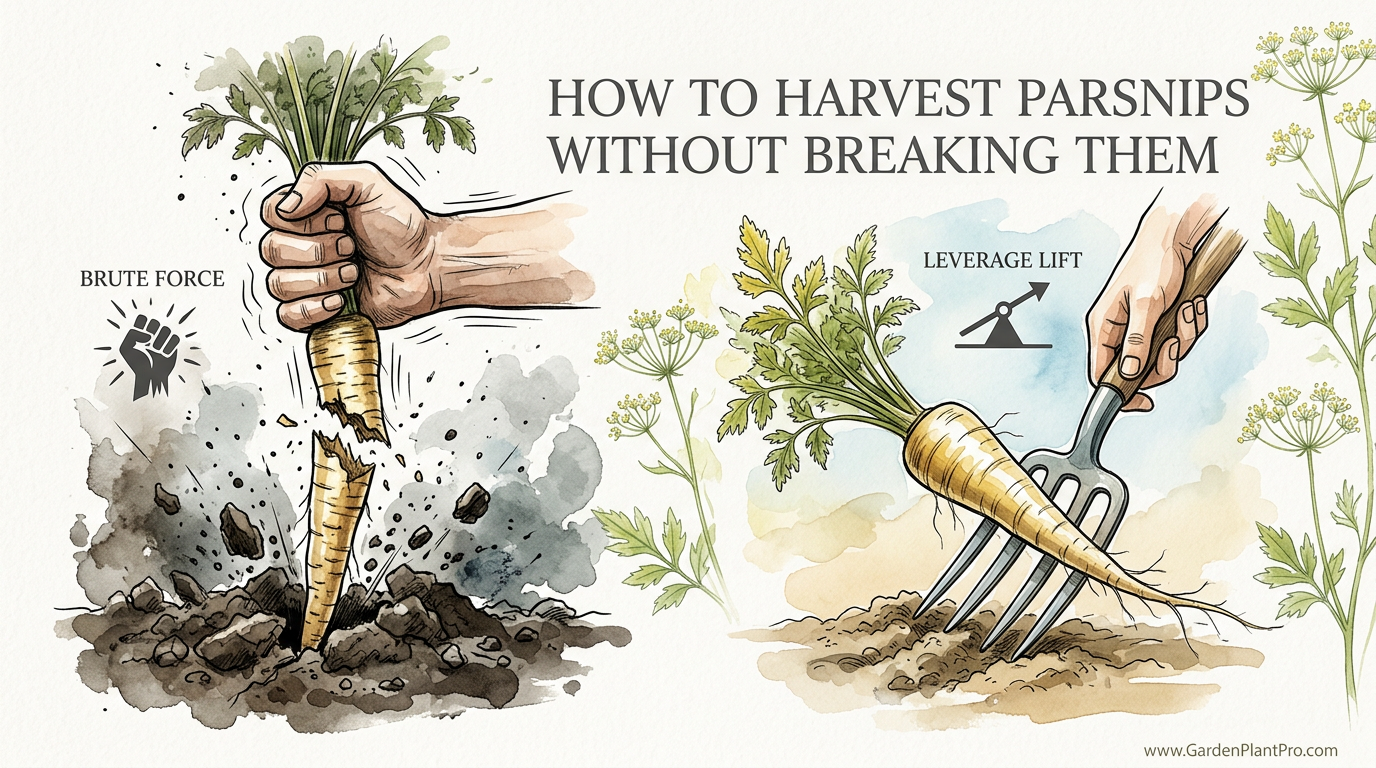
One simple shift in physics prevents the heartbreak of a snapped root forever. Nothing hurts more than growing a parsnip for 6 months only to snap it in half during harvest. If you are still using a standard fork, you are working too hard. Here is how the pros use leverage to slide those long roots out whole.
When you stand over a row of parsnips in the late autumn, the temptation is always there to simply grab the greens and pull. It feels like the most direct path from the soil to the dinner plate. However, that “brute force” approach is exactly what leads to that sickening snap. You are left holding a handful of foliage and a tiny stump, while the best part of the vegetable remains entombed six inches deep in the cold earth. I have spent decades perfecting the art of the harvest, and I can tell you that the secret isn’t in your muscles—it is in the mechanics of your tools.
The parsnip is a unique resident of the garden. Unlike a round radish or a stubby turnip, a well-grown parsnip can reach lengths of 10 to 15 inches (25 to 38 cm) or more. They are tapered, slightly brittle, and they grip the soil with hundreds of tiny lateral root hairs. To get them out without damage, we have to stop thinking about pulling and start thinking about lifting the entire environment around the root. This shift from manual pulling to mechanical leverage is the hallmark of an experienced gardener.
In the following guide, I will show you how to apply basic physics to your gardening routine. We will look at why the garden fork is your greatest ally, how the moisture of your soil changes the game, and the exact physical motions that ensure every root comes up as a trophy. Whether you are dealing with heavy clay or loose sand, these principles remain the same.
How To Harvest Parsnips Without Breaking Them
Harvesting parsnips is the process of removing the long, edible taproot of the Pastinaca sativa plant from the ground while maintaining its full length and structural integrity. Because these roots grow significantly deeper than many other garden vegetables, they require a specific approach that differs from simply “pulling” carrots or beets. The goal is to loosen the bond between the root and the surrounding soil before any upward force is applied.
In practical terms, this means using a tool—typically a garden fork—to create a “leverage lift.” This technique involves inserting the tool into the ground near the plant and using the handle as a lever to pry the soil upward. By fracturing the soil structure around the root, the suction and friction holding the parsnip in place are eliminated. This allows the root to practically slide out of the ground on its own, rather than being dragged out against resistance.
This method is used by professional growers and serious hobbyists alike because it drastically reduces crop loss. A snapped parsnip is more than just a culinary disappointment; it is a storage liability. Once a root is broken, its shelf life drops from months to mere days. The exposed flesh quickly dries out or falls victim to soil-borne pathogens. By mastering the leverage lift, you ensure that your harvest remains pristine and ready for the long winter months ahead.
The Physics of the Lift: Why Leverage Wins
To understand why the leverage method is superior, we have to look at the garden fork as a Class 1 lever. In this setup, the handle is your lever arm, the ground surface acts as the fulcrum (the pivot point), and the soil packed around your parsnip is the load. When you push down on the handle, the force is multiplied at the tines, allowing you to move hundreds of pounds of soil with relatively little effort.
When you attempt a “brute force” pull, you are fighting against two major physical forces: soil friction and vacuum suction. In damp or clay-heavy soils, the earth acts like a sleeve, gripping every millimeter of the root’s surface. Pulling upward creates a vacuum at the tip of the root. If the tensile strength of the parsnip isn’t high enough to overcome those forces, the root will fail at its weakest point—usually about halfway down where the diameter begins to taper sharply.
The leverage lift bypasses these forces by breaking the soil’s “bulk density.” Instead of pulling the root through the soil, you are moving the soil itself. As the fork tines pry the earth upward, the soil fractures and expands. This creates air pockets and breaks the vacuum at the root tip. Once the surrounding earth is “shattered” (in a mechanical sense), the friction drops to near zero, and the parsnip can be lifted out with two fingers.
Choosing Your Tools: The Fork vs. The Spade
One of the most common mistakes I see beginners make is reaching for a spade when it is time to harvest. While a spade is a wonderful tool for shifting dirt, it is a poor choice for harvesting long roots. A spade has a solid, flat blade that acts like a guillotine. If you are even an inch off in your placement, you will slice the parsnip in half before you even begin the lift.
The garden fork, or digging fork, is the gold standard for this task. Here is why the fork wins every time:
- Reduced Resistance: The tines of a fork penetrate the soil much easier than a solid blade, especially in compacted or stony ground.
- Soil Aeration: Instead of shearing the soil, a fork fractures it. This allows for a more “gentle” expansion of the earth around the root.
- Root Safety: If you accidentally hit a parsnip with a fork tine, you might leave a small puncture, but you won’t sever the entire root.
- Greater Leverage: Most garden forks are designed with a slightly curved neck, which naturally creates a better pivot point for prying.
When selecting a fork, look for one made of forged steel rather than stamped metal. Harvesting parsnips, especially in heavy soil, puts immense pressure on the tines. A cheap fork will bend under the strain. I prefer a “border fork” for smaller beds or a “heavy-duty digging fork” if I am working through a long row of large, overwintered roots.
Step-by-Step: The Leverage Lift Technique
Once you have the right tool, the success of your harvest comes down to technique. I have found that following a specific set of steps virtually eliminates breakage, even for the longest roots.
Step 1: The Setback Distance
Never insert your fork directly next to the crown of the parsnip. I usually aim for a distance of 6 to 8 inches (15 to 20 cm) away from the foliage. This ensures that the tines go down vertically alongside the root rather than through it. If the parsnip is particularly large, you may need to increase this distance to 10 inches (25 cm).
Step 2: The Vertical Drive
Push the fork tines into the ground as deep as they will go. Don’t be afraid to use your foot and your body weight. You want the tips of the tines to be at least as deep as the thickest part of the root. In very hard soil, you might need to “wiggle” the handle back and forth slightly as you push down to help the tines penetrate the layers.
Step 3: The Initial Pry
Grip the handle firmly and pull it back toward your body at about a 45-degree angle. You aren’t trying to lift the plant yet; you are trying to “crack” the soil. You should feel the earth shift and see the ground around the parsnip crown rise slightly. This is the moment where the vacuum at the tip of the root is broken.
Step 4: The Secondary Lift
If the soil is particularly heavy, move the fork to the opposite side of the parsnip and repeat the prying motion. Creating this “dual-sided” lift ensures that the root is completely loosened from all sides. Once the soil feels “spongy” or loose, you are ready for the final extraction.
Step 5: The Gentle Slide
While maintaining a slight upward pressure with the fork, grasp the parsnip firmly at the very top of the root—where the greens meet the crown—and lift. Do not yank. If you feel resistance, stop immediately and use the fork to loosen the soil further. If you have done your leverage work correctly, the root should slide out with a satisfying “slurping” sound.
Environmental Factors: Timing Your Harvest
While technique is vital, the state of your garden plays a massive role in how easy (or hard) the harvest will be. Factors like soil moisture and temperature can be the difference between a five-minute job and an afternoon of frustration.
DIY PROJECT: Collect rainwater no matter where you live...
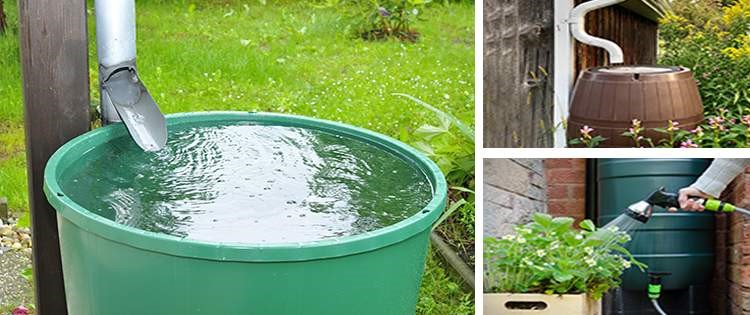
This DIY project is the best way to legally collect rainwater NO MATTER where you live. Get chlorine-free water, cut down on your water bills, and have enough for an emergency situation or to water your garden. Read More Here...
The Frost Factor
In terms of flavor, parsnips are legendary for their ability to sweeten after a frost. This is due to a chemical process where the plant converts stored starches into sugars (primarily glucose and fructose) to lower the freezing point of its cells. From a harvest perspective, wait for at least two or three hard frosts. However, you must harvest before the ground freezes solid. If the soil is frozen, the leverage lift becomes impossible, and you risk breaking your tools or the roots.
Soil Moisture Management
The ideal soil for harvesting is “moist but not saturated.” If the soil is bone-dry, it becomes concrete-like, making it difficult to insert a fork and increasing the brittleness of the root. If it is too wet, the soil becomes heavy and “sticky,” creating a stronger vacuum effect. If you haven’t had rain in a while, I recommend watering your parsnip bed deeply 24 hours before you plan to harvest. This softens the soil structure and makes the leverage lift much smoother.
Benefits of the Leverage Method
Switching to a leverage-based harvest offers several measurable advantages over traditional pulling. It isn’t just about avoiding a snapped root; it’s about the health of your garden and the quality of your food.
- Maximized Yield: Every inch of a parsnip is edible. By preventing snaps, you ensure you aren’t leaving 30% of your crop in the ground to rot.
- Long-Term Storage: Intact roots keep their moisture and resist rot much better than broken ones. A parsnip lifted whole can last up to 6 months in a root cellar or refrigerator.
- Soil Health: The prying motion of the fork actually helps aerate your beds. Instead of compacting the soil as you walk and pull, you are fracturing and loosening the earth, which benefits next year’s crop.
- Reduced Physical Strain: Using leverage allows the tool to do the heavy lifting. This saves your back, shoulders, and wrists from the repetitive strain of yanking on deep-set vegetables.
Challenges and Common Mistakes
Even with the right intentions, there are a few pitfalls that can trip up even experienced gardeners. Recognizing these early will save you a lot of heartache.
Pulling by the Greens Alone: This is the number one cause of broken roots. Parsnip greens are strong, but they are not securely “bolted” to the core of the root in a way that can withstand 20 pounds of soil suction. Always use the fork to lift the soil; the greens are just for guiding the root out once it’s already loose.
Insufficient Depth: If your fork tines only go 6 inches (15 cm) deep but your parsnip is 12 inches (30 cm) long, you are only loosening the top half. The bottom half will still be anchored in firm soil. When you pull, the root will snap at the point where the loose soil meets the firm soil.
Harvesting in Frozen Ground: I have seen people try to use boiling water or pickaxes to get parsnips out of frozen January soil. This almost always ends in disaster. If the ground is frozen, either wait for a thaw or leave them until spring. Parsnips are perfectly happy overwintering in the ground as long as you mulch them heavily with 6 to 12 inches (15 to 30 cm) of straw.
Limitations: When the Fork Isn’t Enough
While the garden fork is the primary tool for this job, there are situations where it might not be ideal. Understanding these boundaries will help you adapt your strategy.
In extremely heavy, rocky, or compacted clay soils, a standard garden fork might struggle to penetrate deep enough to provide effective leverage. In these cases, you might need to use a “broadfork”—a two-handed tool with long, heavy tines—to loosen an entire section of the bed at once. This is a much more aggressive approach but is sometimes necessary for “reclaiming” parsnips from difficult ground.
Additionally, if you have planted your parsnips too closely together, there may not be enough room to insert a fork between them without damaging the adjacent roots. In this scenario, you have to work from the edge of the bed inward, harvesting one “sacrificial” root to create space for the fork to work on the rest of the row.
Optional Comparison: Brute Force vs. Leverage Lift
To help visualize why the pros use leverage, let’s look at how the two methods compare across key factors.
| Factor | The Brute Force (Pulling) | The Leverage Lift (Forking) |
|---|---|---|
| Success Rate | Low (approx. 40-60%) | High (approx. 95-100%) |
| Physical Effort | High (uses back/arm muscles) | Low (uses tool physics) |
| Storage Life | Poor (if snapped or bruised) | Excellent (intact roots) |
| Tool Required | None (Hands) | Garden Fork / Digging Fork |
| Soil Impact | Negligible | Positive (Aeratation) |
Practical Tips for a Flawless Harvest
Beyond the basic steps, there are a few “pro tips” I have picked up over the years that can make your harvest even more efficient.
- The “Rock and Roll” Motion: When the fork is in the ground, don’t just pull back once. Give it a gentle “wiggle” side-to-side and back-and-forth. This vibration helps liquify the grip of the soil and releases the root much more effectively.
- Trim the Greens: Before you start, trim the parsnip foliage down to about 2 inches (5 cm). This gives you a clear view of where the root crown is and prevents you from getting tangled in a mess of dying leaves.
- Wear Gloves: Parsnip foliage contains furocoumarins, which can cause “phytophotodermatitis” (skin blistering) when the sap reacts with sunlight. Even in late autumn, it is best to keep your skin protected.
- Clean as You Go: Don’t let the roots sit in the sun for hours after harvest. The skin is surprisingly thin and will start to shrivel. I like to have a bucket of damp sand or a cool, shaded crate ready to receive the roots as soon as they come out of the ground.
Advanced Considerations: Dealing with Clay Soil
For those of us “blessed” with heavy clay soil, the leverage lift is even more critical. Clay has a high bulk density and tends to form a literal suction cup around the tapered end of the root. If you are struggling with clay, I recommend a technique called “the trench method.”
Instead of lifting each parsnip individually, dig a small trench (about 12 inches / 30 cm deep) parallel to your row of parsnips, about 6 inches (15 cm) away from the plants. Once the trench is open, you can use your fork to push the “wall” of soil containing the parsnips into the open space. This completely removes the sideways pressure from the roots and allows them to be picked up like they were sitting on a shelf. It is more work upfront, but it is the only way to ensure 100% success in very heavy soils.
Example Scenario: The Christmas Harvest
Imagine it is mid-December. You want parsnips for your holiday dinner. The top inch of the soil has a light crust of frost. Using the leverage method, you clear away the straw mulch you laid down in November. You find the crown of a parsnip. You step your fork 8 inches (20 cm) back, drive the tines in deep, and give the handle a firm pry. You hear the soil “crack” as the frost crust breaks. You wiggle the fork, then reach down and lift. A 14-inch (35 cm) parsnip, perfectly white and sweet as candy, slides out without a single scratch. That is the power of using physics in the garden.
Final Thoughts
The transition from a frustrated gardener with a pile of broken roots to a confident harvester is simply a matter of understanding leverage. By treating the garden fork as a precision instrument rather than a blunt tool, you respect the biology of the plant and the physics of the soil. It turns what was once a “back-breaking” chore into a rhythmic, satisfying part of the garden cycle.
I encourage you to experiment with your setback distance and your prying angles. Every garden’s soil is a little different, and you will eventually develop a “feel” for the exact moment the earth lets go of the root. Once you master the leverage lift, you will find that parsnips—once feared for their difficult harvest—become one of your favorite crops to grow and share.
Do you have some charcoal in your house right now? We call charcoal a “miracle leftover” for anyone who wants to be a little more self-sufficient and cut costs. That’s because it can help you with so many different things around the house and garden. You can even use it to make an energy-free fridge. Read More Here...
As you move forward, remember that this technique isn’t just for parsnips. You can apply the same leverage principles to harvesting carrots, leeks, and even large weeds with deep taproots. Gardening is as much about working smart as it is about working hard. Now, go grab your fork and get those roots out whole!