
Most gardeners leave their soil naked all winter, but the secret to spring success is hiding in a packet of mustard seeds. Your garden’s biggest enemy isn’t the frost—it’s exposure. While bare soil bleeds nutrients and erodes in the wind, mustard creates a biological blanket that feeds the earth while it sleeps. Turn your winter wasteland into a nutrient-dense powerhouse.
I have spent years watching the winter rains wash away the hard-earned fertility of my vegetable beds. It is a heartbreaking sight to see that dark, rich topsoil turn into a muddy mess by February. Then I discovered mustard cover crops, and everything changed. It felt like I had finally found a way to put my garden to bed with a warm, nourishing quilt.
Mustard is not just a condiment for your backyard barbecue; it is one of the most hardworking “green manures” a gardener can employ. These fast-growing brassicas do more than just sit there looking pretty with their bright yellow blooms. They are active participants in the health of your soil, working deep underground to recycle nutrients and cleaning up pests before they can strike your spring seedlings.
If you are tired of fighting weeds the moment the snow melts, or if your potatoes always seem to come up with scabs and holes, mustard might be your new best friend. It is a simple, low-cost way to move toward a more regenerative gardening style. You do not need fancy equipment or a degree in soil science—just a handful of seeds and a little bit of timing.
Mustard Cover Crop Benefits For Soil Health
A mustard cover crop acts as a “catch crop,” which is a fancy way of saying it grabs nutrients before they can wash away. Nitrogen, in particular, is very prone to leaching out of bare soil during heavy winter rains. Mustard roots are incredibly efficient at scavenging this nitrogen from the upper 1 to 3 feet (30 to 90 cm) of soil and holding it in their leaves until you are ready to give it back to the earth.
Beyond nutrient recycling, mustard is a champion at improving soil structure. Its deep taproots can actually penetrate up to 6 feet (1.8 meters) in dry conditions, acting like a biological tiller. These roots push through compacted layers of clay, creating channels for air and water to reach deep into the subsoil. When the roots eventually die back, they leave behind “macro-pores” that encourage the next crop’s roots to dive deeper than ever before.
One of the most unique aspects of mustard is its ability to perform “biofumigation.” This is a natural process where the plant releases compounds called glucosinolates. When you chop the mustard and work it into the soil, these compounds turn into a natural gas that suppresses harmful soil-borne pathogens like Verticillium wilt, Fusarium, and various parasitic nematodes. It is essentially a way of “cleaning” your soil without the use of harsh synthetic chemicals.
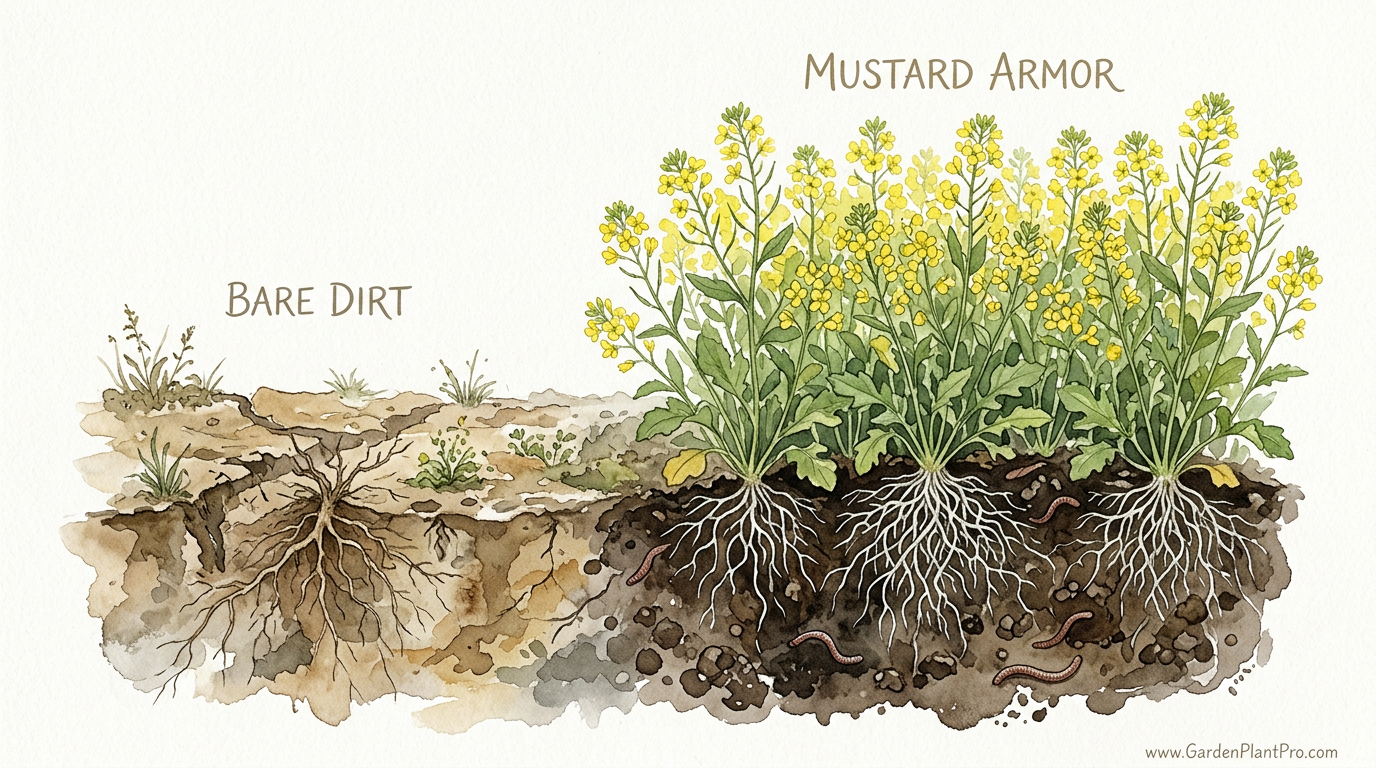
Finally, mustard provides an incredible amount of biomass. In just 60 days, a healthy stand can produce up to 8,000 lbs of organic matter per acre (about 9,000 kg per hectare). When this green material decomposes, it feeds the beneficial microbes and earthworms that make your garden thrive. It turns the “bare dirt” cycle of depletion into a “mustard armor” cycle of abundance.
The Chemistry of Biofumigation: How It Works
To really get the most out of mustard, you have to understand the little chemical factory happening inside those leaves. It all comes down to two things: glucosinolates and an enzyme called myrosinase. In the living plant, these two stay in separate compartments of the cells. They are like a two-part epoxy that only works when you mix them together.
The “mixing” happens when you mechanically damage the plant—typically by chopping or mowing it. Once those cells are crushed, the myrosinase enzyme meets the glucosinolates in the presence of water. This triggers a reaction that releases isothiocyanates (ITCs). These ITCs are chemically very similar to the active ingredients in commercial soil fumigants like metam sodium, but they come from a packet of seeds rather than a chemical jug.
ITCs are the reason mustard tastes hot and spicy, and they are exactly what kills off the “bad guys” in your soil. However, these gases are volatile, meaning they want to evaporate into the air almost immediately. To make biofumigation work, you have to chop the mustard as finely as possible and bury it into the soil within minutes. If you wait even half an hour, most of that “cleansing gas” will have floated away into the atmosphere.
Different types of mustard produce different ITCs. For instance, white mustard (Sinapis alba) produces a non-volatile compound called sinalbin, which is fantastic for suppressing weed seeds. Oriental or brown mustard (Brassica juncea) produces allyl isothiocyanate, which is much more effective against fungi and nematodes. Successful gardeners often use a blend of both to cover all their bases.
Choosing the Right Mustard Variety
Not all mustard seeds are created equal. If you just buy a packet of culinary mustard seeds from the grocery store, you might get some growth, but you will miss out on the high-potency benefits of varieties bred specifically for cover cropping. Serious practitioners look for “high-glucosinolate” varieties that have been selected for their massive biomass and potent chemical levels.
White and Yellow Mustards (Sinapis alba)
These are the workhorses of weed suppression. Varieties like IdaGold are famous for their high sinalbin content. They grow quickly and create a dense canopy that shades out winter annuals. These are usually the best choice if your primary goal is to have a clean, weed-free seedbed for your spring lettuce or onions. They are also very effective at managing certain types of cyst nematodes.
Brown and Oriental Mustards (Brassica juncea)
If you are dealing with soil diseases, these are the heavy hitters. Varieties like Pacific Gold and Kodiak are bred to have massive sinigrin levels. This variety is the go-to for potato growers who want to combat Verticillium wilt. Be aware that Pacific Gold can be sensitive to the length of the day; if you plant it in the spring, it might try to flower too quickly before it has built up enough biomass. It often performs best as a late-summer or fall crop.
Specialty Blends and Trap Crops
Modern seed companies have developed sophisticated blends like Caliente 199. This is a specific mix of Sinapis alba and Brassica juncea that is designed to give you a “double whammy” of biofumigation. It provides both the weed-suppressing power of white mustard and the antifungal punch of the brown varieties. There is also Nemat (Eruca sativa), which is actually a type of arugula bred to act as a “trap crop.” It attracts nematodes to its roots but then prevents them from reproducing.
Step-by-Step Guide to Planting Mustard
Planting mustard is one of the easiest chores in the garden, but doing it correctly makes a huge difference in the biomass you’ll get. You want a thick, lush forest of greens, not a patchy mess. A good rule of thumb is to aim for about 10 to 15 lbs of seed per acre (11 to 17 kg per hectare), which translates to about 1/4 to 1/2 pound of seed per 1,000 square feet (120 to 240 grams per 92 square meters).
1. Prepare the Seedbed
Mustard seeds are tiny—about 1 to 3 mm in diameter. They do not have a lot of stored energy to push through heavy clods of dirt. I like to lightly rake the soil after a summer harvest to create a fine tilth. Remove any large debris or thick layers of old mulch so the seeds can make good contact with the soil. You do not need to till deeply; just the top inch (2.5 cm) is enough.
2. Fertilize for Success (The 6:1 Ratio)
This is the secret step that most beginners skip. To produce those potent glucosinolates, mustard needs sulfur. To produce massive biomass, it needs nitrogen. Aim for a 6:1 ratio of nitrogen to sulfur. If you apply 60 lbs of nitrogen per acre (67 kg/ha), you should add about 10 lbs of sulfur (11 kg/ha). For a backyard bed, a light application of ammonium sulfate or a mix of compost and gypsum usually does the trick perfectly.
3. Sow the Seeds
Broadcast the seeds evenly across the surface. I usually walk the bed in two directions—once North-to-South and once East-to-West—to ensure I don’t leave any “naked” spots. Once the seeds are down, lightly rake them in or pat the soil with the back of a shovel. You are aiming for a planting depth of about 1/2 inch (1 cm). If they are too deep, they won’t emerge; if they are on the surface, the birds will have a feast.
DIY PROJECT: Collect rainwater no matter where you live...
This DIY project is the best way to legally collect rainwater NO MATTER where you live. Get chlorine-free water, cut down on your water bills, and have enough for an emergency situation or to water your garden. Read More Here...
4. Water and Germination
Mustard loves moisture. If the soil is dry, give the bed a good soaking right after planting. In soil temperatures between 55°F and 75°F (13°C to 24°C), you should see sprouts in as little as 4 to 5 days. If you are planting in the late summer for a fall crop, keep a close eye on irrigation. Drought stress will cause the plants to “bolt” or flower prematurely, which reduces the amount of biomass they can produce.
When to Plant: Timing for Different Climates
Timing is everything with mustard. Because it is a cool-season annual, it thrives when the days are mild and the nights are crisp. Depending on your goals and your location, you have two main windows for success. You must coordinate your planting so the mustard reaches peak bloom just when you are ready to prepare the soil for your next main crop.
For a spring cover crop, sow your seeds as soon as the soil can be worked and temperatures reach at least 45°F to 50°F (7°C to 10°C). This allows the mustard to grow for 60 to 70 days before you chop it in late May or June. This window is ideal if you are following the mustard with “heavy feeders” like pumpkins, melons, or late-planted tomatoes. The biofumigation will be fresh and active just as the summer pathogens are waking up.
For a fall or winter cover crop, the goal is often different. In colder regions (like the Northeast US or Northern Europe), gardeners plant in late August or early September. The mustard grows rapidly, provides 100% ground cover to prevent erosion, and then “winter-kills” when temperatures drop below 25°F (-4°C). The dead plants leave a mellow, easy-to-manage residue on the surface that you can plant right into the following spring.
In mild climates where it doesn’t freeze hard, you can grow mustard all winter long. You might plant in October and terminate the crop in February or March. This keeps the soil “alive” throughout the rainy season. However, be careful not to let the plants go to seed. If you see those yellow flowers starting to fade and turn into green pods, it is time to act. Once mustard sets seed, it can become a persistent weed in your garden for years to come.
Termination: The Art of the Chop and Seal
The most critical hour in the life of a mustard cover crop is the day you decide to end it. If you are using it for biofumigation, you cannot just pull the plants up and throw them in the compost. You need to release that natural gas directly into the soil. This requires a specific process that I call the “Chop, Incorporate, and Seal” method.
Wait until the mustard is at 50% to 80% full bloom. This is the moment when the glucosinolates are at their highest concentration. If you wait until the flowers fall off and seeds form, the chemical potency drops significantly, and the stalks become woody and hard to break down. You want the plants to be lush, green, and full of “spice.”
- Step 1: The Chop. Use a flail mower, a string trimmer, or even a sharp hoe to macerate the plant material. The smaller the pieces, the better. You want to break as many cell walls as possible to trigger the ITC release.
- Step 2: Immediate Incorporation. This is the most important rule. You must till or dig the chopped greens into the top 6 to 8 inches (15 to 20 cm) of soil within 20 minutes. Research shows that 80% of the biofumigant gas escapes in the first twenty minutes after chopping. Do not chop the whole garden and then start digging; work in small sections if you have to.
- Step 3: The Seal. Once the greens are buried, you need to trap the gas. Use a lawn roller or the back of a shovel to pack the soil down firmly. This closes up the air pockets. Then, give the area a light watering. This creates a “water seal” on the surface that prevents the gas from escaping into the atmosphere.
After you have sealed the bed, walk away and let it sit for at least 10 to 14 days. This is the “plant-back” window. During this time, the soil microbes are feasting on the green manure, and the biofumigant gases are doing their work. If you try to plant seeds too early, the gases can actually inhibit the germination of your new crop—a phenomenon known as allelopathy.
Comparison: Bare Dirt vs. Mustard Armor
It helps to visualize the difference between a garden that is left “naked” and one that is protected. In the gardening world, bare soil is a liability. It is a vacuum that Mother Nature will fill with weeds if you don’t fill it first. Here is how the two approaches stack up over a typical 4-month winter or fallow period.
| Factor | Bare Dirt (Naked Soil) | Mustard Armor (Cover Crop) |
|---|---|---|
| Nutrient Retention | High leaching; Nitrogen washes away with rain. | High retention; Nutrients are “locked” in plant tissue. |
| Erosion Control | Topsoil is vulnerable to wind and water runoff. | Root and canopy system anchors soil in place. |
| Soil Structure | Surface crusts and compacts under raindrop impact. | Roots break up compaction; adds organic matter. |
| Pest Management | Pathogens and nematodes survive undisturbed. | Biofumigation suppresses fungi and parasites. |
| Weed Pressure | Hardy winter weeds establish easily. | Allelopathic compounds and shading suppress weeds. |
| Microbial Life | Microbes go dormant or die due to lack of food. | Active root exudates and biomass feed soil biology. |
Common Mistakes and Pitfalls
Even with the best intentions, things can go wrong if you treat mustard like a set-it-and-forget-it plant. One of the biggest errors I see is letting the mustard go to seed. While those yellow flowers are great for bees, the seeds are incredibly hardy. If you don’t terminate the crop in time, you will be pulling “volunteer” mustard out of your carrots for the next three years. Always aim to chop when the first few pods are just starting to show, but before they turn brown.
Another common mistake is ignoring the 14-day waiting period. I once made the mistake of planting cucumber seeds only four days after tilling in a heavy stand of mustard. Not a single seed germinated. The same compounds that kill fungus will also kill a tender seedling. Patience is the key to success here. Let the soil “breath” and the chemistry settle before you move on to your next crop.
Gardeners also frequently overlook the moisture requirement. If you incorporate mustard into bone-dry soil and don’t water it in, you won’t get any biofumigation. The chemical reaction literally requires water to occur. If you live in an arid region, you must be prepared to irrigate your cover crop just as carefully as you would your tomatoes.
Finally, be wary of crop rotation issues. Mustard is a member of the Brassicaceae family. If your garden has a history of “clubroot” or other brassica-specific diseases, planting more mustard can actually make the problem worse. In those cases, you are better off using a different cover crop like cereal rye or oats. Never follow a mustard cover crop with broccoli, kale, or cabbage, as they share the same pests like flea beetles and cabbage worms.
Advanced Strategy: Creating a Cover Crop Cocktail
Once you are comfortable with a pure stand of mustard, you can start experimenting with “cocktails.” Mixing mustard with other species can provide a more balanced diet for your soil. Mustard is a heavy scavenger of nitrogen, but it cannot “fix” its own nitrogen from the air. To solve this, many experienced gardeners mix mustard with a legume like Crimson Clover or Hairy Vetch.
In this scenario, the mustard grows fast and provides the “armor” and the biofumigation, while the clover works slowly to add new nitrogen to the system. You get the benefits of disease suppression and fertility boost in one go. Just keep an eye on the seeding rates; mustard is very aggressive and can easily crowd out the slower-growing clover if you use too much seed.
Another popular mix is Mustard and Oats. This is a classic “winter-kill” combination for cold climates. The oats provide massive amounts of carbon and fibrous roots that stabilize the topsoil, while the mustard adds the “spice” to keep the pests at bay. Both will die back in a hard freeze, leaving you with a perfect, weed-free mulch to plant into come spring. I find this much easier to manage than cereal rye, which can be difficult to kill in the spring without heavy tilling.
Real-World Example: The Potato Restoration
To see how this works in practice, let’s look at a common problem: “tired” potato ground. If you grow potatoes in the same spot for a few years, you often notice “Potato Scab” or smaller yields due to Verticillium wilt. One of my neighbors had this exact issue in a 200-square-foot (18.5 square meter) patch. We decided to run a mustard trial.
Do you have some charcoal in your house right now? We call charcoal a “miracle leftover” for anyone who wants to be a little more self-sufficient and cut costs. That’s because it can help you with so many different things around the house and garden. You can even use it to make an energy-free fridge. Read More Here...
After his early summer harvest in July, we cleared the bed and sowed Pacific Gold mustard. We applied a handful of ammonium sulfate (high nitrogen and sulfur) to get it moving. By late August, the mustard was 4 feet (1.2 meters) tall and thick enough that you couldn’t see the dirt. We mowed it down with a lawnmower on the highest setting, immediately rototilled it in, and soaked the bed with a hose.
The following spring, he planted his seed potatoes. The difference was remarkable. Not only were the potatoes cleaner with almost no scab, but the soil was noticeably more “fluffy” and easier to dig. He estimated a 25% increase in yield compared to the previous year. It wasn’t magic—it was just the mustard doing the heavy lifting during the months when the garden is usually ignored.
Final Thoughts
Mustard is more than just a cover crop; it is a tool for the proactive gardener who wants to work with nature rather than against it. By moving away from the “bare dirt” model, you are protecting your most valuable asset: the soil. Whether you are using it to clean up a disease-ridden bed or simply to keep the weeds at bay over the winter, mustard provides a high return on a very small investment of time and money.
Do not be afraid to experiment with different varieties and timings. Every garden is a unique ecosystem, and what works in a sandy Florida backyard might need adjustment in a clay-heavy garden in the Pacific Northwest. Start with a small patch this fall or next spring. Watch how fast those seeds emerge and how the soil feels under your fingers once the crop has been incorporated.
The transition from a “naked” winter garden to one protected by “mustard armor” is a major step in your journey as a gardener. It teaches you to think in terms of seasons and cycles rather than just individual harvests. Give your soil the gift of mustard this year, and I promise your spring vegetables will thank you for it with the most vigorous growth you have ever seen.