
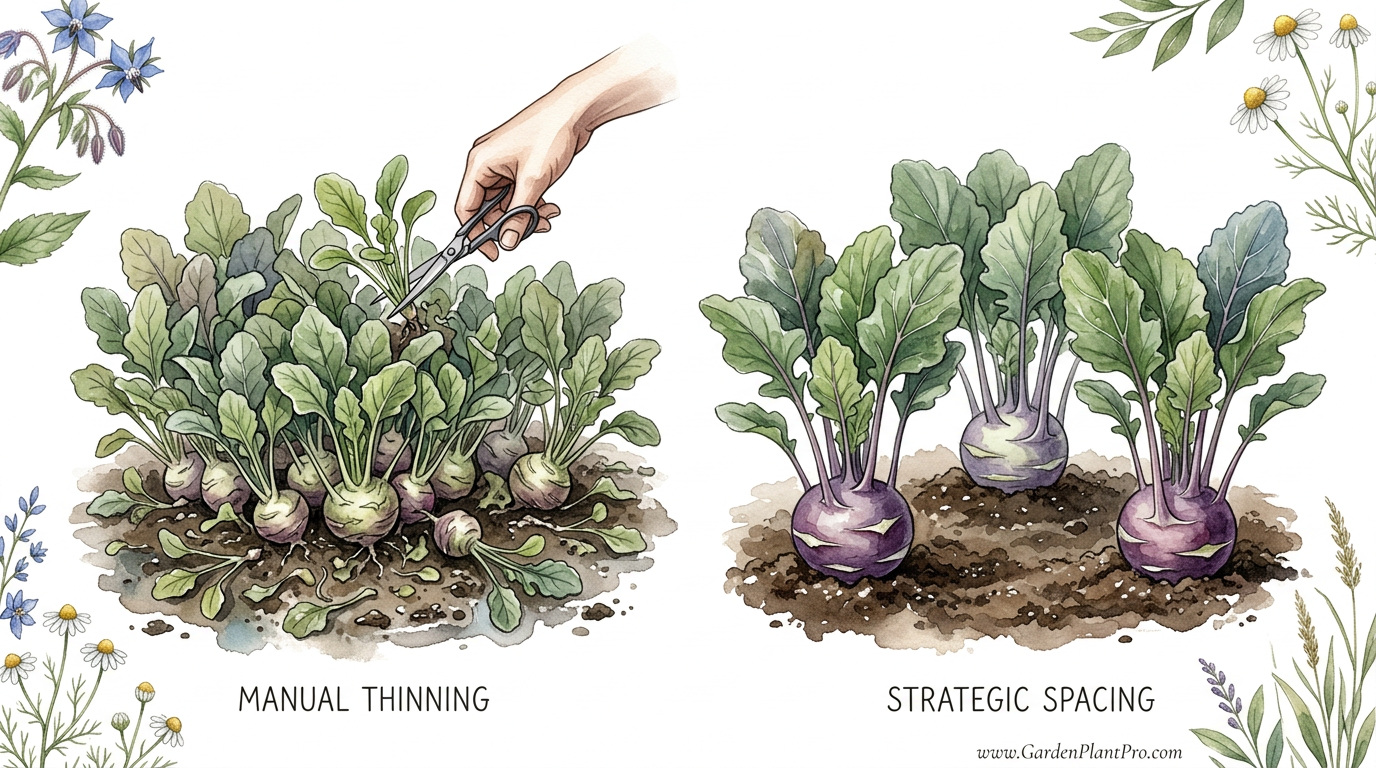
Why back-breaking thinning is actually the slowest way to grow a kohlrabi harvest. If you are spending hours on your knees pulling out extra seedlings, you are doing it the hard way. Strategic spacing at the start means zero waste and double the growth speed. Here is how the pros set up their kohlrabi beds for success without the sweat.
I remember the first time I tried growing kohlrabi. I treated it like carrots, scattering seeds along a trench and figuring I would just pull out the extras later. I spent three afternoons in the hot sun, squinting at tiny green shoots, trying to decide which ones to keep and which ones to sacrifice. It was tedious, it was hard on my back, and worst of all, it actually stunted the plants I left behind because I had disturbed their delicate roots. Years of dirt under my fingernails have taught me that kohlrabi is not a crop that rewards chaos; it is a crop that rewards a bit of math and a steady hand during planting.
When you give this odd-looking “space alien” vegetable exactly what it needs from day one, it grows with a vigor that is hard to believe. You aren’t just saving yourself the work of thinning; you are ensuring that every single plant has its own dedicated “pantry” of soil nutrients and a “window” of sunlight. This approach leads to those crisp, apple-like bulbs we all want, rather than the woody, tough spheres that happen when plants are forced to compete for resources.
Success in the vegetable garden often comes down to how well we understand the physical geometry of the plants. Kohlrabi is unique because we aren’t eating the root or the leaves, but the swollen stem that sits just above the soil line. If that stem doesn’t have room to expand outward, it stays narrow and starts to get stringy. Let’s walk through how to set up your garden bed so you can spend your time harvesting and eating rather than crawling through the dirt pulling weeds and wasted seedlings.
Optimal Kohlrabi Spacing For Maximum Yield
Optimal kohlrabi spacing is the specific distance between seeds or transplants that allows each plant to reach its full genetic potential without crowding its neighbors. For most standard varieties, this means a distance of 4 to 6 inches (10 to 15 cm) between plants within a row. If you are planting multiple rows, those rows should be spaced about 12 inches (30 cm) apart. This creates a grid that maximizes the number of plants per square foot while still allowing for adequate air circulation.
This spacing exists because kohlrabi is a heavy feeder that relies on its broad, waxy leaves to capture sunlight and fuel the expansion of its bulbous stem. When plants are too close, their leaves overlap, creating shade that slows down growth. Crowded plants also compete for moisture and nitrogen. In a crowded bed, you might get “bulb” development, but it will often be lopsided or undersized because the plant spent its energy stretching upward to find light instead of thickening its base.
Think of kohlrabi spacing like seating at a dinner table. Everyone needs enough elbow room to eat comfortably. If you squeeze too many people in, nobody can move their arms, and the meal becomes a struggle. In the garden, that “elbow room” translates directly to the diameter of the harvested bulb. Proper spacing ensures that the bulb can expand to 2 or 3 inches (5 to 7 cm) in diameter—the “sweet spot” for flavor—without touching the plant next to it.
How to Implement Strategic Spacing in Your Garden
The transition from manual thinning to strategic spacing starts with your planting method. Many gardeners prefer direct sowing, but if you want to be precise, starting seeds in modules or trays is often more efficient. When you transplant a seedling that already has its first true leaves, you can place it exactly where it belongs. This eliminates the guesswork and the need for thinning entirely.
If you prefer to sow seeds directly into the garden soil, use a “station sowing” technique. Instead of a continuous line of seeds, drop two seeds at your exact 4-inch (10 cm) or 6-inch (15 cm) marks. After they germinate, if both seeds sprout, you simply snip one off with scissors at the soil level. This is much faster than traditional thinning and protects the root system of the remaining plant. Ensure the seeds are buried about 1/4 to 1/2 inch (6 to 12 mm) deep in well-prepared, loose soil.
Gardeners using the Square Foot Gardening method find that kohlrabi fits perfectly into a 9-per-square-foot pattern for smaller varieties or a 4-per-square-foot pattern for larger ones. To do this, divide your 12-inch (30 cm) square into a grid. For 9 plants, space them every 4 inches (10 cm). This intensive spacing works beautifully if your soil is rich in organic matter and you have a consistent irrigation system in place to support the high density of plants.
- Measure twice, plant once: Use a measuring stick or a pre-marked garden line to ensure your 4-6 inch (10-15 cm) gaps are consistent.
- Account for variety: Smaller “Winner” or “Early White Vienna” varieties can handle the 4-inch (10 cm) spacing, while giant varieties like “Kossak” may require up to 12 inches (30 cm) to reach their full 10-pound (4.5 kg) potential.
- Check your soil: Heavier clay soils may require slightly wider spacing to prevent the soil from compacting too tightly around the expanding bulbs.
The Practical Benefits of Strategic Spacing
The most immediate benefit is the reduction in labor. By skipping the hours spent thinning, you free up time for other tasks like pest management or composting. However, the benefits extend far beyond just saving time. Plants that are never crowded grow faster because they never experience the stress of competition. This faster growth often results in a more tender, less “woody” texture in the final harvest.
Airflow is another critical advantage. Brassicas, the family kohlrabi belongs to, are susceptible to various fungal issues and pests like aphids or cabbage white butterflies. Wide spacing allows wind to move through the leaves, drying out moisture from dew or rain more quickly. This dry environment is much less hospitable to mold and mildew. It also makes it easier for you to spot pests early because you can see the entire plant clearly without digging through a jungle of leaves.
Uniformity is the final major benefit. When every plant has the same amount of space, they all tend to reach harvest size at roughly the same time. This is incredibly helpful for garden planning. You can clear out an entire section of the bed at once and immediately follow it with a second crop, such as bush beans or lettuce. This “succession planting” keeps your garden productive throughout the entire growing season.
Common Mistakes and How to Avoid Them
One of the most frequent errors I see is “emotional planting.” This happens when a gardener sees a packet of 100 seeds and feels bad only planting 20 of them. They end up crowding the seeds together, thinking they are being more productive. In reality, 20 well-spaced plants will usually produce more edible weight than 50 crowded plants that stay small and tough. Trust the spacing recommendations on the seed packet; they are there for a reason.
Neglecting the soil preparation before spacing is another pitfall. Precise spacing only works if the soil can support the plant at that specific spot. If you have “dead zones” in your bed where the soil is compacted or nutrient-poor, the plant in that space will languish regardless of how much room it has. Always work in a generous amount of well-rotted manure or compost before you start marking out your planting grid.
Another mistake is failing to adjust spacing for the season. In the heat of late spring or early summer, kohlrabi may benefit from being slightly closer together to help shade the soil and keep it cool. Conversely, in the damp, low-light conditions of early autumn, wider spacing is essential to prevent rot. Pay attention to your local weather patterns and be willing to give the plants an extra inch (2.5 cm) of breathing room if your area is particularly humid.
Limitations of Fixed Spacing Models
While strategic spacing is a gold standard, it isn’t a “set it and forget it” solution for every single garden. Environmental factors play a huge role. For instance, if you are gardening in a very dry climate with sandy soil, the wide 6-inch (15 cm) spacing might lead to rapid soil evaporation. In these cases, you might actually want to plant slightly closer or use a thick layer of mulch to protect the soil surface between the plants.
There are also genetic limitations. If you are growing heirloom varieties, they can sometimes be less uniform in their growth habits than modern hybrids. A “Winner” hybrid will almost always grow to the exact same size as its neighbor, but an older heirloom might have one plant that takes up twice as much room as the next. When working with older varieties, it is usually safer to lean toward wider spacing to accommodate these natural variations.
Finally, the physical layout of your garden might dictate your spacing more than the “ideal” rules. If you have narrow raised beds, you might find that staggered “zigzag” planting works better than straight rows. This allows you to fit more plants into the space while still maintaining the required distance between each individual stem. Always prioritize the distance between the plants themselves over the neatness of the rows.
Manual Thinning vs. Strategic Spacing
It is helpful to see how these two methods stack up against each other in a real-world garden setting. While manual thinning has been the traditional “safety net” for beginners, strategic spacing is the move toward efficiency and higher quality.
DIY PROJECT: Collect rainwater no matter where you live...
This DIY project is the best way to legally collect rainwater NO MATTER where you live. Get chlorine-free water, cut down on your water bills, and have enough for an emergency situation or to water your garden. Read More Here...
| Feature | Manual Thinning | Strategic Spacing |
|---|---|---|
| Labor Intensity | High (requires multiple sessions) | Low (one-time setup) |
| Seed Waste | Significant (60-80% discarded) | Minimal (almost 0% waste) |
| Root Disturbance | Common (can stunt remaining plants) | None (plants grow undisturbed) |
| Harvest Uniformity | Variable (depends on thinning skill) | High (consistent plant size) |
Practical Tips for Success
To really master this, I suggest creating a “planting template.” You can take a piece of scrap wood and drill holes at 4-inch (10 cm) and 6-inch (15 cm) intervals. Lay this on the soil and poke a finger or a dibber through the holes. This ensures your spacing is perfect every single time without you having to carry a ruler around the garden. It’s a simple tool that has saved me countless hours over the decades.
Another tip is to use your spacing as a guide for irrigation methods. If you are using a drip system, place your emitters exactly at the base of where the kohlrabi will grow. This delivers water directly to the root zone and leaves the gaps between plants dry, which significantly reduces weed growth. Weeds can’t grow where there is no water, so the “empty” space between your perfectly spaced kohlrabi stays clean with almost no effort from you.
- Mulch the gaps: Once your seedlings are about 3 inches (7 cm) tall, tuck straw or shredded leaves into the spaces between them to hold in moisture.
- Label your varieties: Different varieties have different leaf spreads. Mark which is which so you don’t accidentally crowd a large variety.
- Watch the “Shoulders”: As the kohlrabi bulb grows, ensure the soil isn’t mounded up against it. The bulb needs to sit on top of the soil, not buried in it.
Advanced Considerations for Large-Scale Success
For those looking to grow enough kohlrabi for the whole winter, consider the “staggered harvest” spacing. You can plant half of your bed at 4-inch (10 cm) spacing and the other half at 8-inch (20 cm) spacing. The 4-inch plants will be ready to harvest early as “baby” kohlrabi, which are incredibly sweet. Removing them then gives the remaining plants even more room to grow into large, storage-sized bulbs for the root cellar.
Nutrient density is also an advanced factor. Because you are placing plants closer together than they would occur in nature, you are asking a lot of the soil in a very small area. Consider a mid-season “top dressing” of compost tea or a balanced organic fertilizer. This ensures that the plants at the center of your grid aren’t running out of fuel while their neighbors on the edges thrive. Precision spacing requires precision feeding.
Lastly, think about your garden’s orientation to the sun. If your rows run North-to-South, each plant will get equal sun throughout the day. If they run East-to-West, the plants in the southern row might shade out the plants in the northern row. If you must plant East-to-West, increase your row spacing to 15 or 18 inches (38 to 45 cm) to compensate for the shadows cast by the kohlrabi’s large, upright leaves.
Example Scenario: The 4×4 Raised Bed
Let’s look at a practical application. Suppose you have a standard 4-foot by 4-foot (1.2m x 1.2m) raised bed. Using the manual thinning method, you might scatter three packets of seeds and spend hours thinning them out, likely ending up with a chaotic mess of about 40 plants of varying sizes.
Using the strategic spacing method, you would mark out 4 rows, each 12 inches (30 cm) apart. Within each row, you place a transplant every 6 inches (15 cm). This gives you exactly 8 plants per row, for a total of 32 plants in the bed. Because these 32 plants have zero competition and perfect airflow, each one will likely produce a high-quality 3-inch (7 cm) bulb. Your total usable yield will be significantly higher than the crowded bed, and your total work time will be cut by 70%.
In this scenario, you also have clear paths for your hands to reach in and harvest. You won’t be stepping on plants or struggling to find the base of the stem. The garden looks intentional, professional, and—most importantly—it functions like a well-oiled machine. This is the difference between fighting against nature and working with it.
Final Thoughts
Mastering kohlrabi spacing is a rite of passage for many vegetable gardeners. It represents a shift in mindset from “more is better” to “better is better.” By taking those few extra minutes during the planting phase to measure your distances and place your seeds or transplants with care, you are setting yourself up for a season of ease. You will find that your plants are healthier, your harvests are more consistent, and your back will certainly thank you for the lack of thinning duties.
I encourage you to try this approach in at least one corner of your garden this season. Compare it to your usual methods and watch how the plants respond. Gardening is a lifelong conversation with the earth, and sometimes, the best thing we can do is just give our plants a little bit of room to breathe. Once you see those perfectly round, crisp bulbs sitting neatly in their rows, you’ll never go back to the old way of thinning again.
If you find success with this, you might want to look into other ways to optimize your garden layout, such as garden planning for winter storage or exploring pest management techniques that work in harmony with your new, airy garden beds. Every small adjustment you make leads to a more productive and enjoyable backyard experience.