
Stop cutting your rosemary like a hedge and start triggering its ‘growth engine’ with this one simple snip. Most gardeners treat rosemary like a chore, hacking away at the old wood and wondering why the plant never recovers. The secret isn’t more water—it’s strategic apical pruning. Learn how to ‘pinch’ your way to a lush, aromatic hedge that produces 4x more oil-rich leaves.
The first thing I tell folks when they lean over my garden gate is that rosemary doesn’t want to be “trimmed”—it wants to be communicated with. This rugged Mediterranean shrub carries a powerful biological switch in every stem. When you understand how to flip that switch, you stop fighting the plant’s natural tendency to get leggy and start working with its internal hormones.
Years of working this soil have taught me that rosemary is a creature of habit. It wants to reach for the sun, focusing all its energy on the very tip of each branch. This is what we call apical dominance. If you let it go, you end up with a sparse, woody skeleton with just a few tufts of green at the ends. To get that dense, fragrant bush that smells like a Sunday roast every time you brush past it, you have to break that dominance.
How To Prune Rosemary For Maximum Growth
Pruning rosemary for maximum growth is less about “haircutting” and more about redirecting the plant’s internal sap flow. In the simplest terms, rosemary produces a hormone called auxin at the very tip of its branches. This hormone travels down the stem and tells the lower buds to stay asleep. This keeps the plant growing upward rather than outward.
Strategic pruning involves removing those tips to stop the auxin flow. This “wakes up” the lateral buds—the tiny green points hiding along the stem—and forces them to grow into new branches. Instead of one long, spindly stem, you suddenly have two or three. Every time you repeat this process, you effectively double or triple your leaf production.
In the real world, this is the difference between a plant that looks like a bundle of sticks and one that looks like a solid green wall. Whether you are growing an upright variety like ‘Miss Jessop’s Upright’ for a formal hedge or a prostrate variety to cascade over a stone wall, the principle remains the same. You are the architect of the plant’s shape, and your shears are the tools that tell the plant where to build.
How It Works: The Art of the Pinch and the Snip
The process varies slightly depending on whether you are working with a young seedling or a gnarled old veteran. Understanding the anatomy of the stem is the first step to success.
The Early Pinch
Start with your rosemary as soon as it leaves the nursery pot. Many people wait until the plant is “big enough” to prune, but that is a mistake. When the plant is only 15 cm to 20 cm (6 to 8 inches) tall, use your thumb and forefinger to pinch off the soft, green growing tip. This tiny action sets the foundation for a bushy plant. Within a week or two, you will see two new shoots emerging from the leaf axils just below where you pinched.
The Heading Cut
For established plants, you need more than just a pinch. Use sharp, clean bypass pruners to make “heading cuts.” A heading cut is made in the middle of a green, succulent branch, just above a pair of leaves.
Look for the “nodes”—the spots where leaves join the stem. Make your cut at a 45-degree angle about 5 mm (1/4 inch) above these nodes. This angle allows water to run off the cut rather than sitting on it, which helps prevent rot and disease.
The 1/3 Rule
Never remove more than one-third of the plant’s total mass at once. Taking too much can shock the root system. If a plant is severely overgrown, it is better to prune it in stages, waiting 6 to 8 weeks between sessions to allow the plant to recover and push out new growth.
Benefits of Strategic Pruning
Taking the time to prune correctly offers rewards that go far beyond just a “neat” garden. Here is why I never skip my seasonal pruning rounds:
- Increased Oil Content: New growth is where the highest concentration of essential oils lives. By constantly triggering new shoots, you ensure your rosemary has that intense, resinous aroma and flavor that old, dusty leaves lack.
- Better Airflow: Rosemary hates “wet feet” and humid air. A dense, unpruned bush traps moisture, which leads to powdery mildew and root rot. Pruning opens up the center of the plant, letting the wind through and keeping the foliage dry.
- Extended Lifespan: Left to its own devices, rosemary often “collapses” under its own weight or gets so woody that it stops producing. Regular pruning keeps the plant youthful and productive for a decade or more.
- Frost Resistance: A compact, well-managed bush is much easier to protect in the winter. Leggy branches are the first to break under snow or succumb to a hard freeze.
Challenges and Common Mistakes
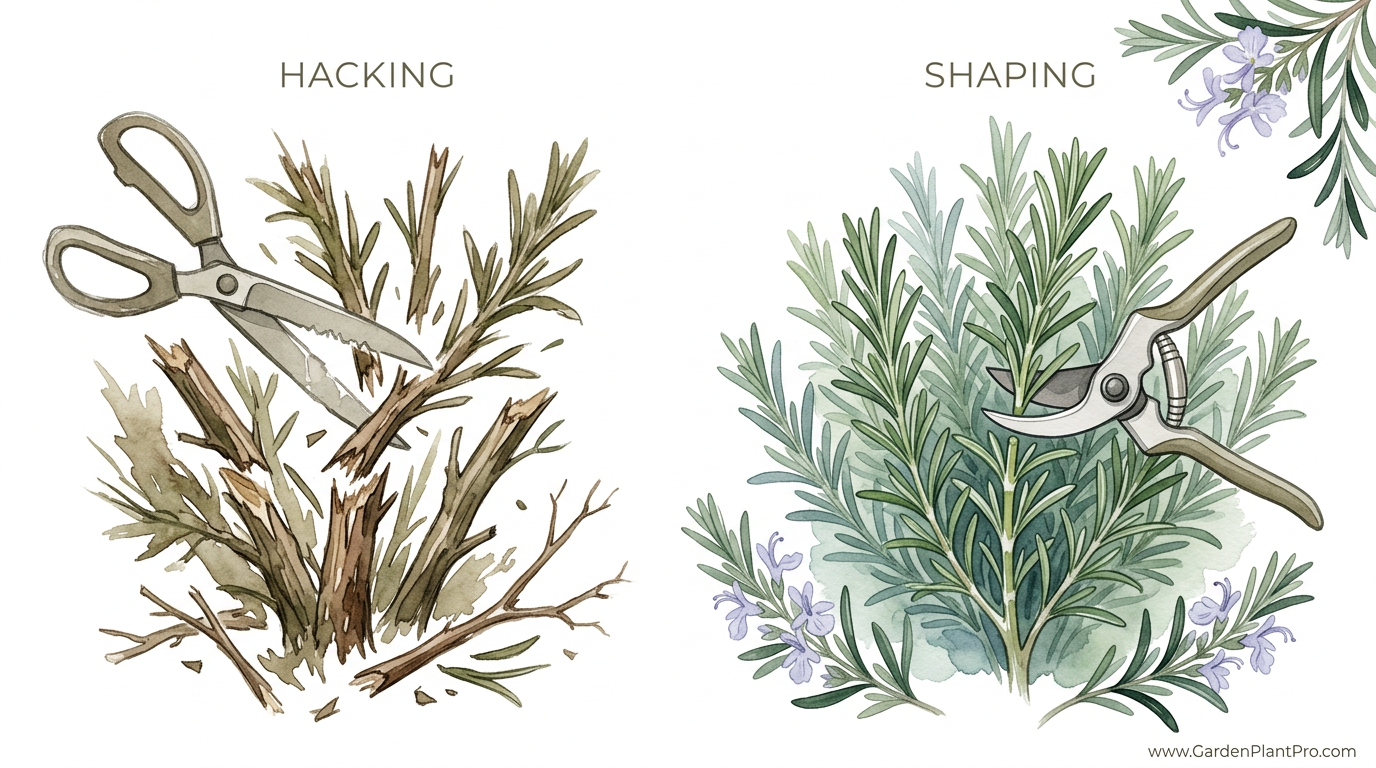
The most heartbreaking thing I see is a gardener who “hacks” into the old wood. Rosemary is not like a boxwood or a privet; it has a very limited ability to regenerate from old, brown, leafless wood.
Mistake #1: Cutting into the “Dead Zone”
If you look at the center of an old rosemary plant, you’ll see thick, scaly, brown branches with no needles. If you cut into this wood, that branch will likely never grow back. It will stay as a dead stump, leaving a permanent hole in your bush. Always ensure there are several sets of green leaves below your cut.
Mistake #2: Pruning Too Late in the Season
In many climates, rosemary needs time to “harden off” before the first frost. If you prune in late autumn, you trigger a flush of tender, watery new growth. The first freeze will hit that new growth like a hammer, potentially killing the entire branch or even the whole plant.
Mistake #3: Using Dull Tools
A dull blade crushes the stem rather than cutting it. This creates a jagged wound that takes longer to heal and serves as an open door for pathogens. Keep your shears sharp enough to slice through a piece of paper.
Limitations: When Pruning Isn’t Enough
Even the best pruning can’t save every plant. There are times when you have to recognize the limits of what a pair of shears can do.
Rosemary plants generally have a productive lifespan of about 10 to 15 years. Eventually, the main trunk becomes so woody and the sap flow so restricted that the plant loses its vigor. If your rosemary is mostly gray wood and the new growth is spindly despite your best efforts, it might be time to start fresh.
Environmental factors also play a role. If your plant is sitting in heavy, clay soil or a spot that gets less than 6 hours of direct sun, no amount of pruning will make it lush. Pruning is a growth trigger, but the plant still needs the right fuel (sun and drainage) to build that new tissue.
DIY PROJECT: Collect rainwater no matter where you live...

This DIY project is the best way to legally collect rainwater NO MATTER where you live. Get chlorine-free water, cut down on your water bills, and have enough for an emergency situation or to water your garden. Read More Here...
Environmental Factors and Timing
Timing your snips is just as important as the technique itself. Because rosemary is a Mediterranean native, it responds to the rhythm of the seasons.
| Season | Activity | Primary Goal |
|---|---|---|
| Late Winter / Early Spring | Light Cleaning | Remove frost damage; prepare for the spring surge. |
| Late Spring | Major Pruning | Shape the plant after flowering; trigger maximum summer growth. |
| Summer | Harvesting / Tipping | Maintenance of shape; gathering herbs for the kitchen. |
| Early Autumn | Last Call | Final light shaping (must be 6–8 weeks before first frost). |
In warmer regions (USDA Zones 9 and above), you can be a bit more aggressive with your timing. However, in cooler areas (Zones 7 and 8), you must be disciplined about stopping all pruning by mid-September (Northern Hemisphere) or mid-March (Southern Hemisphere) to avoid winter kill.
Practical Tips and Best Practices
If you want to move from a beginner to a pro, keep these “neighborly” observations in mind:
- Disinfect your blades: I carry a small spray bottle of rubbing alcohol in my pocket. I spray my shears between every plant. This stops the spread of soil-borne diseases that you might not even know are there.
- Prune in the morning: The plant is most hydrated in the early morning. A hydrated stem heals faster than a heat-stressed one in the middle of a July afternoon.
- Think in 3D: Don’t just prune the outside. Reach into the middle of the bush and remove a few crossing branches. This “opens the chimney,” allowing air to rise through the center and keeping the interior of the plant from becoming a haven for spiders and mold.
- Save the “Waste”: Every green snip is a culinary treasure. If you can’t use it fresh, tie the bundles with twine and hang them in a dry, dark place. Homemade dried rosemary is ten times more potent than the store-bought variety.
Advanced Considerations: Topiary and Hedges
For those who want to take their rosemary game to the next level, consider training your plants into specific forms.
Formal Hedges: If you are growing a rosemary hedge, do not use electric hedge trimmers. They tear the needles and leave the plant looking “bruised” and brown at the tips. Instead, use manual hedge shears or garden snips. Maintain a “tapered” shape—wider at the bottom and slightly narrower at the top. This ensures the lower branches get enough sunlight and don’t die back.
Standards (Rosemary Trees): You can train an upright variety into a “lollipop” shape. This requires choosing a single, vigorous central stem and staking it. You then prune away all side growth on the bottom 30 cm to 60 cm (1 to 2 feet) and repeatedly pinch the top growth to create a dense ball. It takes patience—usually two to three years—but the result is a stunning focal point for a patio.
Example Scenario: The “Neglected Veteran”
Suppose you move into a new house and find a rosemary bush that is 1.5 meters (5 feet) wide, but the center is a hollow, woody mess with only a few green sprouts on the perimeter.
Do not cut it all back to the ground. Instead, follow a two-year recovery plan. In the first spring, identify the most “reachable” green branches. Prune those back by 1/3, ensuring you stay in the green wood. Clear out any dead, brittle twigs from the center to improve light penetration.
Feed the plant with a light layer of compost at the base—not touching the trunk—and ensure it has perfect drainage. By the second year, the increased light and reduced competition will often trigger “dormant buds” on the edges of the woody parts to sprout. You can then prune the other half of the plant. It takes time, but it’s often more rewarding than starting over.
Final Thoughts
Mastering the rosemary “growth engine” is one of the most satisfying milestones for a home gardener. It turns a temperamental shrub into a reliable, year-round performer that feeds your kitchen and scents your garden. Remember that every cut is a signal; you are telling the plant to stop looking at the sky and start filling the space around it.
Approach your rosemary with a clear plan and sharp tools. Don’t be afraid of the “pinch”—it is the most powerful move in your gardening repertoire. If you respect the old wood and time your cuts with the seasons, your rosemary will reward you with a lushness you never thought possible.
As you get comfortable with these techniques, you might find yourself looking at your lavender, sage, or thyme with the same “architectural” eye. The principles of apical dominance and strategic pruning apply across much of the herb garden. Experiment, observe how the plant responds to your touch, and soon enough, you’ll be the one sharing advice over the fence.