
If you are not cutting back 30 percent of your blueberry bush every winter, you are effectively stealing size from your own harvest. Counter-intuitive gardening: The more you cut, the more you get. Most people are too scared to prune their blueberries, resulting in ‘bird-shot’ berries that are all skin and no juice. Here is how the pros get those grocery-store-sized berries at home.
I remember standing in my garden twenty years ago, shears in hand, looking at a beautiful blueberry bush I had spent three years coddling. It felt like a crime to take a blade to those branches. I thought if I left every single bud, I would have a mountain of fruit. What I actually got was a mountain of disappointment—tiny, sour berries that were a chore to pick and even harder to eat. It took a neighbor leaning over the fence to tell me that a blueberry bush is not a museum; it is a factory that needs constant renovation.
Most home gardeners treat their blueberries like ornamental shrubs. They let them grow into a tangled mess of gray wood and twiggy ends. While that might look “natural,” it forces the plant to spread its energy far too thin. When you prune, you are not just “cleaning up” the plant. You are commanding it to focus its limited resources into a smaller number of high-quality berries. The result is fruit that is twice the size and significantly sweeter because the plant has more sugar to go around for each individual berry.
Growing large blueberries is about understanding the cycle of the cane. A blueberry cane is at its most productive between ages three and six. After that, it becomes a “dinosaur”—a thick, gray, woody branch that drinks up water and nutrients but produces very little. By removing that old wood, you make room for the vibrant, reddish new shoots that will carry the heavy harvests of your future. Let’s walk through how to transform your “bird-shot” berries into the giants you see at the market.
Pruning Blueberries For Massive Fruit
Pruning is the intentional removal of specific parts of a plant to improve its health and productivity. In the world of blueberries, this means removing old wood to stimulate new, vigorous growth. The goal is a “renewal” cycle. We want a bush that always has a mix of ages: some young canes for the future, some middle-aged canes for the current harvest, and no canes that are over the hill. This balance ensures that the plant never spends energy on “dead weight” wood that has lost its vitality.
This practice exists because blueberries are naturally “basal-dominant” plants. They want to send up new shoots from the crown at the base of the soil. However, if the top of the plant is crowded with old, shading branches, those new shoots never get the light they need to survive. When you prune, you open up the “chimney” of the bush. This lets sunlight hit the crown and triggers the plant’s hormones to start producing those thick, green, or red suckers that will become your best-producing canes in two years.
Think of your blueberry bush like a small business. If you keep every retired employee on the payroll, you eventually run out of money for the new, energetic workers. Pruning is simply “retiring” the older canes so the young ones can flourish. We do this primarily in the late winter or very early spring when the plant is dormant. This timing is crucial because it allows the plant to store its energy in the roots during the cold months, ready to explode into the remaining branches as soon as the ground thaws.
Anatomy of a Blueberry Bush
Before you start cutting, you need to know what you are looking at. A blueberry bush is made up of “canes” which are the main trunks coming out of the ground. Off these canes grow “laterals,” which are the side branches where the fruit actually hangs. You will notice that 1-year-old wood is usually bright red or green and very smooth. 2-year-old wood starts to turn a light brown. By the time a cane is 6 or 7 years old, it is thick, gray, and has bark that might be flaking off like an old cedar tree.
The most important part of the anatomy for a pruner is the bud. There are two types: flower buds and leaf buds. Flower buds are fat, round, and bulbous. They look like little tiny cabbage heads sitting near the tips of the branches. Leaf buds are much smaller, thinner, and pointed. If you look at a branch in February, the top 2–3 inches (5–7.5 cm) will usually be covered in those fat flower buds, while the rest of the branch has the smaller leaf buds. Knowing the difference prevents you from accidentally cutting off your entire crop while trying to shape the plant.
How It Works: The Step-by-Step Renewal Method
The most effective way to prune a mature blueberry bush is the “Rule of Thirds” or the “renewal” strategy. You aren’t just hacking away at the top; you are working from the ground up. Here is the process I use every February to keep my bushes in peak condition. It works whether you have Northern Highbush, Southern Highbush, or Rabbiteye varieties, though the severity may vary slightly based on the plant’s vigor.
Step 1: The Three Ds (Dead, Damaged, Diseased). Start by clearing out the obvious problems. Any wood that is snapped, shriveled, or showing signs of canker (sunken, dark spots) must go. This is your “cleanup” phase. It opens up the view so you can see the actual structure of the bush. Use sharp bypass pruners for thin twigs and loppers for anything thicker than a pencil. Always cut back to healthy wood or all the way to the ground if the whole cane is affected.
Step 2: Clear the Crown. Look at the very bottom of the plant. You want a narrow “waist” at the soil line, roughly 12 to 18 inches (30–45 cm) in diameter. Any thin, “matchstick” growth coming out of the ground away from the main clump should be removed. These will never grow into strong canes and usually just sit in the shade, sucking up nutrients. This also helps with air circulation, which prevents the fungal diseases that love to hide in a damp, crowded base.
Step 3: Remove the “Dinosaurs.” This is where most people get nervous. Identify the oldest canes—the ones that are thick, gray, and covered in lichens. These canes often have very few new “lateral” branches and their flower buds look small. Cut one or two of these all the way to the soil line every year. By removing the oldest 20% to 30% of the wood, you force the plant to send up new replacement canes. This keeps the bush “forever young.”
Step 4: Thin the Center. A blueberry bush should be shaped like a vase or a wine glass—open in the middle. If you have branches crossing through the center of the bush, they will shade each other and rub together, creating wounds where disease can enter. Remove any “crossover” branches. Your goal is to let sunlight hit every single leaf and berry. If the middle is a dark jungle, the berries in there will be small and may never fully ripen or turn blue.
Step 5: Heading Back and Tipping. Finally, look at the very ends of the branches. If a branch is 6 feet (1.8 meters) long and drooping toward the dirt, cut it back to an upward-facing bud. This is called “heading back.” It strengthens the branch so it doesn’t snap under the weight of the fruit later in the summer. You can also “tip” the very top of the new canes to encourage them to branch out, creating more fruiting surface for next year.
Managing Different Varieties
While the basic steps are the same, the “vigor” of your variety matters. Rabbiteye blueberries (common in the Southern US) are incredibly vigorous and can handle much more aggressive pruning—sometimes you can cut them back to 6 inches (15 cm) and they will grow 4 feet (1.2 meters) in a single season. Northern Highbush varieties are more conservative. They grow slower and require a more surgical approach. If you over-prune a Northern variety, you might lose your crop for two years, so stick strictly to the 30% rule for those.
For Southern Highbush, which are hybrids, they tend to over-produce fruit. If you don’t prune them hard, they will actually “fruit themselves to death,” putting so much energy into berries that the plant becomes stunted and dies within a few seasons. For these, I often remove up to 50% of the flower buds just to make sure the plant stays healthy enough to live another year.
Benefits of Strategic Pruning
The rewards of a well-pruned bush are visible within a single season. It isn’t just about the aesthetics of a neat garden; it is about the chemistry and biology of the plant. When you remove excess wood, you are effectively “re-tuning” the plant’s engine. Here is what you can expect when you follow the 30% rule consistently over several winters.
- Increased Berry Size: This is the most immediate benefit. A plant has a fixed amount of sugar and water it can distribute. By reducing the number of flower buds, each remaining berry gets a larger share of the “pie.” Instead of 1,000 tiny berries, you get 500 massive ones.
- Higher Sugar Content: Sunlight is the “fuel” for sugar production. By opening the center of the bush, you ensure that every berry gets the UV light it needs to develop high Brix (sugar) levels. Shaded berries are often watery and tart.
- Improved Airflow: Fungal pathogens like Mummy Berry or Botrytis thrive in stagnant, humid air. A pruned bush dries out faster after rain or morning dew, significantly reducing the need for organic or chemical fungicides.
- Ease of Harvest: It is much easier to pick from a plant with well-spaced branches than one that is a tangled thicket. You can see the berries better, and you won’t get scratched up by dead, twiggy wood.
- Plant Longevity: Blueberries can live for 50 years or more if they are managed well. Constant renewal pruning prevents the plant from becoming “top-heavy” and old, keeping the root system active and the crown producing new growth indefinitely.
Challenges and Common Mistakes
Even though the process is straightforward, I see the same three or four mistakes every year. Most of them come from a place of kindness—gardeners want to “save” every branch. But in the garden, sometimes the kindest thing you can do is use your loppers. Let’s look at what often goes wrong so you can avoid the same pitfalls.
The “Haircut” Mistake: Many beginners just take hedge trimmers to the top of the bush, cutting it into a nice round ball. This is a disaster for blueberries. It creates a “witch’s broom” of tiny, weak twigs at the top that produce almost no fruit. It also keeps the old, non-productive wood at the bottom. Remember: always prune from the bottom up, focusing on entire canes, not just the tips.
DIY PROJECT: Collect rainwater no matter where you live...
This DIY project is the best way to legally collect rainwater NO MATTER where you live. Get chlorine-free water, cut down on your water bills, and have enough for an emergency situation or to water your garden. Read More Here...
Fear of the Loppers: I often hear, “But that cane has berries on it!” Yes, an 8-year-old cane will have berries, but they will be small and few. If you leave it, you are preventing a new, high-production cane from taking its place. You have to sacrifice the “decent” harvest of today for the “extraordinary” harvest of tomorrow. If a cane is thicker than a quarter and gray, it needs to go, regardless of how many buds it has.
Pruning Young Plants: This is the hardest rule for new gardeners. For the first two years after planting, you should remove all flower buds. You don’t want the plant to produce a single berry. You want it to put 100% of its energy into building a massive root system. If you let a tiny 1-gallon (3.8-liter) plant fruit in its first year, you might stunt it for life. I know it’s hard to wait, but those first-year berries aren’t worth the ten years of poor growth they might cause.
Ignoring Tool Hygiene: Blueberries are susceptible to viral and bacterial infections. If you prune a diseased bush and then move to a healthy one without cleaning your shears, you are the vector for the disease. I keep a jar of 70% isopropyl alcohol or a 10% bleach solution handy. A quick dip between plants is all it takes to keep your patch healthy.
Limitations: When Pruning Isn’t the Answer
Pruning is a powerful tool, but it is not a magic wand. If your blueberry bush is struggling, cutting it back might not be enough to fix the underlying problem. You have to look at the environment. Blueberries are very “fussy” about their living conditions. If these factors are off, even the most expert pruning won’t give you massive fruit.
Soil pH is King: Blueberries must have acidic soil, ideally between 4.5 and 5.2. If your soil pH is 6.5, the plant cannot “unlock” the nutrients in the soil, no matter how much you fertilize or prune. The leaves will look yellow with green veins (iron chlorosis), and the wood will be brittle and weak. Before you prune, do a soil test. If the pH is wrong, address that first with elemental sulfur or peat moss.
Water and Mulch: Blueberries have very shallow, hair-like roots. They don’t have a deep taproot to find water in a drought. If you prune but then let the soil dry out completely in July, the remaining berries will shrivel. You need a 3-inch (7.5 cm) layer of wood chips or pine bark mulch to keep the roots cool and moist. Pruning reduces the “demand” for water, but it doesn’t eliminate the need for consistent irrigation.
Pollination Requirements: If you have huge bushes with plenty of flowers but very few berries, your problem is likely pollination. Most blueberries produce much larger fruit if they are cross-pollinated with a different variety that blooms at the same time. If you only have one bush, or several of the same variety, the fruit will often be smaller and more prone to dropping off the bush before it’s ripe.
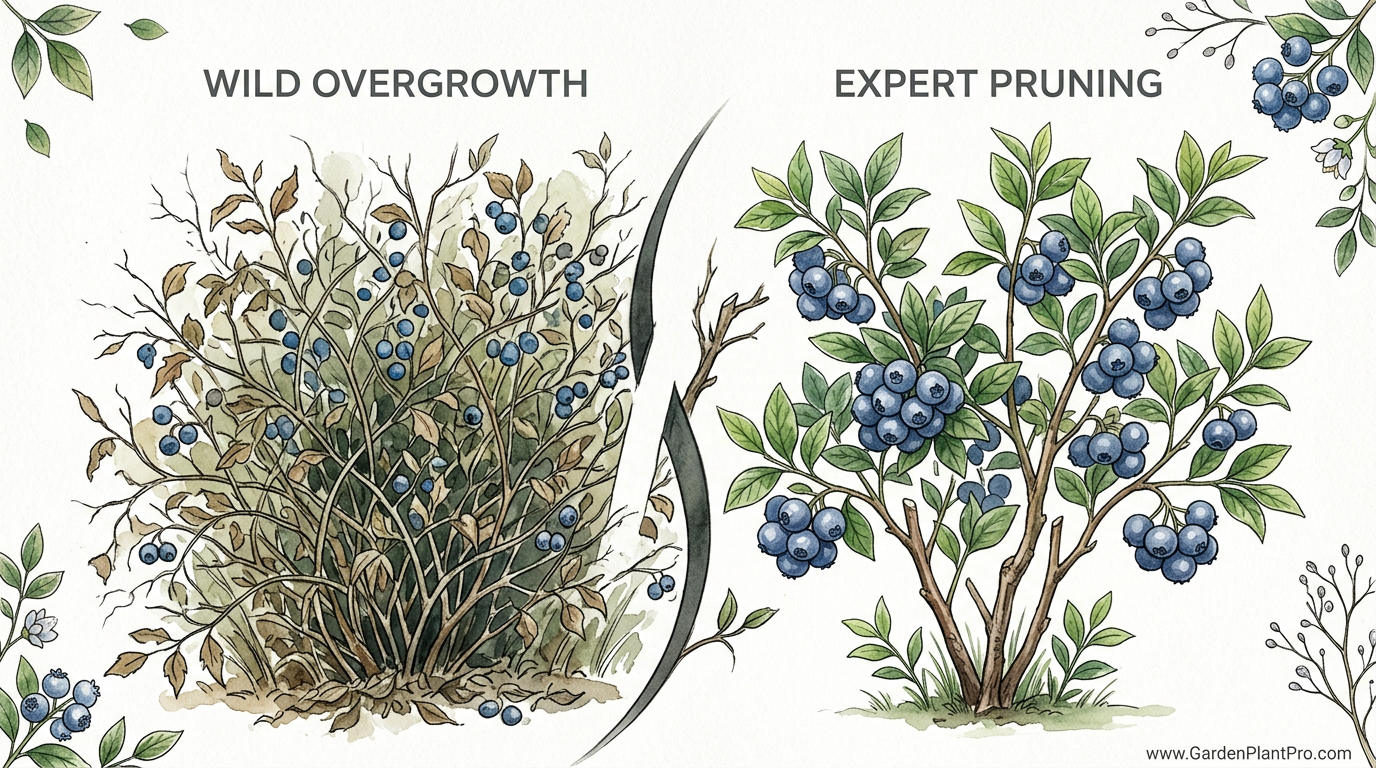
Comparison: Wild Overgrowth vs. Expert Pruning
It helps to see the data to understand why we bother with all this work. Below is a comparison of what you can expect from a neglected bush versus one managed with the renewal method.
| Feature | Wild Overgrowth | Expert Pruning |
|---|---|---|
| Berry Size | Small (4-6mm), “Bird-shot” | Large (12-20mm), “Grocery Store” size |
| Flavor Profile | Often tart or watery, high skin-to-juice ratio | Sweet, intense blueberry flavor, juicy |
| Annual Yield | Irregular (High one year, zero the next) | Consistent and predictable year-over-year |
| Harvest Time | Very long; berries ripen unevenly in shade | Concentrated; berries ripen quickly in sun |
| Disease Risk | High (Mildew, Canker, Mummy Berry) | Low (High airflow, less fungal pressure) |
Practical Tips and Best Practices
Over the years, I have picked up a few “pro” tricks that don’t always show up in the textbooks. These little adjustments can make the difference between a good harvest and a legendary one. If you are ready to take your blueberry game to the next level, keep these tips in mind as you head out to the garden this winter.
Tip 1: The “Two-to-One” Rule. When you are selecting which new canes to keep, try to keep two new ones for every one old one you remove—but only if the bush can handle it. If the bush looks crowded, stick to one-for-one. This ensures the plant is always expanding its canopy until it reaches its maximum healthy size. If you see a cane that is 12 inches (30 cm) long and another that is 3 feet (90 cm) long, always keep the taller, thicker one. Thickness at the base is a sign of vigor.
Tip 2: Prune for Your Picking Style. If you have a bad back, remove all the low-growing branches that hang below 18 inches (45 cm). These branches usually produce berries that get dirty from rain splash anyway. By “legging up” the plant, you make it easier to reach the fruit, and you improve the airflow under the canopy. It might feel like you’re losing fruit, but the plant will just grow more on the upper branches to compensate.
Tip 3: Look for the “Red Wood.” When you are heading back laterals, look for the brightest red wood. This is usually the healthiest and most productive wood from last summer. If a lateral branch is dull brown and twiggy, it won’t produce much. Cut back to where the wood starts to look vibrant and “alive.” This encourages the plant to push its best sap into the most productive tissues.
Tip 4: Feed After You Cut. Pruning is a shock to the system. Once you have finished your winter pruning, that is the perfect time to apply your organic fertilizer. Use something designed for acid-loving plants (like an azalea or holly tone). This ensures that when the plant “wakes up” and sees its branches have been cut, it has the nitrogen it needs to immediately start growing those replacement canes we want.
Advanced Considerations: The Science of Light and Auxins
For those who want to know the “why” behind the “how,” it comes down to plant hormones. The most important one in pruning is auxin. Auxins are produced in the tips of the branches and they tell the plant *not* to grow the buds further down the stem. This is called “apical dominance.” When you cut the tip off a branch (heading back), you stop that flow of auxin. This “wakes up” the lower buds, causing the branch to become bushier and produce more fruit-bearing laterals.
Light penetration is the other major factor. A blueberry leaf needs a certain amount of “Photosynthetically Active Radiation” (PAR) to create the sugars that make berries sweet. In a dense, unpruned bush, the inner 40% of the leaves are essentially “parasites”—they aren’t getting enough light to produce energy, so they actually steal energy from the outer leaves just to stay alive. By thinning the center, you turn every leaf on the plant into a “producer,” which is why pruned berries are so much sweeter.
You also have to consider chill hours. Many gardeners don’t realize that pruning can slightly affect when a plant breaks dormancy. In regions with late spring frosts, pruning too early in the winter can sometimes “prime” the plant to wake up earlier, making the blossoms vulnerable to freezing. If you live in a place where “false springs” are common, wait until late February or even early March to prune. The plant will stay dormant a few days longer, which might save your entire crop from a freak frost.
Real-World Example: Rescuing the “Legacy” Bush
Imagine you’ve moved into a new house and found a blueberry bush that hasn’t been touched in a decade. It’s 8 feet (2.4 meters) tall, looks like a bird’s nest, and produces berries the size of peas. You might be tempted to rip it out, but don’t. You can “reclaim” this bush over three years. This is a classic scenario for serious gardeners.
Do you have some charcoal in your house right now? We call charcoal a “miracle leftover” for anyone who wants to be a little more self-sufficient and cut costs. That’s because it can help you with so many different things around the house and garden. You can even use it to make an energy-free fridge. Read More Here...
Year One: Don’t try to fix it all at once. Remove the three thickest, graggiest canes right at the ground. Cut any branches that are dead or clearly diseased. Then, take the hedge trimmers and take 1 foot (30 cm) off the top just to bring the height down to something manageable. You’ll get fewer berries this year, but they will be slightly larger.
Year Two: Now that you’ve opened it up, you should see some new shoots coming from the ground. Keep the three best-looking new shoots and remove three more “dinosaur” canes. Thin out the middle of the bush by removing about 20% of the crossing branches. You will see a massive jump in berry size this season.
Year Three: Remove the final old, original canes. By now, the bush should be composed entirely of wood that is three years old or younger. It will look like a completely different plant. You have effectively “cloned” the root system into a brand new canopy. This is the power of renewal pruning—it’s like getting a new plant for free without the two-year wait for establishment.
Final Thoughts
Pruning your blueberries can feel like a test of faith. It goes against our natural instinct to “leave things alone.” But a garden is a partnership between the gardener and the earth. The plant provides the life and the energy, but you provide the direction and the discipline. By cutting back 30 percent of your bush every winter, you aren’t destroying your harvest; you are curating it. You are telling the plant that you don’t want mediocre fruit—you want the best it can possibly give.
Start small if you’re nervous. Try the “Rule of Thirds” on just one bush this year and leave another one unpruned as a “control” group. I guarantee that by July, when you see the size and taste the sweetness of the berries on the pruned bush, you will never be afraid of your shears again. Gardening is about learning through doing, and every cut you make is a lesson in how your plants respond to care.
Once you master pruning, you might find yourself looking at the rest of your garden with a new perspective. The same principles of renewal and light management apply to many other plants, from soil-building techniques like mulching to the way you manage irrigation and pest control. Everything is connected. A healthy, well-pruned blueberry bush is just one piece of a thriving, productive home landscape. Now, go grab your loppers—those berries aren’t going to grow themselves!