
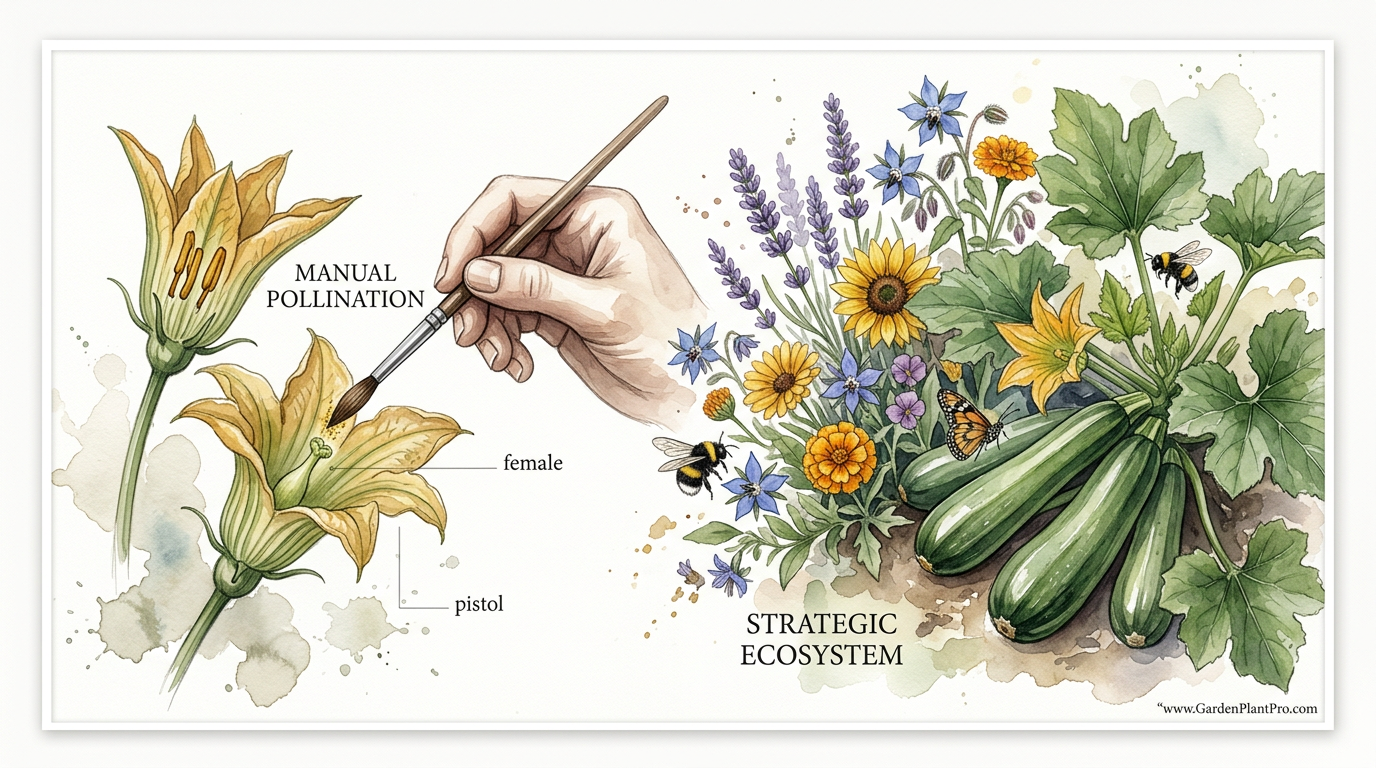
Why your paintbrush is the least efficient tool in your zucchini patch. Are you spending your mornings playing ‘matchmaker’ with your zucchini flowers? There is a better way. Using strategic ‘open-center’ pruning and planting pollinator magnets like borage, you can let nature do the 24/7 labor while you focus on the harvest.
Years of leaning over garden beds have taught me that we often work harder than we need to. I have seen countless gardeners out at 6:00 AM with a Q-tip or a small paintbrush, trying to manually transfer pollen from one golden bloom to another. While that works for a few plants, it is a band-aid solution for a garden that is out of balance. A truly productive zucchini patch should be humming with activity long before you finish your first cup of coffee.
Nature designed these plants to be part of a bustling ecosystem. Zucchini flowers are large, showy, and full of nectar for a reason. They want to be found. If your plants are producing plenty of flowers but the baby fruit is shriveling up and turning yellow at the tips, the issue is rarely the plant itself. It is usually a lack of “traffic” or a “visibility” problem where the bees simply cannot reach the work floor.
Zucchini Pollination Hacks For Higher Yield
Zucchini pollination is the process of moving heavy, sticky pollen from the male flower to the female flower. These plants are monoecious, meaning they produce separate male and female blooms on the same plant. Unlike some flowers that can pollinate themselves with a simple breeze or a shake, zucchini require an external “courier”—typically a bee—to make the trip.
If that trip does not happen, the fruit aborts. You might see a small zucchini start to form at the base of a female flower, but without enough pollen, the plant decide it is not worth the energy to grow seeds. It shuts down the development, leading to that frustrating yellowing and rot. In a real-world garden, this often happens because the foliage is too dense or there are not enough local bees to do the heavy lifting.
Think of your zucchini plant as a busy storefront. If the signs are hidden behind a massive hedge and the front door is blocked by boxes, customers will go elsewhere. Open-center pruning is the act of clearing that “front door” so bees can spot those bright yellow blooms from across the yard. Combining this with high-nectar companion plants turns your garden into a beacon for every pollinator in the neighborhood.
The Difference Between Male and Female Flowers
Distinguishing between the two is the first step in understanding the hack. Male flowers usually show up first on long, thin, wiry stems. They are the “billboards” designed to lure bees to the plant early in the season. Female flowers are tucked closer to the main stem and have a distinct, miniature zucchini (the ovary) right at the base of the bloom.
The One-Day Window
Every zucchini blossom is a “one-hit wonder.” They open at dawn and usually close by mid-morning or early afternoon, depending on the heat. This means you have a very narrow window of about 4 to 6 hours for pollination to occur. If a bee does not visit that specific female flower at least 6 to 10 times during that window, the fruit may be misshapen or fail entirely.
Strategic Open-Center Pruning: Clearing the Path
Dense, umbrella-like leaves are a zucchini’s natural defense, but they can become a barrier to success. In my garden, I use a technique called open-center pruning to ensure every flower is visible. This practice involves removing the older, lower leaves that have already done their job.
Start by looking at the base of the plant. The leaves at the very bottom are often the largest and are frequently the first to show signs of powdery mildew. These leaves usually sit on the ground and provide cover for squash bugs while blocking the view of new flowers forming in the center. Removing them creates a “hallway” for airflow and insect access.
How to Prune for Visibility
Find the lowest developing fruit on the main stem. Use a clean pair of garden shears to snip off any leaves that are growing below that fruit. Cut the leaf stem as close to the main stalk as possible without nicking the main vine. This opens up the “center” of the plant, exposing the base where most female flowers emerge.
Limit your pruning to no more than 30% of the plant’s total foliage at one time. You want enough leaves left to power the plant through photosynthesis, but enough space so that you can see the soil underneath the plant when you stand over it. I aim to keep the center of the crown open to the sky.
Preventing Disease While Boosting Yields
Airflow is just as important as visibility. Zucchini are notorious for catching powdery mildew—that white, flour-like dust that coats the leaves. Dense foliage traps humidity, creating a perfect breeding ground for fungus. Open-center pruning allows the wind to dry out the leaves after a morning dew or rain, keeping the plant healthy enough to keep producing flowers late into the season.
Pollinator Magnets: Bringing the Workers to You
Planting “pollinator magnets” is like putting up a neon sign for bees. While the zucchini flower is attractive, it is not always the most popular spot if there are better options nearby. The goal is to create a diverse ecosystem where bees are already present and active when those zucchini blossoms unfurl at daybreak.
Borage: The Star of the Garden
Borage, often called the “starflower,” is the ultimate companion for squash. It produces beautiful blue, edible flowers that are absolutely loaded with nectar. Bees find borage irresistible. Having a few borage plants within 3 to 5 feet (0.9 to 1.5 meters) of your zucchini ensures that pollinators are already in the vicinity.
This plant also helps by “mining” minerals with its deep taproot, making the soil healthier for the heavy-feeding zucchini. I have noticed that in years where I let borage self-seed around my squash, my fruit set is significantly higher. The bees move from the borage to the zucchini and back again, ensuring a high rate of successful “matches.”
Other Essential Companion Flowers
- Sweet Alyssum: These tiny white flowers smell like honey and attract hoverflies and parasitic wasps that eat garden pests while incidentally pollinating.
- Calendula: Also known as pot marigold, these bright orange flowers draw in bees and act as a “trap crop” for aphids.
- Phacelia: Sometimes called “bee bread,” this is one of the top nectar-producing plants on the planet.
- Herbs (Dill and Chives): Letting your herbs go to flower provides a constant source of tiny blooms that keep native bees resident in your garden year-round.
The Squash Bee: Your Secret Specialist
Most people think of honeybees when they think of pollination, but for zucchini, the real hero is the squash bee (*Peponapis*). These native bees are specialists that evolved alongside the squash family. Unlike honeybees, which are generalists that might get distracted by a nearby patch of clover, squash bees focus almost entirely on cucurbits.
Squash bees are early risers. They often begin working the flowers before the sun has even topped the horizon. By the time a gardener wakes up to hand-pollinate, the squash bees have often already finished the job. They even sleep inside the closed flowers at night!
Protecting these bees is vital for high yields. Because they are ground-nesting bees, they often build their small tunnels right in the soil beneath your zucchini plants. Avoid tilling the soil deeply around your squash beds and skip the heavy use of plastic mulches, which can block their exit holes. A light layer of organic straw mulch is much better for these tiny laborers.
DIY PROJECT: Collect rainwater no matter where you live...
This DIY project is the best way to legally collect rainwater NO MATTER where you live. Get chlorine-free water, cut down on your water bills, and have enough for an emergency situation or to water your garden. Read More Here...
Benefits of a Strategic Ecosystem Approach
Shifting from manual pollination to an ecosystem-based approach offers several measurable advantages. While hand-pollinating can guarantee one specific fruit, a healthy garden environment supports the plant’s entire lifecycle.
Increased Fruit Quality
Incomplete pollination often results in zucchini that are bulbous at one end and thin at the other. This happens when only some of the seeds inside the fruit are fertilized. Bees are much better at thorough pollination than we are. A bee will crawl deep into the flower, ensuring a heavy load of pollen reaches the stigma. This leads to straight, uniform, and dense fruit.
Time and Labor Efficiency
Spending twenty minutes every morning with a paintbrush adds up over a three-month growing season. Creating a self-sustaining system allows you to focus on other tasks, like harvesting, weeding, or preserving your crop. Once the “infrastructure” of flowers and pruning is in place, the garden does the work for you.
Long-Term Resilience
A garden filled with diverse flowers attracts more than just bees. You will see an increase in predatory insects like ladybugs and lacewings. These “good bugs” keep the populations of aphids and squash bug nymphs in check, reducing the need for organic or chemical sprays that might accidentally harm your pollinators.
Challenges and Common Mistakes
Even with the best plan, things can go wrong. Understanding these pitfalls helps you adjust before your harvest suffers.
Over-Pruning
Removing too many leaves at once can shock the plant. Leaves are the “solar panels” that provide the energy to grow the fruit. If the plant looks bare or the main stem is completely exposed to harsh, direct midday sun, you may have gone too far. Always leave enough foliage to shade the main vine and the soil immediately around the roots.
The “Watering” Mistake
Overhead watering in the morning is a major hurdle for pollination. If the inside of the flower gets filled with water, the pollen becomes a soggy mess that bees cannot move. Furthermore, wet flowers often close prematurely. I recommend using drip irrigation or a soaker hose to keep the water at the base of the plant. If you must use a sprinkler, do it in the late afternoon so the plants are dry by the time the flowers open the next morning.
Too Much Nitrogen
High-nitrogen fertilizers encourage massive, lush leaf growth. While this makes the plant look “healthy,” it often comes at the expense of flowers. If your zucchini is all leaves and no blooms, stop the nitrogen and switch to a fertilizer higher in phosphorus and potassium to encourage flower production.
Environmental Factors and Limitations
Sometimes, nature works against us regardless of our efforts. Understanding the limits of pollination helps set realistic expectations.
Heat Waves
Temperatures exceeding 90°F (32°C) during the day and 70°F (21°C) at night can cause zucchini to drop their flowers. High heat can also make the pollen sterile. During extreme heat waves, even the most active bees may struggle to set fruit. Providing some afternoon shade with a light row cover can help lower the temperature just enough to keep the flowers viable.
Rainy Streaks
Bees do not like to fly in the rain. If you have three or four days of consistent morning rain, you will likely see a gap in your harvest about a week later. In these specific cases, a gardener might actually need to step in with that paintbrush, provided they can find a dry window when the flowers are open.
| Factor | Manual Pollination | Strategic Ecosystem |
|---|---|---|
| Daily Effort | High (Daily morning visits) | Low (Weekly pruning/planting) |
| Pollen Coverage | Variable (Human error) | High (Multiple bee visits) |
| Disease Control | None | High (Airflow via pruning) |
| Scale | Best for 1-2 plants | Scales to any size garden |
Practical Tips for Best Results
Implementing these hacks does not require a complete garden overhaul. You can start with these simple steps.
- Plant in Clumps: Instead of long rows, try planting 2 or 3 zucchini in a “hill” or close group. Bees are more attracted to a large concentrated area of yellow flowers than they are to a single plant.
- Sequence Your Flowers: Plant different varieties of summer squash together. I like to mix classic green zucchini with yellow straight-neck and pattypan squash. This ensures a wider variety of bloom times and a higher volume of male flowers to provide pollen.
- The “Two-Week” Rule: Zucchini often produce only male flowers for the first two weeks of blooming. Do not panic if you see flowers but no fruit early on. The plant is simply “training” the local bees to find the location before the important female flowers arrive.
- Clean Your Tools: Always dip your pruning shears in a solution of 70% isopropyl alcohol or a mild bleach solution between plants. This prevents the spread of diseases like bacterial wilt or mosaic virus.
Advanced Considerations: Going Beyond the Basics
For the serious gardener, there are even deeper ways to optimize. Soil health plays a massive role in the “quality” of the nectar. Nectar is essentially sugar water, and plants that are mineral-deficient produce less attractive “food” for bees.
Mineral Balance
Trace minerals like boron are essential for pollen tube growth. If your soil is depleted, even a perfectly pollinated flower might fail. Adding a small amount of kelp meal or a broad-spectrum mineral amendment to your soil in the spring can improve the “success rate” of every bee visit.
Parthenocarpic Varieties
If you live in an area with extremely low pollinator counts—such as an apartment balcony or a high-wind coastal area—look for “parthenocarpic” varieties. These specific zucchini types have been bred to set fruit without any pollination at all. While they are a bit more expensive to buy as seed, they are a fail-safe option for difficult environments.
Example Scenario: The Success Story
Imagine two gardeners, Susan and Bill. Susan plants her zucchini in a corner of her garden, ignores the dense leaves, and spends every morning with a paintbrush. She gets a decent harvest, but by August, her plants are covered in powdery mildew and the squash bugs have taken over.
Bill, on the other hand, plants borage and calendula among his zucchini. Every Saturday, he spends five minutes removing the lowest four or five leaves from each plant. By 7:00 AM, his garden is buzzing with squash bees. His plants stay green and productive until the first frost, and he spends his mornings enjoying a coffee on the porch instead of bending over flowers. Bill’s approach is not just easier; it is more sustainable.
Do you have some charcoal in your house right now? We call charcoal a “miracle leftover” for anyone who wants to be a little more self-sufficient and cut costs. That’s because it can help you with so many different things around the house and garden. You can even use it to make an energy-free fridge. Read More Here...
Final Thoughts
Relying on a paintbrush for your zucchini harvest is like trying to do the wind’s job with a fan. It is possible, but it is not how the system was meant to run. By focusing on open-center pruning to increase visibility and planting borage to draw in the workforce, you create a garden that thrives on its own terms.
Success in the garden is often about stepping back and letting nature take the lead. I have found that the more I work to support the “local help”—the bees and the beneficial insects—the less I have to micro-manage my plants. Give your zucchini the space to breathe and the flowers a chance to be seen, and you will find yourself with more squash than you know how to give away.
Experiment with these hacks this season. Start small by pruning just one plant or adding a single pot of borage nearby. You will quickly see the difference in the hum of the garden and the weight of your harvest basket. Happy gardening!