
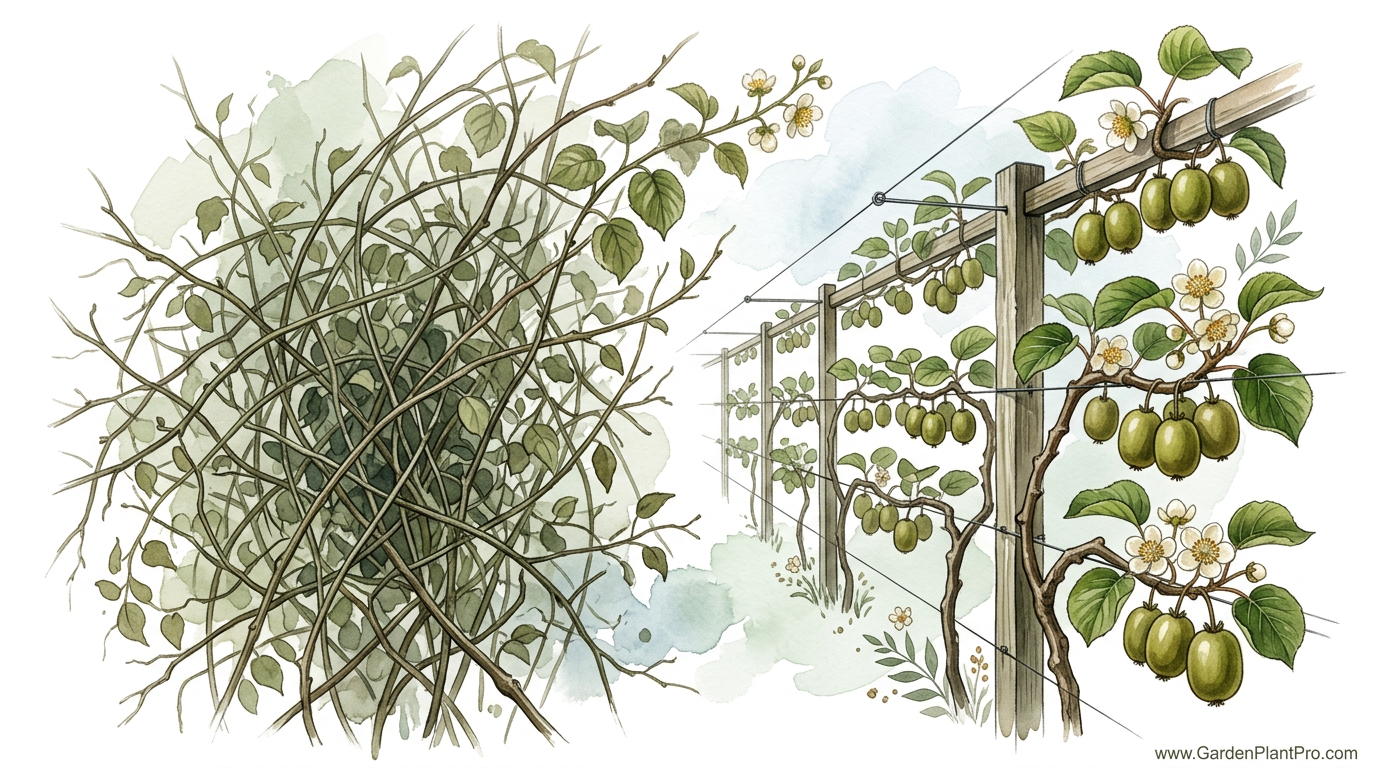
One of these will give you a headache; the other will give you 200lbs of fruit. Are you spending hours untangling a mess that doesn’t even fruit? Switch from manual chaos to strategic training and watch your harvest explode this season.
If you have ever stood in front of a kiwi vine in mid-summer, you know exactly what I mean by manual chaos. These plants don’t just grow; they colonize. Without a firm hand and a sharp pair of shears, a single fuzzy kiwi vine can swallow a garden shed, climb a nearby oak tree, and leave you with nothing but a thicket of shade and a sore back. I have spent decades watching neighbors plant these beautiful vines only to tear them out three years later because they couldn’t find the fruit beneath the mountain of leaves.
The secret to that legendary 200lb (90kg) harvest isn’t a special fertilizer or a secret soil additive. It is the transition from “tangled vines” to a “strategic trellis.” Kiwis are unique in the fruit world because they are exceptionally vigorous but also incredibly specific about where they put their energy. When you understand how to direct that energy through proper pruning, you stop fighting the plant and start partnering with it. Let’s walk through the process of turning that headache into a harvest.
Understanding the Kiwi’s Growth Habit
Before we make the first cut, we have to look at how a kiwi actually operates. Unlike an apple tree that grows on slow-developing spurs or a blueberry bush that stays relatively compact, a kiwi vine is a high-speed climber. In a single growing season, a healthy vine can put out 15 to 20 feet (4.5 to 6 meters) of new growth. This is both a blessing and a curse. It means the plant can recover quickly from mistakes, but it also means it can become unmanageable in a matter of weeks.
The most important thing to remember is that kiwis fruit on current season’s growth that emerges from one-year-old wood. If you look at a vine in the winter, the wood that grew last summer is the “one-year-old wood.” Next spring, little green shoots will pop out of the buds on that wood, and those shoots are what carry the flowers. If you keep wood that is three or four years old, it will produce plenty of leaves but very little fruit. This is why we have to be so aggressive with our shears.
Environmental factors play a huge role here as well. Kiwis love sun, but they hate wind. Their large, platter-like leaves act like sails, and a strong gust can snap a heavily laden branch or even pull down a weak trellis. This is why your pruning strategy must also consider the structural integrity of the plant. We aren’t just cutting for fruit; we are building a living architecture that can withstand the elements while carrying the weight of a massive crop.
How To Prune Kiwi Vines For Maximum Fruit
Pruning for maximum fruit is a game of renewal. Since the vine only fruits on shoots coming from last year’s growth, our goal is to constantly replace old, tired wood with fresh, vigorous canes. Think of it like a relay race: as soon as one cane has finished its “lap” and produced fruit, we need the next runner ready to take the baton. If we let the old runners stay in the race, they just slow everyone down and crowd the track.
This process exists because, in the wild, kiwi vines climb to the top of the canopy to find light. They naturally shed their lower, shaded interior growth. In a garden setting, we use the trellis to simulate that “canopy top” across a flat plane. By keeping the vine thin and spread out, every single bud gets a “front-row seat” to the sun. This sunlight is what triggers the formation of flower buds for the following year. Without light, you get no flowers; without flowers, you get no fruit.
In real-world terms, this means we are removing a shocking amount of plant material every year. Most experienced growers will remove 50% to 70% of the previous year’s growth during the dormant season. It feels wrong the first time you do it. You might think you are killing the plant. But come June, when you see the explosion of blossoms and the manageable canopy, you will understand why the “heavy hand” is the successful hand.
The Two-Season Pruning System
To get the best results, you have to split your work into two distinct phases: the Major Winter Prune and the Maintenance Summer Prune. Both are essential, but they serve very different purposes.
The Dormant Winter Prune (The “Big One”)
This happens in late winter, usually between January and early March, depending on your local climate. You want to wait until the plant is fully dormant, but finish before the sap starts running. If you wait too long and the buds begin to swell, the vine will “bleed” sap profusely when cut. While this rarely kills the plant, it’s messy and can attract pests or pathogens.
- Identify the “Fruited Wood”: Look for the canes that carried fruit last season. You can usually tell by the dried-up fruit stems still clinging to the vine. This wood is now “spent” and needs to be cut back.
- Select Replacement Canes: Look for strong, healthy canes that grew last summer but didn’t fruit. These are usually smooth and light brown. These are your “one-year-old” canes that will provide this year’s harvest.
- The 8-12 Inch Rule: Space these replacement canes about 8 to 12 inches (20 to 30 cm) apart along your main structural branches (the cordons). Anything in between gets the snip.
- Head Back the Canes: Don’t leave these new canes 15 feet long. For fuzzy kiwis (Actinidia deliciosa), cut them back so only 2 to 4 buds remain past where the last fruit would have been. For hardy kiwis (Actinidia arguta), you can be more generous, leaving 8 to 12 buds per cane.
The Summer Maintenance Prune
Summer pruning is all about light and air. From June through August, the vine will try to turn into a jungle. Your job is to stop it. If the canopy becomes too thick, the fruit in the middle won’t ripen, and the buds for next year won’t develop properly because they are stuck in the dark.
During the summer, you should remove any “water sprouts”—those ultra-vigorous shoots that grow straight up and look like they want to reach the moon. Also, look for “tanglers.” Kiwi vines have a habit of wrapping around themselves, which can actually girdle and kill individual branches. If you see a shoot starting to twist like a pig’s tail around another branch, cut it back or redirect it immediately.
Benefits of Strategic Pruning
The most obvious benefit of this disciplined approach is the sheer volume of fruit. When the vine isn’t wasting energy on 500 feet of useless greenery, it puts all that sugar into the berries. You will notice that the fruit is larger, sweeter, and more uniform in size. But the benefits go beyond just the kitchen table.
A well-pruned vine is a healthy vine. By keeping the canopy open, you allow wind to blow through the leaves. This dries out moisture quickly after a rain, which is your best defense against fungal diseases like Botrytis (gray mold). Furthermore, a strategic trellis makes harvesting a joy rather than a chore. Instead of hunting through a thorny mess for a hidden fruit, the kiwis hang down in clear view, ready to be snapped off.
There is also the “Neighbor Factor.” A managed kiwi vine on a T-bar or a pergola is a stunning architectural feature in a garden. It looks intentional and professional. An unpruned vine looks like an abandoned lot. If you are growing in a suburban area, keeping your kiwi in check is the best way to stay on good terms with the folks next door.
Common Challenges and Mistakes
The biggest mistake I see beginners make is “Pinching Fear.” This is the hesitation to cut off a long, healthy-looking branch because it “looks so good.” In the kiwi world, length does not equal quality. If you don’t cut that 15-foot cane back, the vine will try to push sap all the way to the tip, resulting in small, sour fruit and a weak plant.
Another frequent error is ignoring the “Male vs. Female” dynamic. Kiwis are dioecious, meaning you need a male plant to pollinate the females. Many gardeners prune their male vines exactly like the females, which is a mistake. The male’s only job is to produce flowers. You should let the male grow more vigorously in the spring to provide maximum pollen, and then prune him back heavily after the flowers have faded. This prevents the male from crowding out the fruit-bearing females.
Finally, watch out for “Trunk Twining.” When training a young vine up a post, it’s tempting to let it wrap around the support like a vine naturally does. Don’t let it. As that trunk grows from the size of a pencil to the size of your arm, that “twist” will become a chokehold. It can actually restrict the flow of nutrients and eventually kill the vine. Always tie the trunk straight up the post using loose garden ties or soft twine.
DIY PROJECT: Collect rainwater no matter where you live...
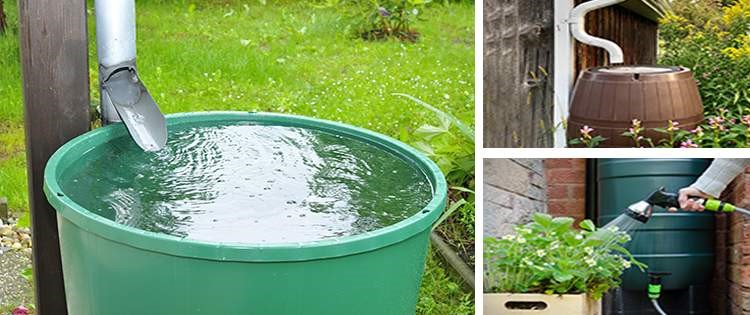
This DIY project is the best way to legally collect rainwater NO MATTER where you live. Get chlorine-free water, cut down on your water bills, and have enough for an emergency situation or to water your garden. Read More Here...
Limitations and Environmental Constraints
Pruning can solve many problems, but it can’t change your climate. Kiwis are sensitive to late spring frosts. If you prune heavily and then a sudden freeze hits, those newly exposed buds are vulnerable. In regions with unpredictable spring weather, some gardeners wait a little longer to do their final “fine-tuning” prune to ensure they have enough backup buds in case of frost damage.
Space is another hard limit. If you only have a 4-foot fence, a fuzzy kiwi is probably not the right choice. No amount of pruning will make a plant that wants to be 30 feet long happy in a 4-foot space. In those cases, looking into the Actinidia kolomitka (Arctic Beauty) varieties might be better, as they are much less vigorous and easier to manage in tight quarters.
Lastly, consider the “Bleeding” issue. If you live in an area where the ground thaws and freezes repeatedly in late winter, the sap can start flowing earlier than you expect. If you cut into a vine that is already “awake,” it will drip like a leaky faucet. While the vine will eventually seal itself, this loss of pressure and nutrients can stress a young plant. In these climates, it is better to prune in early January while the ground is still solid.
Tangled Vines vs. Strategic Trellis
| Feature | Tangled Vines (Neglected) | Strategic Trellis (Pruned) |
|---|---|---|
| Fruit Yield | Low / Inconsistent | High (up to 200lbs/90kg) |
| Fruit Size | Small / Nut-sized | Large / Commercial quality |
| Disease Risk | High (Poor airflow) | Low (Optimized airflow) |
| Harvest Ease | Difficult / Requires “hunting” | Easy / Hanging fruit |
| Plant Longevity | Reduced due to competition | 50+ years with proper care |
Practical Tips for Success
If you want to move from a beginner to a pro, focus on your tools. Kiwi wood is deceptively tough. Use a high-quality pair of bypass pruners for the smaller canes and a sharp set of loppers for the older wood. Keep a sharpening stone in your pocket; a dull blade will crush the stems rather than cutting them, which invites disease.
- The 45-Degree Cut: Always make your cuts at a 45-degree angle, sloping away from the bud. This ensures that rainwater runs off the cut rather than sitting on the bud and causing rot.
- Sanitize Your Gear: If you are pruning multiple vines, wipe your blades with rubbing alcohol between plants. This prevents the spread of soil-borne pathogens.
- Mulch After Pruning: Once you’ve cleared out the winter mess, lay down 2 to 3 inches (5 to 7 cm) of compost or wood chips around the base. This keeps the roots cool and moist, which is vital since kiwis are shallow-rooted.
- Tag Your Males: It is nearly impossible to tell a male vine from a female vine in the winter. Use a permanent tag or a splash of colored paint on the trunk so you don’t accidentally prune your only pollinator like a fruiting female.
Advanced Considerations: Girdling and Spurs
For those who have mastered the basics and want to push their yields even further, there are two advanced techniques to consider: Girdling and Spur Management.
Spur Management: While most fruit grows on long canes, kiwis also produce short, stubby “spurs” that are only 6 to 10 inches (15 to 25 cm) long. These spurs are incredibly productive and can fruit for 2 or 3 years. When pruning, save as many of these short spurs as possible. They are like little fruit factories that require very little space.
Trunk Girdling: In commercial orchards, growers sometimes perform a “controlled girdle”—a shallow cut through the bark of the trunk or a main branch in early summer. This temporarily interrupts the flow of sugars down to the roots, forcing the plant to “pump” those sugars into the developing fruit. This results in much larger fruit. However, this is risky for home gardeners. If you cut too deep, you can kill the branch. It should only be attempted on mature, vigorous vines that are at least 5 years old.
Real-World Scenario: The Overgrown Rescue
Let’s look at a common situation: You’ve inherited a garden with a kiwi vine that hasn’t been touched in five years. It’s a massive, tangled ball of wood. How do you fix it without killing it? The answer is “The Three-Year Plan.”
Year One: Focus on the “Three Ds”—Dead, Damaged, and Diseased wood. Clear out the interior of the tangle so you can actually see the main trunk. Identify one or two strong trunks and remove any secondary trunks that are coming out of the ground. Don’t worry about fruit this year; just worry about structure.
Year Two: Now that you can see the plant, identify the main “arms” (cordons) that will run along your trellis. Remove about 50% of the old, woody mass. This will trigger the plant to send out fresh, green shoots from the base or the main trunk. These are your future fruiting canes.
Year Three: By now, the vine should have plenty of new growth. You can now remove the last of the “old mess” and train the new, vigorous canes onto your trellis. By the end of this year, you will be back on a regular maintenance schedule and likely seeing your first real harvest in years.
Final Thoughts
Pruning kiwi vines is less about “shaving” the plant and more about “sculpting” it. It is an annual conversation between you and the vine. You provide the structure and the sunlight; the vine provides the vigor and the sugar. When you get the balance right, the results are nothing short of miraculous.
Don’t be afraid of the mess or the magnitude of the task. Gardening is a long game, and the kiwi is one of the most rewarding players if you know how to coach it. Start with clean tools, a clear plan, and a bit of courage. Once you taste that first sun-ripened kiwi from your own backyard, you’ll never look at those tangled vines the same way again.
If you find yourself enjoying the structural side of gardening, you might want to look into other training systems like espalier fruit trees or grapevine cordons. Many of the same principles of light management and wood renewal apply across the board. Happy pruning!