
Why more fruit actually means less flavor and a broken tree. It hurts to pull perfectly good fruit off the tree, but if you want orchard-level sweetness and massive size, you have to be ruthless. Learn the 6-inch rule that changes everything.
Walking into the orchard during late spring is usually a joyful experience. You see hundreds of tiny nectarines clinging to the branches, promising a bumper crop. However, that abundance is actually a trap. If you leave every one of those fruits to ripen, you will end up with a tree full of golf-ball-sized, watery fruit and, quite likely, several snapped branches.
Experienced gardeners know that a fruit tree has a finite amount of energy. It can either spread that energy thin across a thousand small fruits or concentrate it into a couple hundred spectacular ones. Choosing the latter is the secret to getting those heavy, juice-dripping nectarines that you simply cannot find in a grocery store.
In this guide, we will look at the practical reality of thinning. It is a chore that feels counterintuitive at first—literally throwing away food—but it is the most important thing you can do for your nectarine tree this season. Let’s get into the dirt and figure out how to do it right.
How To Thin Nectarines For Larger Fruit
Thinning is the intentional removal of immature fruit from a tree to improve the quality of the remaining crop. Nectarines are notorious for “over-setting,” meaning they produce far more fruit than the tree can actually support. In the wild, this is a survival strategy to ensure at least some seeds survive, but in your backyard, it leads to poor results.
When you thin, you are essentially managing the tree’s “energy budget.” Each leaf on your nectarine tree acts like a tiny solar panel, producing sugars through photosynthesis. A single nectarine needs roughly 25 to 30 healthy leaves to produce enough sugar for that classic, intense sweetness we all crave. If there are too many fruits and not enough leaves, the tree cannot keep up, and the fruit stays small and bland.
This practice is used everywhere from small urban raised beds to massive commercial orchards. The goal is always the same: to create space so the fruit can expand without touching its neighbors and to ensure the tree remains healthy enough to produce again next year. Without thinning, many trees fall into a cycle of “biennial bearing,” where they produce a huge crop one year and absolutely nothing the next because they are completely exhausted.
The Timing: When to Reach for the Branches
Timing is everything when it comes to thinning stone fruits. If you go too early, the tree might naturally drop fruit anyway (the famous “June drop”), and you might end up with too few nectarines. If you wait too late, the tree has already wasted its energy on fruit you are about to throw away.
The ideal window is when the nectarines are about the size of a large marble or a nickel, typically between 0.75 and 1 inch (2 to 2.5 cm) in diameter. In most temperate climates, this happens in late spring or early summer. At this stage, the “pit” inside the fruit has not yet hardened. Thinning before pit hardening allows the tree to divert all its resources into the flesh of the remaining fruit immediately.
Watch for the natural drop. Many trees will shed a portion of their crop on their own. Once you see a few small, shriveled fruits on the ground, that is your signal that the tree is ready for you to step in and finish the job. If you miss this window, you can still thin later, but the boost in size won’t be as dramatic.
How It Works: The Step-by-Step Method
Thinning nectarines does not require expensive tools; your hands are usually the best equipment for the job. The process is methodical and requires a bit of a “tough love” mindset. Here is how to approach a heavily laden branch.
- Assess the branch: Look at the overall load. A branch that is already bowing under the weight of marble-sized fruit is in serious trouble later in the season.
- Remove the “culls”: Start by picking off any fruit that looks misshapen, scarred, or exceptionally small. If you see signs of bird pecks or insect damage, those go first.
- Apply the 6-inch rule: Move along the branch and ensure there is roughly 6 inches (15 cm) of space between each remaining nectarine. If two fruits are growing side-by-side (twins), remove one.
- Prioritize the “King” fruit: Always keep the largest, healthiest-looking fruit in a cluster. These have the best head start and the strongest stems.
- Work from the tip inward: Fruit at the very tip of a long, thin branch is the most likely to cause a break. Remove these first and try to keep your crop closer to the stronger, thicker part of the wood.
You can remove the fruit by simply twisting it or pinching the stem with your fingernails. Be careful not to tear the bark of the branch, as this creates an entry point for disease. If the stems are particularly stubborn, a small pair of floral snips can help, but for most nectarines, a quick twist is all it takes.
Benefits of Strategic Thinning
The advantages of being ruthless with your crop are measurable and immediate. Beyond just having “bigger fruit,” you are fundamentally changing the physiology of the tree for the better.
Sugar Concentration: When a tree has fewer fruits to feed, it pumps a higher concentration of sorbitol and fructose into each one. This results in a higher Brix rating (a measurement of sugar content), meaning your nectarines will be significantly sweeter and more flavorful.
Structural Integrity: A mature nectarine can weigh a significant amount. A branch carrying fifty fruits might weigh 15 pounds (6.8 kg) at harvest. By thinning, you reduce this weight, preventing the devastating “mid-summer snap” where a heavy branch breaks, potentially ruining the shape of the tree for years.
Disease Prevention: Fungal issues like brown rot thrive in humid, crowded environments. When nectarines touch each other, moisture gets trapped between them, creating a perfect breeding ground for rot. Providing 6 inches (15 cm) of space allows for better airflow and sunlight penetration, which keeps the fruit skins dry and healthy.
Challenges and Common Mistakes
The biggest challenge isn’t the physical work; it’s the mental hurdle. Most backyard gardeners are “too nice” to their trees. They see a branch with ten beautiful little nectarines and think, “I’ll just leave them and see what happens.” This is almost always a mistake.
The “Timidity” Trap: Gardeners often thin a little bit, look at the pile on the ground, and stop because they feel like they are destroying the harvest. In reality, you usually need to remove 50% to 75% of the initial fruit set. If it doesn’t look like you’ve made a mess on the ground, you probably haven’t thinned enough.
Waiting Too Late: If you wait until the fruit is the size of a golf ball, the tree has already invested the bulk of its early-season energy into those fruits. While thinning late still helps prevent branch breakage, it will not significantly increase the size or sweetness of the remaining fruit because the cell division phase has already passed.
DIY PROJECT: Collect rainwater no matter where you live...
This DIY project is the best way to legally collect rainwater NO MATTER where you live. Get chlorine-free water, cut down on your water bills, and have enough for an emergency situation or to water your garden. Read More Here...
Ignoring the Tips: Leaving fruit at the very end of long, “leggy” branches is a recipe for disaster. The leverage created by weight at the end of a long stick is much higher than weight near the trunk. Always thin the tips more aggressively than the interior of the tree.
Limitations and When Not to Thin
While thinning is a “best practice,” there are certain situations where you might want to hold back. Gardening is never a one-size-fits-all endeavor, and environmental factors play a massive role.
If you live in an area prone to late-season hail or heavy pest pressure, you might want to leave a little “insurance fruit.” In these cases, thinning to 4 inches (10 cm) instead of 6 might give you a buffer so that if a few fruits are damaged, you still have a decent crop left. Similarly, very young trees (under 3 years old) should often have all their fruit removed so they can focus entirely on growing a strong root system and frame.
Dwarf varieties also require a slightly different approach. Because they are smaller and often less structurally robust, they can become “overloaded” even faster than standard trees. On a dwarf nectarine, you might actually need to thin to 8 or 10 inches (20-25 cm) to ensure the small frame doesn’t collapse under the weight of full-sized fruit.
Optimization: Thinned vs. Overloaded
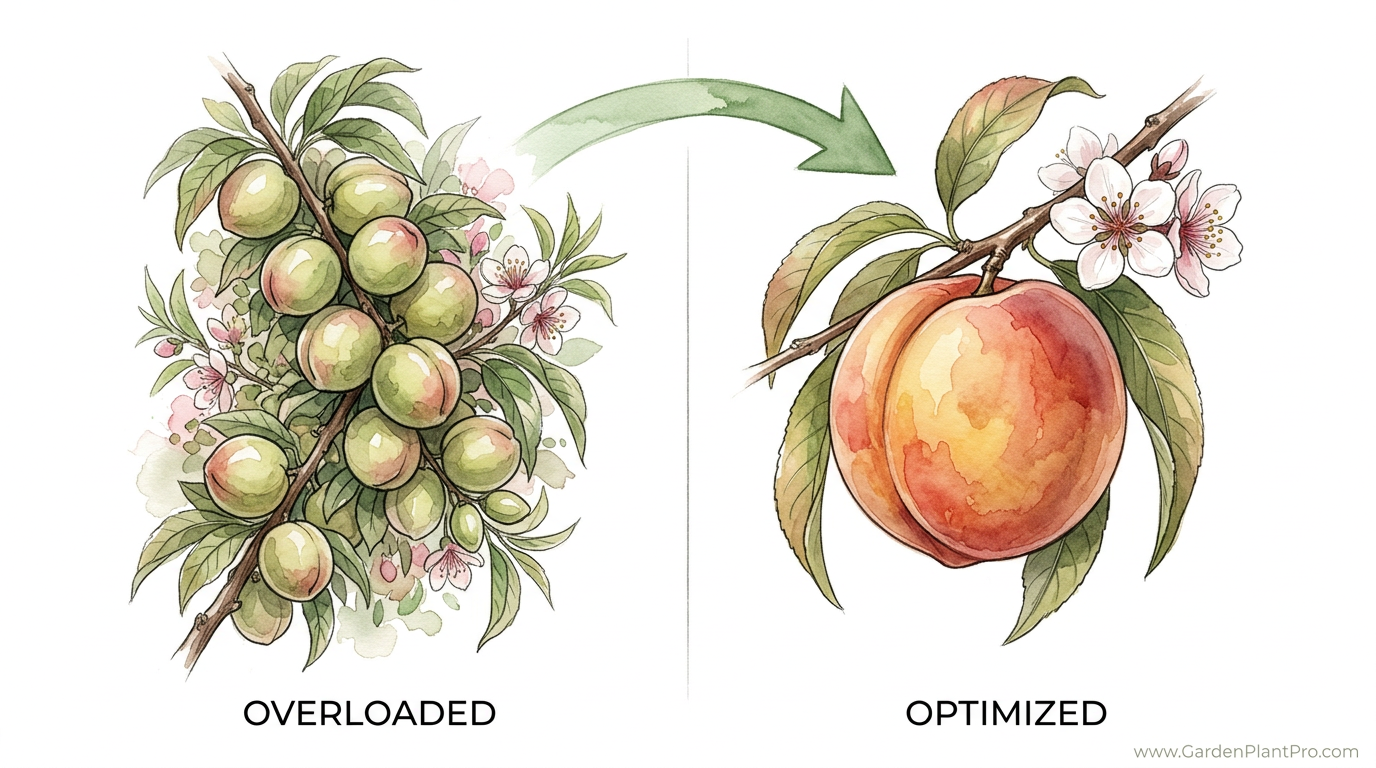
To help visualize why this matters, let’s look at the difference between a tree that has been “Optimized” through thinning and one that is “Overloaded.”
| Feature | Overloaded Tree | Optimized Tree |
|---|---|---|
| Fruit Size | Small (50-60mm) | Large (75-90mm) |
| Flavor Profile | Diluted, watery, tart | Intense, high sugar, aromatic |
| Branch Risk | High (snapping likely) | Low (balanced weight) |
| Next Year’s Crop | Poor (exhausted tree) | Strong (consistent bloom) |
| Disease Risk | High (rot between fruits) | Low (good airflow) |
Practical Tips for Best Results
Working through an entire tree can be daunting. Here are a few ways to make the process more efficient and effective.
- The “Two-Pass” System: If you are nervous, do a first pass where you just remove the obvious junk and space things to 3 inches (7.5 cm). Come back a week later and do a second pass to get to the full 6-inch (15 cm) spacing. It’s often easier to be ruthless the second time.
- Focus on the Sunlight: Fruit in the shaded interior of the tree will never be as sweet as fruit on the outer edges. Thin the “inside” fruit more heavily, as it has a lower potential for quality anyway.
- Pruning as Thinning: Remember that your winter pruning is the first step of thinning. By removing excess fruiting wood in February, you are reducing the number of flowers that can even turn into fruit.
- Check Your Irrigation: Once you have thinned, make sure the tree has consistent water. The remaining nectarines are going to grow rapidly, and they need moisture to build that juicy cell structure.
Advanced Considerations: The Leaf-to-Fruit Ratio
For those who want to take their orcharding to the next level, start thinking about leaf area rather than just linear inches. A vigorous branch with lush, dark green leaves can support more fruit than a thin, weak branch with sparse foliage.
Serious growers often look for a ratio of about 30 leaves per fruit. If you have a branch that is 2 feet (60 cm) long but only has a few clusters of leaves, you might only leave one or two nectarines on that entire branch. Conversely, a thick “water sprout” that has been trained into a fruiting branch might be able to handle slightly closer spacing because its photosynthetic capacity is so high.
Also, consider the variety. Early-ripening nectarines have less time to develop size than late-season ones. Because they are on a “fast track,” early varieties need even more aggressive thinning. If you have an early-season tree, aim for 8 inches (20 cm) of space to give those fruits every possible advantage in their short growing window.
Practical Scenario: The “Bumper Crop” Year
Imagine you have a 5-year-old nectarine tree. This year, the weather was perfect during bloom, and every single flower seems to have set fruit. You have clusters of 5 or 6 nectarines every few inches. The branches are already starting to sag, and it’s only May.
In this scenario, you must be surgical. You start at the base of a 3-foot (90 cm) branch. You see a cluster of three. You pick the biggest one and flick the other two off. Moving up, you find a small, twin nectarine—you remove it. By the time you reach the end of the branch, you have removed 40 tiny fruits and left only 6. The branch immediately springs back upward, no longer weighed down. Those 6 nectarines now have no competition for the sugars produced by the leaves on that branch. By August, those 6 will be the size of softballs, while your neighbor’s unthinned tree will be dropping tiny, shriveled fruit onto the lawn.
Final Thoughts
Thinning nectarines is one of those gardening tasks that proves that “less is more.” It requires a shift in perspective—from seeing every fruit as a prize to seeing every fruit as a potential drain on the tree’s health. By following the 6-inch rule and timing your intervention correctly, you ensure that your tree stays productive and healthy for decades to come.
Do not be afraid of the pile of green fruit on the ground. That pile is the price of admission for a truly spectacular harvest. Once you taste the difference between a thinned nectarine and a store-bought one, you will never hesitate to reach for those branches again. It is a simple, physical connection to the life cycle of your orchard that pays off in the sweetest way possible.
As you continue to care for your trees, consider exploring other ways to support their heavy lifting. Proper mulching to retain moisture and consistent pest management will ensure that those perfectly thinned fruits make it all the way to your table without a scratch.