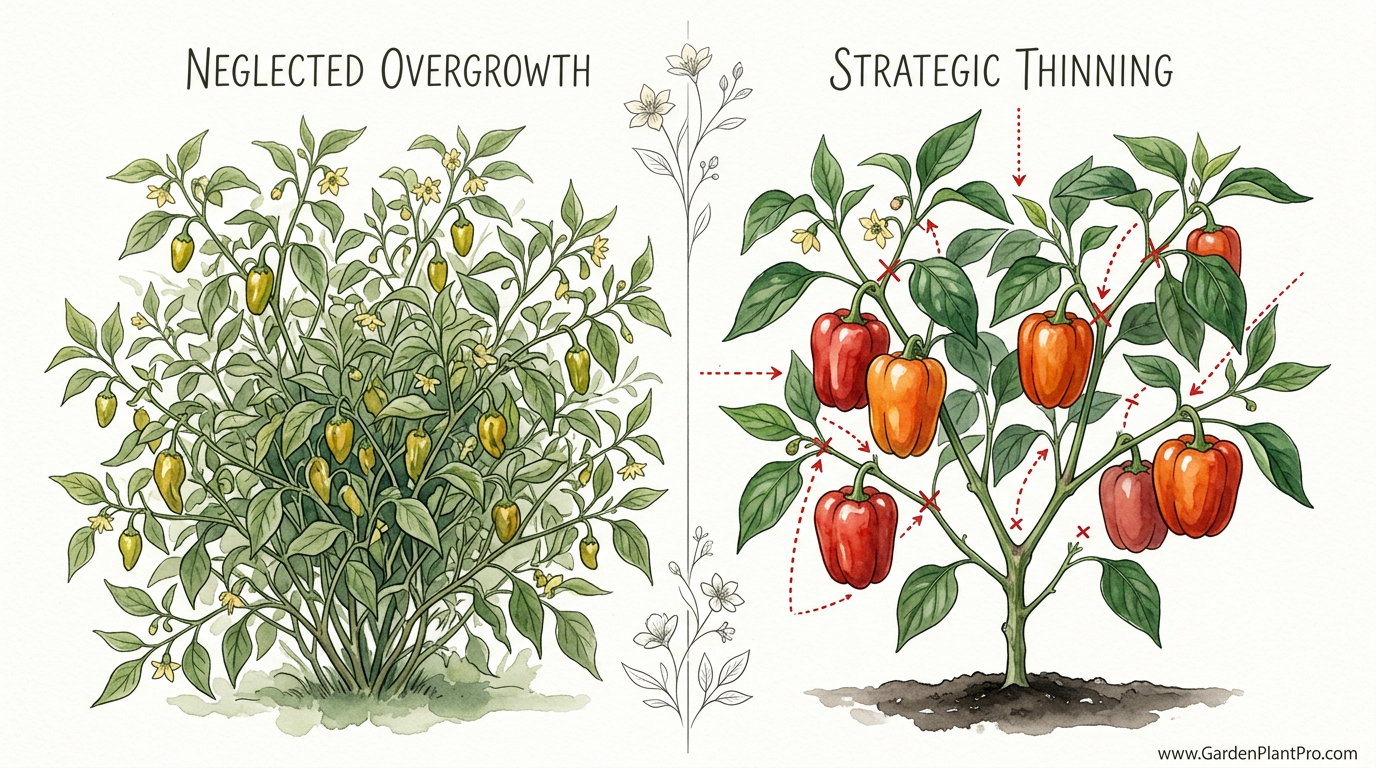
Why your pepper plant is wasting all its energy on leaves instead of fruit. Most gardeners think a bushy plant is a healthy plant, but for capsicums, foliage is the enemy of fruit. Making a few strategic cuts to the ‘crown’ and lower stems forces the plant to stop being a shrub and start being a producer. Here is how I doubled my harvest with 5 minutes of work.
I have spent the better part of forty years watching pepper plants grow in every kind of soil you can imagine. One thing I have learned over those decades is that a pepper plant is a bit like a lazy teenager; if you do not give it clear directions, it will just sit around growing leaves and doing the bare minimum. You might see a giant, lush green bush in your garden and feel proud, but if you look under those leaves and find only two or three small peppers, your plant is failing its primary job.
Most folks are terrified to take a pair of shears to their plants. They feel like they are hurting the thing they worked so hard to grow from a seed. I understand that feeling because I felt it too, back when I was first starting out. However, I soon realized that a controlled, thoughtful cut is the kindest thing you can do for a capsicum. It tells the plant that the “leaf stage” of its life is over and it is time to get down to the business of making food.
When you leave a pepper plant to its own devices, it focuses on vertical growth and a dense inner canopy. This creates a humid, dark environment where pests like aphids and diseases like powdery mildew love to hide. Strategic thinning opens up the heart of the plant to the sun and the breeze. This simple act of maintenance changes the hormone balance of the plant and redirects its limited energy away from building more “solar panels” and toward building the fruit you want to eat.
How To Prune Capsicum For Bigger Fruit
Pruning is the intentional removal of specific parts of the plant to improve its overall health and productivity. In the world of capsicums—which includes everything from sweet bell peppers to the hottest habaneros—pruning is about managing energy. A plant has a finite amount of nutrients and water it can pull from the soil each day. If that energy is spread across fifty branches and a thousand leaves, the fruit will naturally be small and sparse.
Think of your pepper plant as a factory with a limited power supply. If the factory is running too many conveyor belts at once, none of them move very fast. When you prune, you are essentially shutting down the less productive conveyor belts so the main ones can run at full speed. This results in peppers that are not only more numerous but also have thicker walls and better flavor.
In real-world terms, this process involves three main stages: topping the plant early to encourage a sturdy frame, removing “suckers” or side-shoots that sap energy, and thinning the canopy to let in light. You are not just making the plant smaller; you are making it more efficient. Whether you are growing in a small pot on a balcony or in a large backyard plot, these principles remain the same.
You will find that different varieties respond to this in different ways. Smaller pepper varieties, such as jalapeños or Thai chilies, often become incredibly productive “hedges” when pruned correctly. Larger bell peppers need pruning more for structural support, as their heavy fruit can easily snap a weak, unmanaged branch. Understanding the specific needs of your variety is the first step toward a record-breaking harvest.
The Role of Apical Dominance
Understanding the “why” behind pruning requires a quick look at a concept called apical dominance. This is a fancy way of saying that the main tip of the plant wants to be the boss. The apical bud produces hormones called auxins that travel down the stem and tell the lower buds to stay dormant. The plant does this because its natural instinct is to grow as tall as possible as quickly as possible to compete for sunlight in the wild.
In your garden, you do not want a five-foot-tall (1.5 meter) beanpole of a pepper plant that falls over in the first summer breeze. Removing that top bud breaks the “spell” of the auxins. This allows the lateral buds to wake up and start growing. This results in a much shorter, bushier, and more stable plant that can support a heavy load of fruit without needing a massive trellis system.
How It Works: The Step-by-Step Pruning Process
The first step in a successful pruning routine starts when the plant is still quite young. You want to wait until the seedling has established at least six to eight sets of true leaves. At this point, the plant should be about 6 to 8 inches (15 to 20 cm) tall. Using a clean pair of sharp scissors or your fingernails, you should snip off the very top of the main stem, just above a leaf node. This is known as “topping.”
The plant will look a bit sad for a day or two after this, but do not panic. Within a week, you will see two new stems growing out from the node below your cut. This creates a strong “Y” shape that forms the foundation of the plant. This structural base is much better at distributing the weight of heavy capsicums than a single central stem would be.
As the season progresses, you should keep an eye on the lower 6 inches (15 cm) of the stem. Any leaves or small branches growing in this “splash zone” should be removed. Keeping this area clear prevents soil-borne pathogens from splashing up onto the leaves during rain or watering. It also allows air to circulate around the base of the plant, which keeps the roots cool and the stem dry.
Mid-season pruning involves looking for “suckers.” These are the tiny shoots that pop up in the crook where a leaf meets the main stem. While they might eventually produce a pepper, they often just create a crowded interior. Thinning these out every couple of weeks ensures that the plant is putting its energy into the fruits that have already set. I usually aim to keep three to five main structural branches and remove anything that starts to make the center of the plant look like a jungle.
- Early Season: Top the plant at 6-8 nodes to encourage branching.
- Vegetative Stage: Clear the bottom 6 inches (15 cm) of all foliage.
- Flowering Stage: Remove “suckers” that grow toward the interior of the plant.
- Late Season: Pinch off new flowers to ripen existing fruit before the frost.
The Benefits of Strategic Thinning
Increased yield is the most obvious benefit, but it is far from the only one. Pruned plants are significantly more resistant to disease. Fungal spores thrive in the stagnant, humid air of a dense pepper bush. Opening up the canopy ensures that the leaves dry quickly after a rainstorm, which is your best defense against leaf spot and powdery mildew. Healthy leaves mean more photosynthesis, which leads to sweeter, more nutritious peppers.
Improved fruit quality is another major advantage. When a plant has too many peppers to support, it often produces thin-walled, small fruit that lacks the characteristic crunch of a good capsicum. Reducing the number of fruiting sites through pruning ensures that each individual pepper receives a “full ration” of nutrients. You might end up with twenty large, thick-walled peppers instead of forty tiny, shriveled ones, and most gardeners would agree that the former is much more desirable.
Stability in the garden is something I value more as I get older. I have seen many unpruned pepper plants snap right in half during a late-summer thunderstorm because they were top-heavy and gangly. A pruned plant is more compact and has a lower center of gravity. This makes it much more resilient against wind and heavy rain. It also makes the plant easier to harvest, as you don’t have to go on a treasure hunt through a thicket of leaves to find your ripe peppers.
Challenges and Common Mistakes
Over-pruning is the most common pitfall for beginners. It is easy to get “snip-happy” once you see the benefits, but you must remember that the plant still needs leaves to produce energy. Removing more than 20% to 30% of the foliage at one time can send the plant into shock. This will stop fruit production entirely while the plant tries to recover. Always prune in small increments over several weeks rather than doing one massive “haircut.”
Pruning during the heat of the day is another error I see often. When the sun is at its peak, the plant is already under stress from transpiration. Making fresh cuts during this time allows moisture to escape more rapidly and can lead to wilting. It is always best to do your pruning in the early morning or late evening when the temperatures are cooler and the plant is fully hydrated.
DIY PROJECT: Collect rainwater no matter where you live...
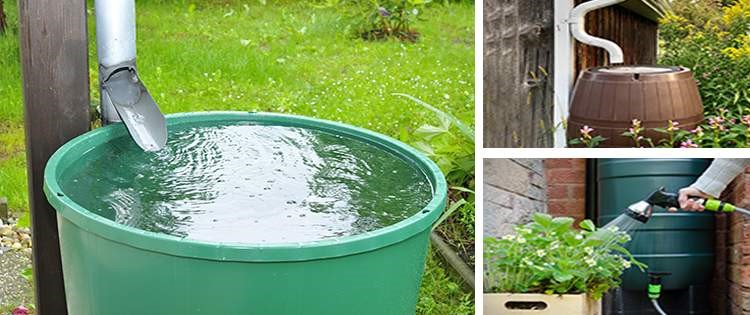
This DIY project is the best way to legally collect rainwater NO MATTER where you live. Get chlorine-free water, cut down on your water bills, and have enough for an emergency situation or to water your garden. Read More Here...
Using dirty or dull tools is a recipe for disaster. Pepper plants are susceptible to viruses, such as the Tobacco Mosaic Virus, which can be easily spread from plant to plant on the blades of your shears. I always keep a jar of rubbing alcohol or a 10% bleach solution handy. I dip my scissors into the solution between every single plant. It takes an extra ten seconds, but it can save your entire crop from a devastating outbreak.
Limitations: When Pruning Is Not Ideal
Short growing seasons present a unique challenge for the pruning gardener. Every time you top a plant or remove a major branch, you are essentially hitting the “pause” button on its development for a week or two. If you live in a region where the frost-free window is very narrow, such as the northern reaches of Canada or parts of Scandinavia, topping might delay your harvest so much that the peppers never have time to ripen. In these areas, a “light touch” is better than a heavy prune.
Extremely hot, arid climates also require a different approach. In places like the Australian outback or the Southwestern United States, those excess leaves actually serve a purpose: they provide “sunshade” for the fruit. Capsicums are prone to sunscald, which looks like a bleached, papery patch on the side of the pepper. If you prune too aggressively in these high-UV environments, you might find that your beautiful peppers are literally being cooked on the vine. You should aim to keep enough of a canopy to protect the fruit while still allowing for airflow.
Soil quality also dictates how much you can prune. If your soil is poor in nitrogen or phosphorus, the plant will already be struggling to produce enough foliage to support itself. Pruning a nutrient-deficient plant only adds more stress to an already weak system. I always tell my neighbors to focus on getting their soil health right with plenty of compost and aged manure before they start worrying about advanced pruning techniques.
Practical Comparison: Pruning vs. Neglect
| Feature | Unpruned (Natural) | Strategically Pruned |
|---|---|---|
| Plant Height | Tall and gangly (3-5 ft / 1-1.5m) | Compact and bushy (2-3 ft / 0.6-0.9m) |
| Air Circulation | Poor; high risk of mold/mildew | Excellent; minimal disease risk |
| Fruit Size | Variable; often small or thin-walled | Uniform; large and thick-walled |
| Wind Resistance | Low; likely to snap or blow over | High; sturdy and self-supporting |
| Harvest Ease | Difficult; fruit hidden in canopy | Easy; fruit clearly visible |
Practical Tips and Best Practices
One of the best habits you can develop is the “Morning Inspection.” I like to walk through my garden with my coffee and look for any new growth that might need attention. Catching a sucker when it is only a quarter-inch (0.5 cm) long is much better than cutting off a thick branch later. Small wounds heal almost instantly, while larger cuts can become entry points for pests or rot.
Always make your cuts at a 45-degree angle. This simple trick prevents water from pooling on top of the cut stem, which significantly reduces the chance of fungal infection. You should also try to cut just above a leaf node. Leaving a long, empty “stub” of stem beyond the node is a bad idea because that stub will eventually die and rot back toward the main plant.
Fertilizing after a heavy prune can help the plant recover more quickly. I usually give my peppers a light dose of a balanced organic fertilizer or a splash of compost tea after a pruning session. This provides the nitrogen needed to push out new lateral growth and the potassium needed to strengthen the cell walls of the newly developing branches. Just be careful not to overdo it, as too much nitrogen can lead to even more of the “all leaves, no fruit” problem we are trying to solve.
Consider the “King Bloom” rule. The very first flower that appears in the center “Y” of the plant is called the King Bloom. Many experienced growers swear by pinching this first flower off. This tells the plant to keep growing its frame for a few more weeks rather than focusing on that one single pepper. In my experience, removing the King Bloom can lead to a much larger flush of fruit later in the season, provided your summer is long enough to accommodate the delay.
Advanced Considerations: The Four-Stem Method
For those of you who really want to treat your peppers like professional greenhouse crops, you might want to try the four-stem pruning system. This involves topping the plant and then selecting the four strongest branches to be your main “leaders.” Every other side shoot that emerges from these four branches is removed throughout the entire season. This is a very labor-intensive way to grow, but it produces the most beautiful, massive capsicums you have ever seen.
Commercial growers often use this method because it makes the plants very predictable. You can tie each of the four stems to a vertical string, much like you would with an indeterminate tomato plant. This allows you to grow peppers very close together—sometimes only 12 inches (30 cm) apart—while still maintaining perfect airflow and light penetration. It is a bit much for most backyard gardeners, but if you have a greenhouse, it is well worth the effort.
Overwintering is another advanced topic where pruning is essential. If you live in a climate with cold winters, you can actually bring your pepper plants indoors to keep them alive for the next year. This requires a “hard prune” where you cut the entire plant back to about 4 inches (10 cm) tall and remove all the leaves. This puts the plant into a dormant state, allowing it to survive on very little light until the spring. A three-year-old pepper plant that has been overwintered this way can produce a massive harvest much earlier than a seedling ever could.
Real-World Example: The Tale of Two Jalapeños
Last season, I decided to run a little experiment for my neighbor, who didn’t believe in pruning. We planted two identical jalapeño seedlings in identical pots with the same soil. One was left completely alone, and the other followed my pruning routine. By mid-summer, the unpruned plant was a tall, messy bush that kept falling over whenever we had a breeze. It had about fifteen peppers on it, but many were hidden deep inside where they stayed green and took forever to ripen.
The pruned plant was a different story. It was about half the height but twice as wide. The center was open, and you could see every single flower and fruit. Because of the “Y” shape and the topped main stem, it had over forty peppers growing at once. They ripened to a beautiful red much faster because they were getting direct sunlight. When we finally weighed the total harvest, the pruned plant had produced nearly three times the weight of fruit compared to the “natural” one.
This wasn’t just about the number of peppers; it was also about the quality. The peppers from the pruned plant were significantly heavier and had that beautiful “corking” or scarring that indicates a high-stress, high-flavor jalapeño. My neighbor was convinced, and this year, he was out there with his shears before I even had mine out. Seeing is believing when it comes to the power of a good prune.
Final Thoughts
Pruning your capsicum plants is one of the most effective ways to take control of your garden’s productivity. It might feel counterintuitive to cut off parts of a healthy plant, but you must remember that you are working with the plant’s natural biology to achieve a common goal. By managing hormones like auxins and improving environmental factors like light and airflow, you are creating the perfect conditions for a bumper crop of high-quality fruit.
Do not be afraid to experiment. Start with just one or two plants if you are nervous. Try topping one, suckering another, and leaving a third as a control group. Gardening is a lifelong learning process, and your plants are the best teachers you will ever have. Pay attention to how they respond to your touch, and you will soon develop the “eye” for exactly which branch needs to stay and which one needs to go.
Mastering these techniques will change the way you look at your garden. You will stop seeing a collection of bushes and start seeing a high-performance food production system. Whether you are aiming for the biggest bell pepper at the county fair or just want enough chilies to make a year’s supply of hot sauce, pruning is the key that unlocks the true potential of your pepper patch. Grab your shears, keep them clean, and get to work—your future harvest will thank you for it.
Do you have some charcoal in your house right now? We call charcoal a “miracle leftover” for anyone who wants to be a little more self-sufficient and cut costs. That’s because it can help you with so many different things around the house and garden. You can even use it to make an energy-free fridge. Read More Here...