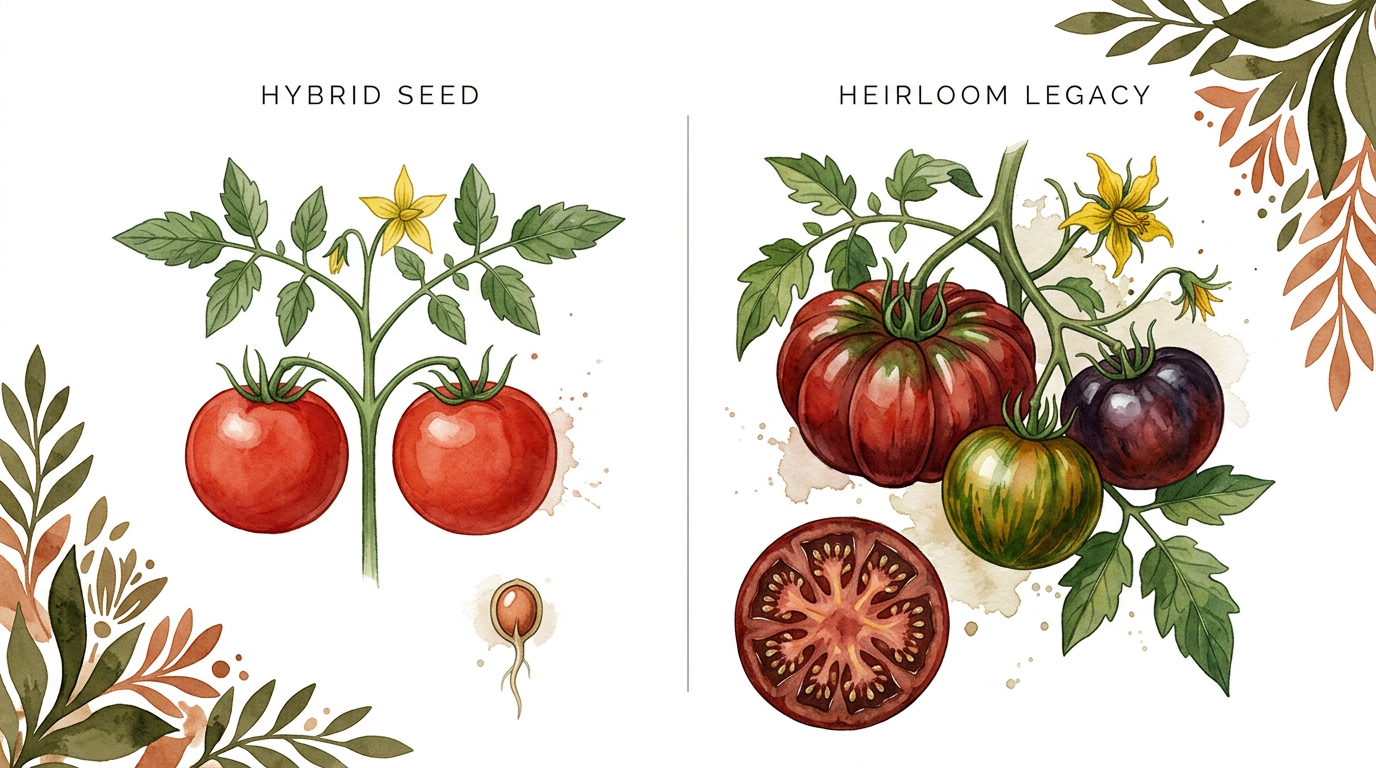
Are you growing a plant for a season, or a legacy for a lifetime? Hybrid seeds offer uniformity but rob you of flavor and independence. Heirlooms are a gift from the past that keeps on giving. Learn why you should stop renting your garden from corporations and start growing a legacy.
Whenever you walk into a modern supermarket, you see rows of perfectly round, fire-engine red tomatoes. They look like they were made in a factory, and in many ways, they were. These hybrid tomatoes are bred for the road, not the dinner table. They have thick skins to survive bouncing in the back of a semi-truck and are often gassed with ethylene to turn red long after they’ve been pulled from the vine. They are consistent, yes, but they are also hollow, tasting more like a squishy cardboard box than a summer afternoon.
Growing heirloom tomatoes is a different journey entirely. It is about a connection to the dirt that spans generations. When you plant an heirloom, you are participating in a tradition of seed saving that predates industrial agriculture. You aren’t just growing food; you are preserving a genetic history that was nearly lost to the quest for shelf-life over soul. In my decades of gardening, I’ve found that heirlooms require a bit more patience and a watchful eye, but the reward is a flavor that can make a grown man weep with nostalgia.
This guide is for the gardener who is tired of buying a new “subscription” of seeds every year. We are going to look at the science of why these old varieties taste so much better, the practical steps to keep them healthy, and how you can save your own seeds so you never have to buy another packet again. Whether you are working with a small raised bed or a sprawling backyard, the switch from hybrid seed to heirloom legacy is the moment you truly become a master of your own soil.
Why Heirloom Tomatoes Taste Better
The first bite of a sun-warmed Cherokee Purple or a juicy Brandywine is a sensory revelation. Science confirms what our taste buds already know: heirlooms are chemically superior in flavor to their hybrid cousins. The secret lies in a combination of genetics, sugar concentration, and aromatic compounds that modern breeding has inadvertently stripped away. Most commercial hybrids possess a genetic mutation called the “uniform ripening” trait. This ensures every tomato turns red at the exact same time, which is great for a machine harvester but terrible for flavor. This mutation actually disables the plant’s ability to produce high levels of sugar and the volatile compounds that give a tomato its “kick.”
Flavor is more than just sugar; it is a complex interaction of Brix levels (a measurement of sugar content), acidity, and aromatic volatiles. Studies have shown that heirloom varieties often contain significantly higher concentrations of geranial, a volatile compound that smells like citrus and roses, which intensifies our perception of sweetness. Because heirlooms lack the uniform ripening mutation, they are able to build up higher concentrations of chloroplasts, the tiny engines that produce sugar within the fruit. This is why you often see “green shoulders” on the top of a ripe heirloom; those green bits are actually a sign of a sugar-making powerhouse.
Texture also plays a massive role in the heirloom experience. Commercial tomatoes are bred with thick cellular walls and tough skins to prevent bruising during transport. Heirlooms, by contrast, were bred for the home garden and local markets. They often have thinner skins and a more “meaty” or “creamy” interior. When you eat a tomato that has been allowed to fully ripen on the vine, the enzymes have had time to break down the starches into sugars. In the world of heirlooms, we trade durability for depth, and in my experience, that is a trade worth making every single time.
Understanding the Heirloom Legacy
To grow heirlooms successfully, we first need to understand what they actually are. The term “heirloom” generally refers to a variety of plant that has been passed down for at least 50 years, often within a specific family or region. All heirlooms are open-pollinated, which means they are pollinated by natural means like wind, bees, or even a gardener’s hand. Because they are genetically stable, the seeds you save from an heirloom tomato will grow into a plant that is nearly identical to its parent. This is the “true-to-type” characteristic that allows you to build a legacy.
Hybrid tomatoes, on the other hand, are the result of crossing two different parent plants to create a first-generation offspring (labeled as F1 on seed packets). While hybrids often have “hybrid vigor”—meaning they might grow faster or resist more diseases—their seeds are genetically unstable. If you save seeds from an F1 hybrid, the next generation will be a chaotic mix of traits from the grandparents, often resulting in poor flavor or weak growth. This forces the gardener to return to the seed company every spring, effectively “renting” their garden from a corporation.
The Categories of Heirlooms
Not all heirlooms share the same origin story. Understanding these categories can help you choose the right variety for your specific garden conditions:
- Family Heirlooms: These are seeds passed down through generations of a single family. The famous “Mortgage Lifter” is a great example—it was bred by a man named Radiator Charlie who sold the plants to pay off his home mortgage in the 1930s.
- Commercial Heirlooms: These are open-pollinated varieties that were introduced by seed companies before the 1940s. They were the “standard” before hybridization became the industry norm.
- Created Heirlooms: These occur when two heirlooms are crossed and then “stabilized” over many generations (usually 8-10 years) until they grow true-to-type.
- Mystery Heirlooms: Sometimes, nature does the work for us. A random cross-pollination in a garden can result in a new variety that a gardener finds and chooses to save year after year.
How to Start Your Heirloom Garden
Starting with heirlooms requires a shift in how you think about your planting schedule. Because many of the best-tasting varieties, like the beefsteaks, are indeterminate and take longer to mature, you have to plan for the long haul. Most heirlooms require 75 to 90 days from the time you transplant them into the garden until you see your first ripe fruit. If you live in a region with a short growing season (less than 120 frost-free days), you’ll want to look for “short-season” heirlooms like Stupice or Silvery Fir Tree, which can ripen in as little as 55 to 60 days.
Preparation begins indoors about 6 to 8 weeks before the last expected frost. Use a high-quality, sterile seed-starting mix. I like to plant my seeds about 1/4 inch (6 mm) deep in trays. Tomatoes need warmth to germinate—ideally between 70°F and 80°F (21°C to 27°C). Once they sprout, they need intense light. If you are using a windowsill, be careful; the plants will often stretch toward the light and become “leggy” and weak. A simple shop light kept just 2 inches (5 cm) above the leaves will produce much sturdier seedlings.
Before these babies go into the ground, you must “harden them off.” This is the process of gradually acclimating them to the outdoors. Start by putting them in a shaded, protected spot for an hour a day, and slowly increase their exposure to sun and wind over the course of a week. If you skip this step, the transition to the garden will shock the plants, and they may never fully recover their vigor. A seasoned gardener knows that a slow start leads to a strong finish.
Soil Preparation and Garden Conditions
Heirlooms are “heavy feeders,” meaning they pull a lot of nutrients out of the earth to build those massive fruits. You cannot just dig a hole in tired dirt and expect a legacy harvest. Your soil needs to be rich in organic matter. Every autumn, I top my beds with 2 to 3 inches (5-8 cm) of well-rotted compost. This feeds the soil biology, including the earthworms and fungi that help your tomato roots absorb minerals. Aim for a soil pH between 6.2 and 6.8; if your soil is too acidic or too alkaline, the plant will struggle to take up calcium, which leads to the dreaded blossom end rot.
Drainage is equally critical. Tomatoes hate “wet feet.” If your soil is heavy clay, you should consider growing in raised beds or adding significant amounts of perlite or coarse sand to improve aeration. I also recommend a “deep planting” technique when you finally move your seedlings to the garden. Dig a hole deep enough to bury the stem up to the first set of true leaves. Tomatoes have the amazing ability to grow “adventitious roots” all along their stems. By burying the stem, you are creating a massive root system that will better support the plant during summer droughts.
The Nutrient Balance
When it comes to fertilizer, less is often more with heirlooms. If you over-apply nitrogen, you will get a beautiful, lush green bush with zero tomatoes. The plant thinks it’s in “growth mode” rather than “repro mode.” Use a balanced organic fertilizer at planting time (something like a 5-5-5 NPK ratio). Once the plant starts to set fruit, switch to a fertilizer higher in phosphorus and potassium. Many old-timers swear by adding a handful of crushed eggshells or bone meal to the bottom of the planting hole to provide a slow-release source of calcium.
| Nutrient | Role in Heirloom Growth | Source |
|---|---|---|
| Nitrogen (N) | Foliage and stem strength | Compost, blood meal |
| Phosphorus (P) | Root development and flower production | Bone meal, rock phosphate |
| Potassium (K) | Fruit quality and disease resistance | Wood ash, kelp meal |
| Calcium (Ca) | Cell wall structure (prevents rot) | Gypsum, eggshells |
Managing Pests and Diseases Organically
One of the trade-offs of heirlooms is that they haven’t been laboratory-bred for disease resistance like many hybrids. This doesn’t mean they are weak—many have survived for centuries precisely because they are hardy—but they do require more active management. The two most common headaches are early blight and septoria leaf spot. These are fungal diseases that live in the soil and splash up onto the leaves during rain. To combat this, I always mulch my tomato plants heavily with straw or shredded leaves. This provides a physical barrier between the soil and the foliage.
Airflow is your best friend when it comes to disease prevention. Space your heirloom plants at least 2 to 3 feet (60-90 cm) apart. If they are crowded, the humidity stays high between the leaves, creating a perfect nursery for fungi. Pruning the “suckers”—the small shoots that grow in the V-shape between the main stem and the leaf branches—is also helpful. This focuses the plant’s energy on a few main stems and keeps the center of the plant open for the wind to dry things out after a morning dew.
When it comes to pests, the Tomato Hornworm is the “big boss.” These giant green caterpillars can strip a plant in 48 hours. The best way to manage them is by hand-picking at dusk or dawn. If you see one covered in tiny white “grains of rice,” leave it alone! Those are the cocoons of a parasitic wasp that will hatch and kill the hornworm naturally. For smaller pests like aphids or whiteflies, a strong blast of water from the hose or an organic insecticidal soap is usually enough to keep the balance in your favor.
DIY PROJECT: Collect rainwater no matter where you live...
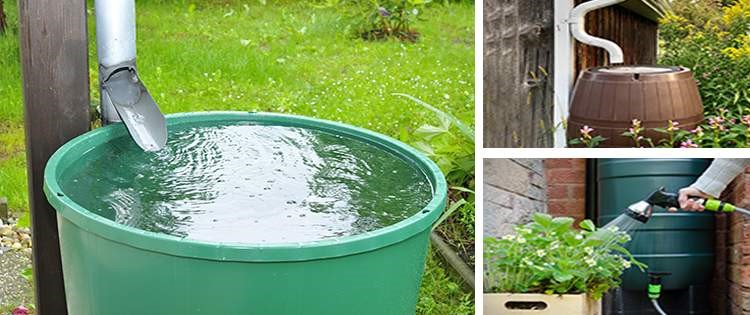
This DIY project is the best way to legally collect rainwater NO MATTER where you live. Get chlorine-free water, cut down on your water bills, and have enough for an emergency situation or to water your garden. Read More Here...
The Art of Seed Saving: Ensuring the Legacy
Saving heirloom seeds is where you truly break free from the cycle of corporate gardening. Tomato seeds have a gelatinous coating that contains germination inhibitors—this prevents the seed from sprouting while it’s still inside the moist tomato. In nature, the fruit would rot on the ground and ferment, which naturally removes this coating. To save seeds effectively, we have to mimic this fermentation process in our kitchen. It sounds a bit messy, but it is the most reliable way to ensure a high germination rate for next year.
Start by picking the very best tomato from your strongest, healthiest plant. This is “selective pressure” in action. If you save seeds from the plant that resisted blight or produced the largest fruit, you are slowly adapting that variety to your specific micro-climate. Squeeze the seeds and the surrounding “goop” into a small glass jar. Add a little bit of water—just enough to cover the seeds—and set the jar in a warm spot out of direct sunlight for 2 to 4 days. You’ll know it’s working when a layer of white or grey mold forms on top. It will smell a bit funky, but that is the sound of success.
After a few days, pour the contents of the jar into a fine-mesh sieve. Rinse them thoroughly under running water, rubbing them gently against the mesh to remove any remaining pulp. Spread the clean seeds out in a single layer on a ceramic plate or a piece of glass (don’t use paper towels, or the seeds will stick and be impossible to remove). Let them dry completely for at least a week. Once they are “snap-dry,” store them in a paper envelope in a cool, dark, and dry place. Properly saved tomato seeds can remain viable for 5 to 10 years, though I usually refresh my stock every three seasons.
Advanced Considerations: Grafting and Specialized Care
For the gardener who wants the flavor of an heirloom with the “armor” of a hybrid, there is an advanced technique called grafting. This involves taking the top of an heirloom plant (the “scion”) and physically joining it to the root system of a disease-resistant hybrid (the “rootstock”). This is an ancient technique used in orchards for centuries, and it has recently gained popularity in the tomato world. It allows you to grow a Brandywine in soil that might be infested with fusarium wilt or nematodes, which would normally kill the heirloom outright.
Grafting requires surgical precision and a specialized environment. You must start your rootstock seeds about a week before your heirlooms so the stems reach the same thickness at the same time. Using a sanitized razor blade, you cut both stems at a 45-degree angle and join them using a small silicone clip. The “union” must then be kept in a “healing chamber”—a high-humidity, low-light environment—for about a week until the tissues fuse. It is a meticulous process, but if you have struggled with soil-borne diseases in the past, grafting is a game-changer that allows you to maintain your heirloom legacy in difficult conditions.
Another advanced consideration is the “Dwarf Tomato Project.” Many heirlooms are indeterminate giants that grow 8 to 10 feet (2.4-3 meters) tall, which is tough for urban gardeners or those with limited space. A group of volunteers worldwide has spent decades crossing heirlooms with dwarf varieties to create “Dwarf Heirlooms.” These plants only reach 3 to 4 feet (1 meter) tall and can be grown in large containers, yet they produce full-sized fruits with that complex heirloom flavor. This is proof that you can grow a legacy even if your “garden” is just a sunny balcony.
Common Challenges and Pitfalls
Every season has its hurdles, and learning to read your plants is part of the “seasoned gardener” journey. One of the most common issues is Blossom End Rot. This looks like a leathery black spot on the bottom of the fruit. While it is technically a calcium deficiency, it is almost always caused by uneven watering. If the soil goes from bone-dry to soaking-wet, the plant cannot transport calcium to the developing fruit. The fix? Consistent, deep watering and a thick layer of mulch to keep soil moisture steady.
Another common sight in heirloom patches is Catfacing. This is when the fruit develops deep scars, holes, and weird lumpy shapes, especially at the bottom. This usually happens because of cool temperatures (below 55°F or 13°C) during the flowering stage, which interferes with proper pollination. While catfaced tomatoes look “ugly” by supermarket standards, they are perfectly safe to eat. In fact, I often find the weirdest-looking ones have the most concentrated flavor. Don’t let a bit of “character” discourage you.
Finally, watch out for Sunscald. Because heirlooms often have thinner skins, the fruit can literally get a sunburn if the plant loses its leaf cover due to disease or over-pruning. This results in a white, papery patch on the side of the tomato. Keeping your plants healthy and avoiding the urge to prune away all the protective shade leaves will prevent this. Remember, the leaves are the solar panels that power the flavor; protect them, and they will protect your harvest.
Benefits of Heirloom vs. Hybrid
When deciding how to allocate your garden space, it helps to weigh the practical benefits of each approach. While I am clearly a champion for heirlooms, a balanced understanding of the trade-offs will make you a better gardener. Most veterans I know grow a mix: a few reliable hybrids for “insurance” and a wide variety of heirlooms for the sheer joy of eating.
- Genetic Independence: With heirlooms, you own the means of production. You are not reliant on a global supply chain or seed catalog availability.
- Biodiversity: Growing heirlooms protects rare varieties from extinction. By planting a “Black Krim” or an “Amana Orange,” you are acting as a curator for a living museum.
- Culinary Versatility: Heirlooms offer a spectrum of colors—purple, green, yellow, striped—and a range of flavors from smoky and savory to citrusy and sweet that you simply cannot find in hybrids.
- Adaptation: Over several years of seed saving, your plants will actually become better suited to your specific soil and weather patterns. They become “local” in a way a store-bought seed never can.
Practical Tips for a Bountiful Harvest
If you want to ensure your heirloom legacy is a successful one, follow these hard-earned lessons from the garden:
- Water at the Base: Never use overhead sprinklers. Wet leaves are an invitation for blight. Use a soaker hose or drip irrigation to keep the water at the roots where it belongs.
- Morning Harvest: Pick your tomatoes in the morning after the dew has dried but before the heat of the day. This is when the sugar levels are highest and the fruit is most firm.
- Don’t Refrigerate: Once you harvest your heirlooms, keep them on the counter at room temperature. Putting a tomato in the fridge kills the enzymes that produce flavor, turning a gourmet fruit into a mealy disappointment.
- Succession Planting: If you have a long season, plant a second round of seedlings 4 weeks after the first. If the first batch succumbs to early blight, the second batch will be ready to take over and keep you in tomatoes until the frost.
Final Thoughts
Growing heirloom tomatoes is a slow, deliberate act of rebellion. In a world that prizes speed and uniformity, choosing to nurture a plant that might be “fickle” or “ugly” but tastes like heaven is a profound choice. It is about reclaiming your independence and ensuring that the flavors of our ancestors aren’t lost to the sterile aisles of a grocery store. Every seed you save is a bridge to the past and a gift to the future.
Don’t be afraid to fail. Your first year might bring blight, or the hornworms might win a battle or two. That is just the soil teaching you. Over time, you will learn the rhythm of the seasons, the “language” of your leaves, and the specific needs of your chosen varieties. You aren’t just growing a plant for a season; you are building a legacy that lives in the dirt and on the tongues of everyone you share your harvest with.
Start small if you must, but start with an heirloom. Pick a variety with a story that speaks to you, put your hands in the earth, and experience the difference between renting a garden and owning one. Once you’ve tasted the legacy, there is no going back to the supermarket shelf.